
Lead time is the number of days between placing a purchase order and having the stock ready to sell. Get it right and your reorder timing and safety stock hold up. Get it wrong and you either stock out waiting on a shipment or tie up cash ordering too early.
This guide shows how to calculate your supplier lead time from your own records, and why its swings matter as much as its average.
You don’t need a special tool to find it — the math is a subtraction and an average. What takes care is measuring the right dates and watching how much they move from order to order. Both are things your own purchase-order history already holds.
What is lead time?
Lead time is the total time from placing a purchase order to having the goods received and ready to sell. In ecommerce it usually means supplier lead time — the full wait on a replenishment order — covering the supplier’s processing, production, transit, customs, and your own receiving. It’s measured in days, and it’s the clock every reorder decision runs against.
A few related terms sit inside that clock. Production lead time is the make-or-pick portion; transit lead time is the shipping leg; cumulative lead time stacks every stage end to end. For reordering, the number you want is the whole span — order placed to shelf-ready — because that’s the gap your stock has to cover on its own.
Miss a stage, like the week goods sit in customs or the days between delivery and shelf, and every downstream number, from the reorder point to the buffer, inherits the error.
The lead time formula
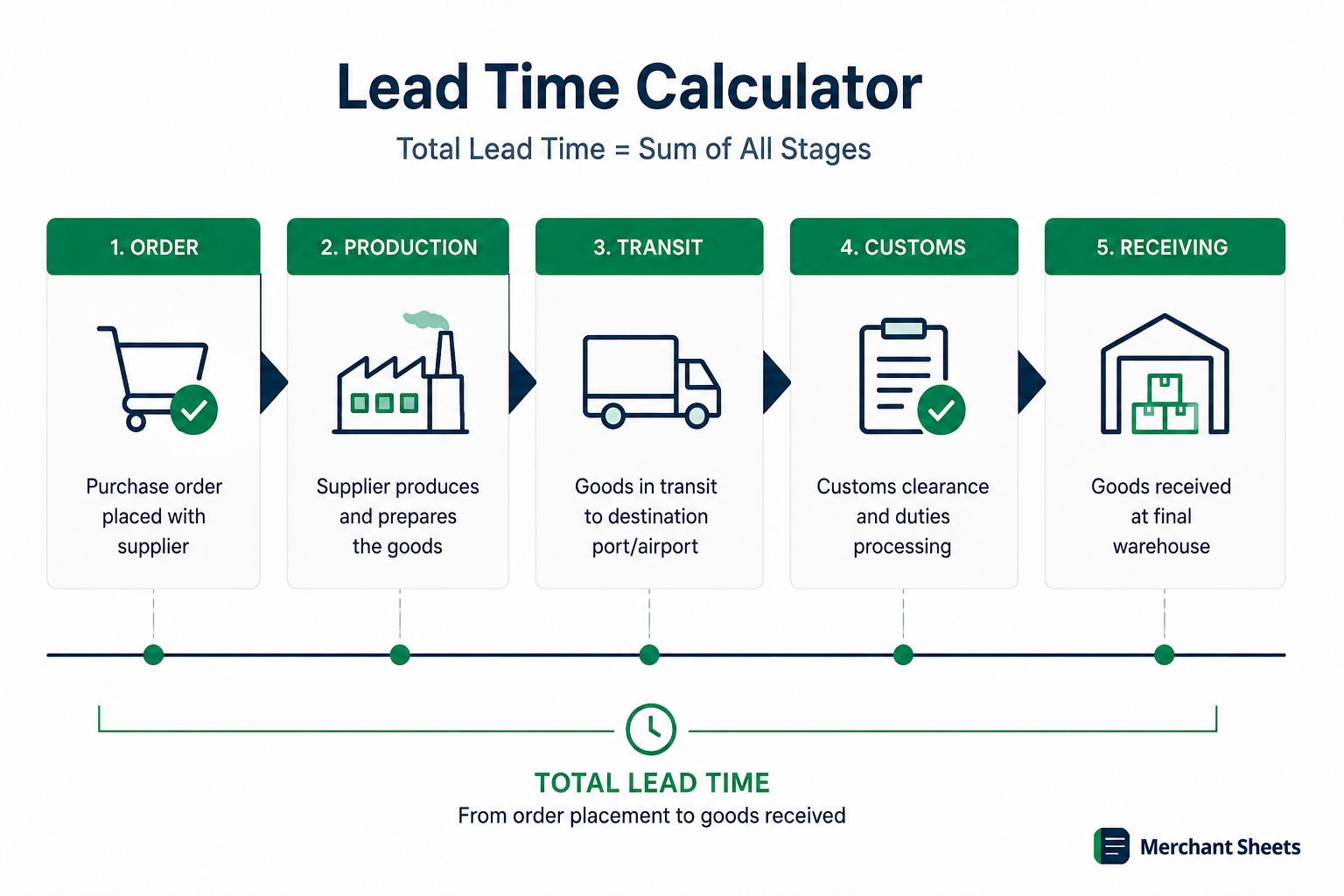
Lead time is the sum of the stages a replenishment order passes through:
Lead time = order processing + production + transit + customs & clearance + receiving
Each stage adds days, and each has its own usual cause of delay. For an overseas supplier, transit and customs often dwarf the rest; for a domestic one, production tends to be the long pole. Breaking a supplier’s lead time into these pieces shows you where the days pile up, and which stage to lean on when you want it shorter:
| Stage | What it covers | Usual driver |
| Order processing | PO sent to supplier accepting and scheduling it | Supplier admin, order size |
| Production | Making or picking the goods | Factory capacity, backlog |
| Transit | Moving goods to your warehouse | Freight mode — sea vs air |
| Customs & clearance | Import checks, duties, release | Paperwork, port congestion |
| Receiving | Unloading, inspecting, shelving | Warehouse throughput |
How to calculate your average supplier lead time
The most reliable lead time comes from your own receiving history rather than a supplier’s quote. Take a handful of recent purchase orders, count the days each one took from order to shelf-ready, and average them.
Measure lead time from your own receiving data. A supplier’s quote is the promise; your purchase-order records are the pattern — and the pattern is what your reorders have to survive.
Here are four orders for one product:
| Purchase order | Order date | Shelf-ready | Lead time |
| PO-1 | Jan 3 | Jan 25 | 22 days |
| PO-2 | Feb 8 | Mar 5 | 25 days |
| PO-3 | Mar 12 | Mar 31 | 19 days |
| PO-4 | Apr 9 | May 5 | 26 days |
The average is (22 + 25 + 19 + 26) ÷ 4 = 23 days. The spread tells you as much: these orders ran from 19 to 26 days, so a plan built on a flat 23 would come up three days short on a bad run.
Count each order through to the shelf-ready date, since inspection and put-away are part of the wait even after the boxes arrive. To calculate your average supplier lead time:
- Pull the order and receiving dates: For each recent purchase order, record the date you placed it and the date the stock was shelf-ready to sell.
- Find each order’s lead time: Count the days between those two dates — the full clock, including production, transit, and receiving.
- Average across orders: Add the lead times and divide by the number of orders for your average supplier lead time.
- Note the spread: Record the range or the standard deviation, since how much lead time varies matters as much as the average.
Why lead time variability matters
The average lead time tells you when to expect stock. The variability tells you how much to trust that expectation. A supplier that lands in a tight 22-to-24-day band is easy to plan around; one that swings from 15 to 35 days forces you to carry more buffer for the same peace of mind, even when your sales are steady. The average of both suppliers can read 23 days, yet they demand very different amounts of stock.
That buffer is exactly what safety stock is for, and lead-time variability is one of its two main inputs. A wider swing in delivery raises the buffer you need, which is why sizing your safety stock leans on the standard deviation of lead time as much as its average.
A steadier supplier earns a leaner buffer; a shaky one pays for its unpredictability in extra stock you hold all year to survive its worst month.
Lead time also sets the trigger to reorder. Multiply your daily demand by the lead time and you get lead-time demand — the units you’ll sell during the wait — which is the core of the reorder point.
Once you have a clean lead time and its spread, the Reorder Point / Safety Stock template turns both into a reorder date and a buffer for every SKU.
How to reduce supplier lead time
You can’t wish lead time down, but you can engineer it. Every lever below trades something for speed, so weigh the cost of each against the stockout risk it removes and the buffer it lets you release:
- Order earlier: Place POs against your forecast sooner, so a long lead time stops being an emergency. Costs nothing but planning discipline.
- Dual-source: Qualify a second supplier so one backlog can’t stall you. Adds vendor-management overhead.
- Move production closer: A nearer supplier trades higher unit cost for shorter, steadier transit.
- Smooth customs: Get paperwork and duty codes right up front to avoid clearance holds. Mostly a one-time setup cost.
- Order more often in smaller lots: Shorter cycles cut how long any single order gates your stock, at the expense of per-order shipping efficiency.
Frequently asked questions
What's a good lead time?
A good lead time is the shortest one you can hold consistently, because a steady 25 days is easier to plan around than a 15-day average that spikes to 30. Chase reliability before raw speed — a predictable supplier lets you run leaner safety stock, while a fast-but-erratic one forces a bigger buffer to cover the bad runs. What counts as good also depends on your category: a domestic print-on-demand line can expect days, while an overseas manufactured product runs weeks.
What's the difference between lead time and lead time demand?
Lead time is how long replenishment takes, while lead time demand is how many units you’ll sell during that wait — your average daily demand multiplied by the lead time. Lead time is measured in days; lead-time demand is measured in units, and it’s the figure that sets how low you can let stock fall before you reorder.
How do I handle a supplier whose lead time varies a lot?
Size for the variability rather than the average alone: a wide-swinging supplier needs more safety stock to hold the same service level, and its standard deviation of lead time belongs in the fuller safety stock formula. If the swings are severe, treat it as a signal to qualify a second source or renegotiate terms, since carrying buffer against an unreliable supplier is a cost you pay every cycle.
Turn lead time into a reorder date
A clean lead time is only useful once it drives a decision. The Reorder Point & Safety Stock template takes your lead-time and demand inputs and sizes the reorder point and safety stock for every SKU, so a slow supplier shows up as a reorder date on your calendar instead of a sold-out listing. Measure the lead time once, and let the sheet turn it into the timing.
