
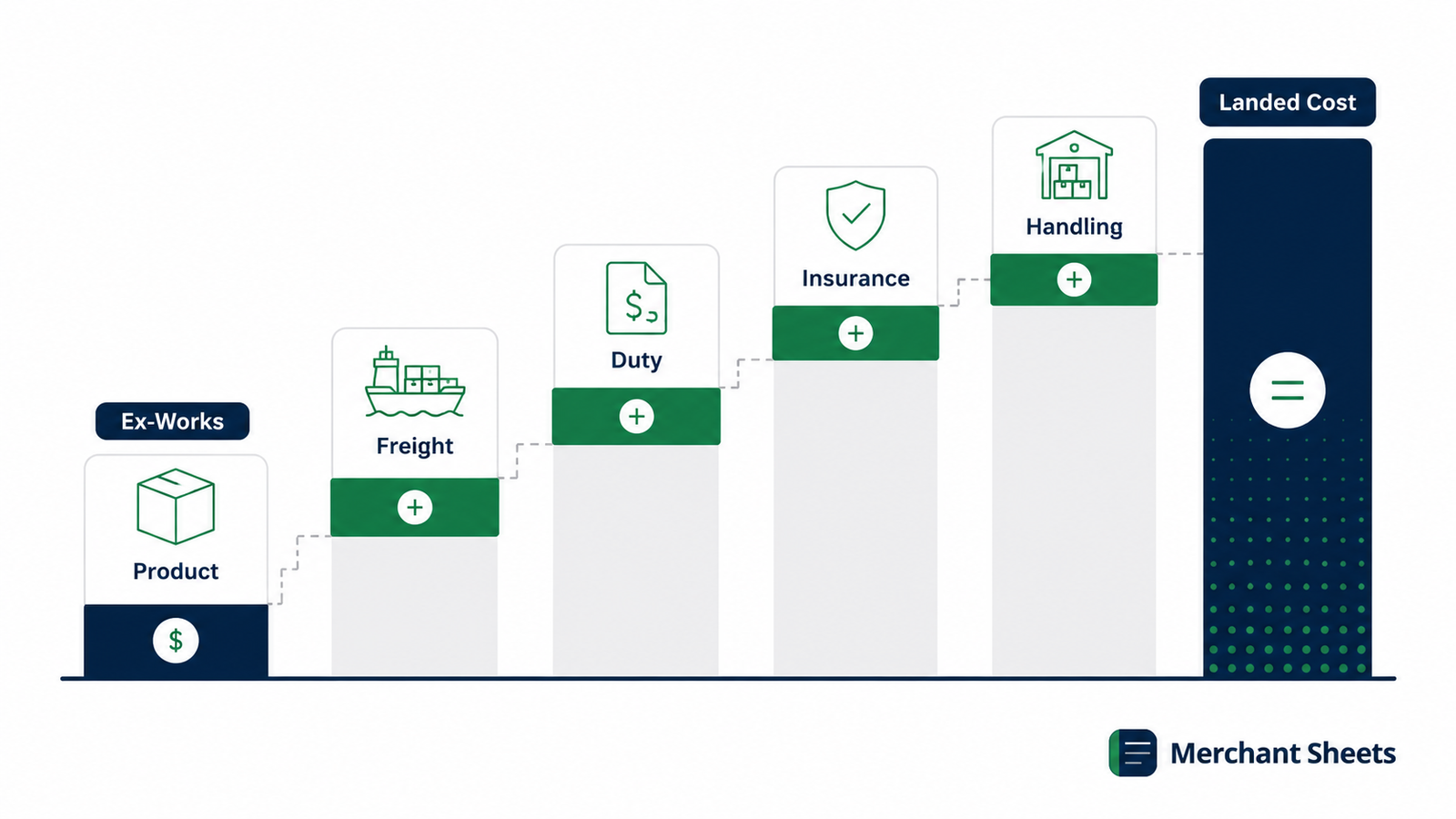
Landed cost is what a unit truly costs by the time it reaches your shelf — the supplier’s price plus the freight, duty, insurance, and fees it takes to get there. The ex-works price on the invoice is only the start. Miss the rest and every margin and price you set downstream is built on a number that’s too low, which is how a product that looks profitable on paper quietly loses money on every order.
This guide covers what goes into landed cost, the formula, a worked example that lifts an $8 unit to its real cost, and how to spread shipment-level costs like freight and duty across the SKUs that share the container. By the end you’ll have a per-unit number you can drop straight into your pricing and margins.
What is landed cost?
Landed cost is the all-in cost to get one unit from your supplier to your warehouse, ready to sell. It adds the product’s ex-works price to every cost of moving it — freight, duty and tariffs, insurance, and customs handling — then divides shared costs across the units in the shipment. It’s the number that belongs in your cost of goods sold, because it’s what the unit really cost you.
Ex-works price is the figure on the supplier’s invoice, before anything ships. Landed cost is that price after the journey — the same unit, counted honestly.
The gap between them is easy to underrate: on imported goods, freight and duty routinely add a third or more to the sticker price, and that difference comes straight out of your margin if you price off the invoice alone. The longer and more complex the supply chain, the wider that gap tends to run.
What goes into landed cost
Landed cost gathers every cost between the supplier’s door and yours. The usual components:
| Component | What it covers |
| Product (ex-works) cost | The supplier’s per-unit price for the goods themselves |
| Inbound freight | Ocean or air shipping, plus drayage to your warehouse |
| Duty & tariffs | Import charges set by the product’s HTS code and country of origin |
| Insurance | Cover on the goods while they’re in transit |
| Customs & handling | Broker fees, port and terminal charges, inspection |
Where the supplier’s price stops
How much is already baked into the ex-works price depends on the shipping terms, or Incoterms, you agreed. Ex-works (EXW) means the price covers the goods at the factory door and nothing else, so you carry every cost from there. Free on board (FOB) puts the goods on the ship at the origin port, so the supplier covers inland transport and export clearance.
Delivered duty paid (DDP) folds freight and duty into the supplier’s price, so more of the landed cost sits inside the invoice already. Knowing your terms tells you which of the costs below you still have to add, and which are counted for you.
A few costs sit on the edges and are worth counting when they’re material: pre-shipment quality inspection, currency conversion or wire fees on an overseas payment, and the reverse cost of goods rejected at receiving. Whether they belong in landed cost comes down to whether they scale with the shipment. If a cost rises with the units you bring in, it’s part of what those units cost.
Some of these are per-unit from the start, like the product cost. Others land on the whole shipment — a single freight invoice, one duty entry — and have to be split across units before you can read a true per-unit cost. That split is the step most people skip, and it’s covered below.
The landed cost formula
At the shipment level, landed cost is the sum of its parts:
Landed cost = product cost + freight + duty & tariffs + insurance + customs & handling
Total those five for a shipment, then divide by the number of units in it for landed cost per unit. The per-unit figure is what you carry into pricing and margin, so the goal of every calculation is to get from a pile of shipment invoices down to one honest number per SKU.
When a shipment holds a single product, that division is clean; when it holds several, the shared costs need allocating first.
A worked example
Say you import 500 units of a product at an ex-works price of $8.00 each. The shipment picks up freight, duty, and fees on the way in:
| Cost component | Shipment total | Per unit |
| Product (ex-works), 500 × $8.00 | $4,000 | $8.00 |
| Inbound freight | $1,200 | $2.40 |
| Duty (6% of goods value) | $240 | $0.48 |
| Insurance | $60 | $0.12 |
| Customs & handling | $300 | $0.60 |
| Landed cost | $5,800 | $11.60 |
The unit that looked like an $8.00 buy costs $11.60 to put on the shelf — 45% more than the invoice. Price this product on the $8.00 figure and you’d give almost a third of the true cost away without noticing. Freight alone adds $2.40 a unit here, more than duty, insurance, and handling combined, which is typical for ocean-shipped goods and the reason freight deserves the most care in the allocation.
Air-freight the same unit to beat a stockout and that line alone can double, turning a healthy margin thin for the length of the rush order.
The duty in this example is 6% of the $4,000 goods value. Your rate depends on the product’s HTS classification and where it’s made, so check the current rate rather than assuming one — as of early 2026, rates on many categories have been moving, and a duty change can reprice a unit without the supplier touching its price.
How to allocate shared costs across SKUs
When one shipment carries several products, the shipment-level costs — freight, duty, insurance — have to be divided among them. Three methods cover most cases, and the right one depends on what’s driving the cost:
| Method | Allocate by | Best for |
| By quantity | Each SKU’s share of total units | Similar-sized, similar-value items |
| By value | Each SKU’s share of total goods value | Mixed-value loads; duty is often value-based |
| By weight or volume | Each SKU’s share of weight or CBM | Freight-heavy loads with mixed sizes |
Match the method to the cost. Duty tracks value, so it splits cleanly by each SKU’s share of goods value. Freight tracks space and weight, so a bulky low-value item should carry more of the freight than a small dense one, even when they cost the same at the supplier.
Why the method matters
Take a $1,200 freight bill shared by two SKUs: SKU A is 300 light units, SKU B is 200 heavy ones. Split that freight by unit count and by weight and the per-unit costs part ways:
| Freight split | SKU A (300 units, 400 kg) | SKU B (200 units, 800 kg) |
| By quantity | $2.40 / unit | $2.40 / unit |
| By weight | $1.33 / unit | $4.00 / unit |
By quantity, both SKUs carry $2.40 of freight, which hides that SKU B takes up twice the weight and truly drives more of the bill. By weight, B absorbs $4.00 a unit and A drops to $1.33 — a read that matches reality.
Use one blanket method for every cost and you’ll leave a heavy, cheap SKU looking more profitable than it is, and a light, dense one carrying freight it never caused.
Why landed cost changes your margins and pricing
Landed cost is the real cost of goods sold, so it’s the figure your margins should run on. Drop the ex-works price into your cost of goods sold instead and every downstream number reads too rosy: your gross margin looks fatter than it is, and the contribution margin you use to set ad budgets and price floors is overstated by the freight and duty you left out.
The effect is largest where you’d least expect it. A product with a low ex-works price but heavy freight — anything bulky, or shipped by air to beat a stockout — can carry the widest gap between invoice and landed cost, and so the biggest margin surprise.
Repricing off landed cost sometimes turns a supposed winner into a break-even SKU, which is exactly the kind of thing worth knowing before you scale its ad spend behind a margin that isn’t there.
Tariffs keep this a moving target. A duty change can lift landed cost overnight without touching the supplier’s price, so the brands that recalculate when rates move are the ones that don’t get caught pricing below cost.
Treat landed cost as a number you maintain, the same way you’d revisit a price when a supplier raises it.
For pricing, landed cost is the floor everything else sits on. Set your target margin against it, not the ex-works price, and your price floor holds even on the SKUs with the heaviest freight.
It also sharpens sourcing calls: a supplier with a lower unit price but a longer, pricier shipping lane can land dearer than a nearer one that quotes more per unit, and only landed cost surfaces that.
How to calculate landed cost for your products
To run this on your own shipments, work one shipment at a time:
- Gather the shipment costs: Pull the supplier invoice, the freight bill, the duty entry, and any insurance and customs fees for the shipment.
- Separate per-unit from shipment-level costs: Product cost is per unit; freight, duty, insurance, and handling land on the whole shipment.
- Allocate the shared costs: Split each shipment-level cost across SKUs by quantity, value, or weight, matched to what drives that cost.
- Total and divide: Add each SKU’s product cost and its allocated share of the rest, then divide by that SKU’s units for landed cost per unit.
- Feed it into pricing: Use the landed cost as COGS in your margins and price floors, and refresh it when freight or duty moves.
Doing it across a catalog
One shipment by hand is manageable. A catalog of SKUs across mixed shipments, with freight and duty to allocate three different ways, is a spreadsheet job.
The Landed Cost Calculator takes your shipment invoices and allocation basis and returns a landed cost for every SKU, so the number that feeds your margins stays current as costs move.
Frequently asked questions
Is landed cost the same as COGS?
Landed cost is what belongs in COGS for a physical product, so the two line up at the per-unit level. Cost of goods sold is the accounting line for what your sold units cost; landed cost is how you calculate that per-unit figure correctly, by including freight, duty, and fees rather than the ex-works price alone.
Does landed cost include duties?
Yes, duties and tariffs are part of landed cost, since they’re a real cost of getting the goods into the country and onto your shelf. The duty amount depends on the product’s HTS classification and country of origin, and because those rates change, landed cost should be recalculated whenever a tariff on your goods moves.
How do I split freight across mixed SKUs?
Split freight by each SKU’s share of weight or volume rather than by unit count, because freight is priced on space and weight. A bulky, light product takes up more of a container than a small, dense one, so it should absorb more of the freight bill even when the two cost the same at the supplier.
Get a landed cost for every SKU
Knowing the formula is one thing; keeping a landed cost current across a live catalog is another. The Landed Cost Calculator allocates freight, duty, and fees across a shipment and returns a landed cost for every SKU, ready to drop into your pricing and margins. Calculate it once, and update it when your costs move.
