
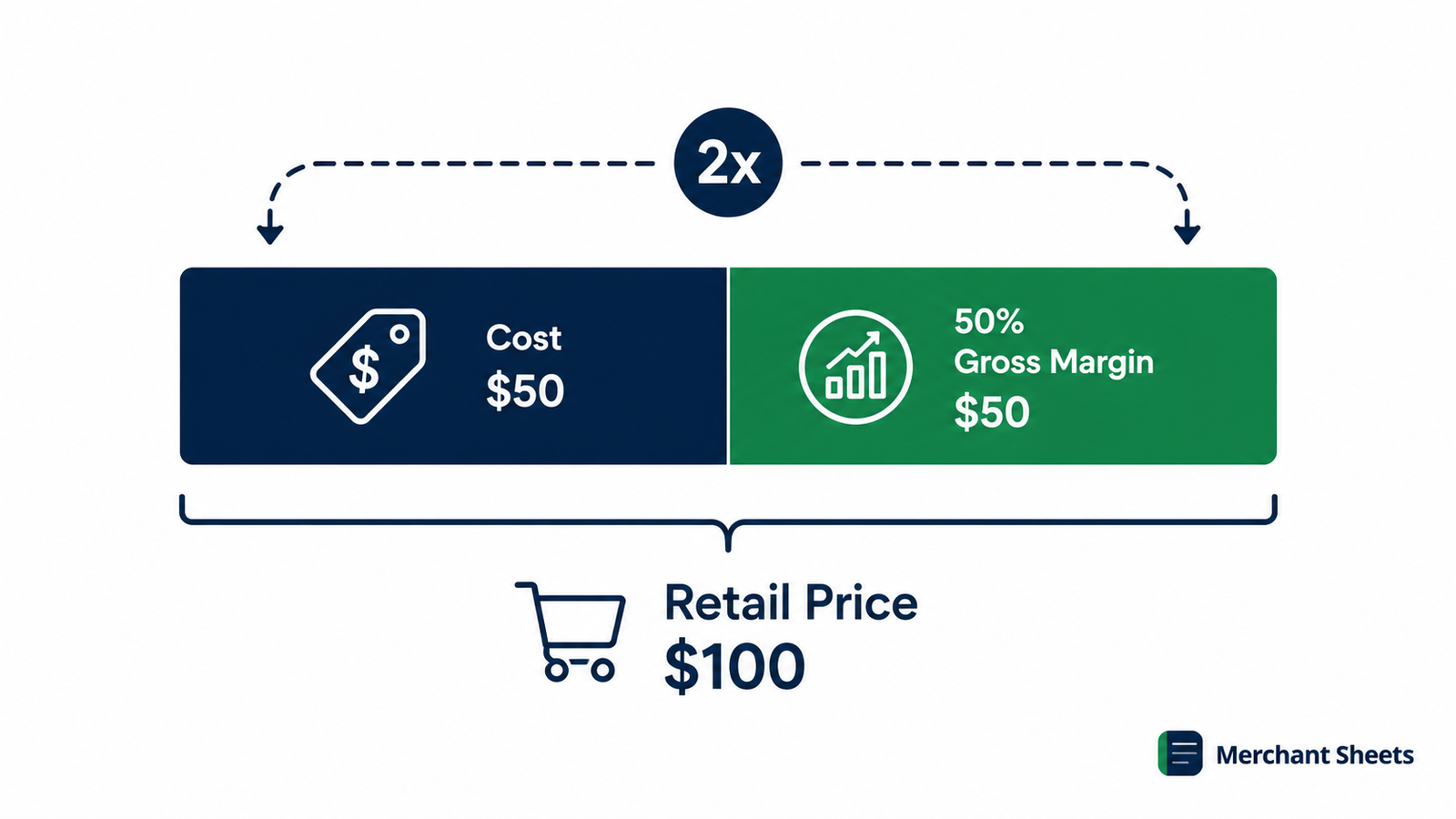
Keystone pricing is the oldest rule in retail: take what a product costs you and double it. That gives you a 100% markup, a 50% gross margin, and a price in seconds — no spreadsheet required. It’s fast, predictable, and it has been the retail default for more than a century.
The catch is what that 50% has to cover. In a store with low overhead, doubling cost leaves room for rent, staff, and markdowns. On a DTC order, payment fees, shipping, ads, and returns come out of the same 50%, and they add up fast.
This guide covers the formula, the markup-versus-margin distinction the math hinges on, and where keystone still earns its place in ecommerce.
What is keystone pricing?
Keystone pricing is a markup method that sets a product’s retail price at double its cost. Doubling the cost produces a 100% markup and a 50% gross margin, which is where the appeal comes from: one calculation prices an entire catalog and builds in a margin that historically covered a retailer’s operating costs.
The method comes from traditional retail, where a buyer needed a fast, consistent way to price hundreds of SKUs by hand. Double the wholesale cost, and the price is set. It still shows up as the basis for a manufacturer’s suggested retail price (MSRP) and as the default in wholesale-to-retail lines.
The keystone pricing formula
The keystone pricing formula is one step: multiply your product cost by two.
Keystone price = product cost × 2
If a product costs you $18 landed — the cost of goods (COGS) plus the freight and duty to get it to your warehouse — its keystone price is $36. That $18 gap between cost and price is a 100% markup on cost and a 50% margin on the selling price. Both describe the same $18; they measure it against different bases, which is where keystone math gets misread.
Keystone pricing, markup, and margin
Keystone is a 100% markup, and a 100% markup is a 50% gross margin. Markup measures profit against your cost; margin measures it against your selling price. The same $18 on a $36 price is 100% of the $18 cost but 50% of the $36 price.
A 100% markup is a 50% gross margin — and that 50% is gross, before payment fees, shipping, ads, and returns.
The distinction sets expectations for what keystone leaves you. A 50% gross margin sounds generous, and in a low-cost-to-serve channel it is. But gross margin sits at the top of the stack.
Everything it takes to fulfill a DTC order — the processor’s cut, the box and the label, the ad that won the click, the share of orders that come back — comes out of that 50%. Read keystone’s margin as a starting point, and keep markup and margin straight when you do.
When keystone pricing works
Keystone works best when your costs are simple and your cost-to-serve is low: traditional retail, wholesale-to-retail lines, and straightforward products with a stable landed cost. In those settings, doubling cost is quick and the 50% gross margin comfortably covers overhead. It’s a strong fit in a few specific cases:
- Wholesale and brick-and-mortar: When you carry inventory and sell in person, keystone’s 50% covers the rent, staff, and markdowns it was designed around.
- New or low-competition products: With no established market price to anchor against, keystone gives you a defensible first number to launch with.
- Large, simple catalogs: When you’re pricing hundreds of low-cost SKUs with similar economics, one consistent rule beats pricing each by hand.
- MSRP anchoring: A keystone price sets a clean suggested retail price that leaves wholesale accounts room to take their own margin.
When keystone pricing breaks
Keystone breaks when cost isn’t the only thing between you and profit. For DTC and marketplace sellers, channel fees, fulfillment, shipping, advertising, and returns all come out of the gross margin — and on a low-priced product they can erase most of it. Take that $18 product at its $36 keystone price, and here’s what a typical Shopify order leaves:
| Line item | Amount |
| Retail price (keystone) | $36.00 |
| Product cost (COGS + freight) | −$18.00 |
| Payment processing (2.9% + $0.30) | −$1.34 |
| Outbound shipping | −$5.00 |
| Pick, pack & fulfillment | −$2.50 |
| Advertising (CAC per order) | −$5.00 |
| Returns reserve (5%) | −$1.80 |
| Contribution per order | $2.36 (6.6%) |
The 50% gross margin — $18 — lands as a $2.36 contribution, under 7% of the price, and that’s before any fixed overhead. On a $36 product, keystone doesn’t leave enough to absorb what DTC costs to run.
Price-transparent categories push the same way: commodities and easily comparison-shopped goods often can’t hold a keystone price at all, while premium and exclusive products can carry far more.
So retailers price above keystone for luxury or slow-moving items, and below it for competitive ones:
| Strategy | Formula | Price | Markup | Gross margin |
| Sub-keystone | cost × 1.5 | $27 | 50% | 33% |
| Keystone | cost × 2 | $36 | 100% | 50% |
| Triple keystone | cost × 3 | $54 | 200% | 67% |
Finding which multiple survives your real costs is where a pricing calculator earns its keep. The Product Pricing Calculator takes your landed cost, channel fees, and target margin and returns the price that hits it, so you can test a keystone price against what it nets before you commit to it.
Keystone vs other pricing methods
Keystone is one of several cost-based methods, and it’s the bluntest. Cost-plus lets you choose the markup, margin-based pricing targets a specific take-home, and value-based pricing sets price by what the customer will pay rather than what the product costs. Keystone is the fast default; the others trade speed for control.
| Method | How it sets the price | Best for |
| Keystone | Double the cost (fixed 100% markup) | Fast first-pass pricing; simple catalogs |
| Cost-plus | Add a chosen markup % to cost | Setting the markup to your own target |
| Margin-based | Work back from a target gross or contribution margin | When a specific take-home margin is the goal |
| Value-based | Price to the customer’s perceived value | Differentiated or premium products |
| MAP | A floor the brand sets on advertised price | Protecting pricing across resellers |
For a serious ecommerce operation, margin-based pricing is usually the one to graduate to. It starts from the contribution margin you need to keep and works back to the price, which flips keystone’s cost-first logic into a profit-first one.
Price to a margin you can keep
A keystone price is a fast first guess, and for a low-fee channel it may be all you need. For DTC and marketplace selling, the question that decides profit is what a price leaves after every cost of the sale.
The Product Pricing Calculator takes your landed cost, channel fees, and target margin and returns the price that hits it — with a break-even floor and a sensitivity P&L, so you can see what a keystone price leaves once fees, shipping, and ads come out.
Set the price once, and know it clears a profit before you launch.
Frequently asked questions
What margin does keystone pricing give you?
Keystone pricing gives you a 50% gross margin, because doubling your cost is a 100% markup and a 100% markup always equals a 50% margin on the selling price. That 50% is a gross figure, though — it’s what’s left after the cost of the product but before payment fees, shipping, fulfillment, advertising, and returns, so your take-home on a DTC order usually lands well below it.
Why is it called keystone pricing?
The name comes from The Keystone, a jewelry-trade magazine that popularized the double-your-cost rule in the 1890s, when pricing hundreds of items by hand made a simple formula valuable. The word points to the keystone itself — the wedge-shaped stone at the top of an arch that locks the structure in place — a nod to the method’s role as the anchor of a retailer’s pricing.
Is keystone pricing still a good strategy?
Keystone is still a useful starting point, though rarely the finished price for ecommerce. It’s fast and builds in a healthy gross margin, which works well for simple products in low-fee channels. It falls short when it ignores what the market will bear — shoppers can comparison-shop a commodity below any keystone price, while premium goods can command far more — and when DTC costs eat the margin it assumes.
What is double keystone pricing?
Double keystone means marking up above the standard 2x, used loosely to describe pricing at roughly three times cost (a 200% markup, a 67% gross margin). Retailers apply it to luxury, exclusive, or slow-moving goods, where perceived value supports the higher price and the extra margin offsets low inventory turnover. The exact multiple varies by industry.
