
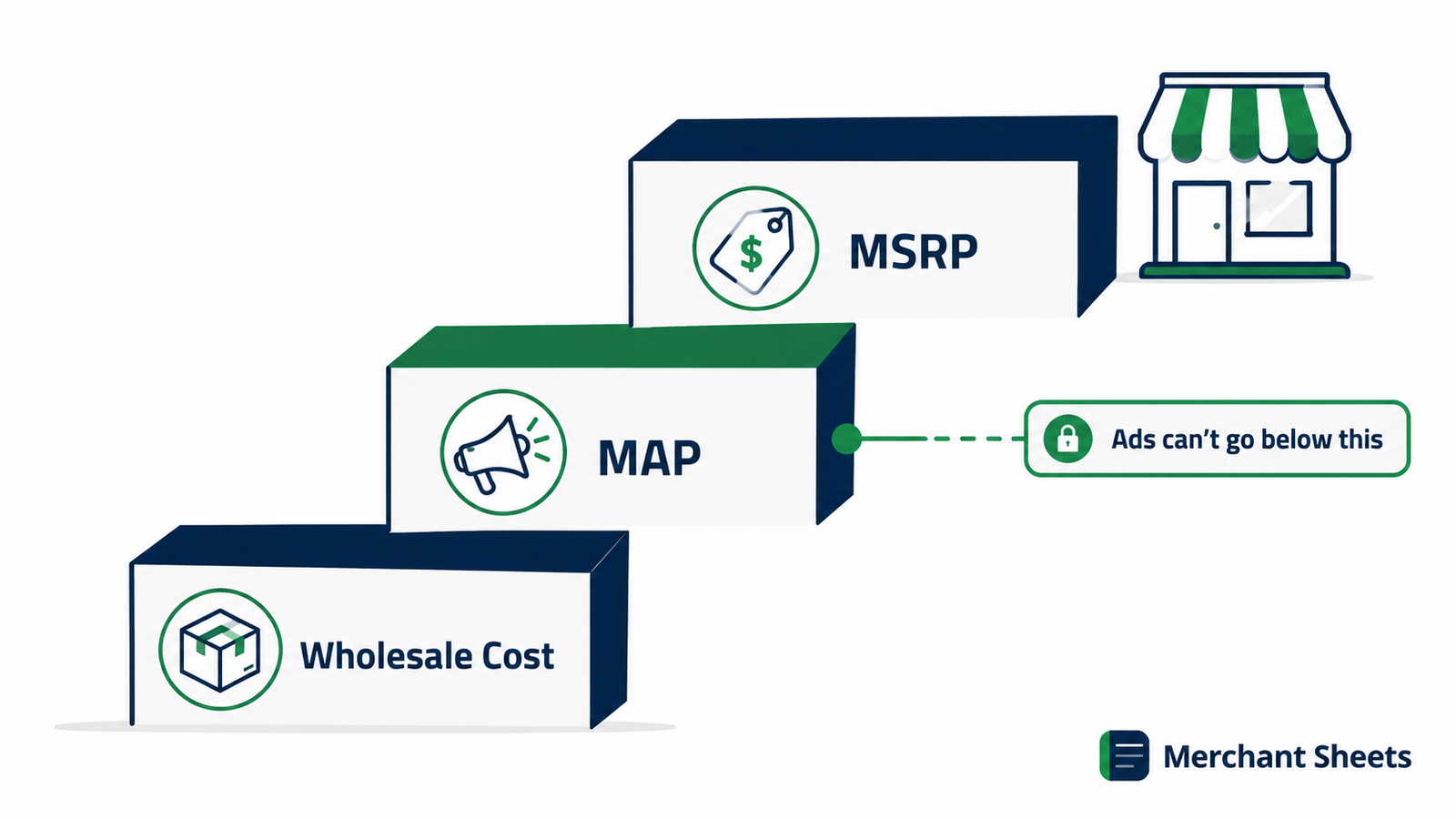
MAP pricing is the lowest price a retailer is allowed to advertise your product for. Brands use it to keep one discounter from dragging the whole market into a price war that cheapens the label and squeezes every reseller’s margin.
This guide covers what MAP is, whether it’s legal, and how to set one that still pencils out.
Minimum advertised price (MAP) comes into play the moment you sell through anyone but yourself — authorized dealers, marketplace sellers, big-box accounts. Each one wants to move volume, and the fastest lever is price.
A MAP policy sets a floor on what they can publish, so your $200 product doesn’t show up at $149 in a Google Shopping ad the week after launch.
We’ll walk through the rules, the money math, and where MAP fits alongside MSRP.
What is MAP pricing?
MAP pricing, or minimum advertised price, is the lowest price a manufacturer allows a retailer to publicly advertise for a product. The brand sets it, and it governs the advertised price across ads, listings, and product pages. Retailers can still sell below MAP through private channels, as long as they don’t publish the lower number.
The distinction that trips people up sits between advertising a price and charging one. MAP governs what a retailer shows the public: the number in a paid ad, a marketplace listing, or on the product page.
What a shopper pays at checkout can be lower, which is why you’ll see tactics like “add to cart to see price.” A retailer stays compliant by keeping the discount out of public view.
Who sets it: the brand or manufacturer, on its own. A MAP is a floor you publish to your resellers as a condition of carrying the line. It doesn’t dictate their final selling price, and that limit is what keeps it on the right side of the law, which we’ll come to.
Picture a $200 speaker with a $159 MAP. Every retailer can list it at $159 or higher in their ads and on their product pages. One of them can still email a repeat customer a $150 quote or ring it up lower in store. What none of them can do is run a $150 shopping ad, because that price is out in public.
MAP vs MSRP, and how they work together
MAP and MSRP get used interchangeably, and they do different jobs. MSRP — the manufacturer’s suggested retail price — is the price a brand recommends a product sell for. MAP is the floor on what a retailer can advertise. A retailer can ignore MSRP; a brand can enforce MAP.
How MAP, MSRP, and the actual selling price differ
| Price | What it controls | Enforceable? | Example |
| MSRP | The suggested selling price | No — guidance only | Brand suggests a $199 jacket |
| MAP | The lowest advertised price | Yes — via a unilateral policy | Ads can’t show it below $159 |
| Selling price | What the shopper pays | Set by the retailer | Retailer sells at $149 in-cart |
MAP usually sits below MSRP, leaving retailers room to run controlled promotions without advertising their way to the bottom. For online channels, brands often write a separate iMAP (internet minimum advertised price) that spells out the rules for ads, marketplaces, and shopping feeds, where most violations happen.
MAP sits on top of whatever method set the target price in the first place, whether that’s keystone pricing or another markup approach.
The one-line version: MSRP is the price you suggest, and MAP is the price you can enforce.
Why do brands use MAP pricing?
Brands use MAP pricing to protect brand value and keep their resellers profitable. Without an advertised floor, one retailer discounts to win the sale, the next matches to stay competitive, and within a season your product carries a lower price in every shopper’s mind. A MAP floor interrupts that race.
MAP earns its keep when you sell through several resellers or marketplaces that can undercut each other. A pure DTC brand that controls every listing has less need for it, and the more places your product shows up, the more a floor is worth. It protects your position in a few specific ways:
- Protects brand value: A product that’s always on sale reads as a cheaper product. Holding an advertised floor keeps the perceived value, and the pricing power, intact.
- Prevents price wars: When no one can advertise below the floor, there’s no undercutting spiral to chase. Retailers compete on service and selection instead of a race to the bottom.
- Protects reseller margins: Partners keep stocking a line they can make money on. A floor that preserves their margin keeps your distribution healthy.
- Keeps pricing consistent: Shoppers see a stable price across channels, so no one feels burned for buying from the wrong store this week.
Is MAP pricing legal?
MAP pricing is legal in the United States when a brand sets the policy unilaterally, applies it evenly to every retailer, and leaves each one free to choose its actual selling price. It’s restricted or banned in other markets, including the UK and EU, where enforced advertised-price floors are treated as unlawful resale price maintenance.
The US framework comes from the Supreme Court’s 2007 Leegin decision, which put vertical pricing policies under the “rule of reason” rather than treating them as automatically illegal. A brand can publish a MAP and stop supplying retailers who break it.
What a brand can’t do is agree with retailers on prices or dictate the final checkout price; that crosses into resale price maintenance (RPM), the illegal cousin of a clean MAP policy.
The rules change by market. The UK and EU competition authorities treat mandatory advertised-price floors as RPM and fine them. Canada and Australia allow advisory price guidance rather than enforced floors. If you sell internationally, set your policy market by market.
This is general information, not legal advice. A MAP policy is a legal document, so have a qualified attorney draft and review yours before you enforce it (as of early 2026).
How to set and enforce a MAP policy
Setting a MAP policy is part pricing decision, part legal document, part ongoing monitoring. The floor has to be high enough to protect margins and low enough that retailers can still promote.
Most breaches happen online — marketplace listings, shopping feeds, and “click for price” cart tricks — so enforcement leans on tools that watch public prices around the clock.
A workable policy usually comes together in five steps:
- Set the floor: Start from your wholesale cost and MSRP, and work out an advertised price that leaves an authorized reseller a real margin after their fees. Price it too low and retailers break it; too high and they can’t compete.
- Draft it unilaterally with counsel: Have an attorney write the policy as a one-way statement from your brand. Negotiating the terms with retailers is what makes a pricing policy illegal.
- Define the scope: List the covered SKUs, the channels the policy applies to, and what counts as a violation, including cart-price tricks.
- Monitor compliance: Watch your listings across marketplaces and shopping feeds. Manual spot checks work at a handful of SKUs; automated price-monitoring tools scale to hundreds.
- Enforce it evenly: Run a tiered response — a warning, then a supply hold, then loss of authorized-reseller status — and apply it to every violator the same way.
The money math behind a MAP price
A MAP floor only works if someone can still make money at it. Set it without checking the downstream math and you get one of two failures: a floor so low that retailers advertise right up to it and margins erode anyway, or one so high that nobody can run a promotion and your best partners quietly stop pushing the line.
Here’s the check for a brand. Take the reseller’s wholesale price, their cost of goods, and run it up to the MAP. Then subtract what it costs them to sell one: the marketplace fee, fulfillment, and shipping.
What’s left is the reseller’s contribution margin, what they keep per order after every variable cost.
A reseller’s margin at a $159 MAP on a $200-MSRP product
| Line item | Amount |
| Advertised price (MAP) | $159.00 |
| Wholesale cost (their COGS) | −$96.00 |
| Marketplace fee (15%) | −$23.85 |
| Fulfillment + shipping | −$12.00 |
| Contribution per order | $27.15 |
| Contribution margin | 17% |
At a 17% contribution margin, this reseller has room to promote and still profit, so the floor holds. Drop the MAP to $129 and that margin turns negative once fees come out, which would push honest retailers to break it. Run this calculation before you publish a number, and run the same one as a reseller before you agree to stock a line.
As a reseller, if the floor leaves you nothing after the marketplace’s cut, that’s your signal to negotiate a better wholesale price or pass on the line.
Set a MAP your resellers can stick to
A MAP floor is a pricing decision dressed as a policy. Set it without the margin math and you either erode the value you’re trying to protect or hand your best retailers a reason to break the rules. The number has to leave everyone in the chain a profit worth keeping.
Start from real costs and work up. The Product Pricing Calculator takes your cost, channel fees, and target margin and returns the price that clears it, with a break-even floor and a sensitivity view, so you can set a MAP that protects your brand and still lets your resellers make money.
It’s the same math a reseller runs to check a floor before stocking your line, and the foundation under how to price your products across every channel.
Frequently asked questions
Can you sell below MAP pricing?
Yes, a retailer can sell below MAP as long as the lower price stays out of public advertising, shown only in the cart, in store, or in a direct quote, while every published price holds at or above the floor. MAP governs the advertised price, so a discount that no shopper sees advertised keeps the retailer compliant.
Who sets the MAP price?
The manufacturer or brand sets the MAP price on its own, with no input from retailers, because the moment a brand and its retailers agree on pricing together the policy can become illegal price-fixing. The brand publishes the floor as a one-way condition of carrying the product.
Does MAP pricing apply to Amazon and other marketplaces?
Yes, marketplace listings and their ads count as advertising, so MAP applies on Amazon, Walmart, and Google Shopping the same as anywhere else. Marketplaces are where most violations happen, because repricing algorithms chase the lowest price automatically, so brands watch them closely and use takedown tools and Amazon Brand Registry to enforce the floor.
What is iMAP pricing?
iMAP, or internet minimum advertised price, is a MAP policy written specifically for online advertising — marketplaces, shopping feeds, and paid search. Brands add an iMAP because online channels move fast and break MAP most often, so the online rules often need their own detail on things like cart pricing and third-party sellers.
