
Key takeaways
- Pricing for profit means Selling Price = Total Cost ÷ (1 − target margin), where total cost is fully loaded and the margin is a decimal.
- A $40 fully-loaded cost priced for a 60% margin gives a $100 selling price: $40 ÷ (1 − 0.60).
- Markup is measured against cost and margin against price, so a 50% markup is only a 33% margin — never treat them as the same number.
- In ecommerce, channel fees, fulfillment, ads, and returns can take 20 to 40 points of margin before you keep a dollar, so your price has to clear all of them on top of product cost.
- A price only works if it clears operating profit after operating expenses are allocated; test it across a range before you set it, and revisit it as costs move.
Pricing a product for profit isn’t adding a markup and hoping. It’s working out what a unit truly costs you, choosing a margin you can defend, and checking the price still makes money after platform fees, shipping, ads, and returns take their cut.
In ecommerce, a price that looks healthy on a spreadsheet can lose money the moment it hits a marketplace, because the referral fee, fulfillment, ad spend, and returns all come out of that same sale.
We’ll walkthrough the full path: fully-loaded cost, the pricing formula, the channel costs that separate a good price from a bad one, and how to pressure-test the number before you commit to it.
What does pricing for profit mean?
Pricing for profit means setting a price that covers everything a sale costs you and still leaves the margin you’re targeting. That includes the obvious product cost and the costs that land after the sale: payment processing, marketplace fees, fulfillment, the ad spend that won the order, and a reserve for returns.
Two words get used as if they’re the same thing, and the gap between them is where money leaks: markup and margin. Markup measures profit against your cost. Margin measures profit against your selling price. Because they use different denominators, the same dollar of profit is a bigger markup number than margin number.
A 50% markup works out to a 33% margin, and a 100% markup is a 50% margin. Set your target as a margin, since that’s the number that maps to your profit and loss.
The ecommerce catch shows up early. A markup that looks generous in isolation can leave a thin or negative margin once a marketplace takes its 15% and a returns reserve comes off the top. That’s why a clean product cost is only the starting point: the price has to clear the whole channel it sells through.
What’s the product pricing formula?
The core formula is Selling Price = Total Cost ÷ (1 − target margin), with the margin written as a decimal. If a unit costs you $40 fully loaded and you want a 60% margin, the math is $40 ÷ (1 − 0.60) = $100. The division builds the margin into the price, so the profit survives after the cost comes out.
It helps to see it next to the markup version, which adds a percentage of cost on top: Selling Price = Cost + (Cost × markup %). A $40 cost with a 150% markup also lands at $100, but the number you quoted yourself — 150 — tells you nothing about the margin you’ll book.
The margin formula answers the question you care about, which is how much of each sale you keep.
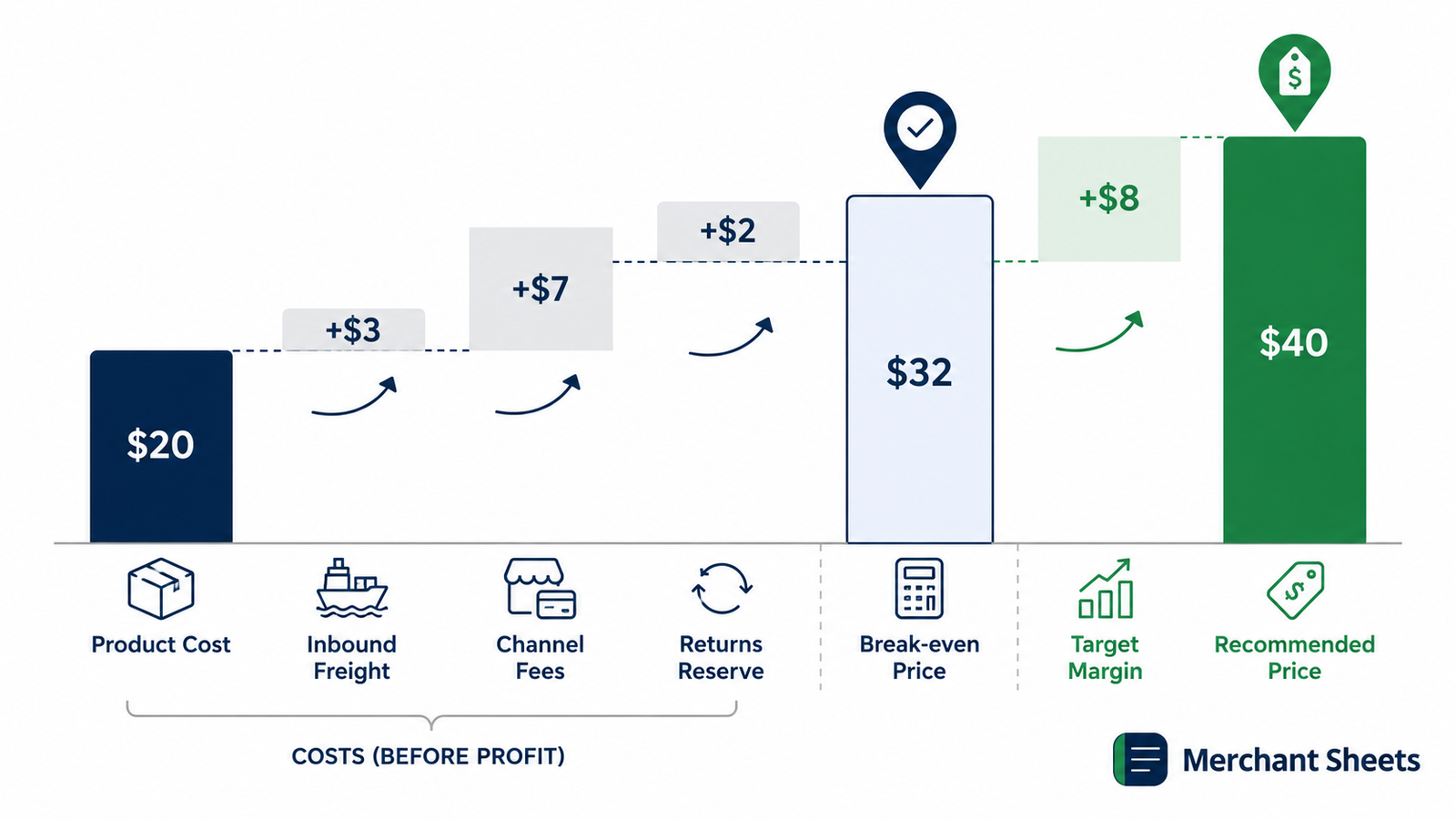
| At a $20 unit cost, pricing for a 50% margin gives $40; pricing for a 60% margin gives $50. That 10-point target adds $10 of gross profit to every order you ship. |
The formula is only as honest as the two inputs you feed it: the total cost and the margin. The next three steps get both right, starting with the cost.
Step 1: Nail your fully-loaded cost
Your price is built on your cost, so a soft cost number produces a soft price. Fully-loaded cost means every dollar it takes to land one sellable unit, not the invoice price from your supplier alone.
- Product cost: What you pay to make or buy one unit — the manufacturing cost or the wholesale price on your purchase order.
- Inbound freight and duties: The shipping, insurance, and customs it takes to get the unit into your warehouse, folded in through your landed cost.
- Variable cost per unit: Anything that rises with each unit, allocated one unit at a time — the basis for your cost of goods sold.
Get the cost base right and the rest of the pricing math has something solid to stand on. If you sell internationally or move inventory in bulk, the freight and duty piece is bigger than it looks, and it belongs in the number before you ever apply a margin.
Step 2: Add the channel costs that eat your margin
This is the step most pricing guides skip, and it’s the one that decides whether your price profits. Every channel takes a cut between the price a shopper pays and the cash you keep.
Price the same product for a direct store and for a marketplace and the economics look different, even though the sticker is identical.
Table 1 — The same $50 product at direct-to-consumer vs. Amazon economics
| Line item | DTC (Shopify) | Amazon (FBA) |
| Selling price | $50.00 | $50.00 |
| Product cost | −$20.00 | −$20.00 |
| Payment / referral fee | −$1.75 | −$7.50 |
| Fulfillment / FBA | −$6.00 | −$5.50 |
| Ad cost per unit | −$8.00 | −$5.00 |
| Returns reserve | −$1.00 | −$1.50 |
| Contribution per unit | $13.25 | $10.50 |
| Contribution margin | 27% | 21% |
Same price, six points of margin apart. The marketplace referral fee and FBA charge cost more than the direct store’s processing and fulfillment, even though ad spend runs lower there.
Read the channel before you price for it: a number that leaves a healthy contribution margin — what you keep per order after every variable cost — on your own store can turn tight on Amazon.
If a channel can’t clear a workable margin at a price the market accepts, that’s the channel telling you to rework the cost or walk away from it.
Step 3: Set a target margin that holds up
The margin you plug into the formula is a business decision, not a default. Set it high enough to survive the channel costs from step two and still fund your operating expenses, and ground it in what your category earns.
- Benchmark your category: Start from a healthy gross margin for your vertical rather than a round guess, then adjust for how you sell.
- Leave room for fees and returns: The margin has to absorb the channel’s cut and a returns reserve, so target above your break-even, not at it.
- Keep contribution positive: Every order should clear its variable costs before it contributes to overhead, or volume multiplies the loss.
A margin target that ignores the channel is a wish. One that starts from a real benchmark and leaves headroom for fees, ads, and returns is a number you can price against and defend when costs shift.
Which pricing method should you use?
A method gives you a starting price fast; the steps above tell you whether it holds. Pick one that fits your category, then run the number through the cost and channel math before you commit.
Table 2 — Four common pricing methods at a $20 unit cost
| Method | How it works | Best for | Example |
| Cost-plus | Add a set margin to fully-loaded cost | A reliable default | $20 cost, 50% margin → $40 |
| Keystone | Double your cost | Retail and wholesale with room to discount | $20 cost → $40 |
| Competitive | Price to the going market rate | Crowded, comparison-shopped categories | Match a $39 street price |
| Value-based | Price to perceived worth | Differentiated or premium products | $79 for a $20-cost item |
Cost-plus and keystone pricing both build off your cost, so they’re quick and safe defaults. Competitive pricing anchors to the market when shoppers can compare you side by side. Value-based pricing earns the most margin when your product stands apart enough that buyers weigh more than the price tag.
If you sell through resellers, a MAP pricing policy sets a floor on what they can advertise, which shapes the price you can realistically hold across the market.
How do you pressure-test a price before you commit?
A single price is a guess until you see what happens around it. The test is simple: hold your costs, move the price up and down, and watch what operating profit does once operating expenses are allocated.
Two floors matter here. The break-even price covers your variable cost only. The operating break-even covers variable cost plus a share of overhead — the real line a price has to clear to help the business.
Table 3 — Price sensitivity at a $37 variable cost and $5 of allocated operating expense per unit
| Price | Operating profit / unit | Operating margin | Read |
| $40 | −$2.00 | −5% | WALK AWAY |
| $45 | $3.00 | 7% | TIGHT |
| $50 | $8.00 | 16% | HEALTHY |
| $55 | $13.00 | 24% | HEALTHY |
At $40 the price sits below the operating break-even of $42, so every sale loses money once overhead is counted — a walk away. At $45 it clears a thin profit that a bad returns week could wipe out. By $50 it hits a margin worth building on.
Seeing the whole range keeps you from setting a price that looks fine at one point and falls apart at the next.
Price every product so it profits
A price is a profit decision wearing a number. Set it from product cost alone and the channel quietly takes the margin you thought you had; set it from the full picture and every order pulls its weight. The formula gets you close, and the cost, channel, and margin steps get you honest.
Start from real costs and work up. The Product Pricing Calculator takes your cost, channel fees, and target margin and returns the price that clears it, with a break-even floor and a seven-point sensitivity view, so you can see whether a price is healthy, tight, or a walk away before you set it.
It’s the same math behind every method above and the foundation under how to price your products across every channel you sell on.
Frequently asked questions
How do you calculate the selling price of a product?
Divide your fully-loaded cost by one minus your target margin written as a decimal: Selling Price = Total Cost ÷ (1 − margin). A $40 cost at a 60% target margin gives $40 ÷ 0.40 = $100. Use the total cost that includes freight and duties, and set the margin high enough to survive channel fees and returns.
What is a good price for a product that costs $10 to make?
At a 60% target margin, the formula puts a $10-cost product at about $25, but that’s a starting price, not your profit. Subtract payment or marketplace fees, fulfillment, ad spend, and a returns reserve before you call the margin real — on a marketplace, those costs can pull a $25 price down to a thin contribution.
Should shipping and fees be included when pricing a product?
Yes, inbound freight and duties belong in your product cost, and the channel fees, fulfillment, ads, and returns that come out of each sale have to be priced above, not absorbed. Leaving them out is the most common reason a price that looks profitable ends up losing money once a sale clears.
How do you price a product to sell on Amazon?
Start from the same formula, then load in Amazon’s costs: the referral fee, the FBA fulfillment charge, your ad cost per unit, and a returns reserve. Those fees run higher than a direct store’s, so a price that profits on your own site can turn tight on the marketplace — check the FBA math before you list.
