Demand forecasting and replenishment planning for ecommerce brands

Know what to reorder, when, and how much. I build the forecast, set reorder points and safety stock per SKU, and hand you a purchase plan that respects your cash. In Excel or Google Sheets, or in the tool you already run.

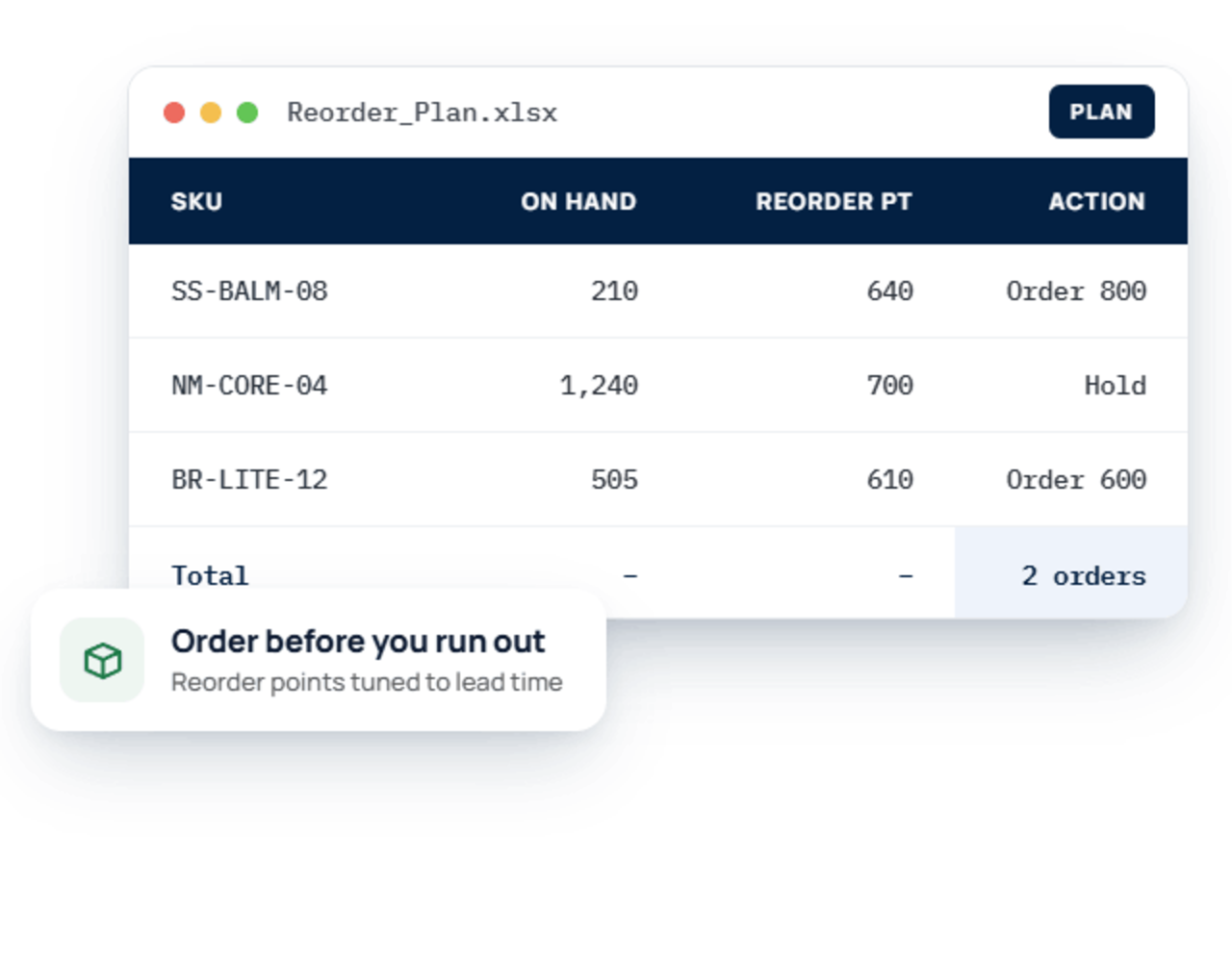
spreadsheet mockup showing an inventory reorder plan

The questions inventory planning answers

Inventory is where most of your cash sits and where a stockout costs the most. These are the calls I help you make.

How much do I reorder, and when?

I set a reorder point and order quantity for every SKU, so each purchase order goes out at the right time in the right size.

How much cash is stuck in inventory?

I tie the purchase plan to your live cash position, so buying stays inside what the business can fund without straining day-to-day operations.

Will I stock out before restock?

I forecast demand against your lead times and flag every SKU heading for a gap, while there's still time to place the order.

How much safety stock do I need?

I size safety stock per SKU from your demand swings and how reliably shipments land, so your fast movers get the cover they need.

What do I buy for Q4?

I model the seasonal build-up so you carry enough to sell through the peak, while keeping cash under control on the way in.

Am I paying Amazon's inventory fees?

I plan around FBA restock limits and keep you clear of the low-inventory fee and the 181-day aged-inventory surcharge on slow SKUs.

What the plan puts in your hands

A working model and a clear read on what to buy, refreshed as the numbers move.

Demand forecast

Sales velocity, seasonality, and promo lift by SKU, so the plan tracks how each product sells.

Reorder points & safety stock

A reorder point and safety stock for every SKU, sized to lead time and demand swings.

Purchase plan

What to order and when, sequenced so buying never outruns the bank.

Amazon FBA guardrails

Per-FNSKU reorder points and restock planning that dodge the low-inventory and aged-inventory fees.

Two ways to build it

You keep the tool you already pay for, or skip software with a spreadsheet system.

In Excel or Google Sheets

I build the forecast and reorder system on the Merchant Sheets templates, formula-only and documented. You own the model, extend it, and run it without a monthly software bill.

In the tool you already run

Already on Inventory Planner, Prediko, or Cogsy? I set it up correctly, tune the forecast and reorder logic, and run the cadence, so the tool you pay for finally earns its keep.

Ways to work together

Start where it fits your business today. Each step can lead into the next, and most brands begin with the audit.

One-Time

Inventory planning system build

from $1,500

A demand forecast and reorder model built for your SKUs, with safety stock and purchase planning set up and handed over trained.


One-Time

Peak / seasonal buy plan

$1,000–$2,500

A build-up plan for Q4 or your busy season, so you carry enough to sell through without tying up cash you need.


Ongoing

Monthly replenishment planning

from $600/mo

I refresh the forecast, flag reorders, produce the purchase plan, and check it against cash, every month.


How we start

A short path from first call to a plan you can order from.

1

Planning call

I look at your SKUs, sales velocity, lead times, and current process, and pinpoint where inventory is tying up cash or risking a stockout.

2

System build

I build the forecast and reorder model, set safety stock per SKU, and hand it over trained, in your spreadsheets or your tool.

3

Keep it current

Month to month, I refresh the forecast, flag what to reorder, and produce a purchase plan you can hand to your supplier.

BT
Bradley Taylor
Founder · Merchant Sheets Finance Practice
What I do
Accounting, inventory planning, and fractional CFO work for ecommerce
Who I work with
Ecommerce brands doing $500K to $10M in revenue
Education
Undergraduate degrees in accounting and finance, University of Maryland
QuickBooks ProAdvisor
Xero Partner
A2X certified

Who does the work

Merchant Sheets is my finance practice for ecommerce operators, and I handle your inventory planning myself, from the first forecast through every reorder. The plan reflects how your products actually sell, never a generic model dropped onto your SKUs.

My background pairs formal training with time in the seat. I’ve sold on Amazon FBA and placed the purchase orders as an operator, and I’m trained in the forecasting and inventory methods behind every plan.

Because inventory is where most of your cash sits, the plan ties straight into cash flow, which is where fractional CFO work picks up.

Start with a planning call

A 30-minute look at your SKUs, lead times, and where inventory is tying up cash or risking a stockout. Book a call to see if it fits.

Credentials behind the work

Trained in the forecasting and inventory methods behind every plan, and certified in the financial modeling underneath.

QuickBooks ProAdvisor Certified Badge

QuickBooks ProAdvisor

Xero L1 Associate badge

Xero Certified Partner

A2x certified badge

A2X Certified

CFI FMVA badge

CFI FMVA & FPAP

Common questions

Weighing your options? A 30-minute planning call is the fastest way to know if it fits.

How do you calculate a reorder point?

The reorder point is your daily demand times your lead time, plus safety stock. I size lead time off the 80th percentile of your actual receiving times, so the plan holds when a shipment runs late, and I set safety stock from how much your demand swings.

Do I need inventory software like Inventory Planner or Cogsy?

No. I can build the whole system in Excel or Google Sheets on the Merchant Sheets templates, or set up and run the tool you already pay for, like Inventory Planner, Prediko, or Cogsy. The core logic is the same, but a dedicated tool and a spreadsheet handle the forecasting differently, so you choose on budget, stack, and how hands-on you want to be.

How much safety stock should I carry?

Enough to cover demand swings and late shipments through your lead time, while keeping cash free for the rest of the business. I size it per SKU from demand variability and lead-time reliability, so fast movers get more cover and steady sellers get less.

Can you help with Amazon FBA restock limits and fees?

Yes. I plan around FBA restock limits and set per-FNSKU reorder points, and I keep you clear of the low-inventory fee and the 181-day aged-inventory surcharge, both of which reward tighter planning.

How is this different from bookkeeping or COGS?

Bookkeeping and COGS look backward at what your inventory cost. Planning looks forward at what to buy, when, and how much, and what it does to your cash. They pair well, and I offer both.

Do you work seasonally, like a Q4 buy plan?

Yes. A peak or seasonal buy plan is a one-time project. I model the build-up for Q4 or your busy season so you carry enough to sell through without overbuying.