
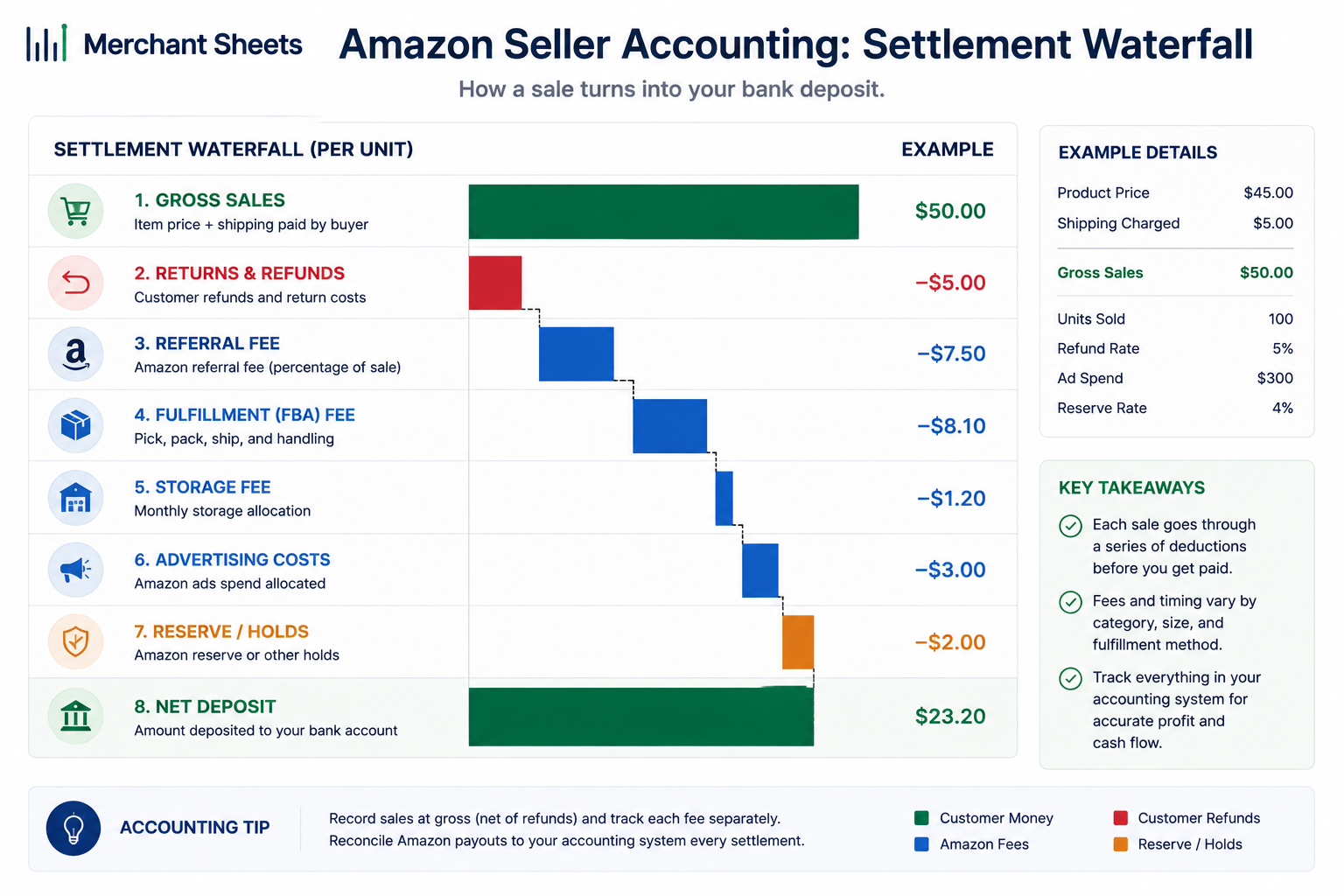
Key takeaways
- Amazon pays you a net deposit every two weeks (or weekly), already reduced by fees, refunds, advertising, and a held reserve, so the deposit isn’t your revenue.
- Booking the deposit as revenue understates gross sales, often by 20% to 35%, and hides every fee, which distorts your margin and your taxes.
- Reconcile top-down: post gross sales to revenue, each fee to its own expense line, refunds as contra-revenue, and sales tax to a liability, so the net ties back to the bank deposit.
- Route each settlement through a clearing account so the leftover balance equals the reserve Amazon still holds.
- Use accrual accounting because settlement periods straddle month-ends: book the sale when it happens, then clear it when Amazon pays.
Every two weeks Amazon drops a deposit in your bank, and it’s tempting to call that number revenue. It isn’t. Amazon already took its fees, netted out refunds, and held back a reserve, so the deposit sits a long way from your real sales.
That gap is what makes Amazon seller accounting tricky, and booking the payout as revenue sends your margins and taxes quietly wrong. Here’s how to reconcile it right.
Why is Amazon seller accounting so hard?
Amazon seller accounting is hard because Amazon pays you a single net deposit every two weeks, not your actual sales. That deposit already has referral fees, FBA fees, refunds, advertising, and a held reserve taken out, so it understates your revenue and hides your costs.
Accurate books mean pulling those pieces back apart.
One payout stands in for hundreds of orders and a dozen fee types, all netted together before the money reaches you. Your bank feed sees one figure; your books need every piece behind it.
That’s the whole job: turn a single net number back into the sales, fees, refunds, and reserve that produced it, which is the foundation of any honest read on your Amazon FBA profitability.
What’s inside an Amazon settlement report?
The settlement report is where those pieces live. It’s Amazon’s breakdown of everything that happened in the period, from gross sales at the top down to the net it sent you.
You’ll find it in Seller Central under Reports, then Payments, as a Date Range Report or the statement view (menu labels shift, so confirm the path in your account). Here’s what each line means and where it belongs in your books:
A settlement report, line by line, and where each piece posts in your books
| Settlement line | What it is | Where it posts |
| Gross product sales | What you sold before any deduction | Revenue |
| Refunds and returns | Money returned to buyers | Contra-revenue (reduces sales) |
| Referral fee | Amazon’s commission per sale, about 8–15% by category | Expense (selling fees) |
| FBA fulfillment fee | Per-unit pick, pack, and ship | Expense (fulfillment) |
| Storage and other FBA fees | Monthly storage, aged-inventory, and surcharges | Expense (fulfillment) |
| Advertising | Sponsored Products and Brands spend | Expense (marketing) |
| Sales tax collected | Tax Amazon collected from buyers | Liability (not income) |
| Reserve | Funds Amazon holds back temporarily | Clearing / holding account |
| Net deposit | What lands in your bank | Bank (clears the settlement) |
Why can’t you book the deposit as revenue?
Because the deposit is net of fees, refunds, and the reserve, recording it as revenue understates your true sales, often by 20% to 35%, and folds every cost into one invisible figure. Two things break.
Your margin looks wrong because the fees never appear as expenses, and your tax filing is off because reported revenue is too low.
The fix is a principle: reconcile from gross sales down, not from the deposit up. Start with what you sold, then account for each of Amazon’s FBA fees and the refunds and reserve on top, and let the net be the result rather than the starting point.
It’s the same discipline behind clean ecommerce accounting, and Amazon stacks more fee types into one payout than most channels, which is why the habit matters more here.
How to reconcile a settlement to revenue, step by step
Reconciling a settlement is the same handful of moves every period. The identity you’re solving for is simple, even when the line items aren’t:
Gross sales − refunds − fees − reserve + reimbursements = net deposit
Work it top-down and the net falls out on its own:
- Pull the settlement report: Open the period’s report in Seller Central so you’re working from Amazon’s own line items, not the single bank figure.
- Post gross sales to revenue: Record what you sold before any deduction, so revenue reflects real demand rather than what’s left after Amazon’s cut.
- Book refunds as contra-revenue: Subtract returns from sales instead of hiding them in an expense, so net sales stay honest.
- Split each fee to its own line: Give referral, FBA, storage, and advertising fees separate expense accounts so you can see what each one costs you.
- Record sales tax as a liability: The tax Amazon collects isn’t income; it’s money owed, so it belongs on the balance sheet, not in sales.
- Clear it through a clearing account: Run the whole settlement through an Amazon clearing account, then clear the payout against your bank so the leftover balance equals the reserve Amazon still holds.
What does a reconciled settlement look like?
Put numbers on the method and the point lands. Take a two-week settlement on $10,000 of gross sales. After Amazon’s fees, refunds, the sales tax it collected to remit, and the reserve it held, only $4,250 reaches your bank.
Book that $4,250 as revenue and you’ve erased $5,750 of sales and every fee behind it.
Reconciled from the top down, the same settlement looks like this:
A sample two-week settlement reconciled from gross sales down to the net deposit
| Settlement line | Amount |
| Gross product sales | $10,000 |
| Refunds and returns | −$400 |
| Referral fees | −$1,300 |
| FBA fulfillment fees | −$1,800 |
| Storage and other FBA fees | −$150 |
| Advertising | −$900 |
| Sales tax collected (held to remit) | −$700 |
| Reserve held | −$500 |
| Net deposit to bank | $4,250 |
Cash vs accrual, and settlements that straddle month-end
Amazon’s settlement periods rarely line up with your calendar months, so one payout often covers the last few days of one month and the first stretch of the next.
That timing is where cash and accrual accounting split. Cash accounting records the money when it lands, which smears revenue into whatever month Amazon happened to pay.
Accrual accounting records each sale when it happens and matches the fees and cost of goods to it, giving you a monthly P&L that reflects the month.
For any business carrying inventory, accrual is the method that tells the truth, and it’s worth the extra step of splitting a straddling settlement at the month-end cutoff and accruing the part Amazon hasn’t paid yet.
Say a settlement runs March 25 to April 7: the sales, fees, and refunds dated in March belong to March’s books even though the deposit lands in April, so you accrue March’s share at the cutoff and clear it when the payout arrives.
The held reserve and payout lag also leave cash tied up in reserve you can’t spend, so watch it the way you’d watch any working-capital drag.
This is general information, not financial or tax advice; confirm the method and the cutoffs with your accountant.
Reconcile down to the ASIN and SKU
Reconciling to a correct total is the floor. The real payoff is knowing which products earned it. Amazon reports sales, fees, and returns by ASIN, the code that names each product in its catalog, while your inventory and cost of goods run on your own SKUs.
Map the settlement’s lines down to the ASIN and SKU and a reconciled deposit becomes real per-product profit: a variation family rolls up to one number, and a thin-margin SKU that’s been riding inside the blended payout finally shows itself.
Matching hundreds of line items by hand is where this gets painful, which is where a reconciliation model earns its place, turning each settlement into your real FBA margin per product without a manual match every time.
| Run every settlement through an Amazon clearing account. When the payout clears it, the balance left behind is the reserve Amazon still holds, and it should match what Seller Central shows. |
Turn one deposit into real books
Amazon hands you one net number; your books need a dozen. The Multi-Channel Reconciliation template breaks each settlement into gross sales, every fee, refunds, sales tax, and the reserve, maps them to your accounts, and ties the total back to the deposit.
Reconcile once a period and your revenue and margin stay real, month after month, which is the kind of Amazon seller accounting that holds up at tax time.
Frequently asked questions
Is the Amazon deposit my revenue?
No, the Amazon deposit is your net payout after Amazon subtracts referral and FBA fees, refunds, advertising, and a held reserve, so it’s smaller than your actual revenue. Book your gross sales as revenue and record each deduction separately, then let the net match the deposit.
How do I reconcile an Amazon settlement report?
You reconcile from gross sales down: post gross sales to revenue, refunds as contra-revenue, and each fee to its own expense line, then run the settlement through a clearing account so the net ties out to your bank deposit. Working top-down keeps revenue and fees visible instead of collapsing them into one number.
Should Amazon sellers use cash or accrual accounting?
Most Amazon sellers carrying inventory should use accrual accounting, because it books each sale when it happens and matches fees and cost of goods to it, giving a monthly P&L that isn’t distorted by Amazon’s biweekly payout timing. Cash accounting is simpler but smears revenue across the wrong months.
How often does Amazon pay out?
Amazon typically disburses every 14 days, though some accounts qualify for more frequent payouts, and each disbursement comes with a settlement report covering that period. The deposit usually lands one to three business days after the settlement period closes.
Do I record the sales tax Amazon collects as income?
No, the sales tax Amazon collects from buyers isn’t income; it’s a liability you record on the balance sheet, because it’s money owed to the tax authority rather than revenue you earned. In most US states Amazon remits marketplace tax for you, but it still shouldn’t sit inside your sales.
Do I need A2X, or can I reconcile in a spreadsheet?
You can reconcile settlements in a spreadsheet by mapping each line to your chart of accounts, and plenty of sellers do exactly that before automating. Tools like A2X speed up the journal entries at higher volume, but the underlying method is the same either way.
