
Key takeaways
- Cash accounting records revenue and expenses when money moves; accrual records revenue when you earn it and costs when you incur them.
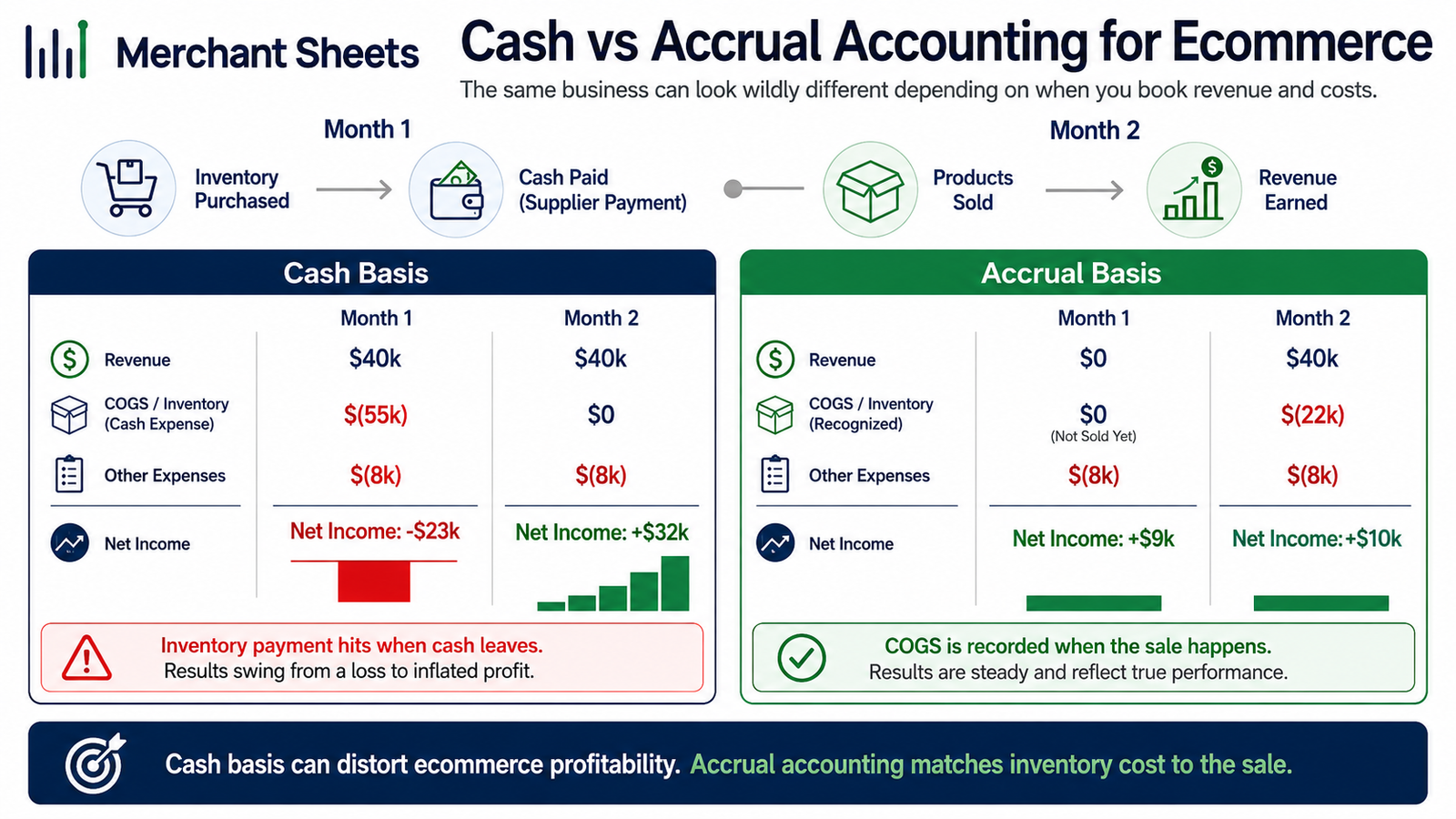
- For a business that carries inventory, cash basis distorts profit: you expense a big inventory buy all at once, then show phantom profit as you sell it with no cost attached.
- Accrual holds inventory as an asset and expenses it as COGS when it sells, so each month shows your real gross margin.
- Cash basis also misreads ecommerce timing: marketplace payouts lag, prepaid inventory deposits, and subscription or gift-card revenue all land in the wrong period.
- Since the 2017 tax law, carrying inventory no longer forces accrual: a business under the gross receipts threshold (about $30 million for 2024, roughly $31 million for 2025) can file taxes on cash even with inventory.
- The practical setup for most sellers is to run accrual for management and decisions, and file taxes on cash while eligible.
Cash accounting counts the money as it moves. Accrual counts revenue when you earn it and costs when you incur them. For most businesses the gap is small, but the moment you carry inventory it’s the difference between books that tell the truth and books that lie to you every month.
Here’s how the two methods work, why the choice hits ecommerce harder than most businesses, what the IRS requires, and how to decide.
What’s the difference between cash and accrual accounting?
Cash accounting records revenue when the money lands in your bank and expenses when you pay them. Accrual accounting records revenue when you earn it and expenses when you incur them, regardless of when cash changes hands. The difference is timing, and for a business that carries inventory it changes your monthly profit dramatically.
Both methods eventually count the same dollars. Over a long enough stretch, cash and accrual land on the same total profit. What differs is which month each dollar shows up in, and that timing is the whole game when you’re reading a monthly P&L to make decisions.
Accrual is also the basis of standard accounting rules, so it’s the language lenders, investors, and buyers expect, while cash basis is closer to a running tally of your bank account. If you’re still mapping out the wider picture, our guide to ecommerce accounting covers where this choice fits.
Cash vs accrual accounting, side by side
| Cash basis | Accrual basis | |
| When revenue is recorded | When the payment hits your bank | When you make the sale |
| When an expense is recorded | When you pay it | When you incur it |
| Inventory | Expensed when you buy it | Held as an asset, expensed as COGS when it sells |
| Complexity | Simple; maps to your bank balance | More involved; needs real bookkeeping |
| Best for | Very small, low-inventory businesses | Inventory businesses and anyone reading real margin |
What is cash basis accounting?
Cash basis records a transaction only when money moves. Revenue hits the books when a customer’s payment lands in your account, and an expense hits when you pay a bill or buy stock. Nothing is recorded for a sale you’ve made but not been paid for, or a bill you’ve received but not settled.
Its virtues are real, which is why so many sellers start here. It’s simple enough to run in a spreadsheet, it maps directly to your bank balance, and it answers the question every founder asks first, which is how much cash do I have right now.
For a business with little or no inventory, like a services shop or a dropshipping brand that never owns stock, cash basis can run for years without distorting much, because there’s no big gap between paying for something and earning the revenue it supports.
Even without inventory, the cracks show whenever a payment and the value it buys fall in different months. Prepay a year of software in January and cash basis dumps the whole cost into January; settle a large ad invoice a month after the campaign ran and the spend lands in the wrong month against the sales it drove.
These are small distortions for a lean business, but they’re the same flaw that inventory turns into a monthly problem.
The trouble starts the moment there’s a lag between spending money and earning it. And in ecommerce, that lag is everywhere.
What is accrual basis accounting?
Accrual basis records revenue when you earn it and costs when you incur them, matching each sale to the cost that produced it. That match, known as the matching principle, is what makes gross margin mean something month to month. Instead of tracking when cash moves, accrual tracks when value changes hands.
The machinery is straightforward once you see it. Inventory sits on your balance sheet as an asset until it sells, then its cost moves to cost of goods sold in the same period as the sale. A bill you’ve received but haven’t paid becomes an accrued liability, a cost you’ve incurred that’s still owed.
Cash a customer pays you before you’ve delivered, like a subscription month or a gift card, becomes deferred revenue, a liability you clear when you actually earn it. Each of these keeps a cost or a dollar of revenue in the period it belongs to, which is exactly what cash basis fails to do.
Accrual takes more bookkeeping, and it’s the foundation of standard accounting rules. That’s the trade: more work in exchange for numbers you can actually steer by, and books an outside party will recognize.
Why the method matters more for ecommerce
Inventory is the reason this choice matters so much for online sellers. It’s usually your single largest cost, and cash basis expenses it the day you pay your supplier instead of the day it sells, so your profit lurches with your buying cycle rather than your sales.
But inventory is only the start. Ecommerce stacks on a series of timing traps that cash basis gets wrong, and accrual gets right.
Marketplace payouts are a common one. Amazon’s biweekly payouts and similar schedules mean the cash for a sale can land days or weeks after the sale itself, so cash basis books the revenue in the wrong period. Deposits to overseas suppliers leave your account months before the goods arrive.
And money collected up front, from subscriptions to gift cards, is income the day it’s received under cash basis but a liability you haven’t earned yet under accrual. Here’s how the most common traps play out:
Where cash basis misreads ecommerce timing
| Timing trap | What cash basis does | What accrual does |
| Inventory purchase | Expenses the whole buy the day you pay | Holds it as an asset, expenses COGS as it sells |
| Marketplace payout lag | Books the sale when the payout clears | Books the sale when it happens |
| Prepaid supplier deposit | Shows the cash gone, with no asset | Records a prepaid asset until the goods arrive |
| Subscription or pre-order revenue | Counts it as income on receipt | Holds it as deferred revenue until you deliver |
| Gift cards | Counts as income when sold | Holds as a liability until redeemed |
The same three months on cash vs accrual
The clearest way to see the gap is to run the same numbers both ways. Say in month 1 you buy $30,000 of inventory and pay for it in cash. Over the next three months you sell all of it, generating $20,000 in revenue each month at a 50% gross margin, so each month’s sales carry $10,000 of cost of goods sold.
Same business, same sales, same total profit. Watch what each method does to the monthly picture.
On cash basis, month 1 looks like a disaster and the next two look like a boom, because the entire $30,000 inventory payment lands in month 1 and nothing after it carries any cost:
Cash basis: the inventory buy sinks month 1, then months 2 and 3 look inflated
| Month | Revenue | Inventory paid | Profit |
| Month 1 | $20,000 | $30,000 | −$10,000 |
| Month 2 | $20,000 | $0 | $20,000 |
| Month 3 | $20,000 | $0 | $20,000 |
On accrual, the $30,000 goes onto the balance sheet as inventory and comes off as COGS only as the goods sell. Every month shows the same honest $10,000 gross profit, and the inventory asset draws down to zero as you sell through it.
How you value that inventory follows your inventory costing method, and the cost moves to the income statement through the entry that records COGS.
Accrual basis: steady margin, with inventory drawn down as an asset
| Month | Revenue | COGS | Gross profit | Ending inventory |
| Month 1 | $20,000 | $10,000 | $10,000 | $20,000 |
| Month 2 | $20,000 | $10,000 | $10,000 | $10,000 |
| Month 3 | $20,000 | $10,000 | $10,000 | $0 |
Which method should you use?
If you carry inventory, use accrual for your management books. It’s the only method that shows real monthly margin, and it’s what any lender, investor, or buyer will expect to see. Cash basis is fine only in the narrow cases where the timing gaps are small. Here’s the quick read by situation:
- Carry inventory: Use accrual for your management books; it’s the only method that shows real monthly margin.
- Little or no inventory: Cash basis works for a services or dropshipping business where cash and earnings move together.
- Raising money or selling: Move to accrual; lenders, investors, and buyers expect numbers on standard accounting rules.
- Deciding off your P&L: Use accrual, so reorder, pricing, and hiring calls rest on real margin instead of cash-timing noise and the cash tied up in inventory.
Do the IRS rules require accrual accounting?
For most ecommerce businesses, no. The IRS lets you use the cash method for taxes as long as your average annual gross receipts over the prior three years stay under a threshold, which is about $30 million for 2024 and roughly $31 million for 2025 (the $25 million base is adjusted for inflation each year, so confirm the current figure).
The bigger surprise is inventory. It used to force many businesses onto accrual, but the 2017 Tax Cuts and Jobs Act changed that: a qualifying small business under the threshold can now use the cash method even while carrying inventory, either treating that inventory as non-incidental materials and supplies or following the way its own books handle it.
The main exceptions are C corporations, partnerships that have a C corporation as a partner, and tax shelters, which generally must use accrual regardless of size. This is general information, not financial or tax advice; confirm your situation with your accountant before you choose or change a method.
| Carrying inventory no longer forces you onto accrual. Since 2017, a business under the gross receipts threshold, about $30 million for 2024, can file taxes on cash even with inventory. Cash still hides your real margin, so run accrual for decisions either way. |
The hybrid setup: accrual books, cash taxes
Because good management and the tax rules aren’t the same question, many ecommerce sellers answer them separately. They keep their internal books on accrual, so the monthly P&L tells the truth about margin, and file the tax return on cash while they’re still under the threshold, which can defer some tax.
Your accountant converts the accrual books to cash at filing time, so you get the decision-useful numbers all year and the tax treatment you’re entitled to.
In practice, the conversion happens through a set of period-end adjustments. Your accountant adds back the inventory still on hand as an asset, records the receivables and payables outstanding at the cutoff, and books any revenue collected but not yet earned as deferred, then reverses it all for the cash-basis tax view.
It’s routine work for a bookkeeper who knows ecommerce, and it’s why keeping the underlying books on accrual costs you little once the structure is in place.
There’s also a lighter middle ground called modified cash basis. It runs most of the books on cash but capitalizes longer-lived items like inventory and equipment, so you pick up some of accrual’s accuracy without the full bookkeeping load.
It isn’t a standard accounting method, but for a smaller brand it can be a reasonable stepping stone before a full move to accrual.
How to switch from cash to accrual
Switching is a real project rather than a setting you flip, because you’re restating how past and future transactions land. Plan it as a handful of deliberate steps:
- Pick a cutover date: Choose a clean start, usually the first day of a fiscal year, so you’re not splitting a period down the middle.
- Put inventory on the balance sheet: Move your stock on as an asset and start expensing it as COGS when it sells, not when you buy it.
- Set up receivables and payables: Record sales and bills when they happen, so revenue and costs land in the period they belong to.
- Record deferred revenue: Book anything collected before delivery, like subscriptions, pre-orders, and gift cards, as a liability until you earn it.
- File Form 3115: Get IRS consent for the change in accounting method if you’re also switching for taxes, not just for your books.
- Bring in an accountant: Have a professional handle the transition adjustments so nothing gets double-counted or dropped in the changeover.
Frequently asked questions
Can I use cash accounting if I have inventory?
Yes, you can use cash accounting with inventory as long as your business stays under the IRS gross receipts threshold, about $30 million for 2024. Since the 2017 tax law, a qualifying small business can treat inventory as non-incidental materials or follow its book method and still file on cash, though cash basis will still distort your monthly margin.
Is cash or accrual better for ecommerce?
Accrual is better for most ecommerce businesses because it matches inventory cost to the sales that produced it, giving you a true monthly gross margin. Cash basis is simpler but swings wildly whenever you buy stock, which is why many sellers keep accrual books for decisions and only file taxes on cash.
At what revenue do I have to switch to accrual?
There’s no revenue level that forces most small businesses onto accrual until their three-year average gross receipts exceed the IRS threshold, about $30 million for 2024. Most sellers move to accrual long before that point, not because they’re required to, but because they need real margin to run the business.
Does Shopify or Amazon report on cash or accrual?
Shopify and Amazon report money in and money out, which is effectively a cash view, not an accrual-based profit and loss. Their dashboards show payouts and sales as cash moves, so you or your accounting software convert that activity to accrual to see true monthly margin.
What is modified cash basis accounting?
Modified cash basis is a hybrid that records most transactions on cash basis but capitalizes longer-lived items like inventory and fixed assets. It gives you some of accrual’s accuracy with less bookkeeping, and it works as a middle ground, though it isn’t a standard accounting method for outside reporting.
Do I need to use accrual for taxes?
Most ecommerce businesses don’t need to use accrual for taxes and can file on the cash method while their three-year average gross receipts stay under the threshold, about $30 million for 2024, even with inventory. C corporations, partnerships with a C corporation partner, and tax shelters are the main exceptions that must use accrual.
