
Key takeaways
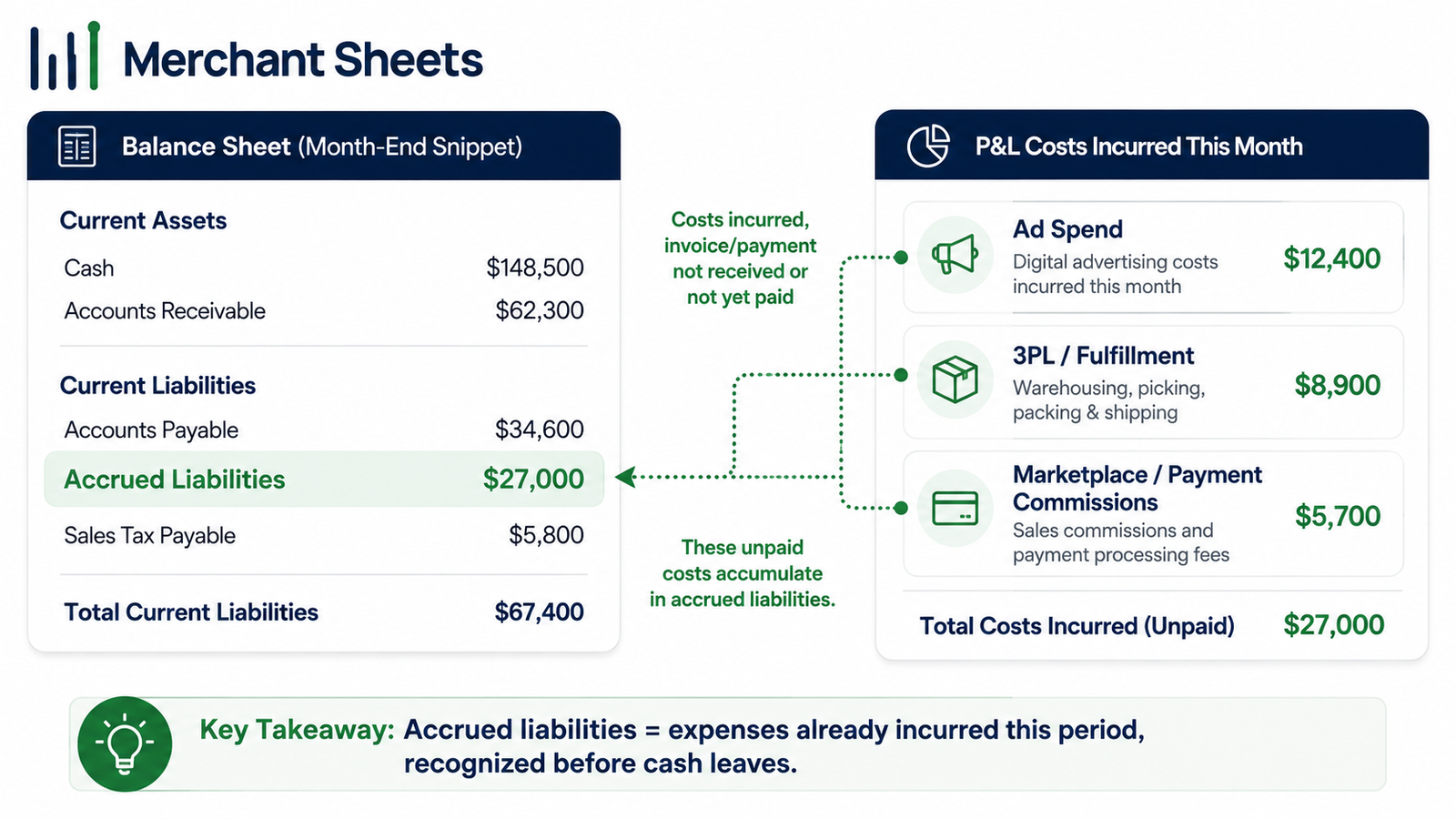
- An accrued liability is a cost you’ve already incurred but haven’t been billed or paid for yet, and it sits in current liabilities until the invoice arrives and you pay it.
- Accrued liabilities come from accrual accounting’s matching principle, which puts a cost in the month it helped earn revenue rather than the month the bill happens to show up.
- An accrued liability isn’t the same as accounts payable: accounts payable is a bill you’ve received, while an accrued liability is a cost you’ve incurred but not yet been invoiced for, so you estimate it.
- In ecommerce, the common ones are advertising billed in arrears, marketplace and FBA fees, 3PL and shipping, affiliate commissions, inbound freight and duty, sales tax owed, and a refund reserve.
- Recording one always takes the same shape: debit the expense and credit accrued liabilities to book it, then debit accrued liabilities and credit cash when you pay, which clears the balance.
- Skip the accrual, and you overstate this month’s profit and clobber next month; the same month can read about three times more profitable than it truly was.
Accrued liabilities are costs you’ve run up but haven’t been billed for yet: last month’s ad spend, the 3PL invoice that hasn’t landed, the commissions you owe your affiliates. Accrual accounting parks each one in current liabilities so the cost hits the month it belongs to.
Here’s what counts as one in an ecommerce business, and how to record it.
What are accrued liabilities?
An accrued liability is an expense your business has incurred but hasn’t yet been billed or paid for. Accrual accounting records it in the period the cost was incurred and holds it in current liabilities on the balance sheet until you pay. It’s how your books match a cost to the revenue it helped earn.
That matching is the whole point. Under the matching principle, a cost belongs in the month it did its work, not the month the invoice lands. When you run ad spend in March, the cost is March’s, even if Meta charges your card in April. An accrued liability is where that cost waits in the meantime.
You’ll hear “accrued expense” and “accrued liability” used for the same thing, and they are: the accrued expense is the cost on your income statement, and the accrued liability is the matching obligation on your balance sheet. One event, booked once, shows up in both places.
And because these costs get paid within a year, and usually within a month or two, accrued liabilities live in current liabilities.
Accrual accounting is the basis behind standard accounting rules, and accrued liabilities are one of the mechanisms that make it work. Without them, every cost would land whenever its bill happened to arrive, and monthly profit would lurch around on billing timing that has nothing to do with how the business performed.
A brand that pays its 3PL on net-30 terms would look more profitable than an identical brand on net-15, purely because the invoice shows up a month later. The accrued liability removes that noise by fixing the cost to the month it was incurred.
This is an accrual-accounting idea, so it rides along with the decision to keep accrual books rather than cash ones. If you’re weighing that choice, accrual accounting is the method that produces accrued liabilities in the first place, and it sits inside the wider set of ecommerce accounting foundations every growing brand ends up needing.
Accrued liabilities vs accounts payable
These two get mixed up constantly, and the rule that separates them is simple: if you’ve got the invoice in hand, it’s accounts payable; if you’ve incurred the cost but no bill has arrived, it’s an accrued liability. Both are current liabilities, and both are money you owe, so on the balance sheet they sit side by side. The difference is documentation and certainty.
Accounts payable is a known amount. A supplier sends an invoice for inventory you received, the amount and due date are set, and you record it exactly. An accrued liability is your own estimate of a cost you know you’ve incurred but haven’t been billed for, and you true it up when the real invoice shows up.
In ecommerce the split is easy to picture: a supplier’s invoice for stock you received is accounts payable, while the Meta and Google spend you ran this month, charged next week, is an accrued liability until the platform bills you.
The distinction matters for two practical reasons. It keeps your month-end books complete, since a cost with no invoice yet would otherwise go unrecorded and quietly inflate profit.
And it sharpens your cash forecast: accounts payable has a known amount and due date you can schedule to the day, while an accrued liability is a near-term outflow you can size but not yet pin to an exact date. Treat them as one bucket and you blur both.
Accrued liabilities vs accounts payable, side by side
| Accrued liability | Accounts payable | |
| Invoice received? | No bill yet | Yes, invoice in hand |
| What triggers it | You incur the cost: run the spend, use the service | You receive a supplier’s bill |
| Amount | Estimated from the best data you have | Known exactly from the invoice |
| Certainty | You know you owe it; you estimate how much | Vendor, amount, and due date are all set |
| Ecommerce example | This month’s ad spend, billed next cycle | A supplier invoice for inventory you received |
Accrued liabilities vs deferred revenue and reserves
Deferred revenue is the mirror image of an accrued liability, and it trips people up every bit as often. Deferred revenue is cash you’ve collected before you’ve delivered: gift cards, subscriptions, and pre-orders. It’s a liability because you still owe the customer the goods, but it sits on the revenue side of the ledger.
The clean way to hold the two apart: an accrued liability is a cost you owe a vendor, and deferred revenue is a product you owe a customer.
A refund or returns reserve is a closer cousin. It’s an estimated liability too, since you book expected refunds against sales you’ve already recorded, and it sits in the same corner of the balance sheet. The difference is that a reserve is a percentage estimate against booked sales rather than a specific cost you’ve run up.
Collected sales tax works the same way: it’s money you’re holding to remit to the state, not a cost you incurred. Some brands group these under accrued liabilities; others give each its own line. Either way, keep the core idea distinct, an accrued liability is a real cost already incurred and waiting for its bill.
Which ecommerce costs count as accrued liabilities?
An ecommerce brand runs up more incurred-but-unbilled cost than most businesses, because so many of its costs are billed on a lag.
The ad platforms charge after the fact, the warehouse invoices weeks late, marketplace fees come out of a settlement that straddles the month-end, and commissions are earned now and paid next month. Individually some are small, but together they routinely add up to a meaningful slice of a month’s operating costs, enough that leaving them out turns a real number into a fictional one.
Here are the usual suspects, what makes each one a cost you’ve incurred before you’ve been billed, and when the cash finally leaves.
The accrued liabilities that pile up in an ecommerce business
| Cost | Why it’s incurred before it’s billed | When the cash leaves |
| Advertising | Meta and Google run your spend now and charge later, on a threshold or monthly billing cycle | Days to weeks after the spend, when the platform bills the card |
| Marketplace and FBA fees | Referral, fulfillment, and storage fees accrue on sales you’ve already made, before Amazon deducts them | At the next settlement, which can straddle a month-end |
| 3PL and fulfillment | The warehouse picks, packs, and ships this month’s orders but invoices later | On the 3PL’s billing cycle, often weeks after the month |
| Affiliate and influencer commissions | Earned on this month’s sales, then tallied and paid on a lag | Next month, when commissions are calculated and paid out |
| Inbound freight and duty | Goods arrive and the forwarder’s or customs broker’s bill follows | When the freight or customs invoice is issued |
| Sales tax owed | You collect or owe tax as you sell, but remit on a filing schedule | On the state’s filing date, monthly or quarterly |
| Payroll and bonuses | Wages and bonuses are earned across a period that doesn’t line up with pay dates | On the next payroll run or bonus payout |
| Refund reserve | You expect returns on sales you’ve already booked, so you reserve for them now | As refunds are actually issued |
How to record an accrued liability
The entry is the same every time, and it’s worth seeing once with real numbers. Say you ran $40,000 of ad spend in March, and the platform won’t charge your card until early April. At the March close, you accrue it: debit advertising expense $40,000, and credit accrued liabilities $40,000. That puts the cost in March’s P&L and the obligation on March’s balance sheet.
When the card is charged in April, you clear the liability: debit accrued liabilities $40,000, and credit cash $40,000. Notice there’s no second hit to the P&L in April, because the expense already landed in March. The net effect across the two months is the cost in the month you incurred it, the cash out when you paid, and the liability back to zero.
Many teams use a reversing entry to keep this clean. You reverse the accrual on the first day of the next month, then book the real invoice normally when it arrives, which avoids any chance of counting the cost twice. It’s the tidiest approach for recurring accruals like ad spend and fulfillment, and it’s the same debit-and-credit logic you’d use to record COGS when inventory sells.
Not every accrual comes with a number as clean as that ad charge. The $12,000 you accrue for March fulfillment is an estimate, because the 3PL won’t invoice for weeks. You size it from the rate card and the units shipped, book it the same way, debit fulfillment expense and credit accrued liabilities, then true up the difference when the real invoice lands.
Estimating is normal; an accrual is a reasoned figure you correct next cycle, not a guess you’re stuck with.
Accruing $40,000 of ad spend, then clearing it when paid
| Date | Account | Debit | Credit |
| March 31 | Advertising expense | $40,000 | |
| March 31 | Accrued liabilities | $40,000 | |
| April (card charged) | Accrued liabilities | $40,000 | |
| April (card charged) | Cash | $40,000 |
A month booked with and without accruals
The clearest way to see why this matters is to run the same month both ways. Say you close March with $200,000 of revenue and $80,000 of COGS, plus $30,000 of other operating costs already recorded. You also incurred three costs in March that won’t be billed or paid until April: $40,000 of ad spend, $12,000 of 3PL fulfillment, and $8,000 of affiliate commissions, $60,000 in all.
Skip the accruals, and those three costs land in April when the money moves. March looks like it cleared $90,000, and April gets saddled with $60,000 of March’s costs on top of its own.
Without accruals: March looks far more profitable than it earned
| Line | March |
| Revenue | $200,000 |
| COGS | ($80,000) |
| Other operating costs | ($30,000) |
| Operating profit | $90,000 |
Accrue them, and each cost lands in March against the revenue it helped produce. March shows $30,000 of real operating profit, and the $60,000 sits in accrued liabilities on the March 31 balance sheet until it’s paid in April.
With accruals: March carries the costs it ran up
| Line | March |
| Revenue | $200,000 |
| COGS | ($80,000) |
| Other operating costs | ($30,000) |
| Advertising (accrued) | ($40,000) |
| 3PL fulfillment (accrued) | ($12,000) |
| Affiliate commissions (accrued) | ($8,000) |
| Operating profit | $30,000 |
Same cash either way, and over a long enough window both treatments total to the same profit. What changes is the monthly shape, and the monthly shape is what you manage: which month made money, whether a promo paid off, when you can afford to reorder. The $90,000 version answers all three wrong.
Miss $60,000 of March accruals and March reads about three times more profitable than it earned, then April absorbs the miss. The cost was real the day you incurred it, invoice or not.
Where accrued liabilities sit on the balance sheet
Accrued liabilities live in current liabilities, usually on their own line or grouped as “accrued expenses,” right next to accounts payable. That placement carries two consequences worth spelling out.
First, they’re part of net working capital. As a current liability, a rising accrued-liabilities balance means you’re holding cash you’ll owe soon, so it flatters your cash position today and drains it later. The money is in your account, but it’s already spoken for.
Second, accrued liabilities are a form of interest-free short-term financing, exactly like accounts payable. Every dollar of cost you’ve incurred but not yet paid is cash still working in the business, funding operations until the bill comes due. That’s healthy, and it’s part of why the timing of these costs shapes your cash conversion cycle.
The trap is mistaking that cash for profit: the obligation is already real, so the balance sheet, not the bank balance, is what tells you where you stand.
Accrued liabilities also shape how outsiders read your books. They sit in the denominator of your current ratio, so a large balance tightens the short-term liquidity picture a lender weighs. And in a sale or a raise, a buyer’s diligence team checks that you’ve accrued completely, because a brand that skips accruals reports smoother, higher profits than it truly earned.
Clean, consistent accruals are part of what makes your numbers hold up under that scrutiny.
How to run accruals at month-end close
Accruals work best as a repeatable step in your close, not a scramble each month. This is also where a good bookkeeper earns their keep, but the routine itself is straightforward.
- Build a standing accrual list: Keep a running list of the costs you accrue every month, ad spend, 3PL, commissions, and freight, so nothing slips through the close.
- Estimate from the best signal you have: Pull the ad platform’s reported spend, the 3PL’s rate card times units shipped, or the commission rate times sales; an accrual is a reasoned estimate, not a guess.
- Book the accrual: Debit the expense and credit accrued liabilities at month-end, so the cost lands in the month it belongs to.
- True up when the invoice arrives: Adjust the gap between your estimate and the real bill, or reverse and rebook, so the estimate self-corrects each cycle.
- Set a materiality threshold: Accrue what moves the number and let small items ride; chasing a $30 accrual costs more time than it’s worth.
Frequently asked questions
Is an accrued liability a debit or a credit?
An accrued liability carries a credit balance: you credit the accrued liabilities account to record the cost, and debit it to clear the balance when you pay. The matching entry is a debit to the expense when you book it, and a credit to cash when you settle it.
Are accrued liabilities current or long-term?
Accrued liabilities are almost always current liabilities, because they’re settled within a year, usually within a month or two. A rare long-dated accrual, like the far-off portion of accrued interest, can sit in long-term liabilities, but day-to-day ecommerce accruals are current.
What's the difference between accrued liabilities and accounts payable?
The difference is whether you’ve received an invoice: accounts payable is a bill you’ve received and will pay, while an accrued liability is a cost you’ve incurred but haven’t been billed for, so you estimate it. Both are current liabilities and both are money you owe.
Are accrued expenses and accrued liabilities the same thing?
Accrued expenses and accrued liabilities describe the same event from two sides: the accrued expense is the cost on your income statement, and the accrued liability is the matching obligation on your balance sheet. Booking one records both.
Do cash-basis businesses record accrued liabilities?
No, cash-basis businesses don’t record accrued liabilities, because cash accounting only books a cost when money leaves the account. Accruals are an accrual-accounting concept, so the moment you run accrual books, incurred-but-unpaid costs start showing up as accrued liabilities.
Is a sales tax or refund reserve an accrued liability?
Both are liabilities that sit alongside accrued liabilities, though they’re slightly different: collected sales tax is money you’re holding to remit to the state, and a refund reserve is an estimate of returns on sales you’ve already booked. Some brands group them under accrued liabilities, while others give each its own line.
