
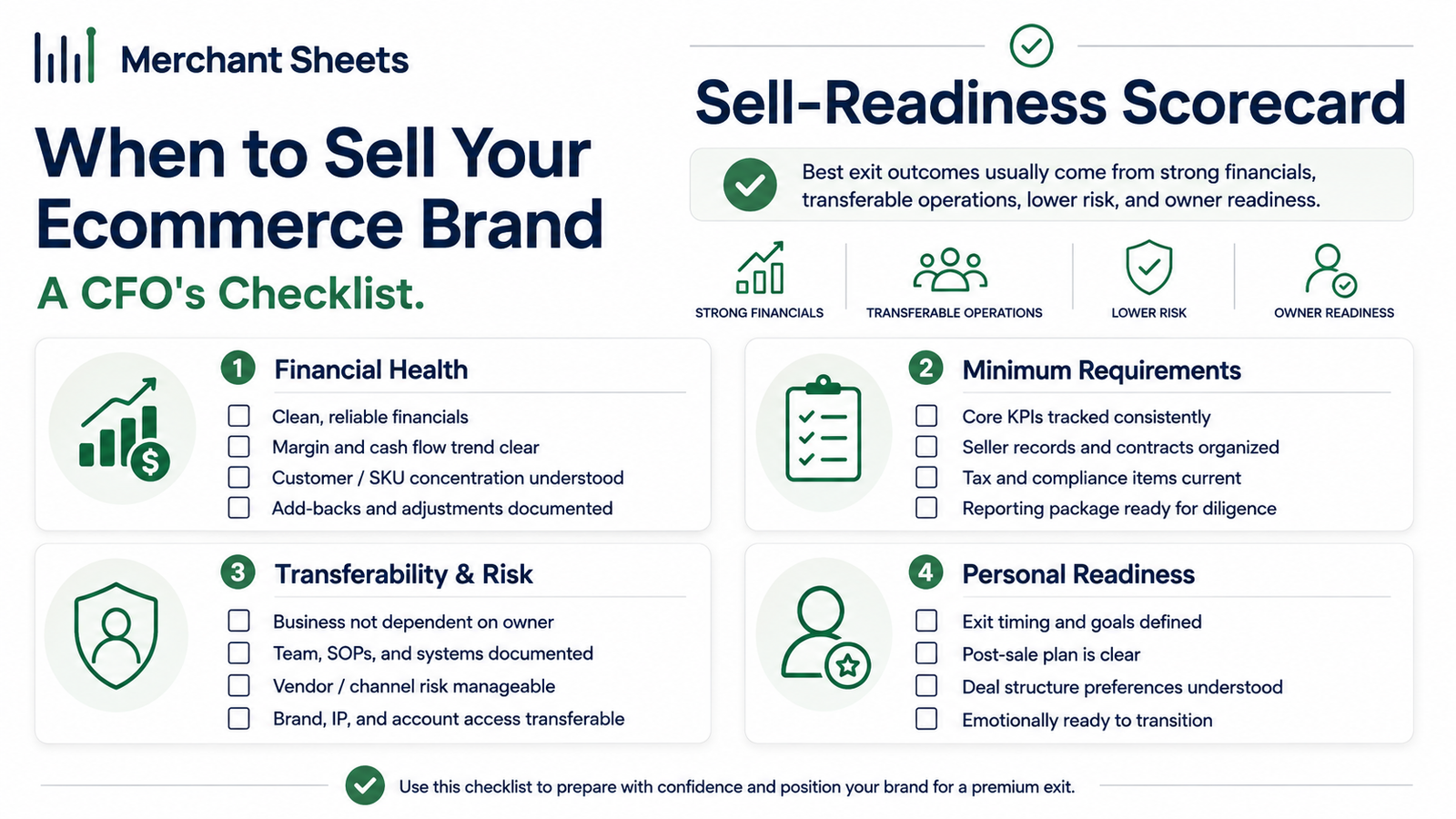
Key takeaways
- It’s the right time to sell when the business is in sellable health, clears the buyer’s minimum bar, and nets you a number that works after tax and fees, whatever revenue you’re at.
- Buyers pay for transferable, low-risk earnings, so the checklist is about proof: clean books, stable margins, diversified revenue, and a business that runs without you.
- Most sub-$5M ecommerce brands sell on a multiple of seller’s discretionary earnings (SDE), commonly around 2.5x to 4x as of 2026, while larger businesses move to EBITDA multiples.
- The minimum bar to attract a broker or serious buyer usually starts at two or more years of clean, verifiable financials and twelve or more months of consistent profit.
- Concentration is the quiet value killer: heavy reliance on one product, one sales channel, one traffic source, or one supplier lowers the multiple or scares buyers off.
- Sell from strength: the best price comes when the business is growing and you could happily keep running it, so readiness and timing beat urgency.
Deciding when to sell your ecommerce business comes down to readiness, not a revenue milestone: whether the business is in shape to sell, whether it clears your buyer’s minimum bar, and whether the sale nets a number that works for you.
A buyer pays for clean, transferable, low-risk earnings, so size alone won’t make the call. Here’s the checklist we’d run as your CFO.
When is the right time to sell your ecommerce business?
The right time to sell is when three things line up: the business is in sellable health, with clean books, stable profit, and low risk; it clears the minimum bar for the buyer you want; and the sale nets you a number that works after tax and fees. A revenue figure on its own isn’t the trigger.
Size doesn’t decide it. A clean, diversified brand at $2M can sell faster, and for a healthier multiple, than a messy, concentrated one at $8M, because buyers price risk alongside revenue. What they’re buying is earnings they can rely on once you’ve gone.
A buyer thinks in risk. Every question they ask, about your books, your suppliers, your traffic, your role, is asking how likely the profit is to hold up after the handover. The cleaner and more transferable the business, the less risk they price in, and the more they pay.
So treat when as a readiness question with four parts: is the profit real and clean, does the business clear the buyer’s minimum, does it run without you, and does the number work for you. The rest of this checklist walks each one.
The financial-health criteria
A buyer’s first question is whether the profit is real and whether they can trust the numbers. In diligence they will normalize your financials, stripping out anything that won’t carry to a new owner, and price off what’s left. These are the financial-health criteria that make your earnings believable when they do:
- Clean, separated books: Two or more years of reconciled, accrual financials with personal expenses out and business and personal accounts kept apart. This is the foundation a buyer’s accountant checks first.
- Stable or growing profit: A consistent trailing-twelve-month trend, flat to up, rather than a single spike year a buyer will treat as luck and discount. Recent months carry the most weight, so a soft last quarter can cost more than a strong year further back.
- Durable margins: Gross and net margins that hold up under scrutiny, so the profit survives once a buyer normalizes the numbers. A margin propped up by a one-off supplier deal or a temporary dip in ad costs won’t make the cut.
- Defensible add-backs: Owner pay, one-time costs, and personal expenses documented and separated as add-backs, so your seller’s discretionary earnings (SDE) holds up in diligence. Over-aggressive add-backs get stripped out and cost you credibility.
- Healthy working capital: Profit that isn’t propped up by stretching suppliers or under-buying stock, and a balance sheet without a pile of dead stock sitting in it.
What’s the minimum bar to be sellable?
Before any of the softer signals, a business has to clear a hard minimum to attract a serious buyer: usually two or more years of clean, verifiable financials, twelve or more months of consistent profit, and records that tie to your tax returns.
That last point matters, because a buyer trusts numbers they can cross-check against filings far more than a spreadsheet you built. Below that bar, the buyer pool shrinks fast.
The exact bar depends on who’s buying. A hobby-scale store can change hands on a marketplace with a year of history, while a broker or private-equity buyer wants more proof and less risk. Aggregator demand has also cooled sharply since the 2021 boom, so don’t assume that buyer pool is still active without checking.
Table 1. Typical buyer types and the rough minimum they look for, as of 2026. Verify the current landscape before you list.
| Buyer type | Typical deal size | Usually wants |
| Online marketplaces (e.g. Flippa) | Under ~$250,000 | 12+ months of history and verifiable revenue |
| Curated brokers (Empire Flippers, Quiet Light, Website Closers) | ~$250,000 to $20M+ | 2+ years of clean financials and consistent SDE |
| Private equity, strategics, aggregators | ~$1M+ SDE | Diversification, low owner dependence, a growth story |
Does the business run without you?
This is where most of the value is won or lost. Buyers pay a premium for a business that transfers cleanly and a discount for one that depends on its founder, because a business that is essentially the founder is hard to hand over and easy to break.
The test they apply is simple: if you stepped away for three months, would the numbers hold? Score these risk and transferability criteria honestly:
- Owner dependence: The business can run for 60 to 90 days without you, because SOPs are documented, a team or contractors hold the key roles, and the logins and know-how aren’t only in your head.
- Revenue concentration: No single product or SKU carries too much of the sales, so one item slipping doesn’t sink the business and a buyer can underwrite the whole catalog. A brand where one hero product is 70% of revenue trades at a discount for exactly that reason.
- Channel and traffic diversity: Sales and traffic come from more than one place, so the brand isn’t one Amazon suspension, algorithm change, or ad-account lockout away from trouble.
- Supply-chain resilience: Reliable suppliers with backups, workable terms, and inventory in good shape rather than aging on the shelf, since single-source risk lowers your price.
- Predictable demand: A buyer can underwrite your CAC and LTV and see repeat customers, so future revenue looks earned instead of lucky.
- Clean legal and platform standing: Trademarks and IP owned, contracts assignable, no live litigation, and marketplace accounts in good standing with no policy strikes.
What raises or lowers your multiple?
The checklist items above don’t only tell you whether you can sell. They move the multiple, the number your profit gets multiplied by to set the price. Diversification, a credible growth story, low owner dependence, and clean books push it up. Concentration, a one-year spike, messy financials, and heavy founder dependence pull it down.
As a rough guide, sub-$5M ecommerce brands commonly trade around 2.5x to 4x SDE as of 2026, and larger businesses shift to EBITDA multiples, earnings before interest, taxes, depreciation, and amortization.
Working out what your brand is worth today is its own exercise; our guide to valuing an ecommerce business walks the SDE and EBITDA math.
The two levers compound. A brand earning $500,000 in SDE at a 3x multiple is a $1.5M business. Spend a year lifting SDE to $650,000 and earning a 3.5x by cleaning the books and cutting concentration, and the same brand is worth about $2.3M.
You moved both the profit and the multiple, and the gap is the payoff for getting exit-ready.
Are you ready, and does the number work?
| Sell from strength. The best time to sell is when you could happily keep running the business, because that’s when the numbers, the growth story, and your leverage are strongest. Selling from distress is how good brands trade at a discount. |
The business can be ready before you are, and the reverse. Two personal checks decide whether now is the moment to act.
First, run the after-tax math. Broker fees, often around 10% to 15% on smaller deals, and taxes come out of the headline price, so what you keep can sit well below the sticker. Know that net number before you fall for a valuation.
The deal structure matters as much as the price. Part of an offer can be an earnout tied to future performance or held back in escrow, so a headline number may include money you only see if the business hits its targets after you have left. Read the terms as closely as the total.
Second, weigh timing and what’s next honestly. Wanting out is a fair reason to sell, and burnout is real, but a single unsolicited offer or one rough quarter isn’t the whole picture.
The strongest position is a business you could keep running, a market that’s paying, and a plan for what you do after.
How to use this checklist
Score the business honestly against the criteria above, and treat every gap as fixable rather than a verdict. Clean books, documented add-backs, lower concentration, and reduced owner dependence are the usual weak spots, and most of them close over 6 to 18 months of deliberate work.
Work the list in order of leverage. Books and add-backs come first, because nothing else can be underwritten until the numbers are trusted. Concentration and owner dependence come next, since they move the multiple the most.
That work tends to lift the price by more than the wait costs, so if you’re not ready, you’re early, and the months before a sale are where the value is made.
Frequently asked questions
When should I sell my ecommerce business?
Sell when the business is in sellable health, clears the minimum bar for the buyer you want, and the sale nets a number that works after tax and fees, rather than when you hit a particular revenue figure. Readiness and timing decide the price more than size does.
How do I know if my business is ready to sell?
It’s ready when the books are clean and separated, profit is stable or growing, revenue isn’t concentrated in one product or channel, and the business can run without you for a couple of months. Each of those lowers a buyer’s risk and lifts your price.
How many years of financials do I need to sell a business?
Most serious buyers and brokers want two or more years of clean, verifiable financials that tie to your tax returns, though some marketplaces will list a business with twelve or more months of history. The cleaner and longer the record, the wider your buyer pool.
What multiple does an ecommerce business sell for?
Sub-$5M ecommerce brands commonly sell for roughly 2.5x to 4x SDE as of 2026, with larger businesses moving to EBITDA multiples. The exact number turns on growth, diversification, and how much the business depends on you.
Does selling from a growing business get a better price?
Yes, buyers pay more when revenue and profit are trending up and you could keep running the business, because that lowers their risk. Selling from decline or distress usually means a discount.
Should I use a broker or sell it myself?
A broker is usually worth the fee, often around 10% to 15% on smaller deals, once the business clears their minimum, because they bring vetted buyers and run the process. The smallest businesses often sell themselves on a marketplace.
What hurts the value of an ecommerce business when selling?
The biggest drags are messy or unverifiable books, revenue concentrated in one product, channel, or supplier, heavy dependence on the founder, and a declining sales trend. Each one raises a buyer’s risk, which lowers the multiple or shrinks the pool of buyers willing to bid.
Get exit-ready before you list
The months before a sale are where the multiple is made. As your fractional CFO, I get the books clean, document the add-backs, and de-risk the concentration and owner dependence that hold your number down, so when you do sell your ecommerce brand, you sell from a position of strength.
This article is general information, not financial, tax, or legal advice. Selling a business carries tax and legal consequences that vary by situation; confirm yours with a qualified professional before you act.
