
Key takeaways
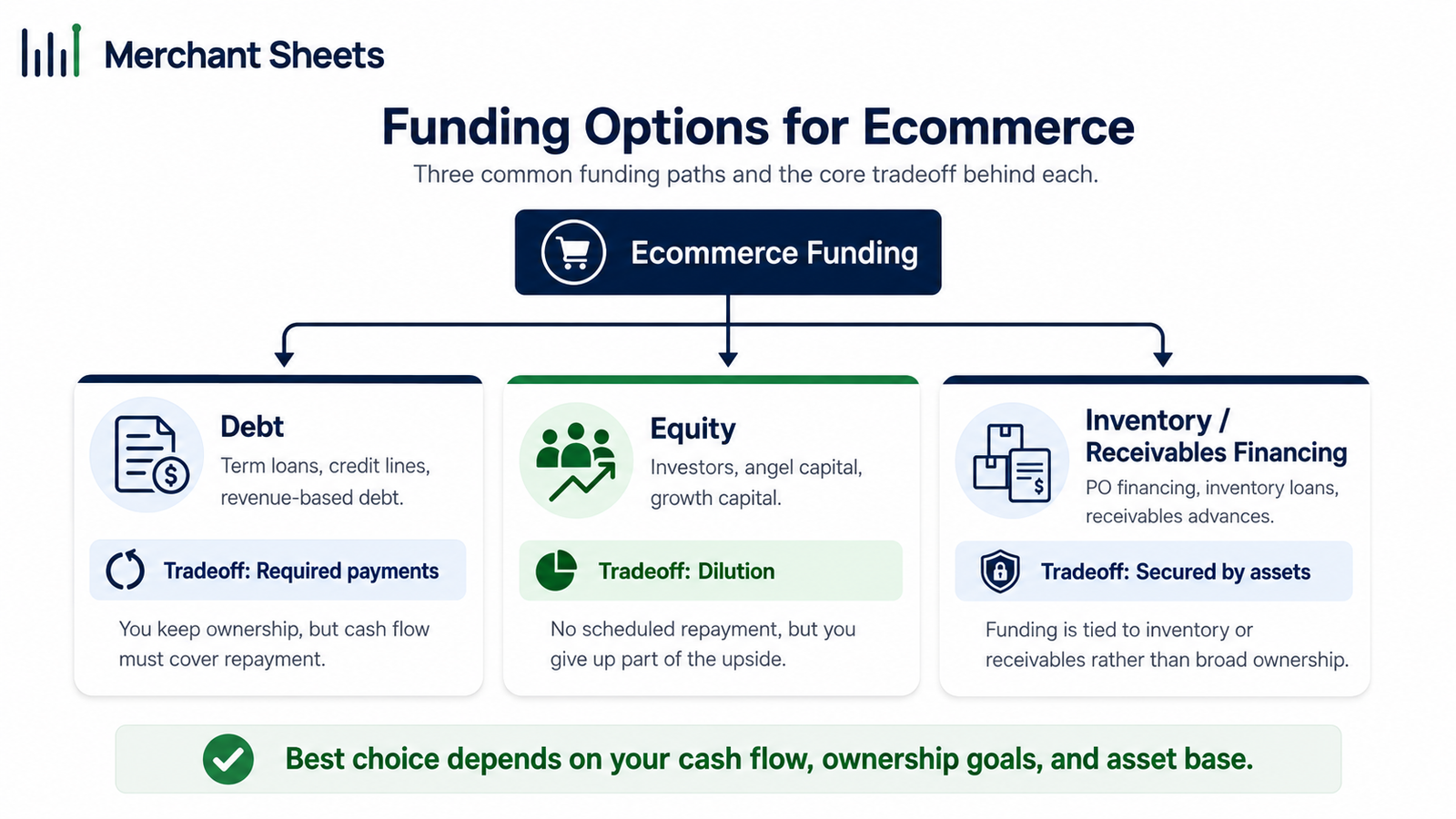
- Ecommerce funding falls into three families: debt (you borrow and repay with interest), equity (you sell ownership for capital you don’t repay), and inventory or receivables financing (capital secured by stock or unpaid invoices).
- Debt keeps your ownership but adds fixed payments and usually a personal guarantee; equity adds no payments but permanently dilutes your stake and hands over some control.
- Inventory and revenue-based financing are the most common ecommerce fit, because they fund stock and ad spend against sales without giving up equity.
- Watch the effective APR on fee-based products: a 6% to 12% flat fee on revenue-based financing can annualize to 28% to 56% or more as of 2026, and faster sales make it more expensive, not less.
- SBA 7(a) loans are among the cheapest capital at roughly 9.75% to 13.25% variable as of 2026, but they’re slow and paperwork-heavy.
Match the money to the use: short-cycle needs like inventory and ads suit short-term financing, while long-term brand building is where a term loan or equity fits.
Every growing ecommerce brand hits the same wall: the inventory and ad spend that drive next quarter have to be paid for before the sales come in. Funding bridges that gap. You can borrow it, sell equity to raise it, or secure it against your stock, and each route carries a very different cost.
What are the funding options for an ecommerce business?
Ecommerce businesses fund growth three ways: debt, borrowing you repay with interest; equity, selling ownership for capital you keep; and inventory or receivables financing, capital secured against stock or unpaid invoices.
Most inventory-based brands lean on debt and inventory financing, since they fund stock and ad spend without giving up ownership. Federal Reserve survey data shows most small firms rely on debt and personal funds long before they ever sell equity.
Two questions decide between them. The first is what the capital costs in cash, the interest or fees you’ll pay to use it. The second is what it costs you in ownership and control, since equity means giving up a permanent slice of the business and a say in how it’s run.
Debt answers the first question, equity the second, and inventory financing sidesteps both by borrowing against assets you already have. The rest of this guide walks each family, compares what they cost, and shows how to pick.
Debt financing: Keep your equity, take on payments
Debt means you borrow money, repay it with interest, and keep 100% of your business. The tradeoff is that the payments are fixed whether sales come or not, and most lenders want a personal guarantee, so you’re on the hook if the business can’t pay. Within debt, the options range from cheap and slow to fast and expensive.
Bank term loans and SBA loans
An SBA 7(a) loan is among the cheapest capital a small business can get, roughly 9.75% to 13.25% variable and 11.75% to 14.75% fixed as of 2026, with long repayment terms that keep the monthly cost low. The catch is the process: weeks of underwriting and heavy paperwork.
Bank term loans sit in a similar range for established borrowers. Both fit large, planned investments with a clear return, like a warehouse move or a major inventory build for a proven product.
Business lines of credit
A line of credit is a revolving limit you draw on as needed and pay interest only on what you actually use, commonly 8% to 25% APR as of 2026. It’s the right tool for smoothing seasonal cash gaps, covering a supplier payment now and repaying once the sales land, rather than funding a single big purchase. Kept undrawn, it’s a safety net that costs nothing until you need it.
Online and short-term lenders
Online lenders approve fast and ask for little paperwork, but they charge for the convenience, with rates that run from around 14% to well over 50% APR. They’re useful when speed genuinely matters and the return is quick, and they get dangerous when they become a habit. Read the effective APR, not the headline fee, before you sign.
Inventory and revenue-based financing: The ecommerce workhorses
These fund the specific ecommerce problem, buying stock and ad spend ahead of the sales that pay for them, without giving up equity. The longer your cash conversion cycle, the more cash is tied up in working capital, and the more a growing brand leans on this kind of financing to keep the shelves full.
Revenue-based financing and merchant cash advances
Revenue-based financing (RBF) advances you a lump sum against future sales, repaid as a percentage of your daily or weekly revenue, often 10% to 15%, for a flat fee of 6% to 12% of the advance as of 2026. Funding lands in one to three days, there’s no fixed term, no equity changes hands, and often no personal guarantee.
The catch is the effective APR, which runs 28% to 56% or more, and it climbs when sales accelerate, because you repay faster. Shopify Capital and Amazon Lending work like a merchant cash advance, priced on a factor rate around 1.1 to 1.3 rather than an interest rate.
This money fits short-cycle inventory and ad buys you’ll recoup quickly, not long-term projects.
Inventory and purchase-order financing
Inventory financing is a loan or line secured by the stock itself. Purchase-order financing goes a step further: a lender pays your supplier directly for a confirmed order, so you can fulfill demand you couldn’t otherwise afford. Either way, you meet a large or seasonal spike without tying up your own cash, and repay as the inventory sells.
Fees are charged per order or as a line rate, and because the stock is the collateral, some of these facilities need no personal guarantee.
Equity financing: Capital you don’t repay, ownership you don’t get back
Equity is money you never repay. You sell a stake in the business to an angel investor, a venture fund, or a private-equity buyer, take on no fixed payments, and often gain expertise and a network alongside the cash. The cost is dilution, a permanently smaller ownership share, plus some loss of control over how the business is run.
If you take it, understand how equity dilution works on a cap table before you sign a term sheet.
Equity suits a specific kind of brand: a high-growth, category-defining business that needs to outspend competitors to win a market, where the upside from moving fast is worth giving up ownership. It fits a steady inventory business poorly, since that brand can fund its stock with far cheaper debt.
The rule we’d give you is simple: raise equity to build something you couldn’t build otherwise, and use financing to fund the inventory and ads that pay for themselves.
Aggregator demand for ecommerce brands cooled sharply after the 2021 boom, so treat that buyer pool as smaller and pickier than the headlines suggest.
What each funding option really costs
The right choice comes down to three things: what the money costs, how fast you can get it, and what you give up to have it. Here’s how the main options compare.
Table 1. Ecommerce funding options compared (as of 2026; costs vary by lender and profile, so verify before you borrow).
| Option | Typical cost | Speed | Dilution | Best for |
|---|---|---|---|---|
| SBA 7(a) or bank term loan | ~9.75% to 14.75% | Slow (weeks) | None | Large, planned investments |
| Business line of credit | ~8% to 25% APR | Moderate | None | Smoothing seasonal cash gaps |
| Revenue-based financing or MCA | 6% to 12% fee (~28% to 56%+ APR) | Fast (1 to 3 days) | None | Short-cycle inventory and ad spend |
| Inventory or PO financing | Per-order or line fee | Moderate to fast | None | Restocks and big or seasonal orders |
| Equity (angel, VC, PE) | No cash cost, but dilution | Slow (months) | High | High-growth brands outspending to win |
How much funding do you actually need?
Borrow to the size of the gap, not a round number. The right amount closes the specific shortfall in front of you, a purchase order you can’t cover, a season’s inventory build, a few months of ad spend, plus a modest buffer, and no more. A bigger raise feels safer, but it rarely is.
Over-borrowing is expensive, because you pay interest or fees on cash that sits idle. Under-borrowing is worse, because a half-funded inventory order or ad push stalls the growth you took the money for.
Size it from a forecast: map the cash you’ll need month by month, the sales those dollars will generate, and when the repayments fall due, so the financing covers the gap and clears before the next one opens.
For revenue-based and inventory financing especially, tie the amount to a specific, measurable return, the stock you’ll sell or the ads you’ll run, so the money visibly pays for itself. If you can’t point to the return, you’re guessing at the size.
How to choose the right funding for your brand
The option that fits isn’t the one with the lowest headline rate, it’s the one matched to what the money is for and what the business can carry.
Run these four checks, and pressure-test the answer in an ecommerce financial model before you commit:
- Match the money to the use: Fund short-cycle needs like inventory and ad spend with short-term financing you’ll repay as those sales land, and reserve equity or a term loan for long-term investments like a category expansion or a warehouse.
- Compare the true cost of capital: Convert every fee to an effective APR before you compare, since a 10% flat fee that repays in three months costs far more than a 10% annual rate. The cheapest headline number is often the most expensive money.
- Weigh cost against dilution: Debt costs cash but keeps your ownership, while equity costs ownership but no cash. Only trade permanent equity for capital that builds lasting value, never to plug a temporary working-capital gap.
- Check you can service it through a slow season: Before you borrow, confirm the payments hold up in your leanest months, not just your best ones; your runway tells you whether the debt is safe.
| A flat fee isn’t an interest rate. A 10% fee repaid in three months is far more expensive than a 10% APR, so convert every offer to an effective APR before you compare. |
Frequently asked questions
What's the best way to fund an ecommerce business?
There’s no single best option; the right funding matches the use of the money, so inventory and ad spend usually suit revenue-based or inventory financing, large long-term investments suit an SBA or bank loan, and equity fits only high-growth brands willing to trade ownership for scale.
Is it better to use debt or equity to fund ecommerce?
For most inventory-based ecommerce businesses debt is better, because it funds stock and ads without giving up ownership, while equity makes sense mainly when you’re chasing category-leading growth that steady debt can’t support.
How much does revenue-based financing really cost?
A typical revenue-based advance charges a flat fee of 6% to 12% of the amount as of 2026, which can translate to an effective APR of 28% to 56% or more, and repaying faster as sales grow raises the annualized cost rather than lowering it.
Can I get funding for a new ecommerce business?
New businesses have fewer options because most lenders want 6 to 12 months of sales history, so a new brand usually starts with personal capital, a business credit card or line of credit, or friends-and-family equity before revenue-based and inventory financing open up.
What is inventory financing?
Inventory financing is capital secured by your stock, either a loan or line against inventory you own or purchase-order financing where a lender pays your supplier for a confirmed order, letting you fulfill large or seasonal demand without tying up your own cash.
Do I need a personal guarantee to fund my business?
Most small business loans and lines of credit require a personal guarantee, meaning you’re personally liable if the business can’t repay, though revenue-based financing and some inventory financing are often exceptions because they’re secured against sales or stock.
Raise the right money on the right terms
Choosing how to fund your brand is one of the highest-stakes calls you’ll make, and the wrong structure can cost you margin or ownership for years.
As your fractional CFO, I map your options to your cash conversion cycle, compare the true cost of each against the return it’ll earn, and check the payments hold through a slow season, so you raise the right money on the right terms.
This article is general information, not financial, tax, or legal advice. Borrowing and raising capital carry risks and consequences that vary by situation; confirm yours with a qualified professional before you act.
