
Key takeaways
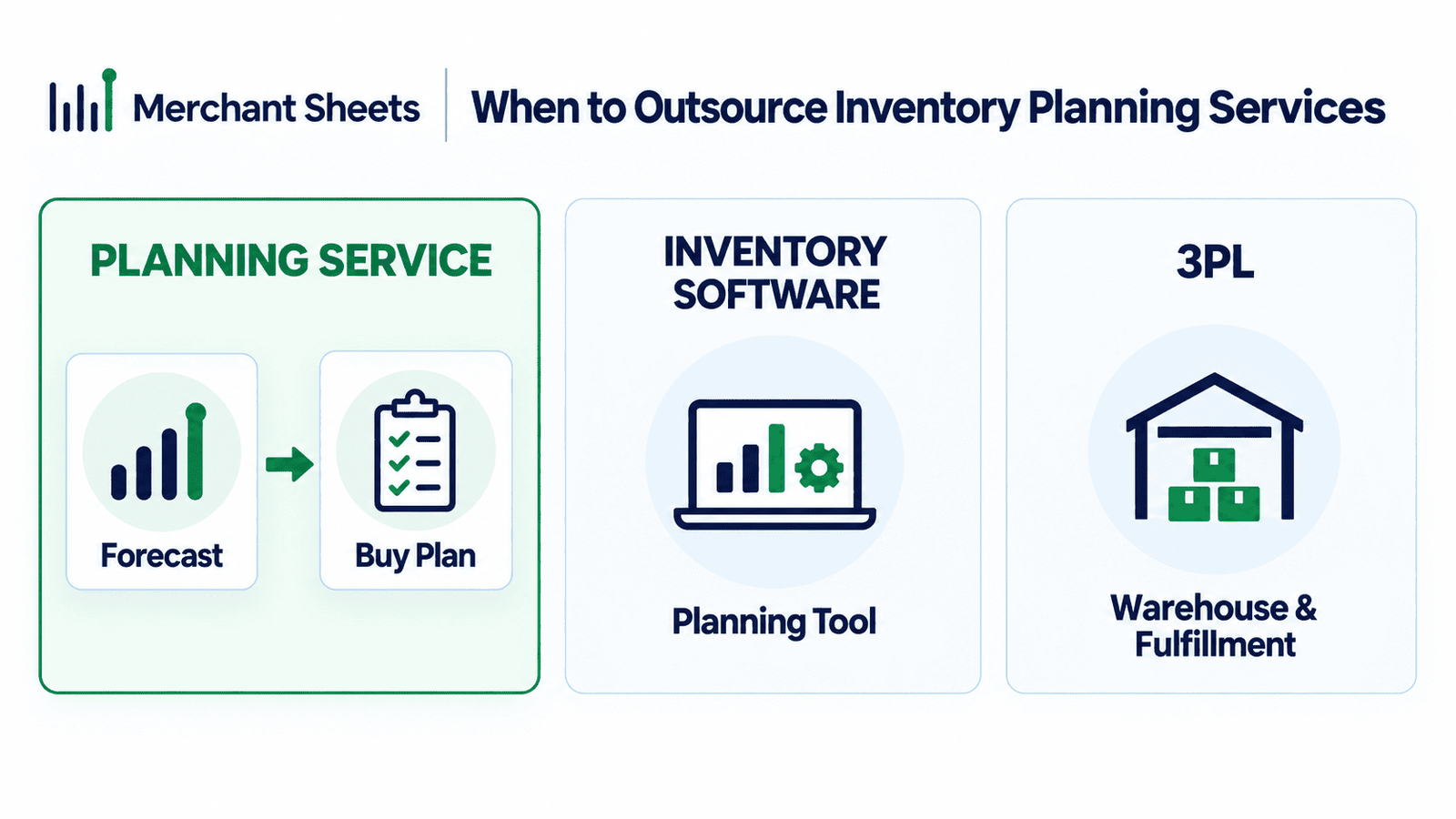
- Inventory planning services outsource the planning function, the forecast, the reorder policy, and the buy plan, which is different from a 3PL that stores and ships and from software you operate yourself.
- Outsource when reorder decisions are eating your time and cash, you can’t justify a full-time planner, or you bought inventory software and never operate it.
- An outsourced service runs the demand forecast, sets reorder points and safety stock, builds a purchase-order plan against your cash, and reviews forecast accuracy each month, usually in the tools you already use.
- Pricing is usually a monthly fractional retainer rather than a full salary, which is why outsourcing fits a brand that can’t keep a full-time planner busy.
- Don’t outsource if your catalog is small and demand is steady, or if you want to build the planning skill in-house; a spreadsheet and a simple reorder rule may be enough for now.
- Inventory is usually the biggest use of cash in an ecommerce business, so outsourcing the plan is a cash decision as much as an operations one.
You didn’t start a brand to spend your Sundays deciding what to reorder. As the catalog grows, those calls get harder, and the cost of getting them wrong climbs with them.
At some point, handing the forecast and the buy plan to a specialist starts to look smart.
Here’s when outsourcing inventory planning is worth it, and when it isn’t.
What are inventory planning services?
Inventory planning services hand the planning function to an outside specialist: the person who forecasts demand, sets reorder points and safety stock, and builds the plan for what to buy and when. They don’t store or ship your stock the way a third-party logistics provider (3PL) does, and they aren’t a piece of software you run yourself.
It helps to separate three things founders often shop for at the same time. A 3PL is a warehouse that holds your inventory and ships orders. Inventory software is a tool that runs the numbers if someone operates it.
An inventory planning service is a person who owns the decisions: they build the demand forecast, set the reorder point (the stock level that triggers your next order) and safety stock (the buffer that absorbs demand and lead-time surprises) for each product, and turn both into a buy plan sized against your cash.
One moves the boxes, one does the math, one decides which boxes to buy.
Table 1. What each option covers: an outsourced planning service, inventory software, and a 3PL.
| Capability | Outsourced planning service | Inventory software | 3PL |
| Demand forecast | Built and maintained for you | Calculated, if you operate it | No |
| Reorder points & safety stock | Set per SKU | Suggested, if configured | No |
| Buy plan against cash | Yes, sized to your cash | Rarely; not cash-aware | No |
| Forecast-accuracy review | Yes, each month | Reports only | No |
| Storage & shipping | No | No | Yes |
When should you outsource inventory planning?
Outsource inventory planning when getting reorders wrong costs you more than the help would, and when you can’t justify a full-time hire to fix it.
The signals are practical: reorders eat your nights and weekends, cash keeps ending up in the wrong stock, you bought software you never open, and the work has grown past spare hours without becoming a full 40-hour role.
If your planning has outgrown the spreadsheet you plan in, that’s usually the tipping point, because the swing between stockouts and overstock is now big enough to pay for the help.
The software signal is its own tell: buying a tool changes nothing if nobody operates it, sets the assumptions, and acts on what it says. When the function keeps slipping no matter what you buy, the missing piece is a person to own it.
Table 2. Signs it’s time to outsource inventory planning.
| Signal | What it looks like in your business | Why it points to outsourcing |
| Reorders eat your time | You’re spending nights and weekends deciding what to buy | The function has outgrown spare hours but not yet a full-time role |
| Cash keeps getting stuck | Stocked out of winners while slow SKUs tie up your money | A planned buy against cash is what the function fixes |
| Software you don’t run | You bought a tool and never operate it | You need someone to own it, since a tool alone gets ignored |
| Can’t justify a hire | The work isn’t a full 40 hours, but it isn’t nothing | A fractional service covers the function without the salary |
| Supplier complexity rising | More SKUs, longer lead times, more vendors to juggle | Planning has become a specialist job, not a side task |
Outsource, hire, software, or keep it in-house?
There are four ways to get inventory planning done, and this piece is about one of them. You can do it yourself in a spreadsheet, buy software and run it, hire a full-time planner, or outsource the function to a fractional specialist, someone who runs planning part-time, for a monthly fee, across several brands.
Comparing all four on cost, who operates them, and who each fits is a longer story than this piece needs.
Outsourcing makes sense in the gap the other three leave. You’ve grown past doing it yourself, you don’t have the volume to keep a full-time planner busy, and a tool on its own keeps drifting because no one drives it.
A fractional service fills that gap: a specialist who runs both the demand forecast and the supply side, and how demand and supply planning fit together shapes what a good one does.
The honest limit is availability, so once you can keep a full-time planner busy, an in-house hire will beat a fractional arrangement.
How to choose an inventory planning service
The right provider runs your plan inside your business, not a generic model inside theirs. A few things separate one worth hiring from one that isn’t:
- Ecommerce-native: They work with Shopify and Amazon brands and understand DTC demand patterns rather than enterprise manufacturing.
- Cash-aware: They size the buy plan against your cash on hand, because inventory is where your cash goes.
- Tool-agnostic: They work in the systems you already run, a spreadsheet or the software you already pay for, rather than forcing a new platform.
- Transparent on method: They show you the forecast logic and the reorder math, so you’re not handing decisions to a black box.
- Right-sized: They take brands your size on as real clients, rather than treating you as the smallest account they’ll tolerate.
What does outsourced inventory planning cost?
Most outsourced inventory planning is priced as a monthly retainer, a fractional fee for running the function, rather than a salary or a per-order charge. Exact rates move, so confirm the current numbers when you shop, but the pricing models are steady.
Three shapes are common. A monthly fractional retainer buys ongoing planning, the forecast, the buy plan, and the monthly review, for a fixed fee. A one-off project sets up your forecast and reorder policy once and hands it back to you. And software-plus-services bundles a tool with someone to operate it.
Set against those, a full-time planner runs well into six figures once you load benefits and overhead, and most brands under a few million in revenue can’t keep one busy. That’s the whole case for renting the function instead of hiring it.
When not to outsource inventory planning
Don’t outsource if the problem isn’t big enough yet, or if you want to own the skill. A few cases call for waiting. A small catalog with steady, predictable demand rarely needs more than a simple reorder rule.
A brand early enough that a spreadsheet still does the job can run the inventory planning framework itself for a while longer. And a founder who wants planning as an in-house muscle, rather than a rented one, is better off building it than handing it away.
If one of those is you, keep your cash and revisit the question when reorders start costing real money.
Frequently asked questions
What are inventory planning services?
Inventory planning services outsource the planning function to a specialist who forecasts demand, sets reorder points and safety stock, and builds the plan for what to buy and when, which is different from a 3PL that stores and ships and from software you operate yourself.
When should you outsource inventory planning?
Outsource when reorder decisions are costing you real time and money, you can’t justify a full-time planner, or you’ve bought inventory software you never operate and the function still isn’t getting done reliably.
How much does it cost to outsource inventory planning?
Outsourced inventory planning is usually a monthly retainer rather than a salary, which is why it fits a brand that can’t keep a full-time planner busy; confirm current bands when you shop and compare them against the loaded cost of a hire.
What's the difference between inventory planning services and a 3PL?
A 3PL stores and ships your inventory, while an inventory planning service decides how much to order and when; one moves the boxes, the other decides which boxes to buy.
Can't inventory software do this instead?
Software runs the calculations, but only if someone operates it, sets the assumptions, and acts on the output; an outsourced service is the person who runs the tool and owns the decisions, which is why brands buy software and still drift.
Should a small ecommerce business outsource inventory planning?
A small brand should outsource once reorders are costing real money but volume can’t justify a hire; below that, a spreadsheet and a simple reorder rule are often enough for now.
What does an outsourced inventory planner do?
They build and maintain your demand forecast, set reorder points and safety stock per SKU, turn that into a purchase-order plan sized against your cash, and review each month how accurate the last forecast was.
Is outsourcing inventory planning the same as hiring a demand planner?
No, hiring brings the function in-house as a full-time role, while outsourcing rents it as a fractional service, which is usually the better fit until your SKU count and volume can keep a full-time planner busy.
