
Key takeaways
- Cost of goods sold (COGS) goes on your income statement, where it’s subtracted from revenue to give gross profit.
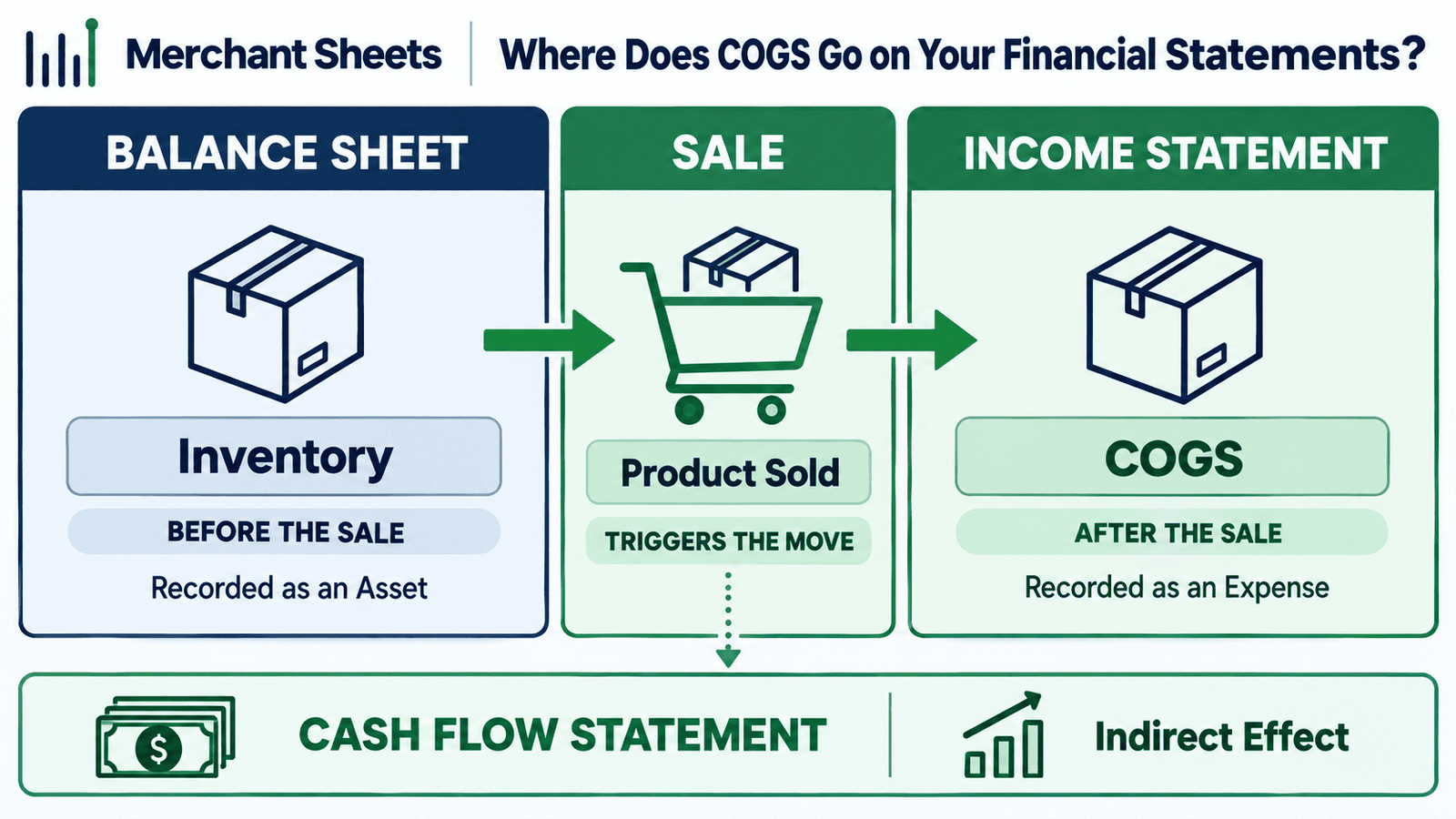
- COGS is not on your balance sheet. The balance sheet shows the inventory it came from, a current asset, until the item sells.
- On the income statement, COGS sits below revenue and above the gross profit line; operating expenses sit below gross profit.
- COGS isn’t a line on the cash flow statement. It flows through indirectly, inside net income and the period’s change in inventory under operating activities.
- People go looking for COGS on the balance sheet because they’re picturing inventory. The cost becomes COGS on the income statement only when the item sells.
- Recording a big inventory purchase in the right place, on the balance sheet, keeps it off your P&L until it sells and keeps each month’s profit honest.
Cost of goods sold goes on your income statement, not your balance sheet. It sits directly below revenue and gets subtracted to give gross profit. The balance sheet holds something related but different: the inventory that becomes COGS once it sells.
Here’s where the cost lands on each of your statements, and why the balance-sheet version of the question comes up so often.
Where does COGS go on your financial statements?
Cost of goods sold goes on your income statement, directly below revenue, where it’s subtracted to give gross profit. It doesn’t appear on your balance sheet; the balance sheet shows the inventory the cost came from, a current asset, until the item sells. On the cash flow statement, COGS shows up only indirectly.
Cost of goods sold (COGS) is the direct cost of the products you’ve sold. Your income statement, the report that shows what you earned and spent over a period, is where it lands.
The other two of your three financial statements hold pieces of the same story: the balance sheet, a snapshot of what you own and owe at a single moment, carries the inventory, and the cash flow statement tracks the cash behind it. The table below maps all three.
Table 1. Where COGS and its inventory appear across the three statements. One cost, mapped to each statement.
| Statement | Where COGS or its inventory shows up | The line you’d look for |
| Income statement | COGS is here, subtracted from revenue | Cost of goods sold, below revenue and above gross profit |
| Balance sheet | COGS is not here; the unsold inventory is | Inventory, a current asset |
| Cash flow statement | COGS isn’t a line; it flows through indirectly | Net income, then the change in inventory under operating activities |
Does COGS go on the balance sheet?
No, COGS doesn’t go on the balance sheet. The balance sheet shows the inventory the cost came from, a current asset, while you still own it.
When the item sells, that cost leaves the balance sheet and lands on the income statement as COGS. So the same dollars sit on the balance sheet before the sale, as inventory, and on the income statement after it, as COGS.
Here’s why the question comes up the way it does. You paid cash for that stock, so you go looking for the cost where the money went.
In accounting terms, though, buying inventory changes the form of your money rather than spending it: cash becomes an asset of equal value, inventory, and nothing counts as a cost until the item sells.
That stock sits on the balance sheet, tracked through the inventory account in your books, and it’s an asset until it sells, at which point its cost moves onto the income statement as COGS.
Where COGS sits on the income statement
COGS sits on the income statement directly below revenue and above the gross profit line. Read the top of the statement in order and it runs revenue first, then COGS subtracted from it, and revenue minus COGS is your gross profit.
Everything below that line – marketing, apps, salaries, and rent – is operating expenses, a separate group lower down.
The income statement, also called the profit and loss statement or P&L, shows what you earned and spent across a period. COGS is the first cost it subtracts, which is what makes gross profit the first profit line you reach. The running COGS number for the period is beginning inventory plus purchases minus ending inventory.
If your statement labels that line cost of sales instead of COGS, it’s the same line. To follow the whole statement from top to bottom, reading your income statement walks it line by line.
Table 2. Where COGS sits on the income statement (illustrative figures). COGS is above the gross profit line; operating expenses are below it.
| Line | Amount |
| Revenue | $100,000 |
| Cost of goods sold (COGS) | $58,000 |
| Gross profit | $42,000 |
| Operating expenses | $30,000 |
| Operating profit | $12,000 |
Does COGS appear on the cash flow statement?
Not as its own line. Under the indirect method, the cash flow statement starts from net income, which already has COGS subtracted, then adjusts for the period’s change in inventory under operating activities.
So the cash you spent on stock shows up through the inventory change, not through a COGS line.
Buying inventory uses cash but doesn’t hit your P&L yet, and the cash flow statement is where that timing shows. An increase in inventory over the period reduces your operating cash.
It’s the same inventory that ties up your cash between paying a supplier and collecting on the sale, which is why a profitable brand can still feel short of cash.
Why the placement matters for an ecommerce brand
Getting the placement right keeps both your profit and your cash view honest. For a brand carrying a lot of stock, a large inventory purchase lands on the balance sheet as an asset and shows in cash flow as cash going out, but it doesn’t hit your P&L as COGS until the stock sells.
A big buy shouldn’t turn a good month into a paper loss.
When those costs are booked in the wrong place, expensed at purchase instead of held as inventory, your P&L swings for no real reason, and the gross margin you read off it misleads every pricing and channel decision downstream.
Once each cost is landing on the right statement, the question worth asking next is whether the books behind those statements are set up to keep it that way.
Frequently asked questions
Where does cost of goods sold go on the financial statements?
COGS goes on the income statement, subtracted from revenue to give gross profit; it doesn’t appear on the balance sheet, where the inventory it came from sits as a current asset until the item sells.
Is COGS on the balance sheet?
No, the balance sheet shows the inventory asset, and that cost only becomes COGS on the income statement when the item sells.
Is COGS on the income statement?
Yes, cost of goods sold is an income-statement line, reported below revenue and above the gross profit line.
Where does COGS go on the income statement?
COGS is subtracted from revenue near the top of the income statement, directly above the gross profit line, with operating expenses reported below gross profit.
Does COGS appear on the cash flow statement?
Not as its own line; COGS is inside net income at the top of the cash flow statement, and the cash effect of stock shows through the change in inventory under operating activities.
Where does inventory go on the financial statements?
Inventory is a current asset on the balance sheet while you own it, and its cost moves to COGS on the income statement when the item sells.
Is cost of goods sold an asset?
No, COGS is an expense on the income statement, while the inventory it came from is the asset on the balance sheet until it sells.
