
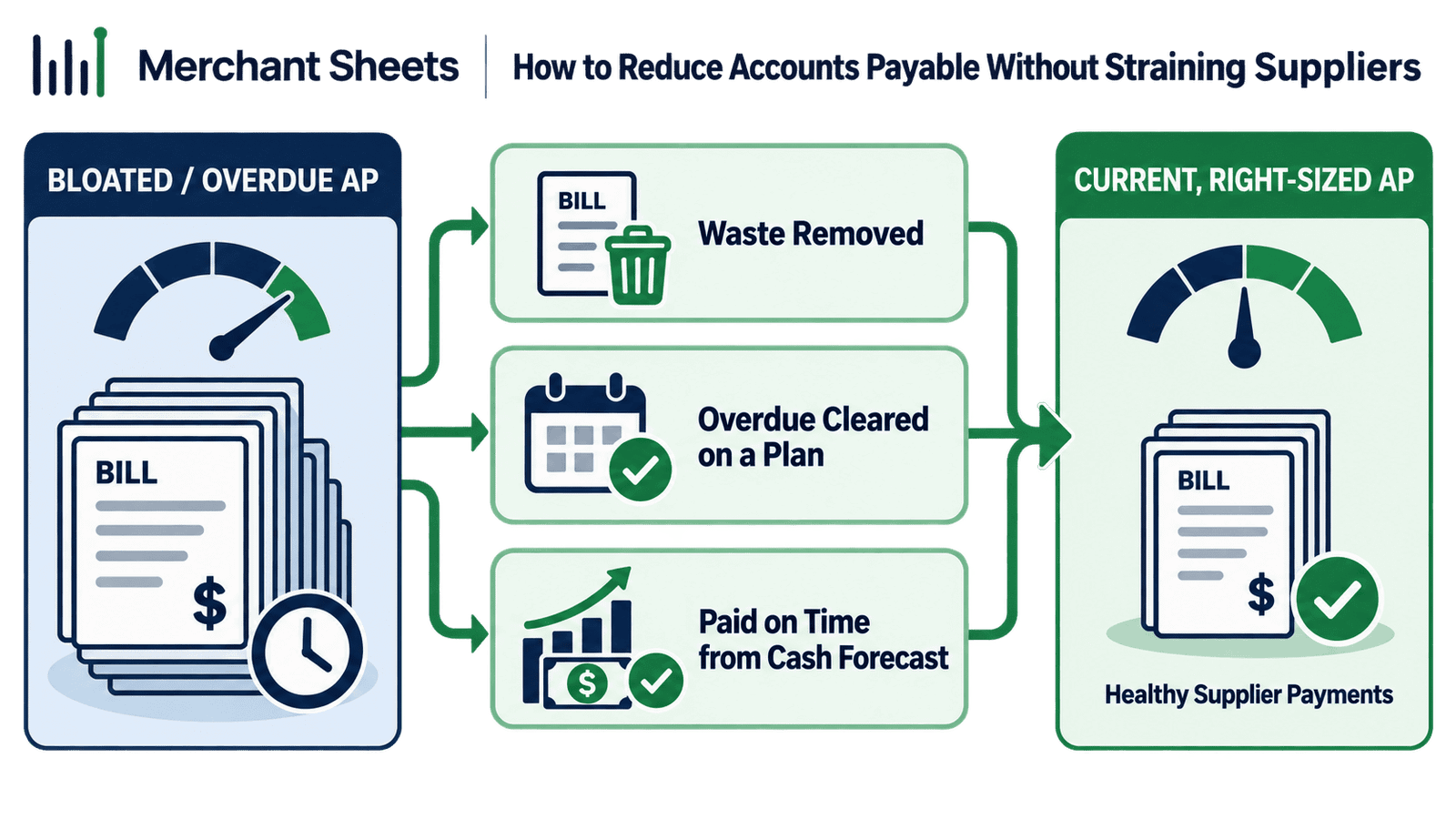
Your accounts payable balance has crept up, some of it’s past due, and a key supplier just asked when they’ll be paid. The answer isn’t to drain your cash paying everyone off at once.
It’s to bring the balance back to healthy and current, strip out the part you shouldn’t be paying at all, and time the rest to your cash.
How do you reduce accounts payable?
To reduce accounts payable, bring the balance to a healthy, current level instead of the lowest possible one. Take off the invoices you shouldn’t be paying, clear overdue amounts with the suppliers you can’t afford to lose first, negotiate longer terms where you need them, and pay the rest on time from your cash forecast.
Accounts payable is the money you owe suppliers for goods and services you’ve been billed for but haven’t paid yet, and it sits as a current liability on your balance sheet.
For a business that buys inventory on supplier terms, a high balance there isn’t automatically a problem. Those terms are often the cheapest financing you have, so paying everything off early to shrink the number forfeits free money and starves the cash you need for stock and ads.
| A smaller number isn’t the goal. If you paid every supplier the day their invoice arrived, your accounts payable would be near zero and so would your cash. Healthy payables are current and controlled: you still owe your suppliers, just on time and on terms you agreed. |
First, work out which problem you’re solving
Reducing accounts payable usually means one of three different problems, and they don’t share a fix, so name yours before you touch anything.
The first is a timing problem: the balance is overdue, suppliers are chasing you, and a relationship or your trade credit is at risk. The second is a hygiene problem: the balance is inflated by things you shouldn’t be paying, like duplicate bills, billing errors, late fees, and subscriptions nobody cancelled.
The third is structural: you owe suppliers more than your incoming cash can cover, a sign you’re carrying too much on supplier credit and may need to negotiate terms, time payments more carefully, or look at financing the purchase another way.
Plenty of businesses have two of these at once.
Table 1. The three problems behind reducing accounts payable, and where to fix each.
| Problem | What it looks like | Where to fix it |
| Overdue, straining suppliers | Past-due invoices, suppliers chasing you, terms at risk | Triage by age and supplier, and communicate early |
| Inflated with waste | Duplicate bills, price and PO mismatches, late fees, dead vendors | Cut what you shouldn’t pay, and run a three-way match |
| Too much on supplier credit | You owe more than your incoming cash can cover | Negotiate terms, time payments to cash, and weigh financing |
Which payables can you cut without straining a supplier?
The safest reduction strains no supplier, because it takes off the balance money you never owed or shouldn’t owe again.
Record bills accurately as you incur them, on an accrual basis, so payables reflect what you truly owe. Post each one to your chart of accounts rather than a catch-all, so a duplicate or a wrong price is easy to spot.
Then work down this list before you negotiate anything or move a payment:
- Duplicate invoices: The same bill entered or paid twice is the most common source of overpayment, so match every invoice to one bill before it’s approved.
- Price and quantity errors: Run a three-way match, lining up the purchase order, the receiving record, and the invoice, so you pay only for what you ordered and received at the price you agreed.
- Billing mistakes: Check for charges on returned or damaged goods, the wrong tax, or freight you weren’t meant to cover, and dispute them before they’re paid.
- Avoidable late fees: Interest and late charges you’re paying because an approval sat in an inbox are pure waste, not a sign you’re short on cash.
- Dead vendors: Cancel the software seats and services still on autopay that no longer earn their keep.
Clear an overdue balance without burning the supplier
When the balance is overdue, how you bring it down decides whether the supplier stays with you. Triage what you owe, and reach out before you miss a date, not after.
Start with an accounts payable aging report, which sorts every open bill by how far past due it is: current, 1 to 30 days, 31 to 60, 61 to 90, and over 90. Then rank what to pay by two things at once, how overdue it is and how critical the supplier is.
A sole-source manufacturer or a long-lead supplier you can’t swap out comes before a commodity vendor with three replacements.
Call the suppliers you’re behind with before the due date passes, offer a realistic catch-up or partial-payment schedule, and keep the promise you make. The relationships to protect first are the ones that would halt your inventory if they put you on hold.
Table 2. How to triage an overdue accounts payable balance by age and supplier.
| Aging bucket | Critical supplier (sole-source, long lead) | Replaceable supplier (commodity) |
| Current (not yet due) | Pay on the last good day inside terms | Pay on the last good day inside terms |
| 1 to 30 days past due | Call now, pay first, protect the relationship | Schedule into the next cash-covered week |
| 31 to 60 days past due | Call, agree a catch-up plan, keep the promise | Agree a plan, and confirm the invoice is valid |
| 61 to 90 days past due | Prioritize; a hold here stops your inventory | Negotiate a settlement or a payment schedule |
| Over 90 days past due | Resolve directly; your terms are at risk | Confirm it’s owed, then resolve or dispute it |
| Silence strains suppliers more than slowness. Most will work with a customer who calls first and offers a plan. The ones who tighten or pull your terms are the ones who had to chase you. Make the call before the due date, every time. |
Negotiate better terms instead of stretching them
The durable way to owe less at any moment, or to buy yourself more time to pay, is to negotiate terms in the open rather than quietly paying late. Both stretch your days payable outstanding, the average time you take to pay a supplier, but only one keeps the supplier on your side.
Ask your reliable suppliers for longer standard terms once you’ve built a payment history, moving net 30 to net 45 or net 60. On a large balance, ask for a formal payment plan rather than defaulting on the invoice. Consolidate more of your spend with fewer suppliers so you’ve got the volume to negotiate with.
And on big inventory buys, use a deposit and milestone payments so the whole landed cost of the order doesn’t hit payables in one lump.
A higher days payable outstanding that comes from terms you negotiated is a real improvement to your cash conversion cycle. One that comes from paying late isn’t; it only hides the problem.
Stretching payments on your own is a false economy in any case, since the late fees, the early-payment discounts you give up, and a supplier who quietly reprices or deprioritizes you cost more than the cash you held onto.
When is an early payment discount worth taking?
Paying early can lower what you owe, but only take an early payment discount when the return beats what the cash is worth to you. A term like 2/10 net 30 is worth far more than it looks.
2/10 net 30 means you can take 2% off if you pay within 10 days, or pay the full amount at 30. Because you’re earning 2% for paying 20 days early, the annualized return works out to roughly 36 to 37%, well above most businesses’ cost of capital.
When you’ve got spare cash, that’s one of the best returns available, and the supplier is glad to be paid early, so it’s a reduction everyone likes.
The counterweight matters just as much. When cash is tight, when the same cash would buy inventory that earns more than 36% a year, or when you’d have to borrow to take the discount, skip it and pay on the normal due date. The discount is a return on cash you already have spare, not a reason to run short.
On a $10,000 invoice at 2/10 net 30, paying by day 10 saves $200 and costs you the use of $9,800 for 20 days, which annualizes to about 37%.
Table 3. What an early payment discount is really worth (rates are approximate).
| Terms | What it means | Effective annual rate | Take it when | Skip it when |
| 2/10 net 30 | 2% off by day 10, else full at 30 | ~36 to 37% | You have spare cash and no better use for it | Cash is tight, or it would buy inventory that earns more |
| 1/10 net 30 | 1% off by day 10, else full at 30 | ~18% | You have spare cash sitting idle | Your cost of capital is higher |
| 2/10 net 60 | 2% off by day 10, else full at 60 | ~15% | You have spare cash | Borderline; compare to your cost of capital |
| No discount, net 30 or 60 | Full amount at the due date | None to earn | Always pay on the last good day inside terms | n/a |
Pay on the last good day, timed to your cash forecast
Once the balance is clean and the terms are right, the ongoing discipline is timing. Pay each bill on the last good day inside its terms, not early and not late, and decide which day that is from a rolling 13-week cash forecast rather than from your gut.
Paying early with no discount hands the supplier free financing and drains your cash sooner than you need to. Paying late strains the supplier and adds fees. The last good day inside terms keeps every supplier current while holding your cash as long as you legitimately can, which is the whole benefit of a longer days payable outstanding without any of the relationship cost.
A 13-week cash forecast shows you, week by week, which payments the cash covers and which to move to a later week that’s still inside terms.
The view is also where payables meet the rest of your working capital, since the cash tied up in stock and the cash your customers owe you set how much you can send suppliers each week. Build one bill calendar off the forecast, set approval thresholds so nothing large goes out unseen, and give one person the weekly bill run.
That routine is the part of steady ecommerce bookkeeping that keeps the balance from creeping back up.
Frequently asked questions
Is a high accounts payable balance bad?
Not on its own. For a business buying inventory on supplier terms, a higher balance means you’re using supplier credit, usually your cheapest financing, so a high but current balance is healthy; a high and overdue balance is the one to worry about.
Does reducing accounts payable improve cash flow?
Not by itself, and it can hurt it. Paying suppliers off faster lowers your payables but lowers your cash by the same amount, so what improves cash flow is paying on time on the longest terms you’ve negotiated, not paying early to shrink the balance.
How do I lower accounts payable without hurting suppliers?
Take off the balance what you shouldn’t be paying, like duplicate invoices, billing errors, and dead vendor subscriptions, clear any overdue amounts on an agreed plan starting with your most critical suppliers, and negotiate longer terms in the open instead of paying late.
What's a healthy days payable outstanding?
There’s no single right number. A healthy days payable outstanding uses the full terms your suppliers have agreed to without going past them, and it should come from terms you negotiated rather than from paying late.
Should I take a 2/10 net 30 early payment discount?
Usually yes if you have the cash, because 2/10 net 30 is worth about 36% a year, well above most businesses’ cost of capital. Skip it when cash is tight or the same money would buy inventory or pay down debt that earns more.
What's the difference between accounts payable and accrued liabilities?
Accounts payable is what you owe against a supplier invoice you’ve already received, while accrued liabilities are expenses you’ve incurred but haven’t been billed for yet. Both are current liabilities, and both sit on your balance sheet.
Does paying suppliers late reduce accounts payable?
No. Paying late doesn’t lower what you owe; it only delays it while adding late fees and eroding the relationship. To owe less over time, cut the waste, negotiate terms, and right-size how much you buy on credit.
