
Key takeaways
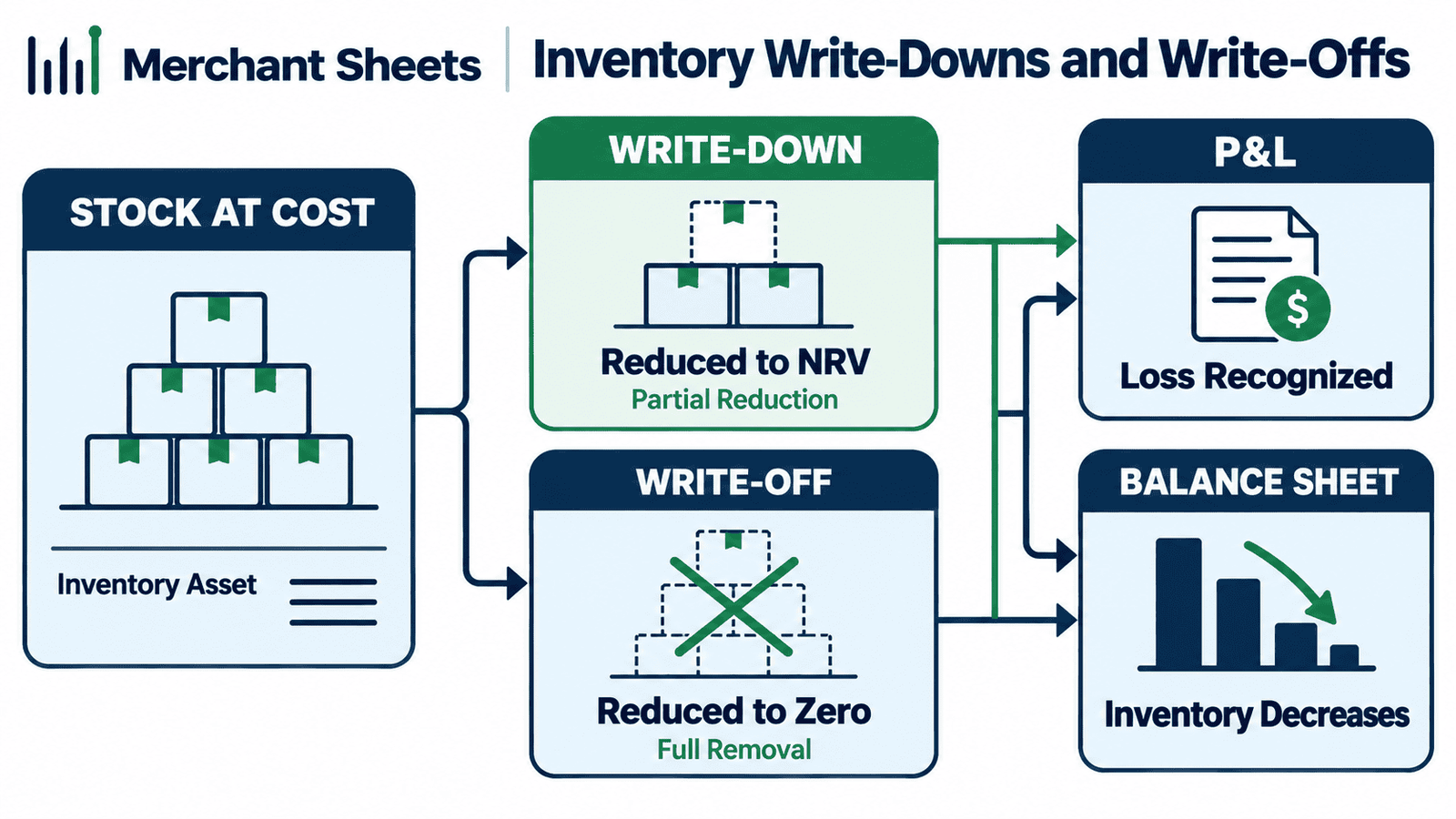
- A write-down and a write-off are two sizes of the same move. A write-down cuts inventory’s value to what it’s now worth; a write-off removes the value entirely when the stock is worthless.
- GAAP carries inventory at the lower of its cost and its net realizable value, the expected selling price minus the cost to sell, so you write it down as soon as the value drops, not when you finally clear it.
- The entry is a loss (or COGS) debited and inventory, or an obsolescence reserve, credited. A reserve spreads the hit; the direct method takes it all at once.
- A small, routine write-down usually sits inside COGS, while a large or unusual one is broken out as a separate loss line. Either way it lowers gross margin and operating income.
- Book and tax don’t line up. You record the write-down when you spot the obsolescence, but the IRS only lets you deduct it once you’ve sold, donated, or destroyed the stock.
- The cheaper fix is catching dead stock early. An inventory aging report and days-on-hand flag slow SKUs while they can still be discounted, bundled, or returned instead of written off.
A box of last season’s stock is sitting in the warehouse; it isn’t going to sell at full price, and it’s still on your books at what you paid for it. Carried there, it overstates your assets and your profit.
Here’s how to write inventory down to what it’s really worth, when to write it off completely, and how the tax side differs.
What’s the difference between an inventory write-down and a write-off?
An inventory write-down reduces the recorded value of stock to what it’s now worth, when that’s less than you paid for it. An inventory write-off removes the value entirely, when the stock is worth nothing at all. A write-down is a partial markdown on the books; a write-off is the full removal.
Both come down to one idea: the inventory on your books should never be worth more than it can bring in. A carrying value is the amount a SKU is recorded at, usually what it cost you. When last season’s stock will only move at a clearance price, you write it down to that price.
When damaged returns come back unsellable, or a pallet is destroyed or stolen, there’s nothing to recover, so you write it off in full. Stock that’s stopped selling at a normal pace or price is what people mean by obsolete, or dead, stock.
Table 1. Inventory write-down vs write-off.
| Aspect | Write-down | Write-off |
| What happens | Value reduced to net realizable value | Value removed entirely |
| When you use it | Stock is worth less than cost but still sellable | Stock is worthless: destroyed, stolen, or unsellable |
| Ecommerce example | A last-season SKU marked to its clearance value | Damaged returns Amazon can’t refulfill; destroyed stock |
| The entry | Debit loss or COGS; credit inventory (or a reserve) | Debit loss or COGS; credit inventory (or clear the reserve) |
| Tax deduction | Only once sold below cost | Only once disposed: sold, donated, or destroyed |
When do you write inventory down? The lower of cost and net realizable value rule
You write inventory down whenever its net realizable value drops below what it cost, because GAAP makes you carry inventory at the lower of the two. Net realizable value is the price you can realistically sell a unit for, minus what it costs you to sell it.
Say a jacket cost you $40, but it’s now moving only at a $30 clearance price, and it runs about $4 to pick, pack, and ship. Its net realizable value is $26, below the $40 you paid, so you write it down by $14 a unit. Do that across the units on hand and the total is your write-down.
A few things push value below cost: a SKU goes obsolete, a version gets superseded, goods are damaged, a category floods and prices fall, or dated stock nears expiry. Whatever costing method you use to set the original cost, the lower-of-cost-and-net-realizable-value rule sits on top of it.
Businesses on LIFO or the retail method apply a slightly different lower-of-cost-or-market test, but the idea is the same.
The timing is the part sellers get wrong. You write the stock down as soon as you know it’s impaired, not when you finally clear it, because the books are meant to reflect what you own right now. And under US GAAP, once you’ve written a value down, you don’t write it back up if the market recovers.
Leaving it at cost doesn’t just flatter your balance sheet. It overstates the profit you report, which can mean tax on income you never really earned and a misleading picture for any lender or buyer reading your numbers.
| Your books should never value stock above what it can sell for. If inventory sits at cost while its real worth has dropped, your assets and your profit are both overstated, and the fix is a write-down, or a write-off if it’s worth nothing. |
How do you record an inventory write-down?
You record a write-down with a single entry: debit a loss (or cost of goods sold) and credit inventory, for the amount the value has dropped. The debit is the expense that hits your P&L, and the credit lowers the asset on your balance sheet.
There are two ways to do it. The direct method posts the loss straight against inventory, which suits a one-off. The reserve method, sometimes called the allowance method, books the loss to an obsolescence reserve now, a contra-asset that offsets inventory, and clears that reserve against inventory later when the stock is sold, donated, or scrapped.
The reserve method fits a business that expects some obsolescence every period and wants to spread the hit rather than take it in lumps.
You can send the debit to cost of goods sold or to a dedicated loss on obsolete inventory account. The separate account keeps the hit visible and out of your core margin, which is worth doing once the amounts get large. With the reserve method, you also true the reserve up or down each period as your read on what won’t sell changes.
Say a SKU cost you $120,000 and its net realizable value has fallen to $100,000. That’s a $20,000 write-down, recorded like this.
Table 2. The $20,000 write-down recorded both ways.
| Method | Account | Debit | Credit |
| Direct method | Loss on inventory write-down | $20,000 | |
| Direct method | Inventory | $20,000 | |
| Reserve method (record now) | Loss on inventory write-down | $20,000 | |
| Reserve method (record now) | Allowance for obsolete inventory | $20,000 | |
| Reserve method (on disposal) | Allowance for obsolete inventory | $20,000 | |
| Reserve method (on disposal) | Inventory | $20,000 |
When a write-down becomes a full write-off
When stock is worth nothing, damaged beyond sale, destroyed, stolen, or truly unsellable, you write it off instead of down, removing its full cost rather than marking it lower.
The entry has the same shape as a write-down, a debit to a loss or cost of goods sold and a credit to inventory, or you clear the reserve you’d built, but it’s for the whole cost this time.
The common triggers for a store are unfulfillable or damaged returns Amazon can’t put back in stock, spoilage or expiry, a discontinued SKU with no buyer, and stock lost to theft or a miscount.
For anything you physically destroy, keep documentation, a record of what it was and proof it’s gone, since that’s what supports the write-off later.
One Amazon wrinkle is worth catching: when Amazon reimburses you for units it loses or damages in its own warehouses, that reimbursement is income that offsets the loss. Net it against the write-off rather than booking the full cost as a loss and the reimbursement somewhere else.
Where write-downs and write-offs land on your statements
A write-down or write-off shows up in two places at once. The inventory line on your balance sheet drops, and an expense hits your P&L, which pulls down gross margin and operating income.
Where the expense sits depends on size. A small, routine write-down usually rides inside cost of goods sold. A large or unusual one is better broken out on its own line, an inventory write-down or a loss on obsolete inventory, so it doesn’t quietly distort your gross margin trend and hide a real shift in your unit economics.
A write-off is the cleanest case of inventory becoming an expense without a sale ever happening. It’s the same asset-to-expense move that cost of goods sold makes on a normal order, triggered by obsolescence instead of a customer.
Recording it keeps the profit you report honest and your margins readable.
Can you deduct an inventory write-down on your taxes?
Not right away. For your books, you record the write-down as soon as the stock loses value. For taxes, the IRS only lets you deduct the loss once you’ve disposed of the inventory, by selling it, donating it, or destroying it.
There are three ways to dispose of it, each with its own treatment. You can sell it, to a liquidator or through a discount channel, and take the loss against cost. You can donate it, a charitable route that can carry an enhanced deduction for inventory given to a qualifying cause.
Or you can destroy it, the most paperwork-heavy option, where you keep before-and-after records to back the deduction.
An estimate alone won’t get you there. A reserve you book by judgment lowers book profit but isn’t deductible; only the actual disposal is.
The gap matters for planning: flagging stock as obsolete lowers your reported book profit in the period you flag it, but the tax deduction lands in the period you dispose of it, so the two rarely fall in the same year.
The treatment also varies by how and where you sell, so check your own situation with an accountant.
Table 3. Book vs tax: when the loss counts.
| Book (GAAP) | Tax (IRS) | |
| When it counts | When you determine the stock is impaired or obsolete | Only when the inventory is disposed of |
| What you do | Write down to net realizable value, or write off | Sell, donate, or destroy the stock |
| Effect | Lowers reported profit in that period | Deduction lands in the period of disposal |
| Watch | Required under lower of cost and NRV; no write-back up | Keep documentation; treatment varies, confirm with a CPA |
| A write-down is a book entry, not a tax deduction. Flagging stock as obsolete lowers your reported profit now, but you can’t deduct it for tax until you’ve sold, donated, or destroyed it, so the book loss and the tax deduction fall in different periods. |
Handle dead stock before it becomes a write-off
The cheapest write-off is the one you avoid, so the real win is catching dead stock while it can still be sold. Spot it early from an inventory aging report and days inventory on hand, both of which flag SKUs that have stopped moving long before year-end.
A common rule of thumb is stock with no sale in 90 to 180 days, or more than a year of supply sitting on hand, though the right line depends on your category.
Once you’ve found it, you’ve got options short of a write-off: discount it, bundle it with a strong seller, liquidate it, return it to the supplier if your terms allow, or donate it.
Any of those beats holding stock that’s only losing value. The write-down or write-off just records whichever path you pick.
The finance discipline behind it is small. Carry an obsolescence reserve so the hit is spread and predictable instead of a lumpy year-end surprise, which is part of keeping your ecommerce bookkeeping honest month to month.
And watch the cash tied up in stock that isn’t moving, since that’s the real cost of letting dead stock sit. Deciding early almost always beats writing off later.
Frequently asked questions
What's the difference between an inventory write-down and a write-off?
A write-down lowers the recorded value of stock to its net realizable value when that’s below cost, but the stock is still sellable, while a write-off removes the value entirely when the stock is worthless.
How do you record an inventory write-down?
Debit a loss or cost of goods sold and credit inventory, or credit an obsolescence reserve if you’re estimating ahead, for the amount the value has dropped; the debit hits your P&L and the credit lowers the asset.
Is an inventory write-down tax deductible?
For your books, yes, in the period you record it; for taxes, not until you dispose of the inventory by selling, donating, or destroying it, so the book write-down and the tax deduction usually fall in different periods.
Do you have to physically destroy inventory to write it off?
No. You can sell it to a liquidator, donate it, or destroy it; destruction is only one route and the one that needs the most documentation, so keep records of what was destroyed and proof it’s gone.
What is net realizable value?
Net realizable value is the price you can realistically sell inventory for minus the costs to complete and sell it, and GAAP makes you carry inventory at the lower of its cost and this value.
Where does an inventory write-off go on the income statement?
Inside cost of goods sold for a small, routine amount, or on its own line as a loss on obsolete inventory for a large or unusual one; either way, it reduces gross margin and operating income.
What counts as obsolete or dead stock?
Stock that’s no longer selling at a normal pace or price, including seasonal and discontinued SKUs, superseded versions, and damaged or expired units, which you spot from an inventory aging report before deciding to discount, liquidate, or write it off.
