
Key takeaways
- Overstock, or excess inventory, is more of a product than demand supports. It still sells, which is what separates it from dead stock that won’t move at all.
- Overstock costs you the cash tied up, the carrying cost to hold it, and the margin you give up on every markdown; if it sits long enough, it turns into dead stock.
- The cheapest liquidation is usually the earliest one, because excess recovers less cash every month it ages.
- Recovery varies a lot by channel: your own clearance or flash sale recovers the most (roughly 40% to 60% of value) but takes work; bulk liquidators and Amazon’s FBA program recover the least (often 5% to 20%).
- Use a staged markdown (for example, 20%, then 40%, then 60%) and gate it behind an outlet or an email segment so you clear stock without training full-price customers to wait.
- Overstock is an ordering problem. Buying to a forecast, budgeting the buy against cash, and right-sizing orders means you rarely have to liquidate at all.
You bought deep on a product that was selling, the reorder landed, and then demand cooled with a wall of stock still on the shelf. It’s not dead; it just won’t clear at full price fast enough, and every week it sits it costs you.
What is overstock?
Overstock, or excess inventory, is stock you hold in greater quantity than demand supports over a reasonable period, so it sells too slowly to justify the cash and space it takes up.
You bought more of a SKU (a stock-keeping unit, your internal code for one product variant) than the sell-through rate can absorb, and now the surplus sits.
The distinction that decides what you do is overstock versus dead stock. Overstock still sells, it’s just too much, so you can usually clear it at a discount and recover real cash. Dead stock has stopped selling and won’t move at a normal price, and obsolete stock is worthless.
The through-line: overstock is a warning light, not a write-off, and left alone it ages into stock that has stopped selling. Treat it while it still has demand and you keep your options open.
Table 1. Overstock vs. dead stock vs. obsolete.
| Term | What it is | The move |
| Overstock | Too much of a product that still sells | Clear the surplus at a discount |
| Dead stock | Stopped selling, won’t move at a normal price | Liquidate or write it off |
| Obsolete | Superseded, expired, or damaged; worthless | Write it off |
How do you spot overstock early?
You spot a building overstock before it becomes a problem by watching a few signals, not by waiting for the warehouse to look full. The clearest is days of cover creeping up: if a SKU that used to hold three weeks of stock now holds three months at the current sales rate, you’re long.
A falling sell-through rate (the share of available units that sell in a period) says the same thing from the other side.
The fastest way to see it across the catalog is an inventory aging report, which buckets your on-hand by how long it has been sitting so a growing pile of older units stands out.
Review it on a cadence: monthly for most brands, weekly in a fast season, and you catch surplus while it still has demand and cheap options, instead of after it has aged into dead stock.
What causes overstock?
Overstock is almost always a buying or forecasting miss, and for an ecommerce brand it comes from a short list of causes. Each one points at a different fix.
- Buying to a price break or minimum: You ordered deep to hit a discount or clear a supplier’s minimum order quantity, and the extra units outran demand.
- A forecast that came in high: You planned for more than sold, or seasonal demand faded before the stock did, leaving a tail on the shelf.
- Buying deep on a winner: A product was selling, so you reordered big, and then it cooled before the reorder cleared.
- Cancelled or returned orders: A wholesale order fell through or came back, and the stock you’d committed landed back on you.
- Promo and channel misses: A campaign underperformed, or stock split across channels that didn’t move it, and the surplus piled up.
What does overstock cost you?
Overstock costs you three ways at once: the cash tied up in stock that’s moving too slowly, the carrying cost to hold it, and the margin you give up when you finally mark it down. Left long enough, it stops being overstock and becomes dead stock you have to write off.
The carrying cost is the quiet one. Holding inventory runs roughly 20% to 30% of its value a year once you count storage, insurance, shrink, and the opportunity cost of the cash tied up in stock, and that meter runs the whole time the surplus sits.
On Amazon it’s worse, because aged FBA stock draws monthly storage plus an aged-inventory surcharge, so slow units cost more the longer they stay.
Then there’s the part sellers underrate: the markdown itself. Every point of discount comes straight off margin, so clearing a batch at 40% off can wipe out the profit you made on the units that sold at full price. That’s why timing matters more than it looks, and it’s the point of the callout below.
Put a number on it. If a product carries a 40% gross margin and you clear a batch at 40% off, that markdown erases the margin entirely; you’re moving units at roughly break-even to recover cash, not profit.
Discount past that and the surplus is costing you on the way out, which is why the goal is to recover cash quickly, not to hold for a price that keeps slipping.
When should you liquidate?
Liquidate when the stock won’t sell through at a price and pace that beats holding it, which usually means it’s aging, tying up cash you need, or taking space you need more.
Before you clear it, give it a fair shot on your own terms: re-merchandise it, reprice it, feature it in a collection, or bundle it with a mover. If it still has real demand, selling through at closer to full price recovers the most.
Move to liquidation when the numbers say it isn’t turning. Pull an inventory aging report and check days of cover, and if the surplus is sitting past the window you’d expect for that product, stop waiting.
The trigger is simple: the longer excess sits, the less you recover, so a decision to liquidate is a decision to stop hoping it clears itself.
How do you liquidate excess inventory?
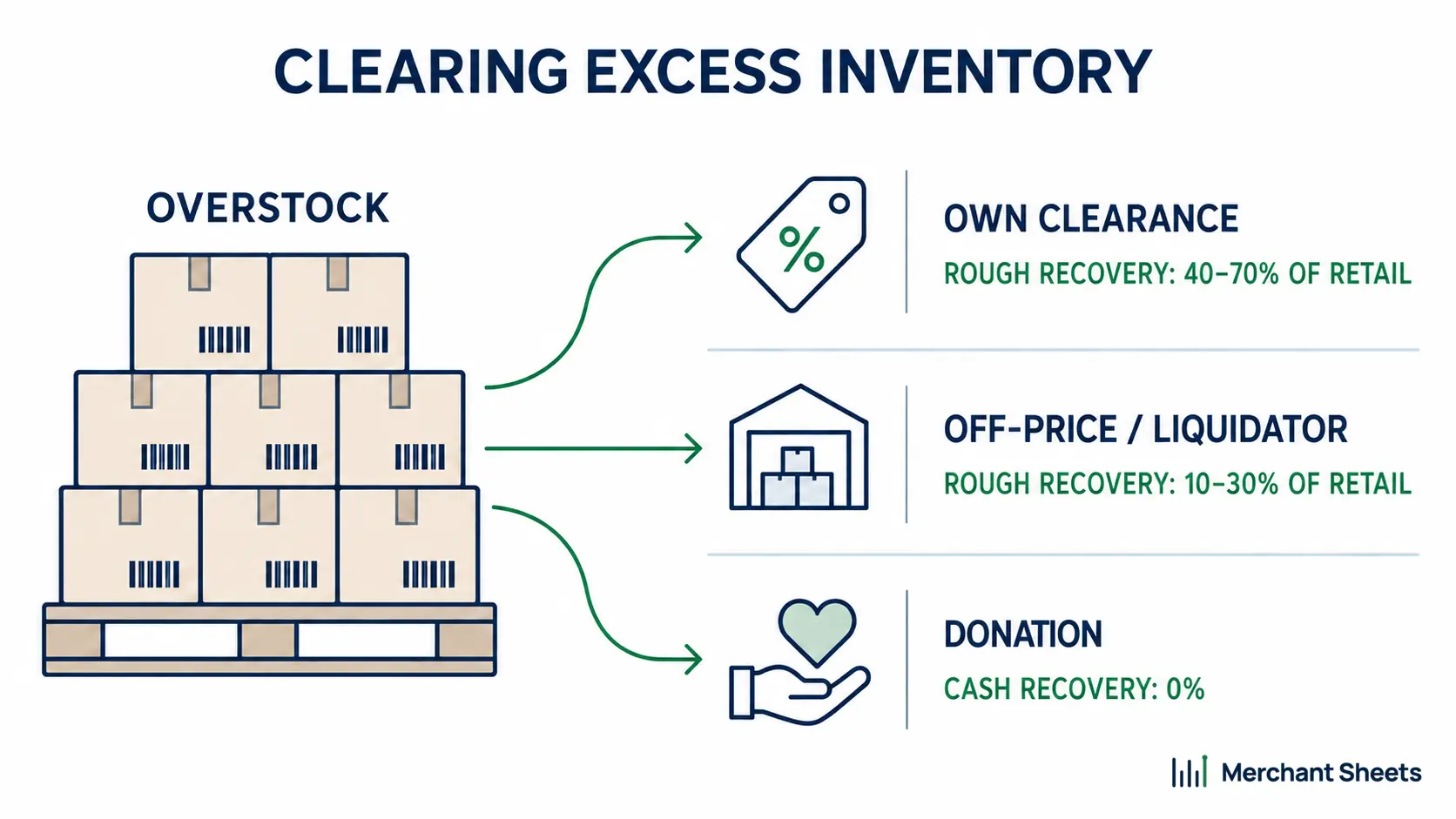
You liquidate excess inventory by matching the channel to how much cash you need to recover, how fast, and how much brand exposure you can accept. The channels trade off hard against each other, and no single one is best for every situation. Here they are, roughly best-cash-first.
Your own clearance section or a flash sale recovers the most, often 40% to 60% of the item’s value, but it takes labor to pick, pack, and ship each order and it puts the markdown in front of your regular customers.
Keeping it a step removed, behind an outlet page or an email-segment sale, protects the main brand. Bundling the surplus with a strong seller moves units without a naked markdown.
Off-price retailers and jobbers take volume at wholesale prices. Online liquidation auctions, like B-Stock, clear pallets fast at roughly 15% to 25%. A bulk liquidator or broker takes everything at once but recovers the least of the cash routes, around 10% to 20% (you’ll often see it quoted as 10% to 30% of retail).
Amazon’s FBA liquidation program is hands-off and recovers the least of all, around 5% to 10% of the average selling price. Returning stock to the supplier, if your terms allow, can beat all of these.
And donating or recycling recovers no cash but gives you the space back and a possible tax benefit, which is the tax side of donating or writing it off worth confirming before you commit.
Table 2. Ways to liquidate excess inventory, roughly best cash first (figures are approximate).
| Channel | Rough cash recovery | Speed | Effort | Brand risk |
| Own clearance/flash sale | 40–60% of value | Medium | High (you fulfill) | High (customers see it) |
| Outlet page/email segment | 40–60% | Medium | High | Lower (gated) |
| Bundle with a seller | Varies | Medium | Medium | Low |
| Off-price retailer/jobber | Wholesale-level | Medium | Low | Medium |
| Liquidation auction (B-Stock) | ~15–25% | Fast | Low | Medium |
| Bulk liquidator/broker | ~10–20% | Fast | Low | Medium |
| Amazon FBA liquidation | ~5–10% of ASP | Fast | Very low | Low |
| Return to supplier | Often the best | Medium | Low | Low |
| Donate/recycle | No cash (tax benefit) | Fast | Low | Low |
What does liquidating net?
The sticker recovery on a channel isn’t what you keep, so it helps to run the net. Say you’re holding $50,000 of overstock at cost across a few hundred units.
Clearing it yourself at 50% off might gross around $25,000 on paper, but once you subtract the pick-pack-ship labor at roughly $4 to $6 an order and the weeks of your team’s time, the real net can land closer to $18,000 to $20,000, spread over a month or more.
Hand the same lot to a bulk liquidator at 15% and you might net around $7,500, but in a few days, with no fulfillment work and the shelf space back immediately.
Neither answer is automatically right: the clearance keeps more cash if you have the time and the traffic to move it, while the liquidator wins when the space, the speed, or your team’s hours are worth more than the extra recovery.
Running the two nets side by side is how you decide, and it’s the habit the next section builds on.
How to choose a channel and how deep to discount
Choose the channel that nets the most cash after fees and labor, not the one with the highest sticker recovery. A bulk liquidator at 15% with no work on your end can beat a 50% clearance that ties up your team for a month, once you count the roughly $4 to $6 an order it costs to pick, pack, and ship, plus the time.
Weigh three things: net recovery, how fast you need the cash or the space, and how much brand exposure the channel carries.
On price, discount in stages instead of one deep cut. A staged markdown captures the buyers willing to pay more first, then steps down to find the ones who’ll clear the rest, and it protects your margin better than opening at 60% off.
Gate the sale behind an outlet page or an email segment so you don’t train full-price customers to wait for markdowns, and mind any minimum advertised price (MAP) commitments you’ve made to suppliers.
Table 3. A staged markdown ladder for clearing overstock.
| Stage | Discount | What it’s for |
| Stage 1 | 20% off | Capture buyers who’d pay near full price; test demand |
| Stage 2 | 40% off | Move the bulk of the surplus |
| Stage 3 | 60%+ off | Clear the stragglers before they age into dead stock |
| After that | Liquidate | Hand the rest to a bulk channel and reclaim the space |
How do you prevent overstock?
You prevent overstock by fixing the buy, since almost all of it is bought, not sold. It comes down to the way you plan your buying, and the pieces below work together to keep you from over-committing in the first place.
- Buy to a demand forecast: Order against a real projection of what each product will sell, not a supplier price break, so you stop buying deeper than demand.
- Budget the buy against your cash: Use an open-to-buy plan to cap what you commit each period to what your cash and expected sales support, so a good deal can’t talk you into a year of stock.
- Right-size what you reorder: Set reorder quantities and safety stock to what sells, so you carry a sensible cushion instead of months of cover on a slow mover.
- Watch order minimums: Push back on or split a supplier’s minimum when it would land more units than you can sell in a reasonable window.
- Don’t over-buy against stockouts: Over-buying so you never run out is a main cause of overstock, so pick a service level on purpose instead of padding every order for the worst case.
Frequently asked questions
What is overstock?
Overstock, or excess inventory, is more of a product than demand supports over a reasonable period, so it sells too slowly to justify the cash and space it takes up. It still sells, which separates it from dead stock that has stopped moving.
What is the difference between overstock and dead stock?
Overstock still sells; it’s just too much of it, so it can usually be cleared at a discount, while dead stock has effectively stopped selling and won’t move at a normal price. Overstock that ages long enough becomes dead stock.
What does overstock cost?
The cash tied up in slow-moving stock, a carrying cost of roughly 20% to 30% of its value a year, and the margin you give up on every markdown, plus aged-storage and surcharge fees on Amazon, and a write-off if it goes dead.
How do you liquidate excess inventory?
Match the channel to the cash and speed you need: your own clearance or flash sale recovers the most but takes work, off-price and liquidation auctions clear volume fast at a lower price, bulk liquidators and Amazon’s FBA program recover the least, and donation is a last resort.
How much do you recover when you liquidate inventory?
It varies widely by channel and category, roughly 40% to 60% of value through your own clearance, 15% to 25% through liquidation auctions, 10% to 20% through bulk liquidators, and 5% to 10% through Amazon’s FBA program, so treat these as rough ranges.
What causes overstock?
Over-ordering to hit a price break or minimum, a demand forecast that came in high, buying deep on a winner that cooled, cancelled wholesale orders, and over-buying to avoid stockouts. Most of it is bought, not sold.
How do you prevent overstock?
Buy to a demand forecast, budget the buy with open-to-buy so you commit only what cash and sales support, right-size reorder quantities, watch order minimums, and review inventory aging on a cadence so a building surplus gets caught early.
Should I liquidate overstock or hold it?
Hold it only while it still has real demand you can capture by re-merchandising, repricing, or promoting it; liquidate once an aging report shows it isn’t turning or you need the cash or space more than the last few points of recovery, because excess recovers less every month it sits.
How do you clear overstock without hurting your brand?
Keep the markdown a step removed from your main storefront: run it through a separate outlet page, an email segment, or a bulk channel rather than a banner across your homepage; discount in stages instead of one deep cut, and respect any minimum advertised price commitments, so you recover cash without teaching full-price customers to wait for a sale.
