
Key takeaways
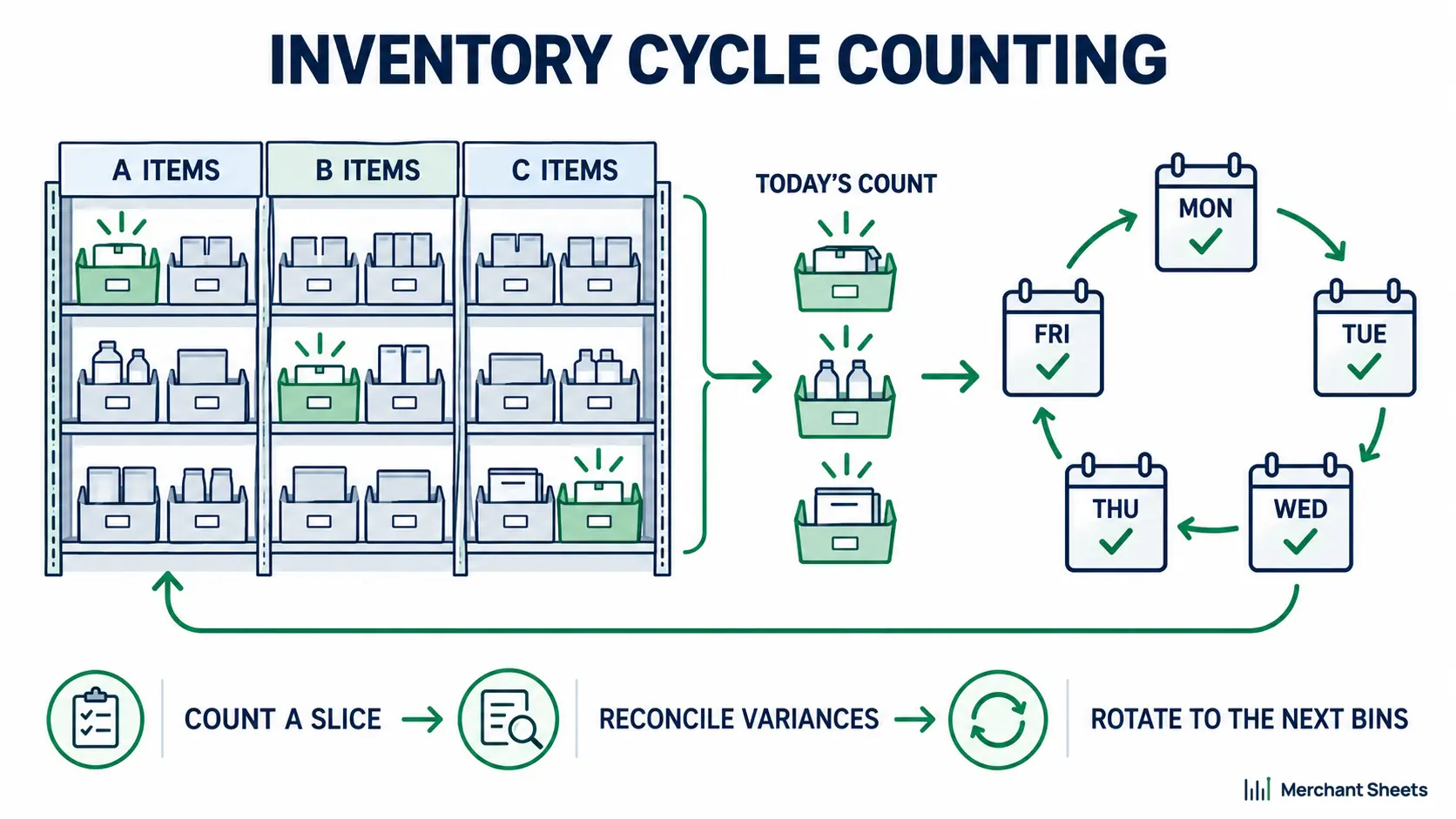
- Cycle counting is counting a small subset of your inventory on a rotating schedule, so the whole catalog gets verified over time without shutting down to count everything at once.
- It replaces the once-a-year full count for most brands: you catch and fix errors continuously instead of discovering a big gap at year-end.
- Use ABC classification to set the cadence: count high-value, fast-moving A items most often, B items less often, and slow, cheap C items least.
- Count blind and freeze the area: the counter shouldn’t see the system quantity, and transactions in the count zone should pause, or the variance is meaningless.
- Score it with count accuracy: correct items counted divided by items counted, times 100. Well-run operations target about 97% to 99%.
- A discrepancy is a signal, not only a number to fix: reconcile the count, then find the cause (a missed sale, a receiving error, shrinkage) so it stops recurring.
Your system says twelve, the shelf has nine, and you found out when an order couldn’t ship. Cycle counting fixes that drift: instead of one big annual count, you check a slice of your stock on a rotating schedule and catch errors as they happen.
Accurate counts are the foundation for how you plan your inventory, the metrics like inventory turnover you track, and a real read on the cash tied up in stock.
What is cycle counting?
Cycle counting, also called an inventory cycle count, is the practice of counting a small subset of your SKUs on a rotating schedule, so every item gets verified over a set period without a full-inventory shutdown. A SKU is the unique code for each product variant.
Rather than closing to count everything, you check a little each day.
The point is to keep your records and the shelf in agreement between big counts, or in place of them. Each count either confirms the system is right or surfaces a gap you can fix while it’s small.
Over a quarter or a year, the rotating schedule covers the whole catalog, and the errors that would have piled into a nasty year-end surprise get caught and corrected along the way.
It applies whether you hold your own stock or use a third party. If you run a small stockroom, you (or a warehouse hand) count a few bins each morning. If your inventory sits at a third-party logistics provider (3PL), the 3PL usually does the physical counting, and your job is to review its results and reconcile them to your own records.
Either way, the principle is the same: count a little, often, and act on the differences.
Cycle count vs full physical count: what’s the difference?
The difference between a cycle count and a full physical count is scope and timing. A physical inventory count counts everything at once, usually once or twice a year, and often means closing the warehouse or stockroom for a day while a team counts every SKU.
A cycle count checks a subset continuously, during normal operations, so nobody stops shipping.
The practical upshot: cycle counting catches errors close to when they happen and spares you the lost day, while a full count still has its place for an annual audit or a year-end true-up.
A perpetual inventory system, which updates your records on every sale, relies on cycle counts to stay honest, because it trusts its own numbers until a count corrects them.
You don’t have to choose one or the other. Most brands run cycle counts all year and keep a single full count as a periodic backstop, often at year-end for the books.
As your cycle-count accuracy climbs and holds, many operations drop the annual freeze entirely, since a well-run rotating count already verifies everything over the year. Start with both, then lean on the cycle counts once the numbers prove they’re trustworthy.
How do you decide what to count and how often?
You decide with ABC classification, ranking your SKUs by value and velocity so the items that matter most get counted most. A items are the roughly 20% of SKUs that drive most of your value or movement; B items are the middle; C items are the slow, low-value tail.
Set the cadence from a count goal you can staff. Pick how many SKUs you’ll cover in a year, then divide it down: to cover 1,000 SKUs a year, you’d count about 20 a week, or 3 a workday, weighting A items so they come around monthly and C items once or twice a year.
Treat those numbers as a starting point rather than a rule, and an inventory aging report helps you decide which items to pull first when something looks off.
A worked split makes it concrete. Say you carry 600 SKUs: 120 A items counted monthly is 1,440 counts a year, 180 B items counted quarterly is 720, and 300 C items counted twice a year is 600, for about 2,760 counts, or roughly 11 a workday.
If that’s more than you can staff, stretch the B and C intervals before you touch the A items, because the A items hold most of your value and cause the most expensive errors when they drift.
Table 1. A typical ABC cycle-count cadence (frequencies are illustrative).
| Class | What it is | Typical count frequency |
| A | The ~20% of SKUs driving most of your value or sales | Monthly, or every few weeks |
| B | The middle tier, moderate value or movement | Quarterly |
| C | The slow, low-value tail | Once or twice a year |
Cycle counting methods
Most brands run ABC-based counting, and a small catalog can keep it that simple with a plain rotating count. A few other methods suit specific needs, from counting at a trigger event to sampling at random, and you can mix them.
Mixing is common and sensible. Many operations run an ABC schedule as the backbone and layer opportunity counts on top, counting a bin whenever it hits zero, when a reorder goes out, or when stock is received, since those are the moments errors creep in.
Pick the backbone that matches your catalog, then add trigger counts where your mistakes tend to happen. The table lays out the common methods and where each fits.
Table 2. Common cycle counting methods.
| Method | How it works | Best for |
| ABC / control group | Count by value and velocity class, A items most often | Most brands; the default |
| Random sample | Pick a set of SKUs at random each period | Simple setups wanting a rough ongoing check |
| Opportunity / process-based | Count at a trigger: a reorder, a zero bin, or receiving | Catching errors at the moment they happen |
| Usage-based | Count the fastest-moving items most | High-velocity catalogs |
| Zone / location | Count by area or bin section on rotation | Your own warehouse or a mapped 3PL layout |
How do you start a cycle count program?
Standing up a program is a one-time setup, separate from running a single count. Get these pieces in place, and the daily counts become routine.
- Baseline with one full count: Start from an accurate opening position, because every count after this is measured against your records.
- Classify your catalog: Sort SKUs into A, B, and C by value and velocity so you know what to count and how often.
- Set a schedule you can staff: Turn your annual count goal into a per-day list, weighted toward A items, and put it on the calendar.
- Pick a tolerance: Decide the count difference that passes versus the one that triggers a recount and investigation.
- Assign an owner: Name who counts, who reconciles, and who signs off, so counts don’t quietly stop when things get busy.
- Review the trend weekly: Track count accuracy over time and watch the causes, not only the daily pass or fail.
How to run a cycle count, step by step
You run a cycle count by freezing the area, counting blind, comparing to the system, and reconciling with a root cause, not by eyeballing a shelf and trusting it.
- Pull today’s SKUs or bins from the schedule.
- Freeze the area and clear open receipts and picks, so nothing moves mid-count.
- Count blind, without showing the counter the system quantity.
- Compare the count to the system and flag anything outside your tolerance.
- Recount the discrepancies to rule out a simple miscount.
- Adjust the record and log the root cause, then feed the fix back into the process.
How do you measure whether your counts are accurate?
You measure whether your counts are accurate by count accuracy, the share of items you counted that matched the system, as a percentage. The formula is correct items counted divided by items counted, times 100. If 490 of 500 SKUs matched on a count, that’s 98% accuracy.
For a value-weighted read, inventory record accuracy takes the total absolute variance divided by total inventory value and subtracts it from 100%, so a few wrong counts on cheap items hurt less than one on an expensive one. Inventory record accuracy is how close your records sit to reality in dollar terms.
Well-run operations aim for roughly 97% to 99%, and a small difference within a set tolerance can pass rather than trigger a full investigation. Down in the low 90s, your numbers aren’t reliable enough to plan on.
Track the number over time, not on any single day. One bad count tells you little; a trend line tells you whether your process is holding or slipping. Set a target, watch the direction, and dig into the recurring causes behind the misses.
Chasing a perfect 100% isn’t the goal, since the cost of counting climbs fast near the top; a steady, high number you can trust to reorder and forecast against is what you’re after.
| Count accuracy = correct items counted / items counted x 100. Well-run operations target about 97% to 99%; below the low 90s, the records aren’t reliable enough to plan on. |
Cycle counting when your stock sits at a 3PL
If a third-party logistics provider holds your inventory, you’re not the one counting, but the accuracy is still yours to manage. The counts happen in the 3PL’s warehouse system, and your platform or inventory app holds the records you sell and reorder against, so the two have to agree.
Your job is oversight and reconciliation. Ask what cycle-count method and cadence the 3PL runs, whether it counts high-value SKUs more often, and how it reports variances and adjustments back to you.
Then reconcile its counts to your own numbers on a schedule, and treat a gap the same way you would in your own stockroom: find the cause, whether it’s a receiving error at the 3PL, a sync lag between systems, or damage in the warehouse.
Get the reporting in writing in your service agreement, including a target accuracy and how discrepancies over a threshold get investigated, so accuracy is a shared commitment rather than a surprise at year-end.
Best practices for accurate counts
A few habits separate counts you can trust from busywork.
- Count blind: Don’t show the counter the expected quantity, so the count is independent of the system.
- Freeze and clear first: Pause transactions in the count area and post open receipts and picks, so nothing moves mid-count.
- Count during quiet hours: Schedule counts when order volume is low, so a live pick doesn’t create a false gap.
- Schedule by ABC, not at random: Count high-value, fast movers most often, since that’s where an error costs the most.
- Root-cause every variance: Fix the cause, not only the number, or the same gap comes back next month.
- Use clean SKU numbers and scanners: Barcodes and consistent SKU numbers cut the manual keying errors that muddy a count.
Why don’t my counts match? Common causes and fixes
Most discrepancies trace back to a handful of process gaps, not theft. When a count doesn’t match, the cause is usually a transaction that hadn’t posted, a receiving or put-away error, or a mix-up in how a bundle decrements.
A common symptom is phantom stockouts, where the system shows zero and blocks sales while the item sits in the wrong bin, and a drifting count can also hide dead stock you’d otherwise clear.
Shrinkage, the stock lost to theft, damage, or error, is one cause among several and a subject of its own.
The fix is a habit, not a one-time cleanup. Adjust the record so the count matches reality, then chase the reason: pull the item’s recent transactions, check the last receipt and the last few orders, and confirm the bundle math if it’s a kit.
When the same SKU or the same cause keeps surfacing, that’s your signal to change the process, retrain on receiving, relabel a bin, or fix a sync between systems. The table pairs each common cause with its fix.
Table 3. Why counts don’t match, and how to fix it.
| Cause | The fix |
| Open or mistimed transactions | Freeze the area and clear open picks and receipts before counting |
| Receiving errors | Verify quantities at intake and scan against the purchase order |
| Put-away or location errors | Count by bin and reconcile the location, not only the total |
| Unit-of-measure or bundle mistakes | Define how kits and multipacks decrement, and count in the same unit |
| Shrinkage (theft, damage, loss) | Track the pattern, tighten handling, and investigate repeat offenders |
Frequently asked questions
What is a cycle count?
A cycle count is a count of a small subset of your inventory on a rotating schedule, so the whole catalog is verified over time without a full-inventory shutdown.
What is the difference between a cycle count and a physical inventory count?
A physical count counts everything at once, usually once or twice a year and often with a shutdown, while a cycle count checks a subset continuously during normal operations.
How often should you cycle count?
As often as your resources and an annual count goal allow, weighting high-value A items heaviest, so a set number of SKUs get counted each day or week and A items come around monthly while C items are counted once or twice a year.
What is the ABC method of cycle counting?
The ABC method ranks SKUs by value and velocity and counts A items, the high-value or fast movers, most often, B items less often, and slow, low-value C items least often.
What is a good inventory accuracy percentage?
Well-run operations target about 97% to 99%, though the right number depends on catalog size and complexity; below the low 90s, your records aren’t reliable enough to plan on.
How do you calculate cycle count accuracy?
Divide the number of items that matched the system by the total items counted and multiply by 100; a value-weighted version divides the total absolute variance by total inventory value and subtracts that from 100%.
Do you have to stop operations to cycle count?
No, that’s the advantage: you count a small area and freeze only that area briefly, so the business keeps running, unlike a full physical count.
What causes cycle count discrepancies?
Usually open or mistimed transactions, receiving and put-away errors, unit-of-measure or bundle mistakes, and shrinkage, so the fix is finding the cause, not only adjusting the number.
Can a 3PL or my platform handle cycle counting for me?
Yes, most 3PLs cycle count and reconcile, and platforms and inventory apps hold the records, so if your stock sits at a 3PL, your job is usually to review their counts and reconcile them to your books.
