
Key takeaways
- Inventory optimization is holding the right amount of each SKU to avoid stockouts while freeing the cash tied up in excess; it’s a balance between service level and working capital, set per product.
- For a growth-stage brand, inventory is usually the cheapest cash you’re not using: a dollar taken out of average stock is roughly a dollar of cash back, plus the carrying cost you stop paying on it.
- The goal isn’t to cut inventory across the board; it’s to trim the slow, low-return tail while protecting availability on the SKUs that earn.
- The playbook is a sequence: segment your SKUs, right-size how much you hold, clear the excess, buy smaller and more often, and do it all on accurate records.
- Carrying cost commonly runs about 20% to 30% of inventory value a year, so slow-moving stock keeps charging you whether or not it ever sells.
- Optimize on measured numbers, not gut: track the metrics first, act second, and judge progress against your own trend rather than a universal target.
Every dollar sitting in stock is a dollar you can’t spend on the next order, an ad, or payroll. The fix isn’t to hold less of everything, because that’s how you stock out the products that pay the bills. Inventory optimization is the balance in between.
What is inventory optimization?
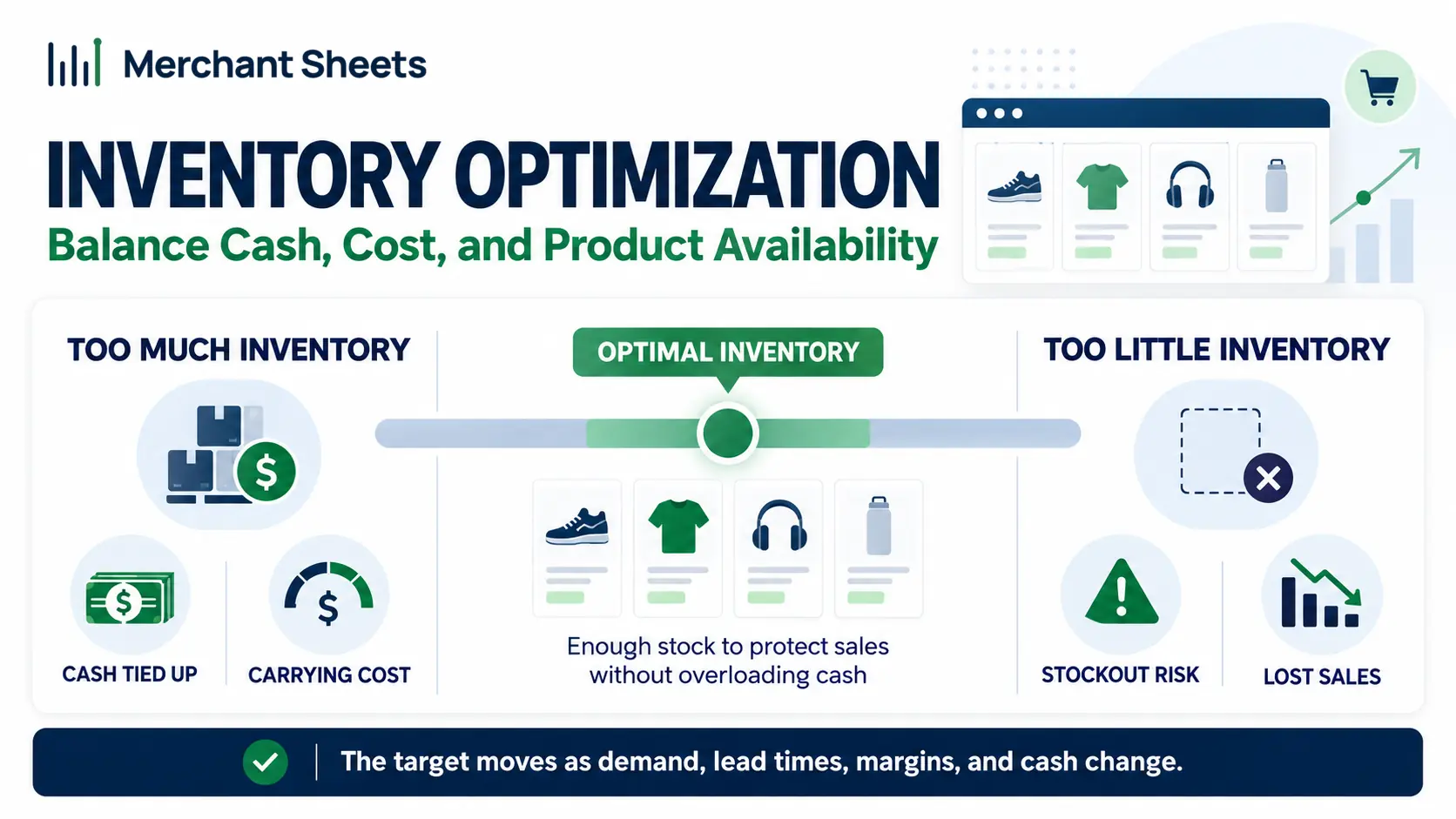
Inventory optimization is holding the right quantity of each product to meet demand at the service level you want, while tying up as little cash and carrying cost in stock as possible. It’s a balance struck per SKU: enough on hand to avoid stockouts, not so much that your cash sits frozen on a shelf.
That balance is the whole game. More stock protects you against running out, but it freezes cash and racks up carrying cost. Less stock frees that cash, but it risks stockouts on the products your customers came for. Optimization isn’t a blanket push to hold less; it’s deciding, SKU by SKU, where the line sits.
Service level is the term for the standard you’re holding to: the share of demand you can fill from stock on hand. Held right, inventory is a lever for growth; held wrong, it’s the reason a profitable-looking brand runs out of cash.
Two things make the decisions possible. You have to measure your inventory first, so you’re working from real turnover, margin, and cover numbers instead of a gut feel for what’s moving.
And optimization sits inside how you plan inventory end to end, from forecast to purchase order, rather than standing on its own. Get those in place and the moves below have something to work with.
Why optimized inventory is the cheapest cash you’re not using
For most product brands, inventory is the single biggest use of cash, which makes it the biggest place to find cash. You pay suppliers months before customers pay you, and every unit on the shelf is money that left the bank and hasn’t come back. That’s why inventory is so often your biggest cash drain, and why tightening it is the fastest source of funds most operators overlook.
The math is simple, and it’s why this matters. A dollar you take out of average inventory is roughly a dollar of working capital back in the bank. On top of that, you stop paying the cost of holding stock: the storage, capital, insurance, and obsolescence that make up carrying cost, commonly about 20% to 30% of a product’s value every year it sits.
Freeing inventory is self-funded growth: it releases cash you’d otherwise borrow or raise, at no interest. It also compounds: cash you free this quarter buys the inventory or ads that earn again next quarter, which is why disciplined operators treat their own shelves as the first place to look for funding.
How to free up cash without stocking out
The way you free cash without running dry is to cut where it’s safe and hold where it counts, in a set order. You’re moving cash from the slow tail to the fast core, not shrinking the whole business. The playbook below runs in sequence, because each step sets up the next: you can’t right-size what you haven’t segmented, and you can’t buy well on numbers you don’t trust.
Work top down, and the early steps pay for the later ones, since the cash you free by clearing the tail funds the shorter, more frequent buys that keep you lean. None of this needs software to start; a spreadsheet and an honest look at your SKUs get you most of the way.
| Lever | What it does | Where to go deep |
| Segment your SKUs | Sorts the catalog by value so you protect the winners and target the tail | ABC analysis |
| Right-size safety stock and reorder points | Sets each SKU’s buffer from demand and lead time instead of habit | Safety stock and reorder points |
| Forecast demand | Buys to what will sell rather than gut feel | Demand forecasting |
| Clear excess and dead stock | Turns slow, stuck stock back into cash | Overstock and dead stock |
| Buy smaller, more often | Shrinks the cash sitting on the shelf at any one time | Open-to-buy and lead time |
| Keep records accurate | Makes every number above trustworthy enough to act on | Accuracy and shrinkage |
Segment first: Protect the winners, trim the tail
Optimization starts by sorting the catalog by value, because your cash and your stockout risk aren’t spread evenly across it. A small share of SKUs drives most of your revenue and margin, and a long tail barely moves. Treating every product the same is how you end up overstocked on slow movers and short on the ones people came for.
Sort your SKUs by value the way an ABC split does, then treat the tiers differently. The split doesn’t have to be precise to be useful; even a rough sort into your top, middle, and bottom sellers changes how you buy.
On the A items that carry the business, hold enough buffer to keep them available, because the point of freeing cash is never to run out of your best sellers.
It’s the slow, low-return C tail where you go to work: cut the depth you reorder, clear the overstock you’re already sitting on, and retire dead stock that’s stopped selling for good.
That tail is usually where turnover is slowest, and the margin each dollar of stock earns is weakest, so it’s where trimming costs you the least and frees the most.
Right-size how much you hold
Once SKUs are sorted, set how much of each to hold from demand and lead time, not from what you happened to order last time. This is where most of the trapped cash comes from, because blanket buffers applied to steady sellers are dead weight. Picture two SKUs that each average ten units a week: one sells steadily, the other swings between two and twenty.
The steady one needs almost no buffer, while the erratic one needs a real cushion, and holding the same safety stock on both is how cash gets stranded on the predictable product.
Right-size your safety stock and reorder points to each SKU’s demand variability and lead time, so you carry a real buffer where demand is lumpy, or suppliers are slow, and trim it where demand is steady and lead times are short. Set a target range of weeks of cover for each tier, so a fast A item and a slow C item aren’t held to the same runway.
And forecast to real demand instead of gut, so the quantity you buy matches what will sell rather than what felt right at the time. Right-sizing rarely means holding less everywhere; it means holding the right amount in each place.
Buy smaller, more often, and timed to cash
How you buy decides how much cash sits on the shelf at once, so the purchase order is the last lever. Three moves keep less capital tied up without raising your stockout risk.
Shorten and stabilize your lead times where you can, because a shorter, more reliable resupply lets you hold a smaller buffer safely. Negotiate minimum order quantities and payment terms so a smaller, more frequent buy is viable with your supplier.
And budget your buys against cash, sequencing purchase orders so you don’t sink a whole quarter’s cash into one shipment and starve the rest of the business.
There’s a real tension here worth naming: smaller, more frequent orders free cash but can cost more per unit and lean harder on reliable suppliers, so it’s a balance to strike, not a rule to max out.
The cash effect is direct: replacing one twelve-week order with three four-week orders can cut the stock you hold at any one time by more than half, and the difference is cash back in the bank.
Common inventory optimization mistakes
Most optimization efforts stumble in the same few ways, and nearly all of them come back to breaking the balance. Watch for these:
- Cutting across the board: Slashing every SKU by the same percentage feels fair and stocks out your winners while the dead tail lingers.
- Chasing turnover alone: A leaner turnover number looks good but ignores whether the fast movers earn their keep, so watch the margin each dollar of stock earns alongside it.
- Optimizing on bad data: Acting on counts that don’t match the shelf just automates the errors, so get your records accurate before you cut.
- Starving your A items: Trimming safety stock on the products that carry the business to save cash on the tail is a false economy that costs you sales.
- Treating it as a one-time cleanup: Demand and lead times drift, so optimization is an ongoing cadence, not a project you finish once.
- Ignoring lead-time reality: Planning smaller, more frequent buys without the supplier reliability to back them trades a cash problem for a stockout problem.
Frequently asked questions
What is inventory optimization?
Inventory optimization is holding the right quantity of each product to meet demand at your target service level while tying up as little cash and carrying cost in stock as possible, balancing the risk of stockouts against the cost of excess.
How do you optimize inventory?
Segment your SKUs by value, right-size safety stock and reorder points to demand and lead time, clear overstock and dead stock from the tail, buy smaller and more often, and do it all on accurate records.
How does inventory optimization free up cash?
A dollar taken out of average inventory is roughly a dollar of working capital returned, plus the carrying cost you stop paying on it, so trimming excess stock releases cash you can redeploy without borrowing.
How can I reduce inventory without stocking out?
Cut depth on the slow, low-return SKUs while protecting safety stock and availability on your best sellers, and base the cuts on demand and lead time rather than an across-the-board reduction.
What's the difference between inventory optimization and inventory management?
Inventory management is the day-to-day work of tracking and moving stock, while inventory optimization is deciding the right quantity to hold of each SKU to balance service level against cash.
How much cash can inventory optimization free up?
It varies with how much excess you’re carrying, but trimming average inventory releases cash close to dollar-for-dollar, and the savings compound through the carrying cost, often about 20% to 30% of inventory value a year, that you stop paying.
Do I need software to optimize inventory?
No, the core levers of segmentation, right-sized safety stock, demand forecasting, and disciplined buying can run in a spreadsheet for a small catalog; software earns its place as your SKU count and complexity grow.
How often should I optimize inventory?
Treat it as an ongoing cadence rather than a one-time cleanup: review your fast-moving reads monthly, and re-segment and re-size at least quarterly or whenever demand or lead times shift.
