
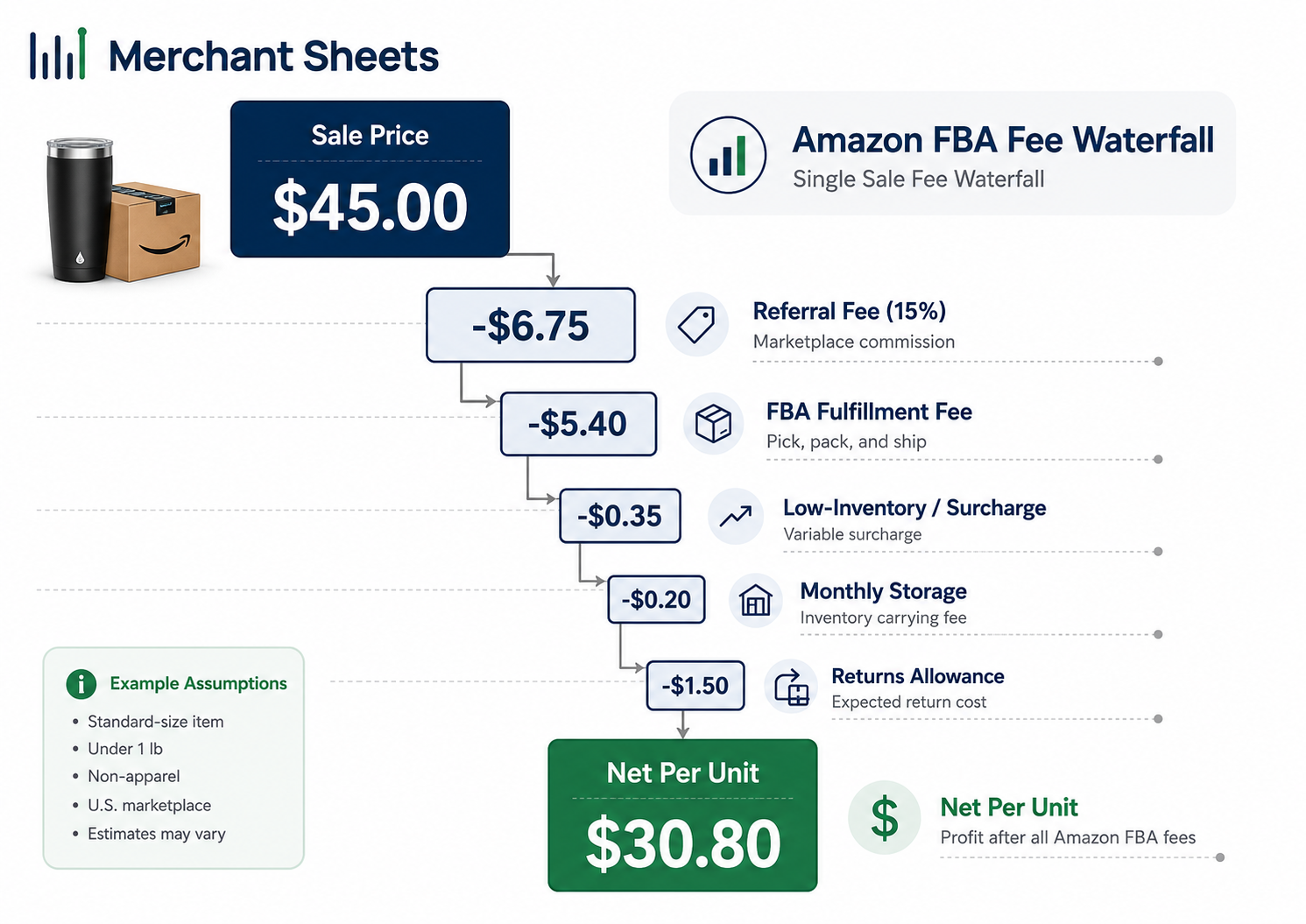
You priced your product with a healthy margin, then the payout landed lighter than the math promised. Amazon’s fees are the reason, and there are more of them than the referral cut everyone knows about. Some hit every sale, some only fire when your inventory sits too long or ships in the wrong box, and a few are new for 2026.
This guide walks through every Amazon FBA fee a seller pays in 2026, what triggers each one, the current dollar figure, and what the whole stack takes from your price on a real product.
What are Amazon FBA fees?
Amazon FBA fees are the charges you pay to sell and fulfill products through Fulfillment by Amazon (FBA): the referral fee Amazon takes on every sale, the per-unit fee to pick, pack, and ship each order, monthly storage, and a set of situational fees for things like slow inventory and returns. Together they fund selling on Amazon and letting Amazon warehouse and deliver your stock.
It helps to split them into two buckets. Selling fees apply to any Amazon seller: the referral fee and, unless you’re on the $0.99-per-item Individual plan, the $39.99 monthly Professional plan. FBA fees apply on top because Amazon holds and ships your inventory: fulfillment, storage, and the logistics fees around them.
Both buckets come out before you ever see your product cost, and together they decide your Amazon FBA profitability.
The referral fee: Amazon’s cut of every sale
The referral fee is a percentage of the total sale price, charged on every unit you sell. It runs 8% to 45% depending on category, though most categories sit at 15%, and Amazon takes a minimum of $0.30 per unit. It’s calculated on the full price the customer pays, including shipping, before any FBA fee comes off, which makes it the single largest fee on most products.
Table 1: Representative Amazon referral fees by category (US, as of 2026; confirm your category’s rate before pricing).
| Category | Referral fee |
|---|---|
| Most categories (home, kitchen, toys, beauty, grocery) | 15% |
| Consumer electronics | 8% |
| Computers | 8% |
| Automotive & powersports | 12% |
| Clothing & accessories | 17% |
| Jewelry | 20% |
| Amazon Device Accessories | 45% |
The FBA fulfillment fee: the per-unit pick, pack, and ship
The fulfillment fee is what Amazon charges to pick your product off the shelf, pack it, and ship it to the customer. It’s billed once per unit sold and set by the product’s size tier (small standard, large standard, or oversize) and its weight.
As of 2026, price is a factor too: Amazon added price-based tiers, so two items of the same size can pay different fulfillment fees depending on what they sell for.
For a standard-size item, the fulfillment fee typically runs a few dollars per unit and climbs with weight and size. Amazon raised these fees by about $0.08 per unit on average in January 2026, with larger increases on heavier and higher-priced items.
Because this fee scales with dimensions, it’s worth comparing to the fulfillment cost per order a brand pays shipping directly, since a bulky, low-price product can cost more to fulfill through FBA than it earns.
Storage fees: monthly, and the aged-inventory surcharge
You pay to keep inventory in Amazon’s warehouses, and the rate jumps in Q4. Monthly inventory storage is billed per cubic foot of space your stock occupies, and it roughly triples heading into the holidays as warehouse space tightens.
Table 2: Monthly FBA storage fees per cubic foot (US, as of 2026).
| Size type | January–September | October–December |
|---|---|---|
| Standard-size | $0.78 / cubic foot | $2.40 / cubic foot |
| Oversize | $0.56 / cubic foot | $1.40 / cubic foot |
On top of monthly storage, an aged-inventory surcharge hits stock that sits too long. As of 2026 it starts at 180 days in the warehouse, down from 270, so slow movers cost more, sooner. Dead stock is a double hit: it ties up cash and racks up storage, which is why inventory that isn’t selling is a margin problem, not only a warehouse one.
The optimization fees: low inventory and inbound placement
Two newer fees, both tied to how you run your inventory rather than to the sale itself, catch sellers off guard. The low-inventory-level fee runs $0.32 to $1.11 per unit and applies when your stock is low relative to your sales velocity; the threshold is 35 days of supply as of 2026.
The idea is that thin inventory forces Amazon into less efficient shipping, so it charges you for it.
The inbound placement service fee applies when you send inventory to fewer receiving locations than Amazon would prefer. It’s about $0.27 per unit for standard-size items and up to roughly $1.58 for large bulky ones.
Accept Amazon’s optimized split across multiple locations and the fee drops to $0, so this one is often avoidable with how you configure your inbound shipments.
Returns and refund fees
Two fees show up when an order comes back or gets refunded. The returns processing fee applies per returned unit in high-return categories such as apparel, shoes, jewelry, and some electronics accessories, running roughly $2.16 to $11.35 by size. The refund administration fee applies whenever you refund a customer: Amazon keeps the lesser of $5.00 or 20% of the referral fee it already charged.
The takeaway is that your return rate is a margin lever, not only a customer-experience number. In a high-return category, every unit that comes back carries a processing fee on top of the refunded referral cut, so a 5-point swing in returns moves your net more than most sellers expect.
The 2026 changes to price in
Amazon revises its fees every January and added a mid-year surcharge in 2026, so a fee schedule from last year is already wrong. Here’s what moved this cycle, with the dates that matter.
- January 15, 2026 fulfillment increase: FBA fulfillment fees rose about $0.08 per unit on average, more on heavier and higher-priced items, with no new fee types introduced.
- Price-based fulfillment tiers: For the first time, your selling price affects the fulfillment fee, so the same box can cost more to ship if it sells for more.
- April 17, 2026 fuel and logistics surcharge: A 3.5% surcharge now applies to all US FBA fulfillment fees; Amazon calls it temporary but has given no end date.
- Aged-inventory surcharge at 180 days: The surcharge on long-held stock now starts at 180 days instead of 270, so slow inventory is penalized earlier.
The fees sellers forget
These don’t hit every order, but they wreck a margin when they land. Keep them on your radar.
- Removal and disposal fees: Per-unit charges to pull inventory back out of Amazon’s network or have it destroyed.
- Unplanned prep and labeling: Per-unit fees when a shipment arrives not prepped to Amazon’s spec and Amazon does the prep for you.
- High-volume listing fee: A small monthly per-listing charge once your catalog gets very large.
- Professional selling plan: $39.99 a month flat, which beats the $0.99-per-item Individual plan once you’re selling more than about 40 units a month.
What the fees do to your margin
Numbers make this real. Take a standard-size product that sells for $25. Stack the fees against the price, then subtract your landed cost per unit, and you see what’s actually left. The figures below are illustrative; your fulfillment fee depends on your exact size, weight, and price tier.
Table 3: Fee stack on a $25 standard-size product (illustrative, US 2026 rates).
| Line | Amount | Running total |
|---|---|---|
| Sale price | $25.00 | $25.00 |
| Referral fee (15%) | −$3.75 | $21.25 |
| FBA fulfillment fee | −$4.75 | $16.50 |
| Fuel & logistics surcharge (3.5%) | −$0.17 | $16.33 |
| Monthly storage (per-unit share) | −$0.10 | $16.23 |
| Returns allowance | −$0.30 | $15.93 |
| Amazon fees total | −$9.07 (36%) | $15.93 |
| Landed product cost | −$8.00 | $7.93 |
In this example Amazon’s fees take about 36% of the sale price before a cent of product cost, leaving a gross margin of roughly $7.93 a unit. That looks fine until you add advertising: a few dollars of PPC per unit can push a healthy-looking price toward breakeven.
Run the real numbers on any product and you’ll know your real FBA margin before you commit to a price or a reorder.
| Amazon’s fees commonly take 30% to 40% of your sale price before product cost. A price that looks profitable on the shelf can still lose money once fulfillment, storage, returns, and ad spend come off it. |
How to lower your Amazon FBA fees
You can’t opt out of the referral fee, but several of the FBA fees respond to how you package, stock, and ship. The moves below map to the specific fees above, and they also feed the bigger question of whether FBA vs FBM makes sense for a given product and how to protect your gross margin overall.
- Shrink the package: Dimensions and weight set the fulfillment fee, and trimming them can drop you into a cheaper size tier.
- Keep inventory healthy: Stay above 35 days of supply to dodge the low-inventory-level fee and under 180 days to avoid the aged-inventory surcharge.
- Accept Amazon’s inbound splits: Taking the optimized multi-location split zeroes out the inbound placement fee.
- Mind price tiers and category: Since 2026 your price affects the fulfillment fee, so know which side of a tier you sit on and check your category’s referral rate before you set a price.
Run the fees on your own product
Reading the fee list is one thing; seeing it hit your product is another. The Amazon FBA Profitability Calculator takes your price, product cost, size, and category and stacks every fee on this page — referral, fulfillment, the fuel surcharge, storage, and a returns allowance — to show your real net margin per unit before you set a price or place a reorder.
Frequently asked questions
How much does Amazon FBA cost per item?
On a typical standard-size product, Amazon’s fees run about 30% to 40% of the sale price, combining the 15% referral fee, a per-unit fulfillment fee of a few dollars, the 3.5% fuel surcharge, and small storage and returns costs, all before your product cost.
What is the Amazon referral fee?
The referral fee is Amazon’s commission on each sale, 8% to 45% of the total sale price depending on category, with most categories at 15% and a $0.30 minimum per unit.
How are FBA fulfillment fees calculated?
Amazon sets the fulfillment fee by your product’s size tier and weight, and as of 2026 also by its selling price, charging one per-unit fee to pick, pack, and ship each order.
What changed with Amazon FBA fees in 2026?
Amazon raised fulfillment fees about $0.08 per unit on average on January 15, 2026, introduced price-based fee tiers, added a 3.5% fuel and logistics surcharge on April 17, 2026, and moved the aged-inventory surcharge to start at 180 days.
Are Amazon FBA fees tax-deductible?
Amazon FBA fees are ordinary business expenses, so they’re generally deductible against your revenue; confirm how to record and claim them with a tax professional for your situation.
