
Key takeaways
- A capital expenditure (CapEx) buys or improves a long-lived asset you’ll use for more than a year; it goes on your balance sheet and is depreciated over time instead of being expensed all at once.
- An operating expense (OpEx) is the day-to-day cost of running the business, used up in the period; it hits your income statement in full right now.
- The quick test: If a purchase gives you an asset you’ll use for years, it’s CapEx; if it’s a cost of operating this year, it’s OpEx.
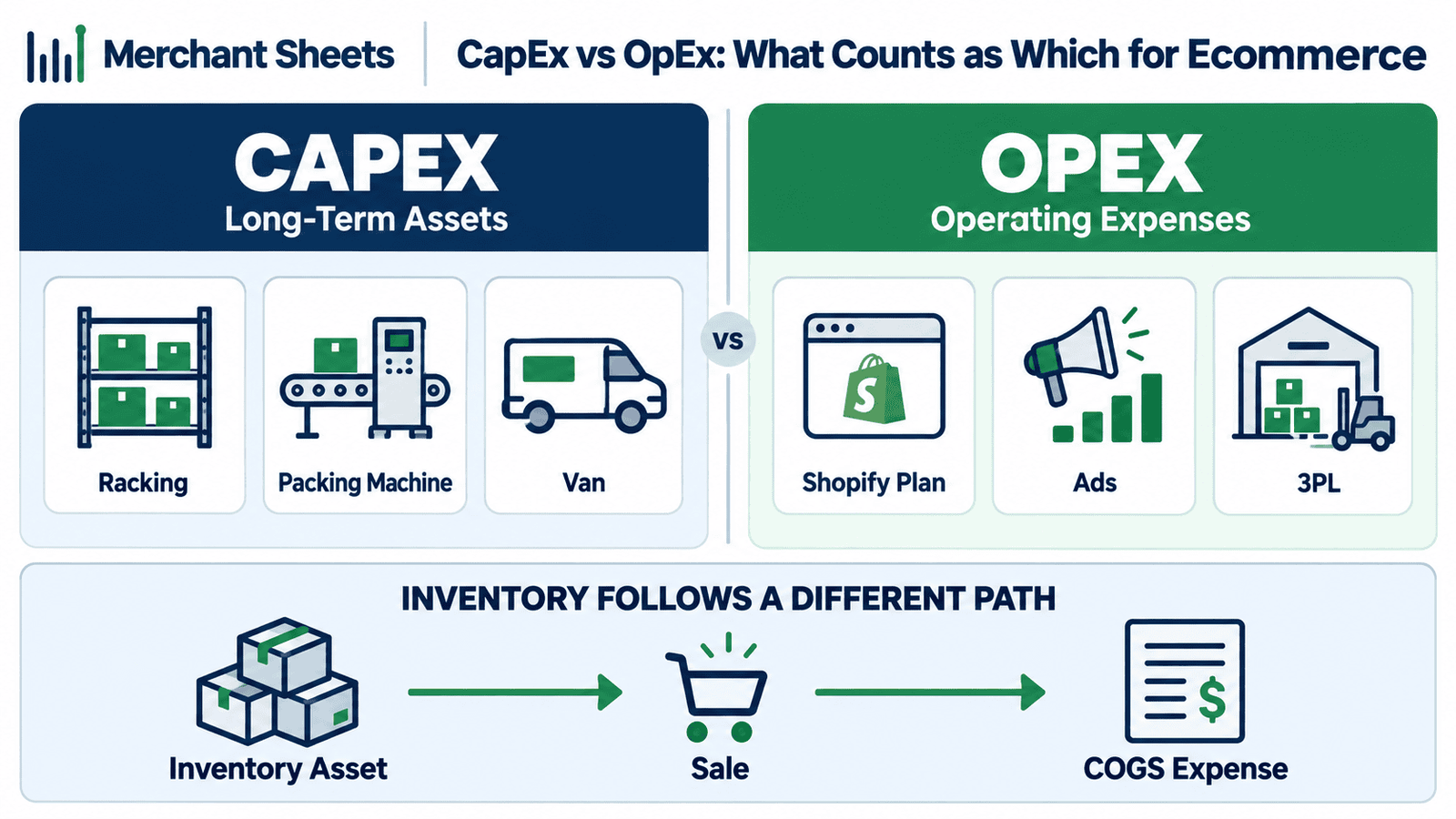
Most of what an ecommerce brand spends is OpEx: Shopify and app subscriptions, ads, 3PL and fulfillment fees, software, and contractors. - Inventory is neither CapEx nor OpEx. It’s a current asset on your balance sheet that becomes cost of goods sold (COGS) when the item sells.
- The split changes your numbers: OpEx lowers this period’s profit in full, while CapEx reaches the P&L slowly through depreciation, so it moves profit, EBITDA, and cash flow differently.
CapEx is money you spend to buy or improve a long-lived asset, like warehouse racking or a packing machine; it sits on your balance sheet and depreciates over years. OpEx is the cost of running the business day-to-day, like your Shopify plan or ad spend, expensed now.
What’s the difference between CapEx and OpEx?
A capital expenditure (CapEx) buys or improves a long-lived asset the business will use for more than a year, so it’s recorded on your balance sheet and depreciated over its useful life. An operating expense (OpEx) is a running cost used up in the current period, so it’s expensed in full on your income statement now.
The two words describe when a cost shows up in your numbers, not how big the cost is. CapEx buys something durable: a fixed asset, meaning property or equipment you’ll use across many periods. Its cost is spread over that life through depreciation, the method that expenses a long-lived asset a slice at a time.
OpEx covers what keeps the business running this month: the subscriptions, ads, fees, and contractors you use up as you go. Both flow through your three financial statements, but they land in different places and on different schedules, which the table lines up.
Table 1. CapEx vs OpEx at a glance.
| CapEx (capital expenditure) | OpEx (operating expense) | |
| What it is | Money spent to buy or improve a long-lived asset used for more than a year | The day-to-day cost of running the business, used up in the period |
| Where it’s recorded | Balance sheet, as a fixed asset, then depreciated | Income statement, expensed in full now |
| How it hits profit | A slice at a time, as depreciation over the useful life | All at once, in the period you incur it |
| Cash flow | Investing outflow | Operating outflow |
| Ecommerce examples | Warehouse racking, packing machinery, a delivery van, a multi-year custom build | Shopify and app subscriptions, ads, 3PL fees, contractors |
The one-question rule for sorting a purchase
One question sorts most purchases: does this buy an asset you’ll use for more than a year, or is it a cost of running the business this year? A lasting asset over your capitalization threshold is CapEx; a cost consumed this period is OpEx.
Two tests decide it, and a purchase has to pass both to count as CapEx. The first is useful life: the item has to last beyond a year. The second is cost: it has to clear your capitalization threshold, the dollar cutoff your business sets below which you expense an item rather than putting it on the balance sheet.
Many brands set that cutoff at $2,500 to line up with a tax rule we’ll get to below. A $180 label printer lasts for years but falls under the threshold, so you expense it; a $4,000 packing station clears both tests, so you capitalize it.
CapEx vs OpEx for an ecommerce brand: what counts as which
For most ecommerce brands, the day-to-day spend is OpEx and the occasional equipment purchase is CapEx. Your Shopify plan, apps, ads, 3PL fees, payment processing, and contractors are all OpEx. Warehouse racking, packing machinery, a delivery van, and gear over your threshold are CapEx, sorted into the fixed-asset and expense accounts in your books.
The gray area is software. A monthly subscription to Shopify, Klaviyo, or any SaaS tool is OpEx, because you’re renting access rather than buying an asset.
A large one-time build is different: pay a developer to build a custom site or internal system you’ll run for several years and that cost can be capitalized like any other long-lived asset. For the everyday tools an operator signs up for, OpEx is the answer.
Table 2. CapEx vs OpEx for an ecommerce brand.
| Purchase | CapEx or OpEx | Why |
| Shopify plan and app subscriptions | OpEx | Recurring cost of running the store, used up each month |
| Ads and marketing | OpEx | Consumed in the period you run them |
| 3PL and fulfillment fees | OpEx | Ongoing cost of shipping orders this period |
| Software (email, SMS, analytics) | OpEx | A monthly service, not an owned asset |
| Warehouse racking and shelving | CapEx | A physical asset used for years |
| Packing and labeling machinery | CapEx | Equipment with a useful life over a year |
| Delivery van or vehicle | CapEx | A long-lived asset over the capitalization threshold |
| Laptops and equipment (over your threshold) | CapEx | Used for years, if above your capitalization cutoff |
| One-time custom site or system build | CapEx (usually) | A bespoke asset used for several years; routine SaaS is OpEx |
| Inventory | Neither | A current asset that becomes COGS when it sells (see below) |
Where inventory fits (and why it’s neither)
Inventory is neither CapEx nor OpEx. The money you spend on stock becomes a current asset on your balance sheet, and it turns into cost of goods sold (COGS) on your income statement only when the item sells.
It’s easy to reach for CapEx here, because buying stock is often the biggest check you write and you’re holding something valuable afterward. But CapEx buys an asset you use to run the business, like the racking the stock sits on, while inventory is the stock itself, bought to resell.
So it follows its own path: it stays a current asset until it sells, then its cost becomes cost of goods sold at the moment of the sale, on the running beginning-inventory-plus-purchases-minus-ending-inventory math.
| Inventory isn’t CapEx or OpEx. It’s a current asset that becomes COGS the moment an item sells, so a big stock buy sits on your balance sheet, not your P&L, until it moves. |
How CapEx and OpEx hit your profit, taxes, and cash
The split decides when a cost shows up in your numbers. OpEx lowers this period’s profit in full. CapEx doesn’t: it sits on the balance sheet and reaches your P&L a slice at a time as depreciation over the asset’s useful life, so a single large purchase doesn’t turn one good month into a loss.
That timing ripples through three numbers. On profit, an OpEx cost hits now while a CapEx cost is spread across years, so how you classify a big buy changes this month’s bottom line and where each cost lands on your statements. It also shapes how your income statement reads, since a capitalized purchase shows up as depreciation rather than a single hit.
On EBITDA, the measure adds depreciation back, so heavy CapEx flatters it while the cash for that equipment has already left the bank.
On cash, OpEx is an operating outflow and CapEx is an investing one, and your free cash flow is operating cash flow minus CapEx, which is why a capital-heavy quarter can post solid profit and thin cash.
Either way, the cash leaves when you pay. The classification changes where the cost shows up and how fast, not your bank balance, though a big inventory or equipment buy still ties up your cash between paying out and earning it back. What classification also changes is how fast you can deduct it.
Can you deduct a capital purchase the year you buy it?
Often, yes. On your books, CapEx is capitalized and depreciated over years, but the tax code lets many small businesses deduct a capital purchase in the year it’s placed in service, so an item can be a fixed asset for your books and a full write-off on your taxes at the same time.
This is general information, not tax advice; confirm the current limits with your accountant. Three rules do most of the work:
- De minimis safe harbor: Elect it, and you can expense items under $2,500 each, or $5,000 if you keep audited financial statements, instead of capitalizing them. That’s the rule many brands set their capitalization threshold to match.
- Section 179: You can elect to expense the full cost of qualifying equipment in the year you buy it, up to a cap that runs to about $2.56 million for 2026, well beyond what most ecommerce brands will spend.
- Bonus depreciation: You can deduct 100% of the cost of qualifying property in the year it’s placed in service, a rule made permanent for property placed in service after January 19, 2025.
Frequently asked questions
Is inventory CapEx or OpEx?
Neither; inventory is a current asset on your balance sheet that becomes cost of goods sold on your income statement when the item sells.
Is software CapEx or OpEx?
A monthly software subscription like Shopify or Klaviyo is OpEx; a large one-time custom build you’ll use for years can be capitalized as CapEx.
Is marketing CapEx or OpEx?
Marketing and advertising are OpEx, expensed in the period you run them, even when the payoff carries into later months.
Is a website CapEx or OpEx?
A SaaS storefront plan and ongoing maintenance are OpEx; a significant one-time custom site build you’ll use for several years can be capitalized.
Are packaging and shipping supplies CapEx or OpEx?
Consumable packaging is OpEx, or part of your fulfillment cost; a packing machine you’ll use for years is CapEx.
Can I deduct a capital purchase in the year I buy it?
Often yes, through the de minimis safe harbor, Section 179, or bonus depreciation, even though it’s capitalized on your books; confirm the details with your accountant.
What's the difference between CapEx, OpEx, and COGS?
CapEx buys long-lived assets, OpEx is your running costs, and COGS is the cost of the products you sold in the period.
