
Key takeaways
- Deadstock is inventory that has stopped selling and probably won’t, which is different from slow-moving stock that still sells, just too slowly. The label decides what you do about it.
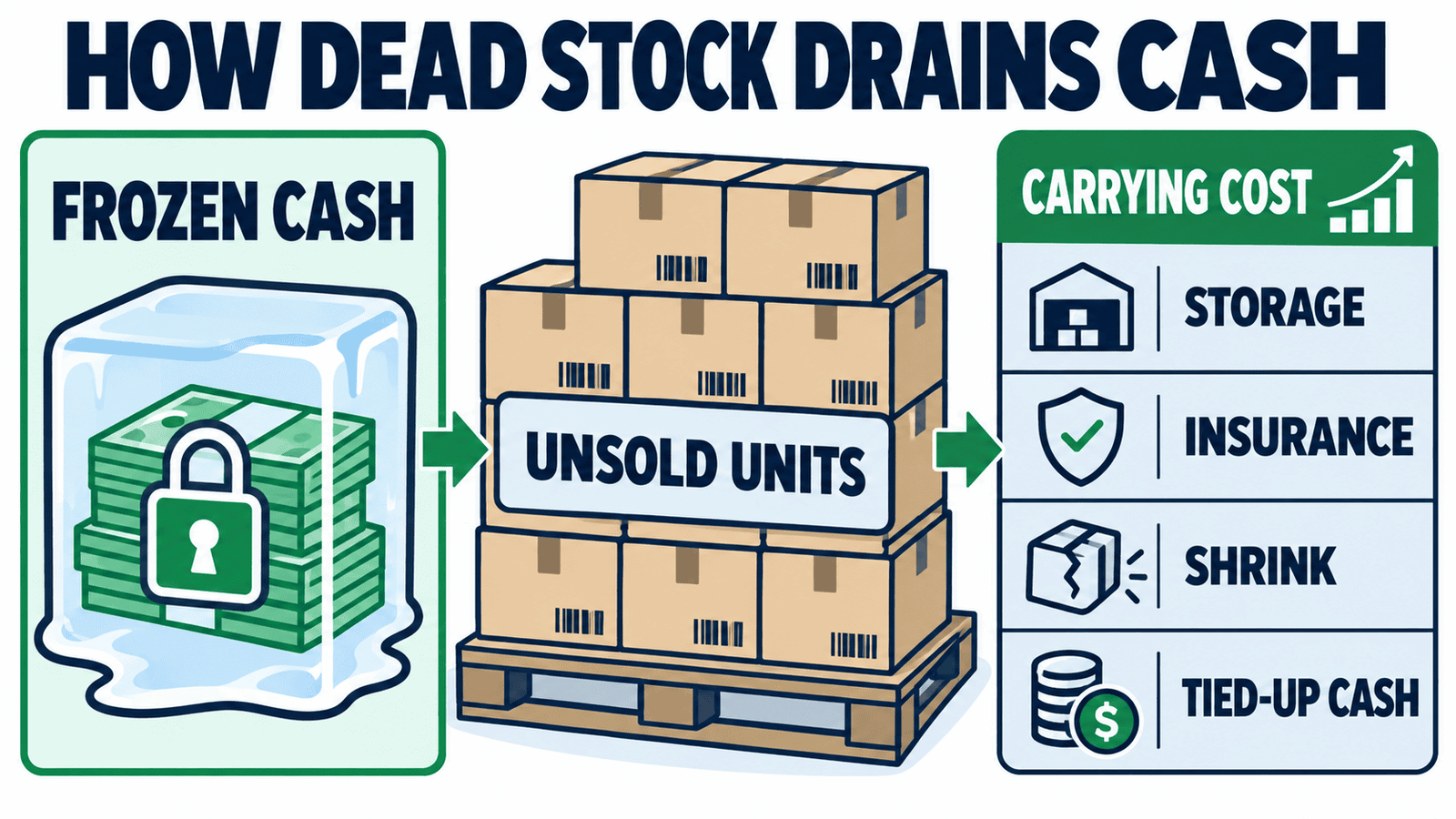
- Deadstock costs you twice: the cash frozen in the stock, and a carrying cost of roughly 20% to 30% of its value a year to keep holding it (storage, insurance, shrink, and the tied-up cash).
- On Amazon, it gets worse with age. FBA charges an aged-inventory surcharge that starts at 181 days in storage and steps up after 271 days, on top of monthly storage.
- Waiting for full price usually costs more than taking the loss now. When you clear it, the goal is to recover the most cash you reasonably can, as fast as possible.
- The ways to clear it, roughly best cash first: discount, bundle with a seller, off-price marketplace or liquidator, return to the supplier, sell B2B, donate, or scrap as a last resort.
- Deadstock is an ordering problem. Buying to a forecast, right-sizing what you reorder, and watching order minimums prevents most of it, and it’s the flip side of stockouts.
There’s a pallet in the back that hasn’t moved in months, and every week it sits there it’s costing you in storage, in the cash you can’t spend on stock that sells, and in the slow slide toward worthless.
What is deadstock?
Deadstock, also called dead inventory, is stock that has stopped selling and isn’t expected to sell, so it sits on the shelf tying up cash and space. It’s the inventory you’d struggle to move even at a discount- the units still on hand long after the demand for them faded.
The word gets used loosely, and the distinctions matter because they decide what you do. Slow-moving stock still sells, just below the pace you’d like, so it usually needs re-merchandising or a nudge on price, not a clear-out.
Obsolete stock is a subtype of deadstock that’s been superseded, expired, or damaged, so it won’t sell at any normal price.
And overstock is too much of something that still sells, which is a warning sign, not deadstock yet, though left alone it’s often how deadstock is born. A quick look at how fast your stock sells tells you which bucket a SKU (a stock-keeping unit, your internal code for one product variant) is in.
Table 1. Deadstock vs. slow-moving, obsolete, and overstock.
| Term | What it means | The move |
| Deadstock | Stopped selling, won’t move at a normal price | Clear it out and recover cash |
| Slow-moving | Still sells, just too slowly | Re-merchandise or nudge the price |
| Obsolete | Superseded, expired, or damaged (a deadstock subtype) | Write down or write off |
| Overstock | Too much of something that still sells | Slow reorders before it goes dead |
How do you spot deadstock?
You spot deadstock by flagging what hasn’t sold in a set window, adjusted for how the product normally moves. Pick a threshold that fits your catalog; a common one is no sales, or near-zero sell-through, over the last 6 to 12 months, and shorter for fast-moving or seasonal lines, then flag every SKU past it.
The point is a rule you apply the same way every month, not a gut call about which pile looks stale.
The fastest way to see it is an inventory aging report, which buckets your on-hand by how long it’s been sitting so the oldest, slowest units stand out. Pair it with sell-through rate (units sold as a share of what you had available) and days of cover (how long current stock lasts at the recent sales rate), and the deadstock separates itself from the merely slow.
Catch it early, and you still have cheap options; catch it late, and you’re down to clearing it at a loss.
What causes deadstock?
Deadstock is almost always a buying or forecasting miss, and for an ecommerce brand it comes from a short list of causes. Naming the cause matters, because each one points at a different fix.
- Over-ordering: You bought more than demand supported, often to hit a price break. The fix is to buy to a demand forecast instead of a gut feel about how well something will sell.
- A forecast that faded: Seasonal or trend demand dropped off before the stock did, leaving the tail on your shelf. Forecasts miss, so the buy has to leave room to be wrong.
- Order minimums: A supplier’s minimum order quantity forced in more units than you could realistically sell, so the overage was dead the day it landed.
- Weak product-market fit: The product just didn’t land, or the merchandising never gave it a fair shot, and it stalled at launch.
- Quality and returns: Defects, damage, or a wave of returns you can’t resell as new turn sellable stock into deadstock.
- Over-buying against stockouts: Padding every order to avoid running out of your best sellers is how the padding on the slow ones quietly goes dead.
Why deadstock sinks your cash
Deadstock costs you twice: the cash frozen in stock you can’t sell, and a carrying cost of roughly 20% to 30% of its value every year just to keep holding it. Most guides stop at “it ties up money.” The real damage is that it keeps billing you.
Start with the frozen cash. Every dollar sitting in deadstock is a dollar you can’t spend on inventory that sells, on ads, or on payroll, and for most brands, inventory is already the biggest use of cash tied up in stock. Deadstock is the worst version of that: cash locked in units that aren’t coming back as sales.
Then add the carrying cost. Storage, insurance, shrink and damage, and the opportunity cost of the money itself run to about 20% to 30% of the stock’s value a year, so a $20,000 pile of deadstock can quietly cost you $4,000 to $6,000 a year to hold, on top of the $20,000 you can’t touch.
If you sell on Amazon, it gets worse with age: FBA adds an aged-inventory surcharge that starts at 181 days in storage and steps up after 271 days, on top of monthly storage fees. The longer it sits, the more it costs to keep.
To put a rough number on it, add the cash still tied up in the stock to a year of carrying cost (the stock’s value times your carrying-cost rate), then subtract whatever you could recover by clearing it today.
That gap is what holding on is costing you. For most deadstock it grows every month you wait.
Table 2. What it costs to hold $20,000 of deadstock for a year.
| Cost of holding deadstock | What it is | On $20,000 of deadstock |
| Frozen cash | Cash you can’t spend on stock that sells | $20,000 locked up |
| Carrying cost (per year) | Storage, insurance, shrink, opportunity cost (~20–30%) | $4,000 to $6,000 a year |
| Amazon aging (FBA) | Aged-inventory surcharge after 181 days, steeper after 271 | Rises the longer it sits |
| The trend | Value drifts toward zero as it ages | Recovers less every month you wait |
How do you clear deadstock?
You clear deadstock by picking the route that recovers the most cash you reasonably can, as fast as you can, and taking the loss instead of holding out for a full price that isn’t coming. The options run roughly best-cash-first, and the right one depends on what the stock is and how fast you need the space and the money.
Discounting or a clearance section is the fastest and keeps the sale on your own site, though it recovers the least margin. Bundling deadstock with a strong seller moves units without a naked markdown.
An off-price marketplace or clearing excess through a liquidator shifts volume fast at a low price when you need the space back. Returning it to the supplier, if your terms allow, often recovers the most.
Selling B2B or to another brand can clear a whole lot at once. Donating it frees the space and can carry a tax benefit, and scrapping or writing it off is the last resort for stock nobody will pay for.
The deep liquidation playbook, choosing channels and how far to mark down, is its own subject; this is the menu and the cash logic.
Table 3. Ways to clear deadstock, roughly best cash first.
| Way to clear it | How it works | When it fits |
| Discount/clearance | Mark it down on your own site | Fast, keeps the sale in-house, recovers cash |
| Bundle | Pair it with a strong seller | Moves units without a naked markdown |
| Off-price marketplace/liquidator | Sell in bulk at a low price | You need the space and cash back fast |
| Return to supplier | Send it back under your terms | Often the best recovery, if allowed |
| Sell B2B / to another brand | Move a large lot at once | A wholesale buyer wants the category |
| Donate | Give it to a nonprofit | Clears space, possible tax benefit |
| Scrap / write off | Dispose of it and book the loss | Truly worthless, no paying buyer |
Which clearance route should you choose?
Choose by trading off three things: how much cash each route recovers, how fast it clears, and how much it risks your brand or your full-price customers. Returning to the supplier and selling B2B usually recover the most cash.
Discounting and bundling are fast and keep the sale on your own channel, but a steady clearance rack can train customers to wait for markdowns, so time-box the sale or gate it behind an outlet page or an email segment.
Liquidators clear volume fast at the lowest price, and donation or scrap is for stock with no paying buyer, where the space and the write-off are the whole win.
| The right route is the one that nets the most cash after fees and effort, within the time you can afford to wait. Recovering 40% of cost this month usually beats holding out for 70% that never comes. |
Handling the accounting and the tax
Once you’ve cleared deadstock or given up on it, the books have to catch up. You write it down or off on the books: a write-down reduces the carrying value to what the stock is now worth, and a write-off removes it entirely when it’s worthless.
Either way an expense hits your P&L and the inventory on your balance sheet drops.
The tax timing trips sellers up, so keep it straight: for taxes you generally deduct the loss when you dispose of the stock, by selling, donating, or destroying it, not in the period you flag it as dead.
Keep records of what you cleared and how, and confirm your own situation with your accountant.
How do you prevent deadstock?
You prevent deadstock by fixing the buy, since almost all of it starts as an ordering decision. The pieces below work together, and each one keeps a little more cash out of stock that won’t sell.
- Buy to a demand forecast: Order against a real projection of what each product will sell, not a round number or a price break, so you stop over-committing to the unproven.
- Right-size what you reorder: Set reorder quantities and right-sized safety stock to what sells and to your cash, so you’re not carrying months of a slow mover to buffer a fast one.
- Watch order minimums: Push back on a supplier’s minimum order quantity, or split it, when the MOQ would land more units than you can sell in a reasonable window.
- Review your oldest stock on a cadence: Check which SKUs are aging on a schedule so slow movers get caught early, while a small nudge on price or placement can still turn them.
- Plan the whole buy against cash: Build a buy plan built to your cash so the money goes to what sells, and accept a chosen service level instead of over-buying to never stock out.
Frequently asked questions
What is deadstock?
Deadstock, or dead inventory, is stock that has stopped selling and isn’t expected to sell, so it sits tying up cash and space. It’s different from slow-moving stock, which still sells, just too slowly.
What is the difference between deadstock and slow-moving stock?
Slow-moving stock still sells, just below the pace you’d like, while deadstock has effectively stopped selling and won’t move at its current price, so slow stock gets re-merchandised or discounted and dead stock gets cleared out.
How much does deadstock cost?
The cash frozen in the stock plus a carrying cost of roughly 20% to 30% of its value a year, covering storage, insurance, shrink, and the opportunity cost of the tied-up cash, and on Amazon an aged-inventory surcharge on top once units pass 181 days in storage.
How do you get rid of deadstock?
Recover the most cash you can, fastest: discount or bundle it, sell it on an off-price marketplace or to a liquidator, return it to the supplier if your terms allow, or sell it B2B, and donate or scrap it only as a last resort.
Is deadstock tax deductible?
You generally deduct the loss when you dispose of the stock by selling, donating, or destroying it, not when you flag it as dead, so keep documentation of what you cleared and confirm the treatment with your accountant.
What causes deadstock?
Over-ordering, a demand forecast that didn’t hold, order minimums that forced in too many units, weak product-market fit, quality or return issues, and over-buying to avoid stockouts. Most of it traces back to the buy.
How do you prevent deadstock?
Buy to a demand forecast, right-size what you reorder against your cash, watch supplier order minimums, and review inventory aging on a cadence so slow movers get caught before they go dead.
How is deadstock different from obsolete inventory?
Obsolete inventory is a type of deadstock that can no longer be sold at a normal price because it’s been superseded, expired, or damaged, while deadstock is the broader term for anything that has stopped selling, including stock that’s simply out of season or over-ordered and might still move at a discount.
