
Key takeaways
- Deferred revenue is cash a customer has paid you for a product you still owe, so it sits on your balance sheet as a liability until you deliver.
- Two journal entries do the work: when the cash arrives, you debit cash and credit deferred revenue, and as you deliver, you debit deferred revenue and credit revenue.
- For a physical subscription box, you recognize revenue as each box ships, and you relieve inventory and recognize its cost of goods in the same month, the part a software example leaves out.
- A pre-order is deferred revenue until the item ships, and the inventory you buy to fill it in the meantime is an asset, so a large pre-order can raise cash and inventory without adding revenue.
- On a refund or a mid-term cancellation, you reverse only the undelivered portion of deferred revenue, since the delivered part was already earned.
- Neither QuickBooks nor Xero schedules deferred revenue for a physical subscription on its own, so you run it with a liability account and a recurring monthly entry, or an app, and reconcile the balance each month.
A pre-paid annual subscription can put a year of cash in your bank, and almost none of it is revenue yet. Deferred revenue is how you record money you’ve taken but haven’t earned, and for an ecommerce business, with a real product behind every promise, booking it right means moving revenue and cost together as you ship.
What is deferred revenue, and when does an ecommerce business have it?
Deferred revenue, also called unearned revenue, is payment you’ve taken for a product you haven’t delivered yet. It sits on your balance sheet as a liability, not as revenue, and it becomes revenue only as you hand the product over. For an ecommerce business it appears whenever cash comes in ahead of the product.
An ecommerce business creates deferred revenue every time it takes money before it delivers: a pre-paid subscription or subscription box, a pre-order for stock that hasn’t shipped, a deposit on a made-to-order item, and a gift card.
It’s a liability rather than revenue because of the recognition principle, that revenue is earned when the product reaches the customer, which is covered in full in revenue recognition for ecommerce.
The two journal entries at the heart of deferred revenue
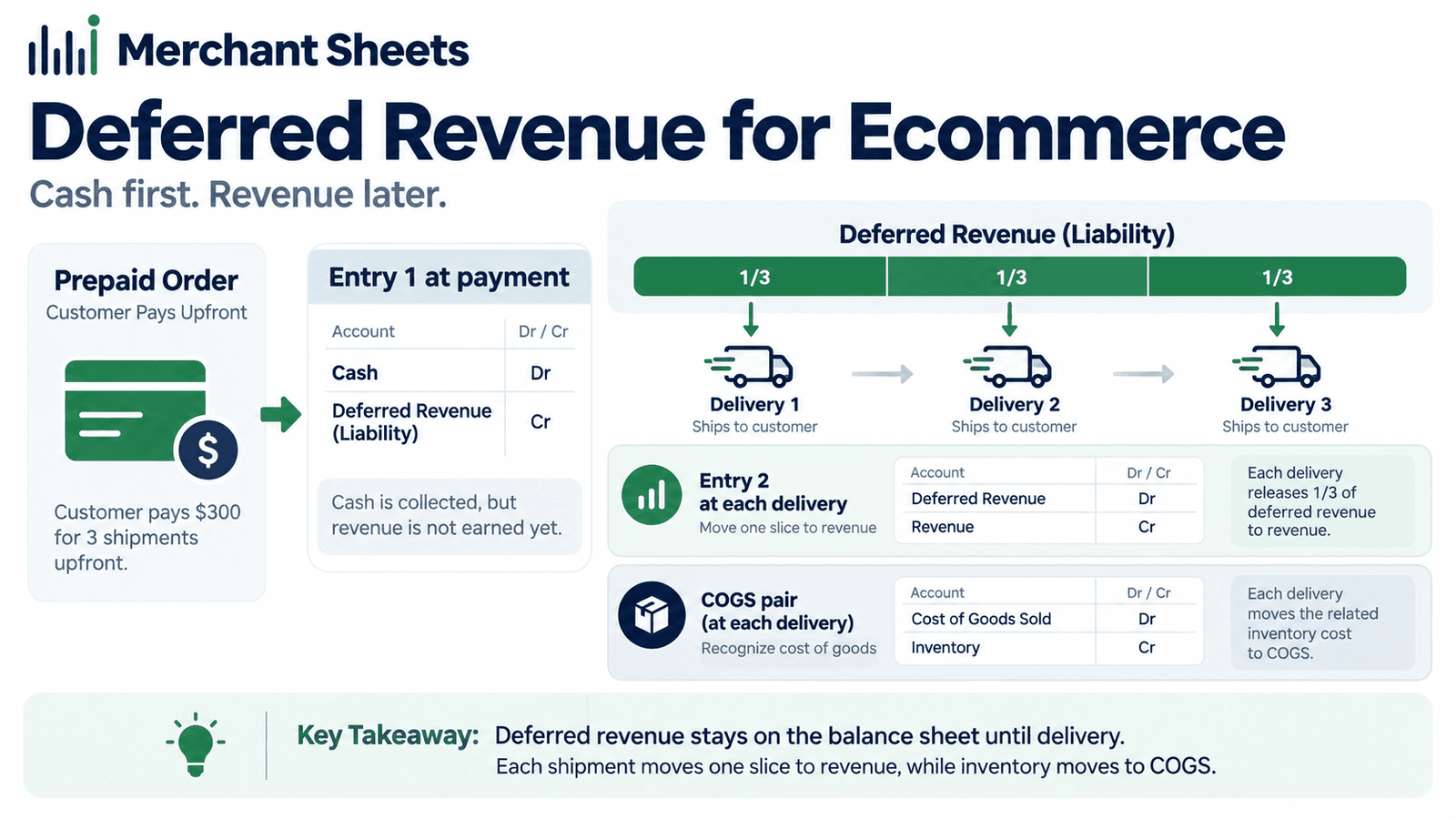
Booking deferred revenue is two entries. When the cash arrives, you debit cash and credit deferred revenue, so the money lands on your balance sheet as a liability instead of on your profit and loss statement (P&L) as revenue. Then, as you deliver, you debit deferred revenue and credit revenue, moving it off the liability and onto the P&L a piece at a time.
A debit and a credit are the two sides of every bookkeeping entry. Here the first entry parks the cash and the second earns it, and you repeat that second entry every period until the liability is back to zero.
For a physical product there’s a second pair of entries running alongside, because when you recognize the revenue for a shipped box you also relieve inventory and book its cost of goods sold (COGS), so revenue and cost move together.
Table 1. The two journal entries at the heart of deferred revenue.
| Event | Debit | Credit | What it does |
| When the cash arrives | Cash | Deferred revenue | Parks the payment on the balance sheet as a liability |
| As you deliver | Deferred revenue | Revenue | Moves an earned slice onto the P&L as revenue |
Booking a subscription box, month by month
For a pre-paid subscription box you record the full payment as deferred revenue up front, then recognize an equal slice of revenue as each box ships, and you relieve inventory and book that box’s cost of goods in the same month, so revenue and cost land together. A month-to-month plan works the same way, one month at a time.
The figures here are illustrative teaching numbers, not a real business’s. Picture a customer who pays $180 up front for a six-month box that costs $12 each to fulfill. Day one, you book $180 in cash against a $180 deferred revenue liability, with nothing in revenue or cost yet.
Each month, as a box ships, you recognize $30 of revenue, move it off the liability, and relieve $12 of inventory as the cost of goods for that box, so the month shows $30 of revenue against $12 of cost tied to the same shipment.
Over six months the liability winds down to zero and all six boxes’ revenue and cost have landed in the months they shipped.
That’s the ecommerce move a software example never has to make: revenue and cost of goods recognized together as the product goes out.
Table 2. Booking a six-month subscription box: the recognition schedule with the cost-of-goods side (illustrative numbers).
| Point in time | Cash | Revenue recognized | COGS recognized | Deferred revenue remaining |
| At sign-up (Day 1) | $180 in | $0 | $0 | $180 |
| Month 1 | – | $30 | $12 | $150 |
| Month 2 | – | $30 | $12 | $120 |
| Month 3 | – | $30 | $12 | $90 |
| Month 4 | – | $30 | $12 | $60 |
| Month 5 | – | $30 | $12 | $30 |
| Month 6 | – | $30 | $12 | $0 |
Booking pre-orders and deposits
A pre-order is deferred revenue from the day the customer pays until the day the item ships, and a deposit on a made-to-order product is deferred revenue until the item is delivered or finished.
In both cases you park the cash as a liability with the first entry and recognize it as revenue with the second when you deliver, the same as the subscription box but as a single delivery rather than a series.
With a pre-order you often take the cash weeks or months before the product exists, and the inventory you buy to fill it in the meantime is an asset on your books, so the pre-order can raise both cash and inventory while adding no revenue and no cost until it ships.
A deposit that covers only part of the price leaves the rest as an ordinary account receivable, the money a customer still owes you, due on delivery; only the amount you’ve collected sits in deferred revenue.
Where the deferred revenue and inventory accounts live is set by your chart of accounts, and the cash-versus-profit timing this creates is the working-capital story in cash vs accrual accounting.
Table 3. Booking each prepaid case at a glance.
| Case | When the cash arrives | When revenue is recognized | The recognition entry |
| Subscription box | At sign-up (prepaid) or each cycle | As each box ships | Debit deferred revenue, credit revenue (per box) |
| Pre-order | When the order is placed | When the item ships | Debit deferred revenue, credit revenue (at ship) |
| Deposit (made-to-order) | When the deposit is taken | When the item is delivered or finished | Debit deferred revenue, credit revenue (on delivery) |
| Gift card | When the card is sold | On redemption; breakage over time | Debit deferred revenue, credit revenue (on redemption) |
Gift cards and the breakage question
Selling a gift card creates deferred revenue, and redeeming it for product turns that into revenue, booked with the same two entries as everything else. The wrinkle is breakage, the share of gift-card value a business never sees redeemed, which you bring into revenue gradually in proportion to how your customers actually redeem, rather than all at once or never.
On sale, you debit cash and credit deferred revenue for the full card value. On each redemption, you debit deferred revenue and credit revenue for the amount spent, and relieve the cost of the product taken.
For breakage, once you have enough redemption history to estimate the share that will never be used, you recognize that share as revenue on the same pattern your real redemptions follow, so the liability doesn’t sit on your books forever.
Refunds, cancellations, and churn
When a customer cancels or asks for a refund on something you haven’t fully delivered, you reverse only the undelivered portion of deferred revenue, because the part you already delivered was already earned.
You debit deferred revenue and credit cash for the refund of the unshipped remainder, and the revenue and cost you already recognized on delivered boxes stay put.
Take the running example. If the six-month subscriber cancels after two boxes, you’ve recognized $60 of revenue and $24 of cost on the two shipped boxes, and $120 of deferred revenue is left on the liability. Refunding the four remaining boxes means debiting deferred revenue $120 and crediting cash $120, which clears the liability without touching the revenue you already earned.
If your terms are non-refundable, you recognize the remaining balance as revenue instead of refunding it, on the date the cancellation makes delivery impossible. This is also where subscription churn shows up in the books, and what a normal rate looks like by category is its own benchmark in subscription churn.
How to set up deferred revenue in QuickBooks or Xero
Neither QuickBooks nor Xero schedules deferred revenue for a physical subscription on its own, and your sales channel records the sale at checkout as income, so you run deferral as a small monthly layer on top of your ecommerce bookkeeping: a liability account plus a recurring recognition entry, or a purpose-built app.
Work through these steps:
- Create a deferred revenue liability account: add it to your chart of accounts, and if you sell more than one prepaid thing, add a sub-account or a class for each of subscriptions, pre-orders, and gift cards.
- Point the prepaid sale at the liability: set the cash from a subscription, pre-order, or gift card to land in deferred revenue rather than an income account when the channel syncs it.
- Build a recognition schedule for each order: note the amount, the number of periods or the ship date, and the revenue to release each month.
- Book the monthly recognition entry: debit deferred revenue and credit revenue for the amount delivered that month, as a recurring journal entry or through a deferred-revenue app.
- Recognize the matching cost of goods at fulfillment: relieve inventory and book COGS as each box or order ships, so revenue and cost land in the same month.
- Reconcile the deferred revenue balance monthly: tie the balance to what you still owe, so it equals the undelivered orders and nothing is stranded or double-counted.
Frequently asked questions
Is deferred revenue an asset or a liability?
Deferred revenue is a liability because it’s money you owe the customer for product, so it sits on the balance sheet as a liability, usually a current one, and becomes revenue only as you deliver.
How do you record a deferred revenue journal entry?
When you receive the cash, you debit cash and credit deferred revenue, and as you deliver, you debit deferred revenue and credit revenue, repeating the second entry each period until the liability reaches zero.
How is subscription revenue recorded in accounting?
You record the payment as deferred revenue up front and recognize it as revenue over time as you deliver, so a physical box is earned as each box ships and a membership is earned evenly across the period it covers.
When do you recognize revenue on a pre-order?
You recognize revenue on a pre-order when the item ships and control passes to the customer, so the pre-payment sits in deferred revenue from the day it’s paid until the day it’s fulfilled, no matter how far ahead the order was placed.
Is a gift card deferred revenue?
Yes, a gift card sits in deferred revenue from the moment it’s sold and moves into revenue as it’s redeemed for product, with the unredeemed share, known as breakage, brought into revenue gradually as your customers spend the cards down.
Does QuickBooks handle deferred revenue automatically?
No, QuickBooks and Xero don’t schedule deferred revenue for a physical subscription on their own, so you run it with a liability account and a recurring monthly journal entry, or a deferred-revenue app, and reconcile the balance each month.
How do you account for a subscription refund or cancellation?
You reverse only the undelivered portion of deferred revenue, debiting deferred revenue and crediting cash for the unshipped remainder, while the revenue and cost you already recognized on delivered boxes stay in place.
What is the difference between deferred revenue and accounts receivable?
Deferred revenue is cash you’ve collected but not yet earned, a liability, while accounts receivable is revenue you’ve earned but not yet collected, an asset, so the two sit on opposite sides of the balance sheet.
