
Key takeaways
- FBA (Fulfillment by Amazon) means Amazon stores, packs, and ships your product; FBM (Fulfilled by Merchant) means you handle storage and shipping yourself while still selling on Amazon.
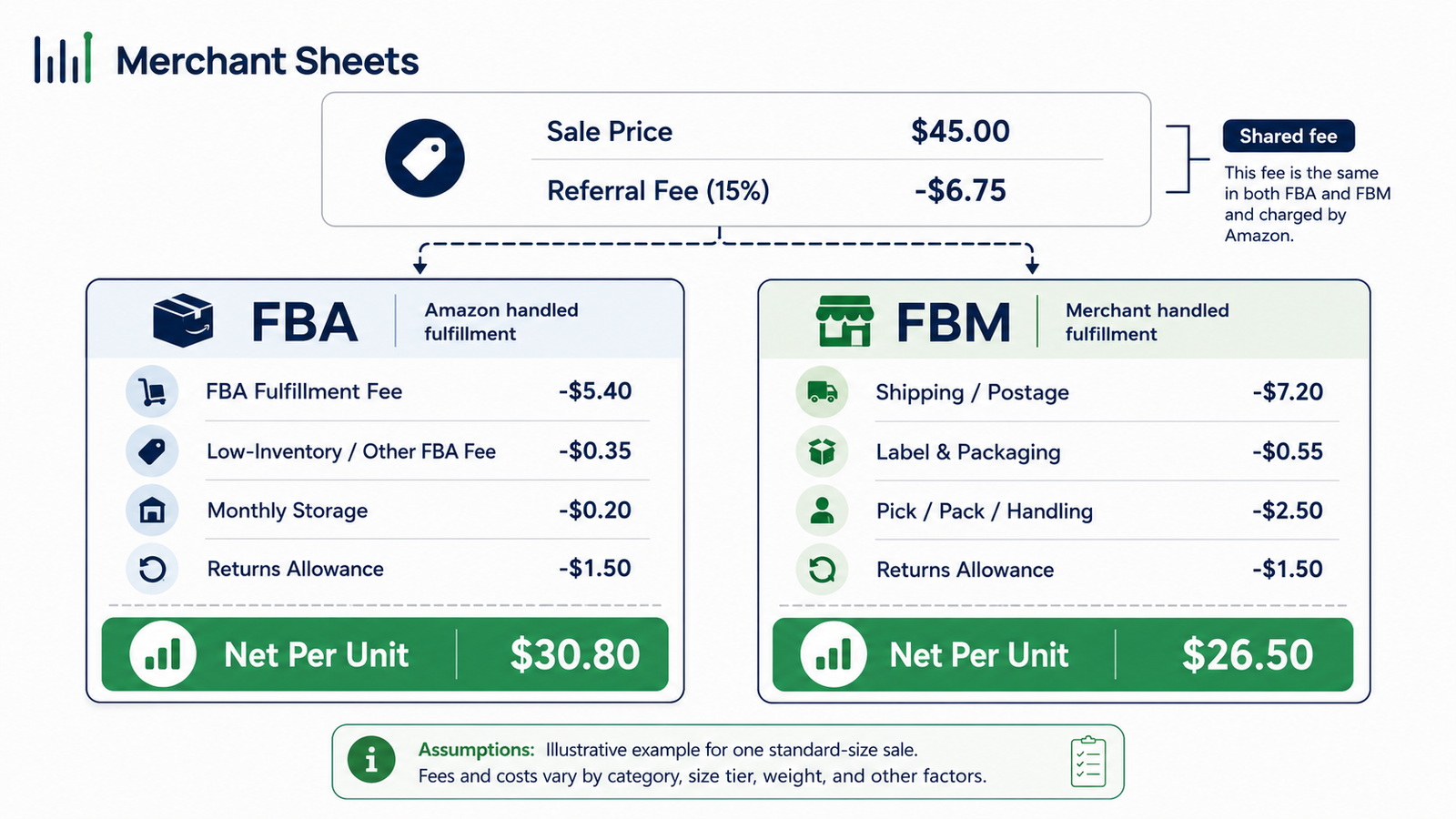
- The referral fee applies to both models; FBA adds fulfillment, storage, and optimization fees, while FBM replaces those with your own warehousing, labor, postage, and customer-service costs.
- FBA includes the Prime badge, which can lift conversion 15% to 30% in competitive listings; FBM products don’t show the Prime badge unless the seller qualifies for Seller-Fulfilled Prime.
- FBM tends to win on heavy, oversize, slow-moving, or thin-margin products, where FBA’s fulfillment and storage fees outweigh the conversion premium.
- There’s no catalog-wide answer: the choice is per SKU, and most established sellers run a hybrid, using FBA for fast movers and FBM for the rest.
Ask which is more profitable, FBA or FBM, and most answers give you a blanket rule. The real answer depends on the product in front of you. A light, fast-selling item and a heavy, slow one can point in opposite directions, and picking the wrong model can quietly cost you more per unit than the fees you were trying to avoid.
This guide compares what each fulfillment method actually costs, the Prime-badge trade-off that decides more sales than the fees do, and a framework for choosing the right one for a specific product.
What’s the difference between FBA and FBM?
FBA, or Fulfillment by Amazon, means you send inventory to Amazon’s warehouses and Amazon stores it, picks and packs each order, ships it, and handles customer service and returns. FBM, or Fulfilled by Merchant, means you list on Amazon but store the inventory and ship every order yourself.
Both models pay Amazon’s referral fee on each sale; they differ in who does the fulfillment and what that work costs.
That difference is the whole decision, and it sits inside your wider Amazon FBA profitability picture. FBA buys convenience and the Prime badge at the price of Amazon’s fee stack. FBM strips those fees away but hands you the shipping, the labor, and the service. Which one leaves more per unit depends on the product.
What each model actually costs
Start with what’s the same. Both models pay the referral fee, 8% to 45% of the sale price depending on category and most often 15%, plus the $0.99-per-item Individual fee unless you’re on the $39.99 monthly Professional plan. Everything after that diverges.
FBA adds a per-unit fulfillment fee set by size, weight, and now price, monthly storage, and the newer optimization fees for low inventory, inbound placement, and aged stock. FBM adds none of those, but you take on warehousing, pick-and-pack labor, postage, packaging, and returns handling.
For the full detail on the FBA side, see Amazon’s FBA fees; for the FBM side, benchmark your own shipping against the average fulfillment cost per order a brand pays.
Table 1: What each fulfillment model charges (US, as of 2026).
| Cost line | FBA | FBM |
|---|---|---|
| Referral fee | 8–45% (most 15%) | 8–45% (most 15%) |
| Per-item / plan fee | $0.99 (Individual) or $39.99/mo (Pro) | Same |
| Fulfillment | Amazon per-unit fee by size, weight, price | Your postage + packaging |
| Storage | $0.78–$2.40 / cubic foot monthly, plus surcharges | Your warehouse or 3PL cost |
| Pick, pack & ship labor | Included | Your labor |
| Customer service & returns | Amazon handles it | You handle it |
| Prime badge | Included | Only via Seller-Fulfilled Prime |
The Prime badge and the Buy Box
The fees get the attention, but the Prime badge decides more sales. FBA listings show the Prime badge automatically, which lifts conversion — commonly cited at 15% to 30% in competitive categories — and strengthens your position in the Buy Box, the box where most purchases happen.
FBM listings don’t carry the Prime badge unless the seller qualifies for Seller-Fulfilled Prime (SFP), the program that lets you self-fulfill while keeping the badge.
SFP isn’t a light commitment. As of 2026 it requires a track record of at least 100 seller-fulfilled orders, a cancellation rate under 2.5%, valid tracking above 95%, and a late-shipment rate under 4%. From July 6, 2026, the delivery-speed bar rose too: standard-size items need one-day delivery on 40% of Prime customer page views and two-day on 75%.
In a shared, competitive listing, Prime eligibility is close to the cost of playing; on a unique listing you own outright, it matters far less.
| In a competitive listing, the Prime badge’s conversion premium usually outweighs the FBA fee gap. On a listing only you sell, the badge matters much less — which is often where FBM starts to win. |
When FBA is more profitable
FBA earns its fees when the product and the listing play to its strengths.
- Small, light products: Amazon’s bulk shipping rates usually beat what you’d pay to ship a lightweight item yourself.
- Fast movers: High velocity clears inventory before monthly storage and aged-inventory fees pile up.
- Competitive listings: When several sellers share a listing, the Prime badge wins the Buy Box and the conversion premium is real.
- Hands-off operations: Amazon absorbs the pick-pack, shipping, customer service, and returns you’d otherwise staff for.
When FBM is more profitable
FBM pulls ahead when the FBA fee stack outweighs what it buys you.
- Heavy or oversize items: FBA fulfillment can run far more than self-shipping, so a bulky product often nets more through FBM.
- Slow movers: Skipping monthly storage, aged-inventory, and low-inventory-level fees protects margin on stock that sits.
- Thin margins: When there’s little room per unit, stripping the FBA fees can be the difference between profit and loss.
- Specialty and branded goods: Custom packaging, insert cards, and a branded unboxing are only possible when you pack it yourself.
A worked cost comparison
Two products make the point. A light, low-cost item usually costs less to fulfill through FBA than to ship yourself, and it picks up the Prime badge on top. A heavy or oversize item flips the math: self-shipping can undercut the FBA fulfillment fee by several dollars a unit.
The figures below are illustrative — run your own in the calculator to know your real FBA margin, and read the difference against your gross margin per unit.
Table 2: Fulfillment cost by model on two products (illustrative, US 2026).
| Product | FBA fulfillment fee | FBM self-ship cost | Lower-cost model |
|---|---|---|---|
| Light item (~12 oz, $20) | ~$4.75 | ~$6.50 | FBA (plus Prime badge) |
| Heavy item (~5 lb, $60) | ~$23.50 | ~$18.00 | FBM (~$5.50 back per unit) |
The hybrid approach most sellers land on
The mature answer is that you don’t have to choose once for everything. Many established sellers run both: FBA for fast-moving, competitive SKUs that need the Prime badge, and FBM for heavy, slow, seasonal, or specialty items where the fees would eat the margin.
The call is made per SKU and revisited as velocity and fees change, not set once for the whole catalog.
A hybrid also hedges risk, since a storage-fee spike or an FBA capacity limit won’t take down every product at once, and it keeps your blended numbers closer to the average ecommerce profit margins a healthy brand targets.
How to decide for your product
Four factors settle most decisions. Weigh them for a single SKU, not the whole catalog, and remember that ad costs apply either way, so know your break-even ACoS before you lean on paid traffic to carry a thin-margin listing.
Table 3: Which fulfillment model each factor favors.
| Factor | Favors FBA | Favors FBM |
|---|---|---|
| Size & weight | Small, light | Heavy, oversize |
| Sales velocity | Fast-moving | Slow or seasonal |
| Margin per unit | Comfortable | Thin |
| Listing competition | Shared, competitive | Unique or your own brand |
Run FBA vs FBM on your own product
The framework narrows it; the numbers settle it. The Amazon FBA Profitability Calculator lets you run the same product both ways — Amazon’s fulfillment and storage fees against your own shipping and handling costs — so you can see the net margin per unit each model leaves before you commit a single SKU.
Frequently asked questions
Is FBA or FBM more profitable?
It depends on the product: FBA usually wins on small, fast-moving items in competitive listings where the Prime badge lifts conversion, while FBM wins on heavy, slow, or thin-margin products where its fulfillment and storage fees would outweigh that premium.
What is the difference between FBA and FBM?
With FBA, Amazon stores, packs, ships, and handles service and returns for you; with FBM, you sell on Amazon but store the inventory and fulfill every order yourself.
Do FBM sellers pay referral fees?
Yes, the referral fee applies to every Amazon sale regardless of fulfillment method, so FBM sellers pay the same 8% to 45% category rate as FBA sellers; they simply avoid the FBA fulfillment and storage fees.
Can FBM sellers get the Prime badge?
Only through Seller-Fulfilled Prime, which lets you self-fulfill with the Prime badge but requires meeting Amazon’s shipping-speed and reliability metrics, including the tighter delivery thresholds that took effect July 6, 2026.
Can you use both FBA and FBM?
Yes, and most established sellers do — running FBA for fast-moving, competitive SKUs and FBM for heavy, slow, or specialty items is the common hybrid strategy, decided product by product.
