
Key takeaways
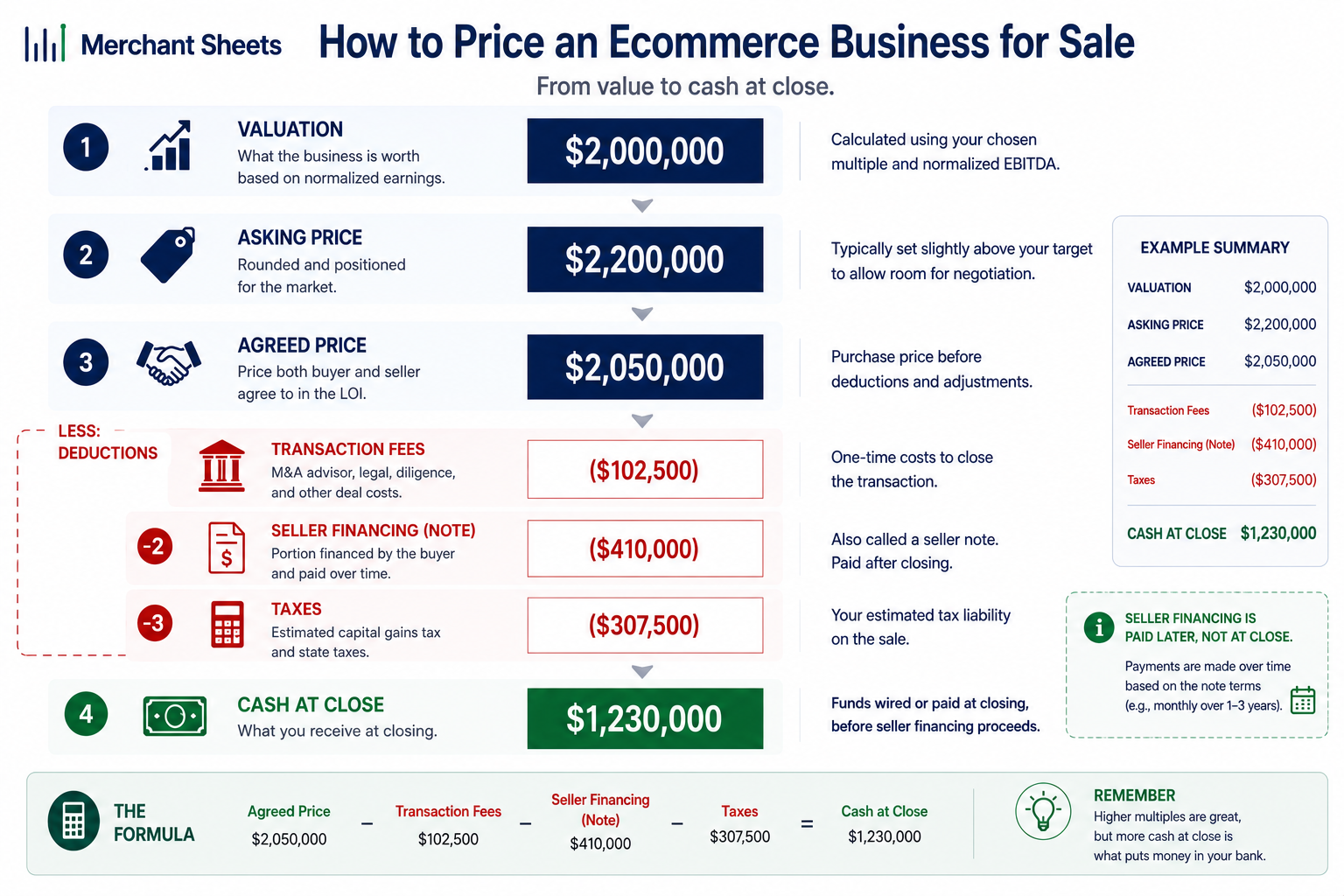
- Pricing a business for sale starts from its valuation, an earnings figure times a multiple plus inventory at cost, then turns that into an asking price and a realistic net.
- Most sub-$5M ecommerce businesses are priced on seller’s discretionary earnings (SDE), commonly around 2.5x to 4x as of 2026, while larger, team-run brands price on EBITDA at roughly 3x to 6x.
- Set the asking price above the number you’d accept to leave room to negotiate: about 5% to 10% over in a competitive auction, and 15% to 20% in a single-buyer talk.
- Overpricing is the costly mistake, because an ask well above market screens out serious buyers and leaves the listing to sit for months before selling at a discount.
- Where you sell sets both the buyers you reach and the fee, from low-cost marketplaces for small businesses to curated brokers charging roughly 8% to 15%.
- The headline price isn’t your take-home: fees, seller financing, inventory, and taxes decide what actually lands in your account.
A valuation tells you what your business is worth. An asking price is what you put in front of buyers, and the two aren’t the same number.
Pricing an ecommerce business for sale means turning a defensible value into a listing price the market will meet, then protecting what you keep once fees, deal structure, and tax come out. Here’s how we’d price it as your CFO.
How do you price an ecommerce business for sale?
To price an ecommerce business for sale, start from its valuation: an earnings figure (SDE or EBITDA) times a multiple, plus inventory at cost, then set an asking price a little above the value you’d accept so you have room to negotiate. Where you sell and how the deal is structured decide what you actually keep.
Think of it as three moves: establish a defensible value, set an asking price for the buyers you’ll attract, and protect the net once fees and structure come out.
Get the first one wrong and the rest doesn’t matter, because a price the earnings don’t support gets discounted the moment a buyer runs the numbers.
Start from the valuation, not the price you want
Your asking price has to sit on top of a value you can defend, or serious buyers walk. The value of an ecommerce business gets built the same way most small businesses are: take an earnings figure, multiply it by a market multiple, then add inventory at cost and subtract any debt.
Below about $5M in revenue, that earnings figure is usually seller’s discretionary earnings (SDE), your profit with the owner’s pay and one-off costs added back; larger, team-run brands are priced on EBITDA, earnings before interest, taxes, depreciation, and amortization.
The trap is pricing on the number you need for whatever comes next instead of the number the earnings support. Buyers don’t pay for your plans. Set the value from the financials first, then decide how to price around it.
Which 12 months you get priced on
Online businesses are usually priced on the trailing twelve months (TTM) of earnings, the most recent twelve months of profit. Buyers weight recent performance most, so the shape of the year before you list is the number you’ll be measured on.
A flat-to-growing trend supports the multiple; a declining one pulls it down, and whether now’s the right time to sell is its own decision worth making before you price.
One caution on a strong year: if your TTM captures a one-time spike, a single viral product or a seasonal bump that won’t repeat, a buyer will normalize it downward and price off what looks sustainable. Price on earnings you can defend as repeatable.
If the last few months are soft, a quarter or two of clean, steady numbers before you list can be worth more than rushing to market now.
How far above your target should you set the ask?
Set the asking price above the number you’d accept, because it’s an opening anchor, not the deal price. How far above depends on how many buyers you’ll have. A competitive auction needs only a small cushion, while a single-buyer conversation needs a wider one, since a lone buyer has all the leverage to negotiate down.
A rough rule holds here: in a one-buyer talk, a “fair” asking price often gets ground down toward 80% of the ask, so the cushion is what protects your real target. The premiums below scale with how much competition you can create.
Table 1. How far above your target price to set the ask, by sale process (as of 2026; verify before you list).
| Sale process | Buyers in play | Premium over target |
|---|---|---|
| Competitive auction | 8+ bidders | 5% to 10% |
| Limited auction | 3 to 5 bidders | 10% to 15% |
| Single-buyer negotiation | 1 buyer | 15% to 20% |
| Thin comparables or niche | 1 buyer | 20% to 30% |
Why overpricing costs you the sale
The most expensive pricing mistake is aiming too high. An ask well above what the market supports, and the classic error is around 50% over, tells buyers you’re unrealistic. Serious buyers screen out, tire-kickers trickle in, and the listing sits while comparable businesses in recent marketplace transaction data change hands at sensible numbers.
A stale listing works against you twice. It loses momentum, and every later buyer asks the same question, why hasn’t this sold, then uses it to justify a lower offer. Price to sell within about twelve months.
A slightly conservative ask that draws several interested buyers usually closes higher than a greedy one that draws none, because competition, not the sticker, is what lifts the final price.
| Overpricing doesn’t get you more, it gets you a stale listing. An ask far above market screens out the serious buyers and leaves the tire-kickers, so the business sits, then sells at a discount to whoever’s left wondering why it didn’t move. |
Where you sell changes the price and the fee
Where you list decides both the buyers you reach and the fee that comes out of your proceeds. Open marketplaces suit smaller businesses: they’re cheap to list, put you in front of the widest audience, and leave you to run the sale, with median small-business sale prices sitting in the low six figures.
Curated brokers and marketplaces suit larger deals: they vet buyers, manage the process, and charge a success fee off the top, usually the single biggest cost of selling.
The fee matters less than the buyer it brings. A broker who charges 12% but surfaces a competitive buyer can net you more than a cheap listing that draws one lowball offer. Match the venue to your size, and read the fee as part of your net rather than a sticker to avoid.
Table 2. Where to sell an ecommerce business and what it costs (as of 2026; verify current fees before you list).
| Venue | Typical deal size | Fee |
|---|---|---|
| BizBuySell (open marketplace) | Small businesses, median sale near $350,000 | Subscription listing fee, no commission |
| Flippa | Under $100,000 to about $50M | Listing fee plus about a 10% success fee, tiering down on large deals |
| Empire Flippers | $100,000 to $10M | About 15% under $700,000, dropping to about 8% above |
| Acquire.com | $250,000 to $1M+ | About 6% to 8% closing fee |
| Quiet Light, Website Closers | $250,000 to $25M | About 8% to 12% |
The headline price isn’t what you keep
The number you shake hands on isn’t the number you bank. A smart seller prices with the net in mind and reads the deal terms as closely as the total, because most small business sales include some seller financing. Four things stand between the headline price and your account:
- Deal structure: All-cash at close is the cleanest outcome, but most sub-$5M sales carry part of the price as a seller note you collect over time, and some tie a slice to future performance through an earnout. Cash at close is the part that’s certain.
- Fees: The broker or marketplace success fee comes off the top, roughly 8% to 15% on a curated sale, and it usually applies to the whole transaction, inventory included.
- Inventory: Sellable stock is normally paid on top of the business price at its landed cost, so it adds to the headline number rather than sitting inside the earnings.
- Taxes: How the deal is structured, an asset sale or a share sale, cash or a note, changes your tax bill, so the after-tax figure is the one that actually decides your outcome.
A worked example: from value to asking price to net
Round numbers make the moves clear. Say a Shopify DTC brand earns $300,000 in SDE over the trailing twelve months and prices at a 3.0x multiple, for a business value of $900,000.
Add $80,000 of inventory at landed cost, and the indicative value is about $980,000. Selling through a broker to a small pool of buyers, you set the ask around 15% above the business value, so the brand lists near $1.05M plus inventory.
Here’s where the headline and the take-home part ways. The $980,000 gross and the roughly $682,000 that clears at close are different numbers, and a carried seller note plus taxes still sit between you and the rest.
Table 3. From agreed price to cash at close (illustrative; a broker fee of 12% and a 20% seller note).
| Line | Amount |
|---|---|
| Agreed business price | $900,000 |
| Plus inventory at landed cost | $80,000 |
| Gross sale price | $980,000 |
| Less broker fee (12% of gross) | ($117,600) |
| Less seller note carried (20% of business price) | ($180,000) |
| Cash at close, before tax | $682,400 |
Frequently asked questions
How much can I sell my ecommerce business for?
Most sub-$5M ecommerce businesses sell for roughly 2.5x to 4x seller’s discretionary earnings plus inventory at cost as of 2026, so a brand with $300,000 in SDE and $80,000 of stock might list around $900,000 to $1.2M before fees. The exact figure turns on growth, risk, and channel.
What's the difference between a valuation and an asking price?
A valuation is the defensible estimate of what the business is worth, while the asking price is what you list it at, usually set a little above the value you’d accept so you have room to negotiate down. Buyers treat the ask as an opening anchor, not the final number.
Should I price an Amazon or Shopify business differently?
The method is the same: an earnings multiple plus inventory, but an Amazon-heavy business often carries a lower multiple because platform concentration is a risk, and FBA multiples have softened recently. Verify current comparable sales for your channel before you set a price.
How do I price my business to sell fast?
Price close to a defensible market value rather than reaching, list where buyers your size actually shop, and have clean, verifiable books ready, because an accurately priced business with tidy financials sells far faster than an overpriced one. Speed comes from a credible number, not a low one.
Do I pay the broker fee on the inventory too?
Usually yes, since most brokers and marketplaces charge their success fee on the total transaction value, which typically includes inventory sold at cost. Factor the fee into your net before you agree a price so the take-home number is the one you’re negotiating.
How much less than the asking price do businesses sell for?
It depends on the process: in a single-buyer negotiation, a business often sells for around 80% of a “fair” ask, while a competitive auction with several bidders can close much closer to, or occasionally above, the asking price. More competition means a smaller gap.
Price it right before you list
Pricing a business to sell is a one-time decision with a lot riding on the number. As your fractional CFO, I build a valuation you can defend, set an asking price the earnings support, and model the deal structure so you know what actually lands in your account at close.
This article is general information, not financial, tax, or legal advice. Selling a business carries tax and legal consequences that vary by situation; confirm yours with a qualified professional before you act.
