
Key takeaways
- Inventory accuracy is how closely your records match what’s physically there; shrinkage is the specific loss when the real count comes up short of the books.
- Measure accuracy as your record accuracy rate, matched items over items counted, with well-run operations targeting about 97% to 99%.
- Calculate shrinkage as (recorded inventory minus actual inventory) divided by recorded inventory, times 100; a healthy rate is low single digits of inventory value.
- For an ecommerce brand, shrinkage is mostly administrative and warehouse error, damage, returns issues, and 3PL discrepancies, with shoplifting a small slice.
- You fix it with process: regular counting, tight receiving and returns controls, clean SKUs and barcodes, and a 3PL you reconcile against.
- Don’t chase 100% on every SKU; prioritize accuracy on your high-value items and set a tolerance for the cheap, low-risk tail.
Your system says you have 40, the shelf has 34, and the six that vanished are the difference between a clean month and an oversell.
That gap has two names: inventory accuracy is how well your records match reality, and shrinkage is the stock you’ve lost along the way.
Inventory accuracy vs shrinkage: what’s the difference?
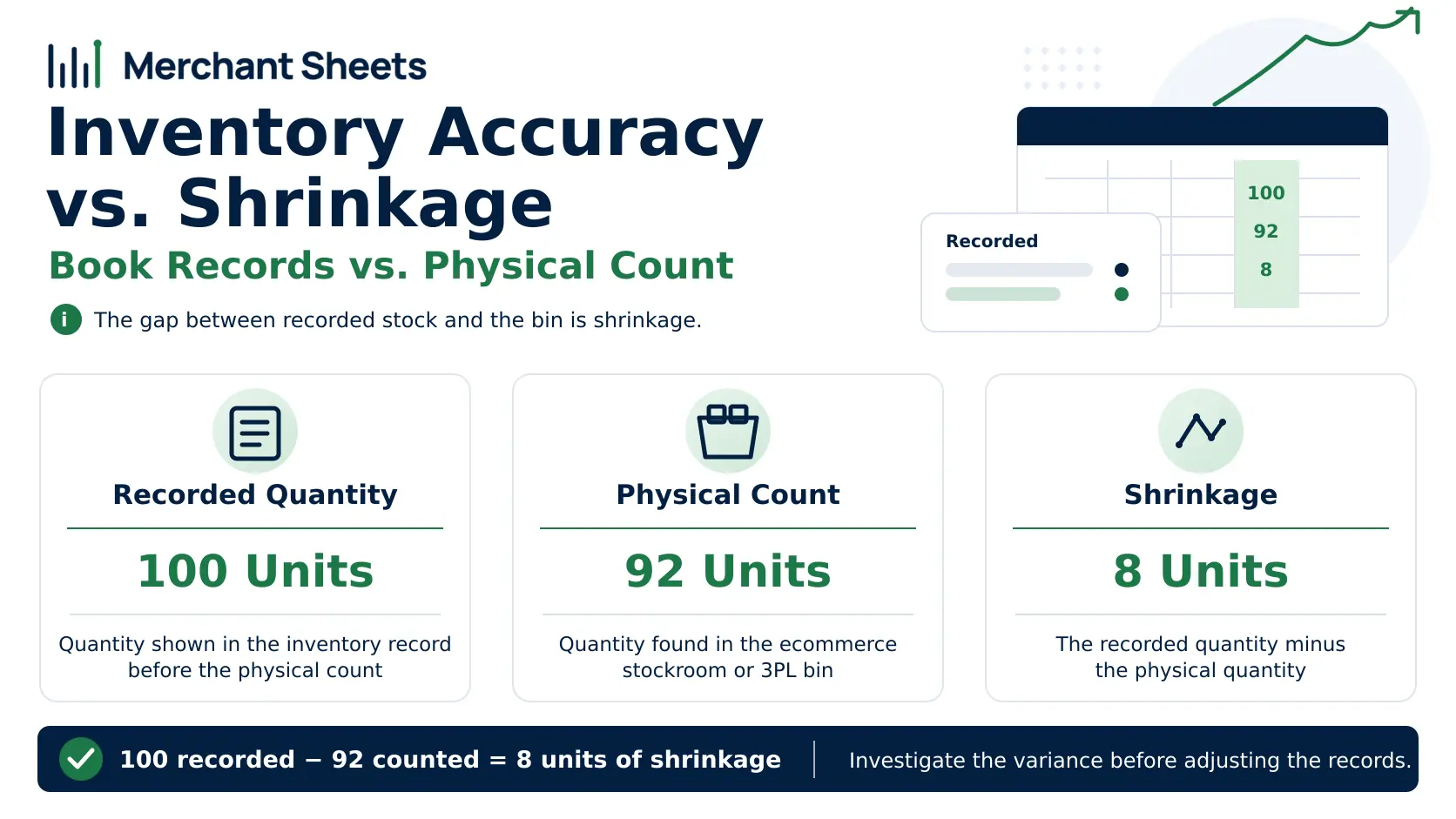
Inventory accuracy, also called inventory record accuracy, is how closely your recorded quantities match a physical count. Inventory shrinkage is the loss you find when that count comes up short of the records.
They’re related but distinct: accuracy is a data-quality measure that can run off in either direction, while shrinkage is a one-way loss that costs you money.
You find both the same way, by counting. When a count matches the system, it feeds your accuracy rate; when it comes up short, the gap is shrinkage.
And that gap isn’t harmless while you ignore it, because records that overstate what’s on the shelf lead straight to overselling and phantom stockouts, where an order comes in for something you can’t ship.
Records that understate it are just as costly in reverse, hiding stock you’ve already paid for.
How to measure inventory accuracy
You measure inventory accuracy with your record accuracy rate: the share of items you counted that matched the system. Count 500 SKUs, find that 490 matched, and your accuracy is 98%. That unit-based version is the common starting point, because it’s quick to run and easy to read.
For a value-weighted read, use the dollar-based version: take the total absolute variance across everything you counted, divide by total inventory value, and subtract that from 100%. It weights a $200 miscount more heavily than a $2 one, so a brand can post 98% on units and a lower number by value if the misses cluster on expensive SKUs.
Well-run operations target about 97% to 99% record accuracy; below the low 90s, your numbers aren’t reliable enough to reorder or plan against.
You get these figures by checking a slice of your catalog on a rotating schedule; this is the standard way to keep accuracy current, running the counts without a shutdown of the whole operation. Check accuracy on a regular cadence rather than once a year, so a drift shows up while it’s still small and cheap to fix.
| Record accuracy = items that matched ÷ items counted × 100. Well-run operations target about 97% to 99%; below the low 90s, the records aren’t reliable enough to plan on. |
How to calculate inventory shrinkage
Shrinkage has its own formula. The shrinkage rate is your recorded inventory minus the actual counted inventory, divided by the recorded inventory, times 100, valued at cost.
Shrink rate = (recorded inventory − actual inventory) / recorded inventory × 100
Say your books show $120,000 of stock and the physical count finds $117,600. You’ve lost $2,400, a 2% shrink rate, and that $2,400 is real money, one slice of the cost of holding stock that you’ll never sell.
You surface the number at a count or a period close, whenever you compare book to physical, so the cleaner your counting cadence, the sooner you catch it.
Retailers often express shrinkage a second way, as a percentage of sales, and the widely-cited figure is the National Retail Federation’s roughly 1.4% to 1.6% of sales in its recent surveys. Treat that as retail context rather than your target, because it’s a physical-store number skewed by shoplifting, and an online brand’s loss profile looks different.
Measure your own shrink against your inventory value, track it over time, and watch the trend more than any single benchmark.
Table 1. A shrinkage calculation, valued at cost.
| Line | Value |
| Recorded (book) inventory | $120,000 |
| Physical count | $117,600 |
| Shrinkage (variance) | $2,400 |
| Shrink rate | 2.0% |
What causes shrinkage for an ecommerce brand
The retail guides lead with shoplifting, and for an online brand that’s usually the smallest piece. Your stock doesn’t sit on an open sales floor, so the losses come from the handling in between: booking it in, storing it, picking it, and taking it back.
Administrative and receiving errors start the drift when a count is miskeyed, or the wrong quantity is booked against a purchase order. Warehouse and pick-pack mistakes add to it: mispicks, stock in the wrong bin, moves nobody recorded.
Damage takes its cut in storage and transit, and again when a return comes back unsellable. Returns are their own leak, from a refund processed without the item being restocked to returns fraud like wardrobing, where a customer buys an item to use once and send back.
And your supplier or 3PL can hand you a gap you never chose, a short shipment or a 3PL miscount you never reconciled. Internal theft happens, but for an online brand it usually trails the process problems.
Table 2. What causes shrinkage for an ecommerce brand.
| Cause | Where it shows up |
| Administrative/receiving error | A miskeyed count, the wrong quantity booked against a PO |
| Warehouse / pick-pack error | Mispicks, stock in the wrong bin, unrecorded moves |
| Damage | Broken in storage or transit; returns that come back unsellable |
| Returns issues | Refunds without a restock, wardrobing, empty-box returns |
| Supplier / 3PL discrepancy | Short shipments, 3PL miscounts you never reconciled |
| Theft | More often internal than external for an online brand |
How to find where the loss is coming from
A shrink number tells you that you’re losing stock; it doesn’t tell you where. Before you spend on fixes, localize the loss by stage, because the receiving desk and the returns bench call for different responses.
Walk the path a unit takes and check each handoff against a record: what the supplier shipped versus the PO, what’s in the bin versus the system, what shipped versus what was picked, and what came back versus what was refunded.
The stage where the numbers first stop agreeing is where your money is going. Keep a simple log of where variances land over a few counts, and a pattern shows up fast: one receiving step that arrives short, one product that never ties out, one 3PL bin that’s always off.
Table 3. Where to look for the loss, stage by stage.
| Stage | How to check it |
| Receiving | Compare booked quantities to the PO and the packing slip |
| Storage | Cycle count bins and look for stock in the wrong location |
| Picking | Audit a sample of orders, picked versus shipped |
| Returns | Track each return from refund through to restock or write-off |
| 3PL | Reconcile the 3PL’s inventory report against your book count |
How to fix it: cut shrinkage and keep records accurate
Because the causes are mostly process, the fixes are too, and they point at your workflow rather than a security budget.
- Count regularly: Cycle count on a rotating schedule, weighting your high-value items most, so gaps surface within weeks instead of at a once-a-year reckoning.
- Tighten receiving: Check quantities in against the purchase order before you book them, since an error at intake follows the stock everywhere it goes.
- Clean up SKUs and barcodes: Scan rather than key, and give every product clean SKUs and barcodes so counts and picks stop introducing typos.
- Fix returns handling: Inspect returns and restock or write them off deliberately, closing the gap where a refund goes through but the unit never comes back into stock.
- Hold your 3PL accountable: Reconcile the 3PL’s counts to your books on a schedule, and put an accuracy standard in the contract.
- Root-cause every variance: Adjust the record, then find why it drifted and fix that, so the same gap doesn’t come back next month.
How much accuracy is worth chasing
Perfect accuracy on every SKU sounds like the goal, and it isn’t worth the labor, because the last few points cost more to chase than the errors they catch.
Prioritize instead. Count and control your high-value, fast-moving products most rigorously, and accept a wider tolerance on the cheap, slow tail, which is the same value-first logic behind sorting your high-value items into an A group.
Set a tolerance threshold as well, so a tiny variance passes and a real one triggers a recount and a root cause.
A practical target is to hold overall accuracy in the 97% to 99% band while spending most of your counting effort on the SKUs that carry the value.
The payoff for getting this right runs through everything downstream. Accurate records are what let you trust every other inventory number and shape how you plan your inventory, from what to reorder to how much to hold.
And the shrinkage you can’t see is margin leaking quietly: it lands on your books as a write-down and higher COGS, so tightening it up defends your profit about as directly as a price increase does.
Frequently asked questions
What is inventory shrinkage?
Inventory shrinkage is the loss of stock when your physical count comes up short of your recorded inventory, whether from error, damage, returns, or theft, usually measured as a percentage of inventory value.
How do you calculate inventory shrinkage?
Subtract your actual counted inventory from your recorded inventory, divide by the recorded inventory, and multiply by 100; for example, $120,000 recorded and $117,600 counted is a 2% shrink rate.
What is a good inventory shrinkage rate?
Low single digits of inventory value is typical and lower is better; the retail average runs around 1.4% to 1.6% of sales, but that’s a store figure skewed by theft, so measure your own against inventory value.
What is inventory accuracy?
Inventory accuracy, or inventory record accuracy, is how closely your recorded quantities match the physical count, usually expressed as the share of items counted that matched the system.
What is a good inventory accuracy rate?
Well-run operations target about 97% to 99%; below the low 90s, your records aren’t reliable enough to plan or reorder against.
What causes inventory shrinkage in ecommerce?
Mostly administrative and warehouse errors, damage, returns that never get restocked, and 3PL discrepancies, with theft a smaller share than in a physical store.
How do you reduce inventory shrinkage?
Count regularly with cycle counts, tighten receiving and returns controls, use clean SKUs and barcodes, reconcile your 3PL’s counts, and root-cause every variance so it stops recurring.
Is inventory shrinkage an expense?
Yes, shrinkage reduces your inventory and shows up on the books as a write-down and higher cost of goods sold, which lowers your profit.
