
Key takeaways
- Inventory carrying cost, also called holding cost, is the total cost of keeping unsold stock for a period, and it’s usually 20% to 30% of the inventory’s value per year.
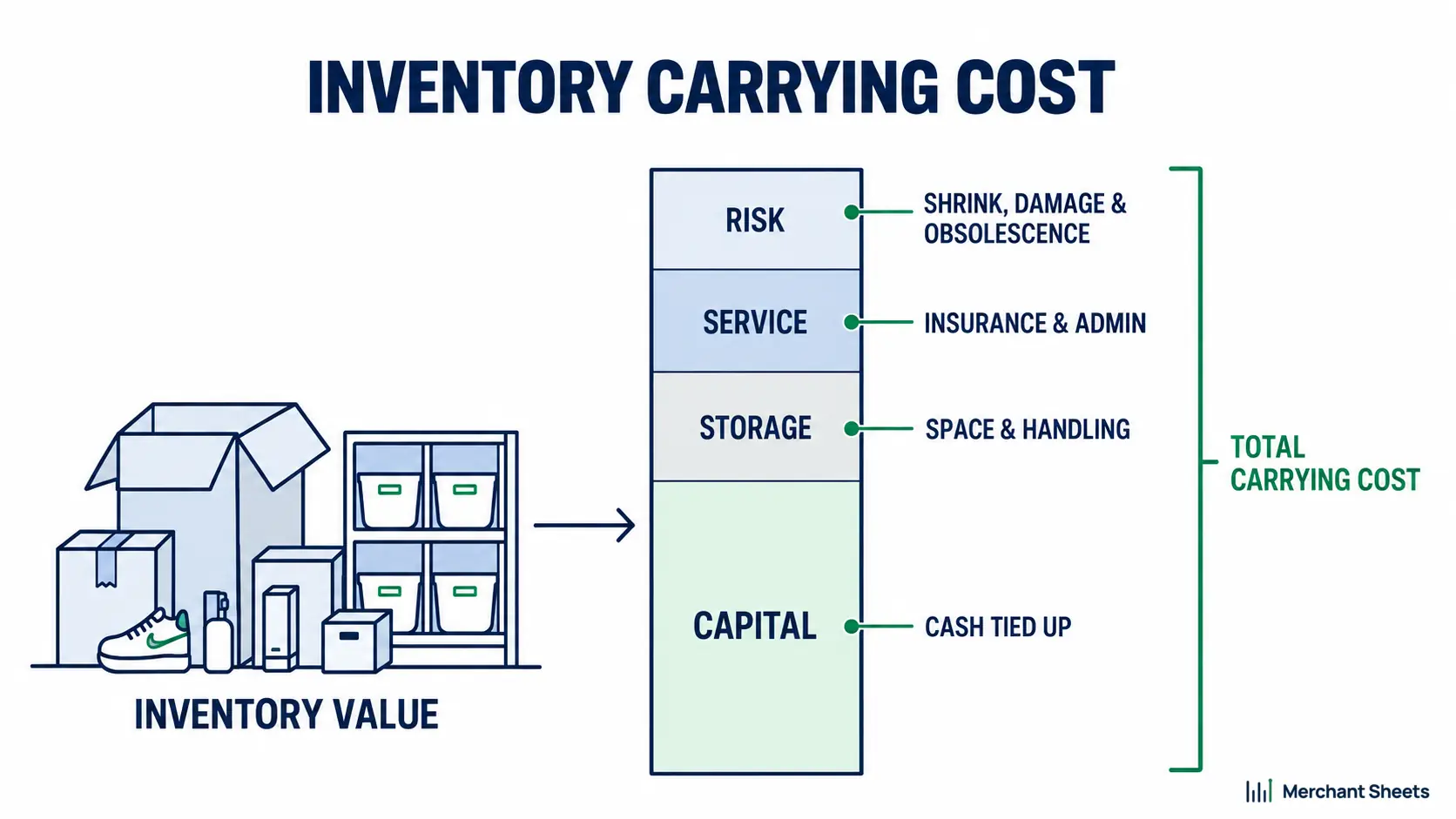
- It’s four costs rolled together: the capital tied up in stock, storage, service costs like insurance and software, and risk costs like shrinkage and obsolescence.
- The biggest piece is usually the cost of capital, the return you give up by parking cash in stock, and it’s the easiest to undercount.
- The formula is straightforward: add the four costs for a period, divide by the average inventory value, and multiply by 100 for the percentage.
- The 25% rule of thumb is only a starting point; build your own number from your costs and your real cost of capital.
- A high carrying cost is the case for holding less: turn faster, order in smaller batches, and clear the stock that’s costing you every month.
That stock sitting in your warehouse or at Amazon isn’t free to keep. Between the cash it ties up, the space it fills, and the risk it goes stale, holding inventory usually costs 20% to 30% of its value every year. Inventory carrying cost is how you put a real number on it.
What is inventory carrying cost?
Inventory carrying cost, also called holding cost, is the total cost of keeping unsold inventory for a set period, usually a year. You can write it as a dollar figure or, more useful for comparison, as a percentage of the inventory’s value.
It covers four things: the cash tied up in stock, the space the stock takes, the service costs to insure and track it, and the risk that it loses value while it sits. It’s the cost of holding stock, separate from what it costs to get a unit in the door in the first place.
One thing to know up front: carrying cost is a management number you calculate, and you won’t find a line for it on your profit and loss statement.
Its pieces are scattered across interest, storage, insurance, and write-downs, which is part of why the cost stays hidden and why stock so often costs more to hold than an owner expects.
Because it never appears as one line, a brand can grow its revenue while its margin quietly leaks into holding cost.
The four costs of holding stock
Carrying cost breaks into four buckets, and knowing them is what lets you build your own number instead of borrowing a rule of thumb.
Capital cost is the cash tied up in stock and the return you give up on it. If you financed the inventory, it’s the interest you pay; if you paid cash, it’s what that cash could have earned somewhere else, in ads that bring in customers or in the next product you’d launch.
For a growing brand, that opportunity cost is real money, and it’s why capital is usually the biggest bucket.
Storage cost is what it takes to house the stock: warehouse rent or third-party logistics (3PL) fees, utilities, handling labor, and for Amazon sellers, the FBA monthly and aged-inventory fees.
Those FBA fees are worth watching, because they rise in the Q4 peak months and add a surcharge once a unit passes Amazon’s aged-inventory threshold, so slow stock at FBA gets expensive fast (check Amazon’s current rates).
Service cost is insurance, inventory taxes where they apply, and the software and admin time to track everything.
Risk cost is what you lose while stock sits, from theft and damage (shrinkage) to obsolescence, the markdowns and write-offs on product that ages out before it sells. It bites hardest on anything seasonal, trend-driven, or perishable, where a few months on the shelf can turn a full-price SKU into clearance.
Capital is the biggest of the four for most inventory-heavy brands, and the easiest to overlook.
Table 1. The four components of inventory carrying cost.
| Component | What it includes | Ecommerce examples |
| Capital cost | The cash tied up and the return it could earn | Interest on a credit line; the ad spend that cash could fund |
| Storage cost | Housing and handling the stock | Warehouse rent, 3PL fees, FBA monthly and aged-inventory fees |
| Service cost | Protecting and tracking the stock | Insurance, inventory tax, inventory software |
| Risk cost | Value lost while stock sits | Shrinkage, damage, obsolescence, markdowns |
The inventory carrying cost formula
You calculate carrying cost by adding the four buckets for a period and dividing by the average inventory value, then multiplying by 100:
Carrying cost % = (capital + storage + service + risk) / average inventory value × 100
Average inventory value is your beginning and ending inventory at cost, divided by two, so one seasonal spike doesn’t skew the picture. Here’s how it looks on a brand holding $200,000 in average inventory. Add the buckets, $24,000 in capital, $12,000 in storage, $6,000 in service, and $8,000 in risk, and you get $50,000.
Divide by the $200,000 of inventory, and the answer is 25%. So this brand spends a quarter of its inventory’s value each year on the privilege of holding it, and capital alone is half of that.
You can run the same math for the whole business or for one product. Do it per SKU and the percentage becomes a lens on your catalog, because the slow movers and the bulky, low-margin items carry far more than the blended average suggests.
Table 2. A worked carrying-cost example on $200,000 of average inventory.
| Cost bucket | Annual amount | Share of inventory value |
| Capital (cost of capital) | $24,000 | 12% |
| Storage (warehouse + FBA fees) | $12,000 | 6% |
| Service (insurance, tax, software) | $6,000 | 3% |
| Risk (shrinkage, obsolescence) | $8,000 | 4% |
| Total carrying cost | $50,000 | 25% |
What’s a normal carrying cost percentage?
The common rule of thumb is about 25%, or somewhere in the 20% to 30% range a year. It’s a fine place to start and a poor place to stop, because the real figure is specific to your business. Estimates across industries run wider than the rule suggests, from the high teens to well over half of inventory value, depending mostly on how you count the capital.
That capital piece is where the rule of thumb usually goes wrong. The cost of capital alone can run around 15%, yet it gets booked at a token interest rate or left out entirely. Use your real cost of capital instead: the rate on the line of credit or supplier financing you’d otherwise pay down, or the return you’d earn putting that cash into ads or more product.
A brand growing 40% a year prices that cash far higher than a brand sitting on it, and their carrying costs should reflect that.
Once you price the cash correctly, build the number from your own four buckets rather than borrowing someone else’s 25%.
Carrying cost per unit and per day
The percentage is the headline; the per-unit and per-day numbers are what you use in practice. Carrying cost per unit is a unit’s cost times your carrying cost percentage, and dividing by 365 gives the daily cost.
Take a $40 unit at a 25% carrying cost. That’s $10 a year to hold one, or about $0.03 a day. It sounds small until you multiply it by thousands of units sitting for months.
The lever is time: the longer a unit sits, measured as its days on hand, the more it costs, so turning your stock faster lowers carrying cost directly.
Table 3. What a $40 unit costs to hold at a 25% carrying cost, by how long it sits.
| Days the unit sits | Carrying cost per unit |
| 30 days | $0.82 |
| 60 days | $1.64 |
| 120 days | $3.29 |
| 240 days | $6.58 |
| 365 days | $10.00 |
Carrying cost vs ordering cost: how much to buy at once
How much to buy in one order is a tug-of-war between two costs. Order in big batches and you place fewer orders, so your ordering cost, the freight, the per-order fees, and the admin, drops; but more stock sits longer and your carrying cost climbs.
Order in small, frequent batches and it flips: lower carrying cost, higher ordering cost. The cheapest order quantity is the one where those two costs balance, which is the idea behind economic order quantity (EOQ).
You don’t need the textbook formula to use the idea. A low carrying cost makes big, infrequent buys cheap to hold, while a high carrying cost pushes you toward smaller, more frequent orders.
Your supplier’s minimums and price breaks pull the other way, so the real answer weighs all of it together, along with the safety stock you keep for demand swings and lead time.
At a 10% carrying cost, you might comfortably reorder a product once a quarter; at 30%, that same product is often cheaper bought monthly in smaller runs. Carrying cost is the input that keeps the batch-size math honest.
What else your carrying cost should change
Beyond sizing orders, a real carrying cost number sharpens how you plan your inventory in two more ways.
The first is when to clear stock. Once the monthly bleed on slow-moving inventory is a number, the math on holding it gets honest. Say a $30 unit carries 25%, about $7.50 a year or $0.63 a month.
Sit on a slow SKU for eight months hoping for full price, and you’ve spent $5 a unit to get there, which often costs more than taking a markdown now and freeing the cash.
That reframes excess stock and dead stock as something with a running meter rather than a someday problem.
The second is what you stock at all. A SKU whose carrying cost eats its margin is a candidate to cut or reprice. Price the holding, and these calls stop being guesses about what feels slow and start being decisions about what costs you.
How to reduce inventory carrying cost
You lower carrying cost mainly by holding less stock for less time, then trimming each bucket. The biggest wins usually come from the first two levers below; the rest chip at the edges.
- Turn your stock faster: The fewer days a unit sits, the less it costs, so tighten reorder timing and order in smaller, more frequent batches where your terms allow.
- Buy to demand, not to fear: Size orders and safety stock to real demand and lead time, so you’re not funding a warehouse of just-in-case stock.
- Clear dead and slow stock early: A markdown now usually beats months of carrying cost on product that won’t sell at full price.
- Watch Amazon’s aged-inventory fees: FBA charges monthly storage plus a surcharge once stock lingers, so pull or liquidate before those land (check the current fees).
- Trim the smaller buckets: Reprice insurance, revisit storage terms, and drop the SKUs whose space and handling cost more than they earn.
- Lower your cost of capital: Cheaper financing or better supplier terms shrink the biggest bucket directly.
Frequently asked questions
What is inventory carrying cost?
Inventory carrying cost is the total cost of holding unsold stock over a period, covering the capital tied up, storage, service costs like insurance and software, and risk costs like shrinkage and obsolescence, usually 20% to 30% of the inventory’s value a year.
How do you calculate inventory carrying cost?
Add your capital, storage, service, and risk costs for the period, divide by the average inventory value, and multiply by 100 to get the percentage.
What is a good inventory carrying cost percentage?
The common benchmark is about 20% to 30% a year, but the right figure is specific to your business, so treat 25% as a starting point and build your own from the four cost buckets.
What are the four components of carrying cost?
Capital cost, storage cost, service cost, and risk cost, with the capital tied up in stock usually the largest of the four.
Is carrying cost the same as holding cost?
Yes, carrying cost and holding cost are two names for the same thing, the total cost of keeping inventory on hand over a period.
What is the difference between carrying cost and ordering cost?
Carrying cost is what it costs to hold stock, while ordering cost is what it costs to place and receive an order, and the two trade off when you decide how much to buy at once.
What is carrying cost per unit?
Carrying cost per unit is a unit’s cost multiplied by your carrying cost percentage, which tells you what one unit costs to hold for a year, and dividing by 365 gives the daily cost.
Why is inventory carrying cost important?
It reveals a cost that stays hidden on the profit and loss statement, so knowing it helps you right-size orders, decide when to mark down slow stock, and free up cash that’s stuck on the shelf.
How can you reduce inventory carrying costs?
Hold less stock for less time by turning inventory faster and buying to demand, clear dead and slow stock early, avoid Amazon’s aged-inventory fees, and lower your cost of capital with better financing or supplier terms.
