
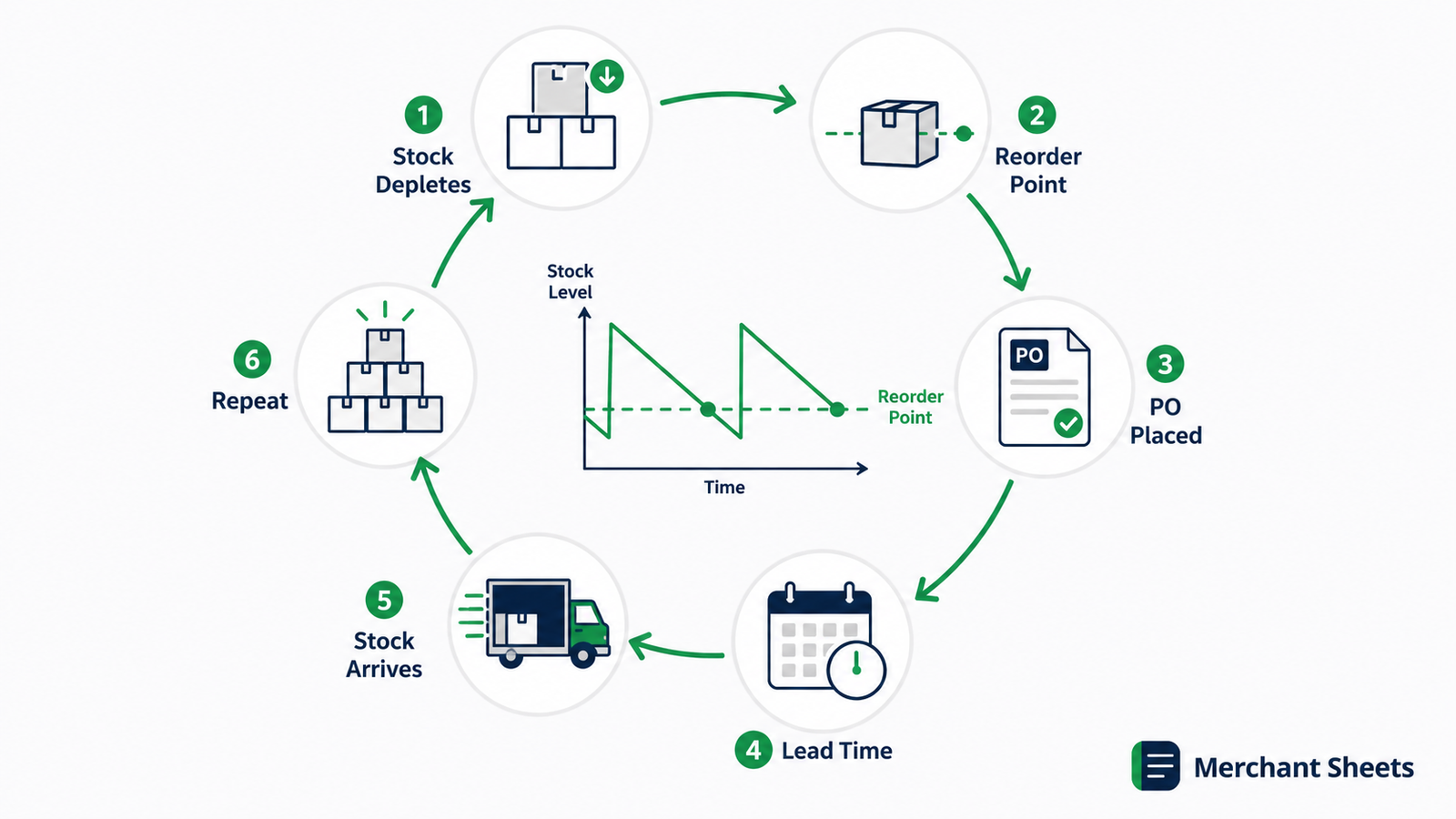
Inventory replenishment is how you keep stock topped up without tying cash in shelves you don’t need — the recurring call on when to reorder each product and how much.
Get the timing right and shelves stay full while cash keeps moving. Get it wrong and you’re either stocked out of your best seller or sitting on a pallet of your worst.
This guide covers what replenishment is, the three methods stores use, how to set the reorder trigger and the order quantity, and the ecommerce realities — lead times, MOQs, and cash — that break a textbook formula.
What is inventory replenishment?
Inventory replenishment is the ongoing process of reordering and restocking so you keep enough inventory to meet demand without overstocking. It’s the loop you run every week: watch stock fall, decide when to reorder and how much, place the order, then repeat as the goods arrive and sell.
Replenishment sits inside inventory planning, the framework that sets your stock targets for each SKU. Planning decides what good looks like; replenishment keeps you there week to week. Your reorder point is one piece of the loop — the stock level that triggers a new order — and this guide is about the whole cycle around it.
The three inventory replenishment methods
There are three common ways to run replenishment. Most stores use more than one, matching the method to how much a SKU matters to the business.
Table 1. The three inventory replenishment methods at a glance.
| Method | How it works | Best for | Watch-out |
| Continuous review (reorder-point) | Reorder a set quantity the moment stock hits the reorder point | High-value, fast-moving A-items with variable demand | Needs live stock visibility; more frequent, smaller orders |
| Periodic review (fixed interval) | Check stock on a set schedule and order up to a target level | Consolidating orders with one supplier; steady demand | Bigger buffer to cover the gap between reviews |
| Min-max | Drop below the minimum, top back up to the maximum | The long tail of B- and C-items; easy to run | Static min/max levels drift as demand shifts |
Continuous review, also called reorder-point control, watches stock in real time and fires an order the moment a SKU hits its reorder point. It reacts fast and holds less buffer, which suits the high-value, fast-moving products you can’t afford to lose.
Periodic review checks stock on a fixed schedule — every week, every two weeks — and orders each SKU up to a target level. It’s easier to run and lets you consolidate orders with a supplier, at the cost of a larger buffer to cover the gap between reviews.
Min-max is the practical hybrid: set a minimum and a maximum, and whenever stock drops below the min, order back up to the max. It’s easy to picture and run, which is why it fits the long tail of B- and C-items. Most catalogs end up mixing all three — continuous on the SKUs that drive revenue, periodic or min-max on everything else.
Bigger catalogs add a fourth layer on top: demand-driven replenishment, which reorders to a rolling forecast instead of fixed levels, topping each SKU up to the demand it’s expected to see over the next lead time.
It’s the most responsive approach and the hardest to run by hand, which is why it usually lives in a forecasting sheet rather than a founder’s head.
When should you reorder?
You reorder when stock falls to the reorder point — the level that covers demand during the time it takes new stock to arrive, plus a buffer for the days things go wrong. The formula is short:
Reorder point = (average daily demand × lead time) + safety stock
Average daily demand is how fast the SKU sells; lead time is how long resupply takes from order to shelf; safety stock is the cushion for the days both run against you.
A SKU selling 20 units a day with a 30-day lead time and 150 units of safety stock hits its reorder point at 750 units — that’s when the next order goes in.
Two of those inputs carry their own math. Safety stock is sized from how much your demand and lead time vary, and supplier lead time is worth measuring rather than guessing. For the full derivation, including the variable-demand version, see the reorder point formula.
A reorder point isn’t a set-and-forget number. As a SKU speeds up or a supplier’s lead time drifts, the trigger should move with it — checking it against recent sales rather than a stale annual average is what keeps you from ordering a week too late.
How much should you reorder?
The reorder point tells you when; the order quantity tells you how much. The baseline is to order enough to carry you through the next cycle without overshooting. A common form is:
Order quantity = lead-time demand + safety stock − stock on hand − stock on order
Take the same SKU. Twenty units a day across a 30-day lead time is 600 units of lead-time demand, plus 150 of safety stock, less 200 already on hand and 300 already on order — a 250-unit reorder. Skip the 300 on order and the math would tell you to buy 550, and you’d drown a fast seller in six months of stock.
Two ecommerce constraints bend that number. Minimum order quantities (MOQs) from your supplier can force you to round up, which inflates how long the stock then sits; and economic order quantity (EOQ) is the batch size that balances the cost of placing an order against the cost of holding it, useful when either runs high.
The line most stores miss is stock on order. Count what’s already in transit before you place a new order, or you’ll double up and bury cash in inventory that sits for months — the fast lane to dead stock.
What makes ecommerce replenishment different
A textbook reorder point assumes steady demand and a fixed lead time. Ecommerce gives you neither, and the gap is where restocks go wrong.
Lead time swings
Overseas production plus ocean or air freight means the same PO can land in six weeks or twelve, so the reorder point has to flex with it — and your demand forecast has to look far enough ahead to cover the long version.
Demand jumps too
A feature, a viral post, or a promotion can clear weeks of stock in days, so a reorder point set in a quiet month understates a busy one. This is why the demand forecast behind your triggers matters as much as the triggers themselves.
MOQs and payment terms reshape the order
A supplier who wants a deposit now and the balance on shipment turns a single restock into two cash outflows, weeks apart and often weeks before the stock sells.
Seasonality moves the whole schedule
Ahead of Q4, you reorder earlier than the formula suggests, because lead times stretch exactly when a stockout costs the most.
A restock is a cash event
The reorder math tells you when stock runs low; your cash flow forecast tells you whether you can place the order that week. Timing the two together is what keeps a big inventory buy from tipping you into a cash crunch.
Put your restocks on a schedule
Timing every restock by hand is where the misses happen — the PO placed a week too late, or the double-order that buries cash.
The Inventory Forecasting template projects demand per SKU, then calculates the reorder point, the expected stockout date, and the recommended PO date and quantity, with a 30/60/90-day reorder queue so you see what to order next — in Excel or Google Sheets. Fill in your history, and read the queue.
Frequently asked questions
What’s the difference between inventory replenishment and reorder point?
Inventory replenishment is the whole process of restocking — choosing a method, timing each order, and sizing it — while the reorder point is one input to it: the stock level that triggers a new order. Replenishment is the loop; the reorder point is the trigger inside that loop.
How often should you reorder inventory?
It depends on the method and the SKU. Continuous review reorders whenever a product hits its reorder point, so the timing tracks how fast it sells; periodic review reorders on a fixed schedule, like weekly or monthly. Fast-moving A-items get reordered often and watched closely, while slow C-items might turn over on a monthly cycle.
What is the replenishment cycle?
The replenishment cycle is the time from placing a reorder to that stock arriving and being ready to sell — your supplier’s processing time plus shipping and receiving. A shorter cycle lets you hold less stock and reorder more often; a longer one forces a bigger buffer and earlier orders.
What’s the best replenishment method for a small store?
Most small stores do well running continuous review on their handful of A-items — the products that drive revenue and hurt most when they run out — and a simple min-max rule on everything else. It puts your attention where the money is without turning replenishment into a full-time job.
