
Key takeaways
- The inventory-to-cash cycle is the gap between paying a supplier for stock and collecting cash from the customer who eventually buys it; the longer that gap, the more cash is locked up.
- Inventory is usually the single biggest use of cash in an ecommerce business, because you pay for it months before it sells and get paid back only after it does.
- Holding inventory isn’t free: carrying costs run roughly 20% to 30% of the stock’s value per year once you count tied-up capital, storage, and the risk of markdowns and obsolescence.
- Growth makes it worse. A growing brand pours each month’s profit back into more stock, so the faster it grows, the more cash inventory swallows, which is the classic profitable-but-broke trap.
- Four metrics measure the cash locked in stock: days inventory on hand and inventory turnover for speed, the cash conversion cycle for the full loop, and GMROI for return on the cash invested.
- You free trapped cash by buying closer to demand: tighter forecasts, smaller and more frequent orders, clearing dead stock, better supplier terms, and a buying budget checked against cash.
Your P&L says you’re profitable, but the bank balance never agrees. The money is sitting on your shelves. In most ecommerce businesses, inventory is the biggest single use of cash: you pay for it months before it sells, and you get paid back only after.
What is the inventory-to-cash cycle?
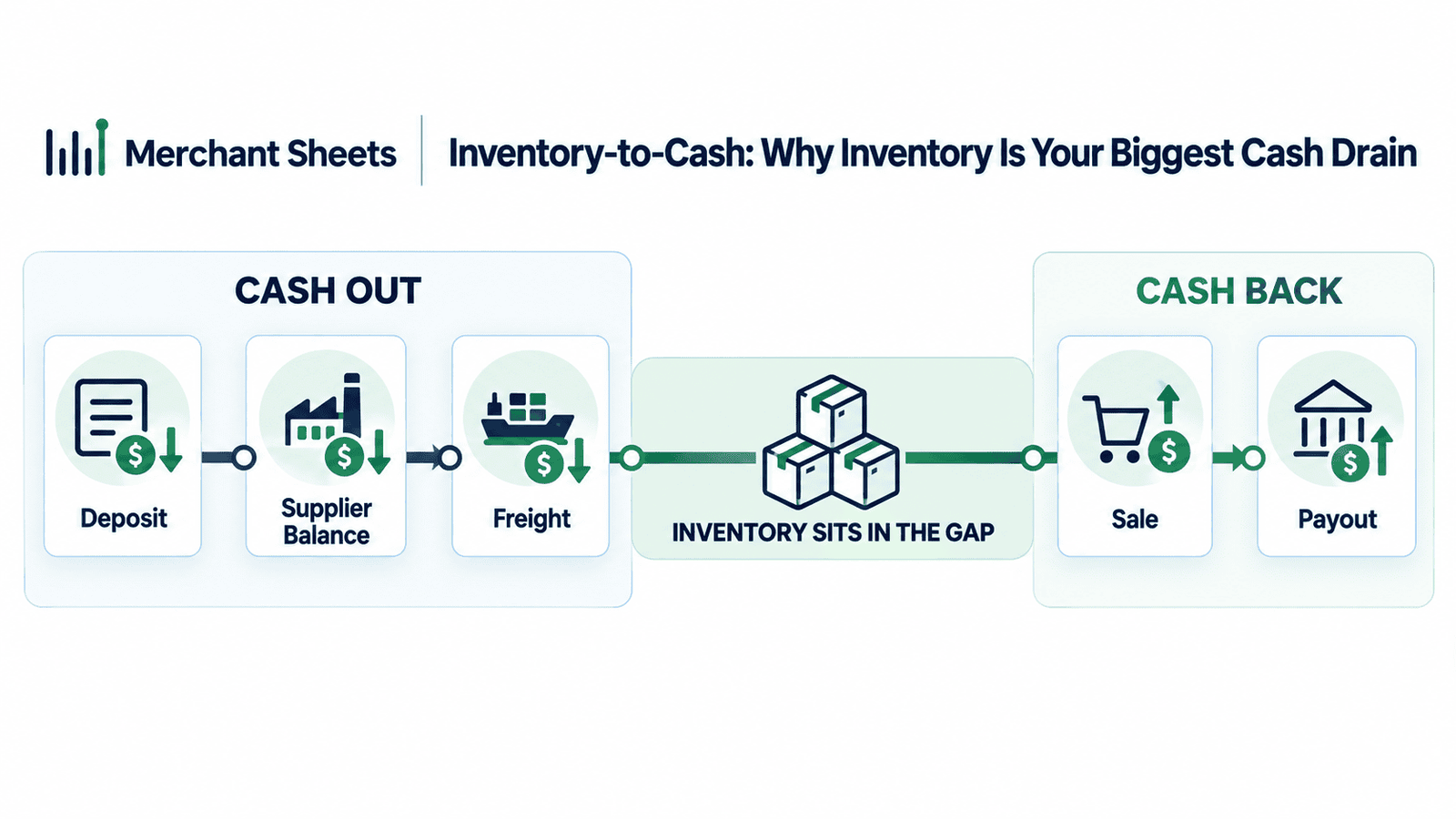
The inventory-to-cash cycle is the time and money between paying a supplier for stock and collecting cash from the customer who buys it. Cash goes out when you place and pay for a purchase order, and it comes back only after the item sells and your processor or marketplace pays out. Every unit ties up cash in between.
So inventory is cash you’ve already spent, sitting in product form and waiting to turn back into cash. The wait is the problem: for an imported product it can run three to five months from the day you wire a deposit to the day the sale’s payout clears.
Why inventory is usually your biggest use of cash
For a physical-product brand, inventory is normally the largest current asset on the balance sheet and the biggest single outflow in any given month. A current asset is something you expect to convert to cash within a year; inventory qualifies, but slowly.
You fund it up front and recover it over months, and while you wait, that money can’t go to ads, payroll, or the next product.
Walk the timeline. A supplier deposit leaves on day zero. The balance, freight, and duties follow over the next several weeks. The goods then land and sell down over the following months.
The customer’s money only arrives after the sale, and even then it waits out the payout delay before it’s cash in your account. Cash leaves early and comes back late, and inventory is what sits in the gap.
This is why revenue and cash are not the same thing. A strong sales month can still be a tight cash month if most of that cash went straight into the next inventory buy.
Table 1. The inventory-to-cash timeline for a typical imported product (illustrative figures).
| Stage | What happens | Cash effect | Timing |
| Place PO, pay deposit | Wire the supplier deposit, say 30% | Cash out | Day 0 |
| Production balance | Pay the balance when goods are made | Cash out | Day 30 to 60 |
| Freight and duties | Pay freight, duties, and landed costs | Cash out | Day 45 to 75 |
| Goods on the shelf | Inventory lands and sells down | Cash locked in stock | Day 60 to 150 |
| The sale | A customer buys the item | Sale booked, not yet cash | Day 90 to 150 |
| Payout | Your processor or marketplace pays out | Cash in | Day 92 to 165 |
What does it really cost to hold inventory?
Holding inventory costs roughly 20% to 30% of its value per year, and most of that cost never shows up as a line on your P&L. This is the carrying cost, the all-in price of keeping stock on hand, and it comes in three buckets.
The first is the capital cost: the cash locked in that stock can’t work anywhere else, so you carry the opportunity cost of everything you couldn’t fund with it. The second is the storage cost: warehousing, handling, insurance, and the fees a 3PL charges to hold each unit.
The third is the risk cost: markdowns, shrinkage, and obsolescence, because stock loses value the longer it waits, and some of it never sells at full price.
Slow-moving stock is the most expensive kind, since it draws all three costs while returning nothing, which is why aging inventory is worth watching closely.
How to measure the cash tied up in inventory
Four metrics tell you how much cash is stuck in stock and how fast it moves.
Days inventory on hand is how many days of stock you’re holding right now. Inventory turnover is how many times a year you sell through it.
The cash conversion cycle is the full loop from cash out for stock to cash in from the sale. And GMROI is the gross profit you earn for every dollar tied up in inventory.
Above all of them sits net working capital, the balance-sheet view of the cash your operations tie up, of which inventory is usually the largest piece.
Table 2. Four ways to see the cash tied up in inventory.
| Metric | What it measures | What you’re aiming for |
| Days inventory on hand (DIO) | How many days of stock you’re holding | Lower, without risking stockouts |
| Inventory turnover | How many times a year you sell through stock | Higher |
| Cash conversion cycle (CCC) | Days from paying for stock to collecting cash | Lower, even negative |
| GMROI | Gross profit per $1 tied up in inventory | Above $1, and higher over time |
Why am I profitable but out of cash?
You can be profitable and still out of cash because growth pours every dollar of profit straight back into more inventory, and often more than the profit. To sell more next month, you buy more stock this month.
So a growing brand is always funding a larger inventory position than the one it’s currently selling, and that difference comes out of cash.
Picture a brand growing 20% a month. Each month’s sales are genuinely profitable, but each new purchase order is bigger than the last, and the deposit goes out weeks before the extra sales come in.
On paper, the business is making money; in the bank, the balance keeps sliding, because profit is being converted into stock faster than stock is being converted back into cash. The figures are illustrative, but the pattern is the one that catches most operators off guard.
The problem here is timing. The business is profitable; the cash arrives later than the bills. The fix is to plan each buy against the cash you’ll have, so you can keep growing without draining the bank.
How to free up cash trapped in inventory
You free trapped cash by buying closer to demand and moving stock faster. Most of the levers below are part of a disciplined inventory plan, and each has its own method you can lean on rather than rebuild here.
- Forecast demand more tightly so you buy to real demand instead of a comfortable cushion. A tighter demand forecast is the single biggest lever, because every extra unit you don’t need is cash on a shelf.
- Order smaller and more often, where your supplier terms allow it, so cash sits as stock for less time even if you pay a little more per unit.
- Clear dead and aging stock through markdowns or bundles; the cash you recover, even at a discount, beats stock that never sells.
- Negotiate longer supplier payment terms so you hold your cash later into the cycle, which shortens the gap between paying for stock and getting paid for it.
- Set a buying budget for each period and check it against cash before you order, buying to the lower of the two. An open-to-buy budget does exactly this.
- Match your reorders to how fast each product turns, so your fast movers get the cash and your slow movers stop soaking it up.
Frequently asked questions
Why is all my cash tied up in inventory?
Because you pay suppliers for stock months before customers pay you for it, so in a physical-product business, inventory is normally the largest current asset and the biggest single use of cash at any moment.
What is the inventory-to-cash cycle?
It’s the loop from paying a supplier for stock to collecting cash from the customer who buys it, and the longer it runs, the more of your cash stays locked in inventory instead of in the bank.
How much does it cost to hold inventory?
Carrying cost runs roughly 20% to 30% of the inventory’s value per year once you count the tied-up capital, storage and handling, and the risk of markdowns, shrinkage, and obsolescence.
Can you be profitable and still run out of cash?
Yes, and it’s common in fast-growing ecommerce: each month’s profit gets reinvested into a larger inventory buy, so cash falls even while the P&L shows a profit.
How do I free up cash stuck in inventory?
Buy closer to demand with tighter forecasts and smaller, more frequent orders, clear dead stock, negotiate longer supplier terms, and budget each buy against the cash you have.
Is inventory an asset or an expense?
Inventory is an asset on the balance sheet while you hold it and becomes an expense, cost of goods sold, only when it sells, which is exactly why it can absorb cash without ever showing up as a cost on your P&L.
