
Key takeaways
- Cost of goods sold (COGS) is an expense, and it lives on your income statement.
- The inventory that COGS comes from is an asset, and it sits on your balance sheet until the item sells.
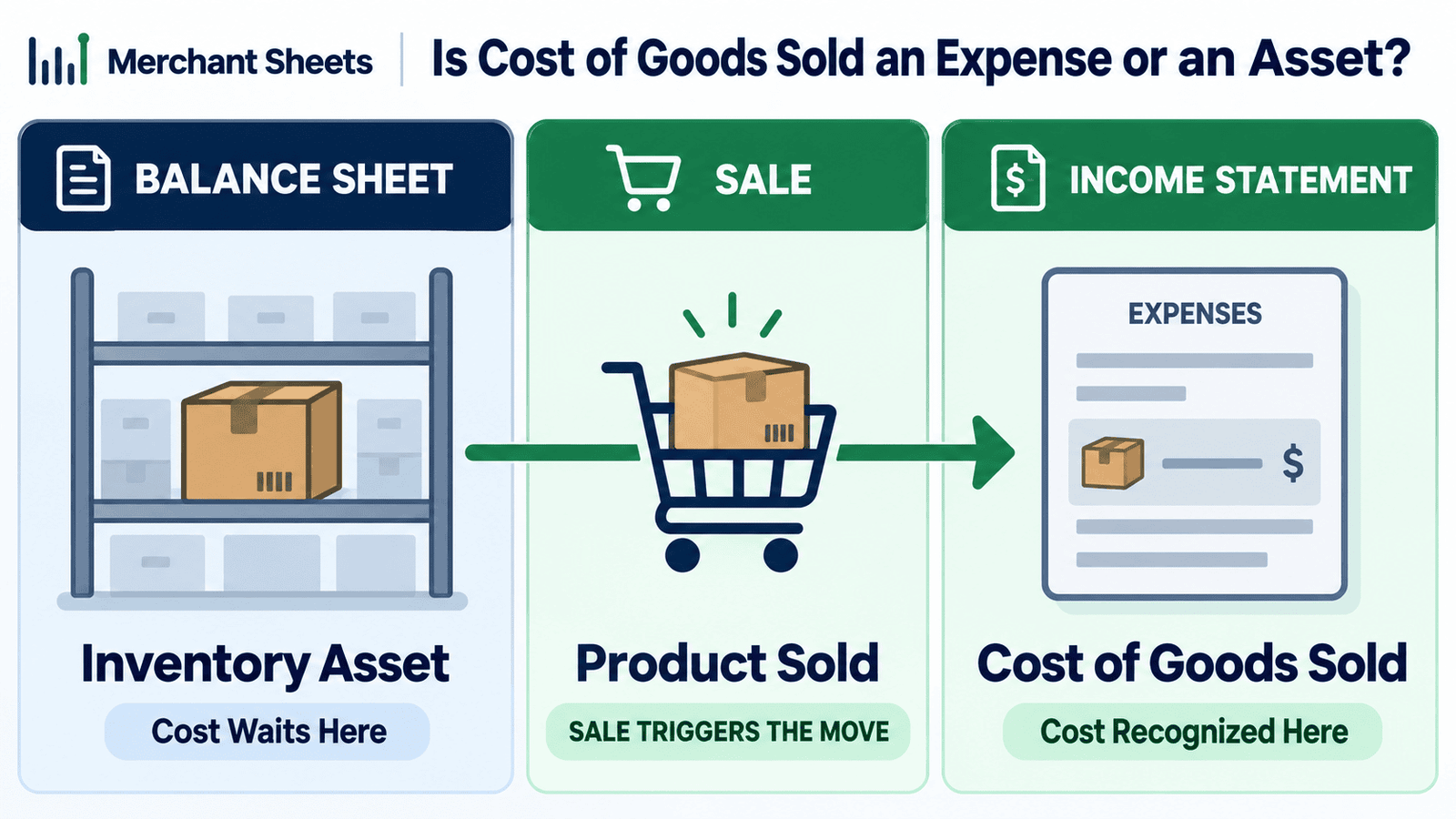
- The cost moves from asset to expense at a single moment: when the item sells. That’s the matching principle at work.
- Buying inventory is recorded as an asset first. It becomes an expense, COGS, only when you sell the item, so a big purchase order doesn’t hit your P&L on the day you pay for it.
- COGS is a direct cost reported above the gross profit line; operating expenses like marketing and payroll sit below it.
- Getting this right matters: booking an inventory purchase as an expense overstates your costs, understates profit, and misstates your taxes.
Cost of goods sold is an expense. The money you spend on inventory, though, is an asset first. It sits on your balance sheet until the item sells, and only then does its cost move to your income statement as COGS.
That single shift is the whole answer to whether COGS is an expense or an asset, and it’s what trips up most operators.
Is cost of goods sold an expense or an asset?
Cost of goods sold is an expense on your income statement. The inventory it comes from is an asset on your balance sheet while you own it. When an item sells, its cost moves off the balance sheet and onto the income statement as COGS. So the same dollars are an asset before the sale and an expense after it.
Cost of goods sold (COGS) is the direct cost of the products you’ve sold, the unit cost of the goods plus what it took to get them ready to sell. Inventory is the stock you own but haven’t sold yet.
An asset is something you own that holds value; an expense is a cost that lowers your profit for the period.
Why inventory is an asset until it sells
Inventory is a current asset because it’s something you own that you expect to turn into cash within the year. A current asset is any resource you’ll convert to cash in the near term, and unsold stock qualifies, even when it takes a few months to move.
Here’s the part that catches operators out. You paid cash for that stock, so it feels like the money’s gone. In accounting terms, though, the cash didn’t disappear. It changed shape. You swapped one asset, cash, for another asset of equal value, inventory. Nothing was used up, so nothing counts as a cost yet.
That stock sits on your balance sheet, tracked through an inventory account in your chart of accounts. It’s the same inventory that ties up your cash, which is why a brand can look profitable and still feel broke. Holding product parks your money in a different form, waiting for a sale to turn it back into cash, and into an expense.
When inventory becomes an expense
Inventory becomes an expense at the point of sale, and not a moment before. The rule behind this is the matching principle: you record the cost of a product in the same period you record the revenue from selling it, so the sale and the cost that earned it land together.
In bookkeeping terms, the sale triggers one move. The cost comes off the inventory asset and lands in COGS, recorded as a debit to COGS and a credit to inventory. The full entry that records it has a couple more moving parts, but that swap is the heart of it.
Which dollar amount moves depends on which costing method you use, whether you value each unit under FIFO, LIFO, or a weighted average. Across a whole period, the running total works out the way you’d calculate COGS for a period: beginning inventory, plus what you purchased, minus what’s still on the shelf at the end.
Table 1. One product’s cost, before and after the sale (illustrative figures). The same $18 is an asset until the unit sells, then an expense.
| Stage | Where the cost sits | Statement | Amount |
| You buy the unit for $18 | Inventory (asset) | Balance sheet | $18 |
| It sits in your warehouse | Inventory (asset) | Balance sheet | $18 |
| The unit sells for $40 | Revenue booked; cost moves to COGS | Income statement | $40 revenue, $18 COGS |
| After the sale | Gross profit on the unit | Income statement | $22 |
Where COGS sits on your financial statements
COGS appears on your income statement, directly below revenue and above your operating expenses. The unsold inventory it came from appears on a different report, the balance sheet. The same dollars land in two places, depending only on whether the item has sold.
Read the top of an income statement in order and it runs revenue first, then COGS, and revenue minus COGS is your gross profit. Everything below that line, marketing, software, salaries, and rent, is operating expenses, a separate group.
The income statement, also called the profit and loss statement or P&L, shows what you earned and spent over a period; the balance sheet shows what you own and owe at a single moment. If you’re reading your P&L and want to see how the two reports connect, the same costs move across your two statements as your stock sells.
Table 2. COGS and the inventory it comes from: the same cost on two different statements.
| Inventory | Cost of goods sold (COGS) | |
| What it is | Products you own and haven’t sold yet | The cost of the products you’ve sold |
| Statement | Balance sheet | Income statement (P&L) |
| Type | Current asset | Expense (a direct cost) |
| When it’s recorded | When you buy or receive the stock | When the item sells |
| Effect on profit | None yet | Reduces gross profit |
Is COGS an operating expense?
No, COGS is not an operating expense. COGS is the direct cost of the products you sold, and it sits above the gross profit line. Operating expenses, sometimes called OpEx or SG&A, are the costs of running the business, marketing, apps, rent, and salaries, and they sit below gross profit.
The line between them matters because gross profit only subtracts COGS. If an operating cost gets miscategorized into COGS, your gross margin reads worse than it is, and every pricing and channel decision you make off that margin inherits the error.
Why the expense-or-asset distinction matters
Getting this right keeps both your profit and your taxes honest.
On your P&L, timing is everything. If you expense a big inventory purchase in the month you pay for it, you pile all that cost into one month and leave the months when the stock sells looking artificially cheap. No single month’s profit is real, and one large purchase order can turn a good month into a paper loss.
On your taxes, COGS gets subtracted from your gross receipts to reach gross profit, which lowers your taxable income. It’s figured separately from your other business deductions: a sole proprietor reports it in Part III of Schedule C, while a corporation or partnership files Form 1125-A.
Booking inventory as an expense at purchase can misstate an entire year of taxable income. This is general information, not tax advice, so confirm the treatment for your business with your accountant.
Once COGS is landing in the right place at the right time, the more useful question is whether the books behind it are set up to keep it that way.
Frequently asked quesitons
Is cost of goods sold an expense or an asset?
COGS is an expense on your income statement, while the inventory it came from is an asset on your balance sheet until the item sells, at which point its cost becomes COGS.
When does inventory become an expense?
Inventory becomes an expense the moment the item sells, when its cost moves from the inventory asset account to cost of goods sold under the matching principle.
Is buying inventory an expense?
No, buying inventory is recorded as an asset, and it becomes an expense (COGS) only when the item sells, so a large purchase order doesn’t hit your P&L on the day you pay for it.
Is COGS an operating expense?
No, COGS is the direct cost of the goods you sold and is reported above gross profit, while operating expenses such as marketing, software, and salaries are reported below it.
Does COGS go on the balance sheet?
No, COGS is an income-statement line; the balance sheet shows the inventory asset you haven’t sold yet.
Is cost of goods sold a debit or a credit?
COGS is an expense, so it’s increased with a debit, and the offsetting credit reduces the inventory asset when the item sells.
How does COGS affect taxable income?
COGS lowers your taxable income because it’s subtracted from your gross receipts to reach gross profit, before your other business deductions are applied.
