
Key takeaways
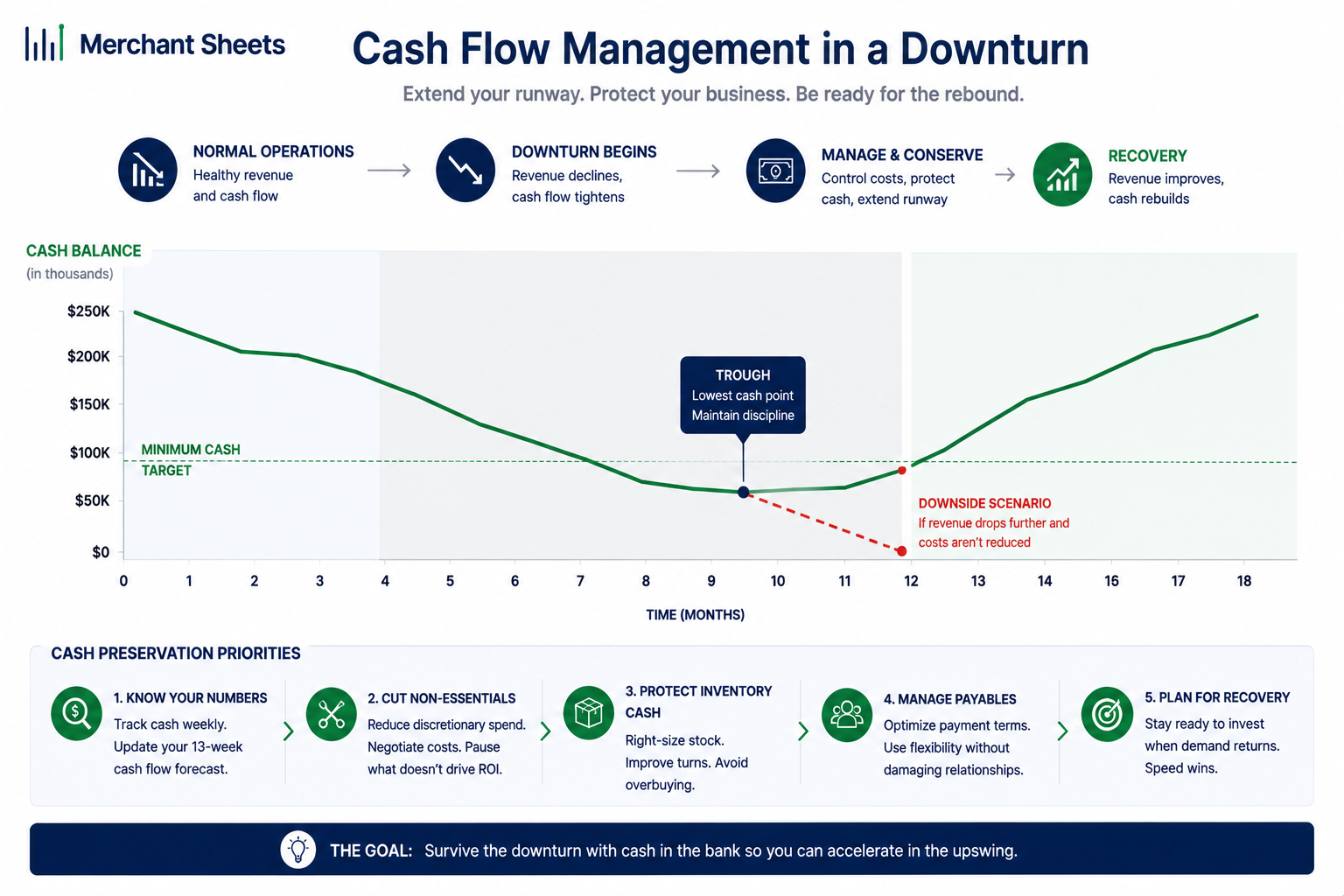
- In a downturn, liquidity matters more than profit on paper, so the number to protect is runway: how many months your cash can cover operations while demand is soft.
- Start with visibility before you cut. Build a short-horizon cash forecast, a 13-week view works well, and read your low point off the trough rather than a monthly average.
- Model a downside case before you act: run revenue down by roughly 20% and 40% so you know the week cash gets tight and how big a gap you have to close.
- In an inventory-led brand most of the cash is locked in stock, so slowing reorders, trimming open purchase orders, and clearing dead stock frees more cash than any expense cut.
- Protect margin over volume: deep discounting to chase sales can drain cash faster than it brings in, so defend price and lead with your proven, high-margin products.
- A cash reserve of roughly three to six months of operating expenses and a credit line arranged early are far cheaper to secure before a crunch than during one.
When demand softens, cash gets tight faster than profit does, because your money is already committed to inventory and fixed costs.
Managing cash flow in a downturn is about protecting runway: seeing your real position, sizing the downside, and pulling levers in the right order. Here’s the sequence, built for an inventory-led ecommerce brand.
What does managing cash flow in a downturn really mean?
Managing cash flow in a downturn means shifting your focus from profit to liquidity: protecting the cash you hold and the runway it buys, so the business stays solvent while demand is soft. Revenue falls before costs do, and in ecommerce your cash is already tied up in inventory and overhead, so a brand that looks profitable can still run out of cash.
Runway is how many months your cash lasts at the current pace of spending, and liquidity is how much cash you can get your hands on right now. In a slump both shrink at once, because sales slow while rent, payroll, software, and the stock you already ordered keep draining the account. When cash is the constraint, how long it lasts matters more than what the P&L says.
The job is to stretch that runway until demand recovers, without starving the parts of the business that will carry the recovery. That means acting early, while you still have options, and working in an order that frees the most cash for the least damage.
In what order should you act?
When cash is tightening, the sequence matters as much as the moves. Work through it in this order:
- Build a 13-week cash forecast so you can see your low point.
- Model a downside case to size the gap you need to close.
- Free cash from inventory first, where most of it is trapped.
- Protect margin instead of chasing volume with discounts.
- Tighten the timing of cash coming in and going out.
- Cut non-performing costs before you touch what drives sales.
- Line up a reserve and a credit line before you need them.
How do you see your real cash position?
You can’t manage cash you can’t see, and in a downturn a monthly average isn’t good enough. The tool that works is a short-horizon cash forecast: a 13-week, one-quarter view of cash in and cash out, week by week. It’s near-term enough to stay accurate and detailed enough to show the weeks money leaves in a rush.
Read your runway off the low point in that forecast, the single week your balance dips closest to zero. The big outflows, a supplier payment or an inventory order, land in a single week, so an average smooths over the exact week the balance runs lowest.
A weekly cash flow forecast lays those weeks out so you see the trough before you reach it, which is the number a downturn turns on.
How do you model the downside?
Before you start cutting, size the problem. Take your forecast and run a downside scenario: drop revenue by a set amount, hold or flex your costs, and watch where the cash line goes.
Running two cases, a moderate decline around 20% and a harder one around 40%, turns a vague worry into two numbers: the week your balance hits its floor, and how much cash you have to free to clear it.
Table 1. An illustrative downside cash view for a brand starting the quarter with $300,000 in cash and a $50,000 minimum floor.
| Scenario | 13-week revenue | Projected low-point cash | Gap to the $50k floor |
| Base plan | $600,000 | $120,000 | None |
| Revenue down 20% | $480,000 | $30,000 | $20,000 short |
| Revenue down 40% | $360,000 | ($40,000) | $90,000 short |
Nobody knows how deep or how long a downturn runs, so planning against a range beats betting on a single forecast. The output of this step is your target: it tells you how much cash the levers below have to produce, and by when, so you cut with a number in mind instead of cutting blind.
Pull the inventory lever first
In an inventory-led brand, most of your cash isn’t in the bank, it’s on the shelf and in transit. That makes inventory the first and largest source of cash in a downturn, and the cash tied up in stock is exactly what shortens your runway. The goal is to free that cash without starving the products that still sell.
| Cut the losers, defend the heroes. Slashing inventory to the bone is as dangerous as over-ordering: a stockout on your best seller costs the sales that fund everything else. |
Pull these levers in roughly this order:
- Slow and stagger reorders: Buy smaller and more often so you’re not committing cash to stock ahead of soft demand. Size each order to what the downside forecast supports.
- Cut or renegotiate open POs: Review the purchase orders already placed and pull back the ones that no longer fit the forecast. Many suppliers will move a date or trim a quantity to keep the relationship.
- Clear dead and slow stock: Turn shelf-sitting inventory back into cash with targeted markdowns or a clearance push, even at a thin margin. Cash today beats stock that may never sell.
- Protect your high-turn winners: Keep your proven sellers in stock so you don’t lose the revenue that funds the business. Free cash from the slow tail of the catalog, and leave the fast movers fully stocked.
- Turn inventory faster overall: Aim to hold fewer weeks of cover across the catalog so less cash sits still. Faster turns mean the same sales tie up less money.
Protect margin over chasing volume
The reflex in a slump is to discount hard to keep revenue up. The danger is that deep, blanket discounts can burn cash faster than they bring it in, because you give up the margin that funds operations on every order you’d have won anyway. In a downturn, a dollar of margin protects you more than a dollar of revenue.
Defend price and lean on value, bundles, and your best-known products rather than across-the-board markdowns. Point promotions at high-margin items and at the dead stock you’re clearing, so a discount does a job instead of training customers to wait for the next one.
Protecting contribution margin, what’s left from a sale after the costs that rise with each order, is what keeps each sale adding to cash rather than draining it.
Tighten the timing of cash in and out
Beyond inventory, you can free cash by changing when money moves. The gap between paying for stock and getting paid for the sale is your cash conversion cycle, and every day you shorten it is cash back in your account without cutting anything.
Work both sides. Ask suppliers for longer or staged payment terms so cash leaves later; in a downturn many will flex to keep your orders. On the other side, speed up the cash coming in with faster marketplace payout options and prompt invoicing on any wholesale or B2B sales.
Hold your cash longer, and collect what you’re owed sooner.
Cut costs in the right order, then build a cushion
Cost cuts come after the cash-timing and inventory moves, and the order you cut in matters as much as the amount. Cut in from the edges, protect the spend that brings in sales, and set up a safety net while you still can:
- Trim discretionary spend first: Cancel unused software, pause nice-to-have projects, and cut ad channels that aren’t paying back. This is the spend that frees cash with the least effect on revenue.
- Protect what drives sales: Keep the marketing and retention spend that’s clearly earning its keep, since cutting all of it deepens the hole. Trim by performance, channel by channel.
- Treat headcount as a later lever: People and long-term commitments are heavier, slower cuts with real costs, so reach for them after the lighter levers.
- Build a cash reserve: Aim for roughly three to six months of operating expenses as a buffer, sized to how seasonal and volatile your sales are. As of 2026 that’s a common target to adapt to your own numbers.
- Line up credit before you need it: A line of credit is far easier and cheaper to arrange while your numbers look strong than mid-crunch. Set it up early even if you never draw on it.
Steer the downturn with a plan
Managing cash flow in a downturn is a sequence you can run yourself, and many operators do.
If you’d rather have a second set of financial eyes on it, that’s the work I do as your fractional CFO.
I build the downside forecast, set the order to pull your cash levers, and run the weekly cash cadence with you, so every call is made with a clear view of what it does to your runway.
Frequently asked questions
How do you manage cash flow in a recession?
Shift your focus from profit to liquidity: forecast cash weekly, model a revenue-down scenario, free cash from inventory first, protect margin instead of discounting, and line up a reserve and a credit line before you need them. The aim is to stretch runway until demand recovers.
How much cash should a business keep in reserve?
A common rule of thumb is three to six months of operating expenses, though the right amount depends on how seasonal and volatile your sales are. A brand with lumpy, inventory-heavy cash flows should sit at the higher end.
What should a business do first in a cash flow crisis?
Get visibility first: build a short-horizon cash forecast so you can see your low point and how many weeks of runway you have before you start cutting. You can’t fix a cash problem you can’t measure.
Should you cut inventory during a downturn?
Cut the slow and dead stock to free trapped cash, but keep your proven, high-turn products in stock, because a stockout on your best sellers costs the sales that fund the business. Trim the slow sellers and keep the fast ones stocked.
Is it better to hold cash or inventory in a recession?
In a downturn, cash is usually safer than extra inventory, because cash keeps your options open while surplus stock ties money up against uncertain demand. Hold enough inventory to serve your reliable sellers, and no more.
How do you extend runway in a downturn?
Free cash from inventory, tighten your cash conversion cycle, protect margin, trim non-performing spend, and slow large outflows, so the cash you have lasts longer while demand recovers. Each move either lowers what you burn or adds to the cash on hand.
