
Key takeaways
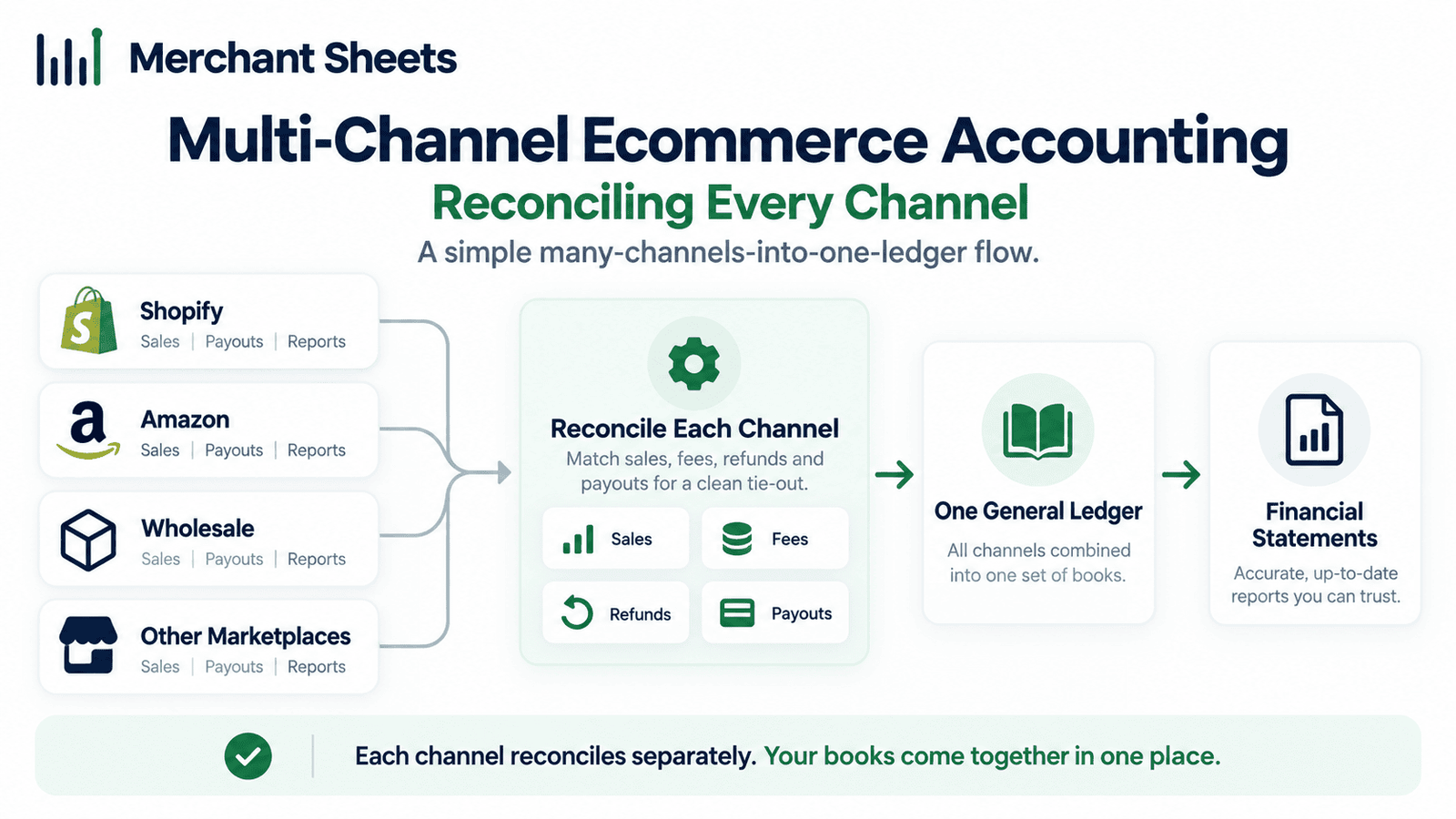
- Multi-channel ecommerce accounting reconciles each sales channel to its own settlements, then rolls them into one chart of accounts so revenue and margin tie across channels.
- Every channel deposits differently: Shopify pays out every few days net of processing fees, while Amazon, Walmart, TikTok Shop, and eBay settle on their own cycles net of their own fees and a reserve.
- Give each channel its own clearing account and tag every transaction with a channel dimension, a class in QuickBooks or a tracking category in Xero, so one set of books reports profit by channel.
- Marketplace channels like Amazon, Walmart, and TikTok Shop collect and remit sales tax for you; on your own Shopify site, that job stays yours, so the two are booked differently.
- A settlement connector like A2X that supports several channels posts each channel’s settlement split into sales, fees, and refunds, which is what keeps multi-channel books tied.
- A blended number hides which channel is making money; a channel-level P&L is what shows you where to spend and where to pull back.
Selling on one channel is hard enough to keep straight. Add a second, and the books stop being simple addition: Shopify pays out one way, Amazon another, and each deposit hides a different stack of fees. Multi-channel ecommerce accounting is how you reconcile every channel into one clean set of books.
What is multi-channel ecommerce accounting?
Multi-channel ecommerce accounting is the practice of recording sales, fees, refunds, inventory, and tax from every channel you sell on, so your financial statements tie across all of them. It reconciles each channel to its own settlements, then rolls them into one chart of accounts that reports profit by channel and in total.
A settlement is the batched payout a channel sends to your bank, net of its fees.
The hard part isn’t any single channel; it’s that each one pays out on its own schedule with its own fees, so the books need a consistent way to bring them together. The foundation is the same bookkeeping every brand needs, covered end to end in the complete ecommerce bookkeeping guide.
Why multi-channel books break: every channel pays differently
Each channel deposits a net figure on its own cycle, and the differences are the whole problem. Shopify pays out every few days, net of payment processing fees, and leaves sales tax to you.
Amazon settles about every two weeks, net of referral and FBA (Fulfillment by Amazon) fees and a held reserve, and remits sales tax for you as a marketplace facilitator. Walmart, TikTok Shop, and eBay each settle on their own schedule, net of their own fees, and act as facilitators too.
Stack three or four of these together and a single blended view of your bank deposits is guaranteed to miss fees and misstate revenue. One channel’s payout is smaller because of a reserve, another’s because of ad spend, a third’s because of returns, and no bank feed tells them apart.
The fix is a per-channel discipline: reconcile each channel to its own settlements, keep each channel’s fees and clearing separate, and only then combine. Here’s how the channels differ.
Table 1. How each channel pays out, charges fees, and handles sales tax (2026; verify current terms).
| Channel | How it pays out | Fees taken out | Sales tax |
| Shopify (your own site) | Payout every few days | Payment processing fees | You register, collect, and remit |
| Amazon | Settlement about every 2 weeks, net of a reserve | Referral, FBA, storage, ads | Amazon collects and remits (facilitator) |
| Walmart Marketplace | Settlement on its own cycle | Referral and fulfillment fees | Walmart collects and remits (facilitator) |
| TikTok Shop | Settlement on its own cycle | Commission and fulfillment fees | TikTok collects and remits (facilitator) |
| eBay | Managed-payments payout | Final value and processing fees | eBay collects and remits (facilitator) |
Reconcile each channel to its own settlement first
The method has two steps, and the first is to conform each channel before you combine anything. For every channel, book revenue from the settlement report rather than the bank deposit, split out that channel’s fees and refunds, and clear the net deposit against a clearing account that belongs to that channel alone.
A clearing account is the holding account where a channel’s sales sit between the order and the payout, so the deposit has a clean home instead of a mystery figure to force-match.
Done this way, each channel ties to its own payouts on its own schedule, and a payout that straddles a month end is matched by its settlement period rather than the deposit date.
The channel-by-channel mechanics are already covered in depth: the payout side in Shopify accounting, the settlement side in Amazon seller bookkeeping, and the line-by-line Amazon walkthrough in reconciling Amazon settlements to revenue.
The reason to reconcile per channel first is that the fee structures and timing don’t line up, so combining raw deposits buries the differences you need to see.
A quick example shows the discipline. Say a month brings $30,000 in Shopify sales and $20,000 on Amazon. You reconcile Shopify first: gross sales to income, processing fees to their own expense line, refunds against sales, and the net payouts clearing to the bank.
Then Amazon on its own: gross product sales, referral and FBA fees split out, the held reserve parked in its own account, and its settlements cleared separately.
Only once each channel ties on its own do the two roll up into one set of numbers, and any deposit that looks off traces back to a single channel instead of a tangle.
Roll every channel into one chart of accounts
The second step is to bring the reconciled channels into one chart of accounts (COA), the master list of accounts every transaction lands in, so the business runs on a single ledger. Each channel keeps its own clearing account and, where the platform holds funds, its own reserve account.
Shared accounts like product sales, channel fees, and cost of goods sold are split by a channel dimension: a class in QuickBooks Online or a tracking category in Xero.
Tag every transaction with its channel from the start, and one set of books reports each channel on its own and all of them combined, with no rebuild when you add the next channel.
A settlement connector like A2X that supports several channels is the practical way to feed this. It reads each channel’s settlement and posts it already split into sales, fees, and refunds and mapped to the right channel, which keeps the books tied without hand-keyed journal entries; the setup is walked through in connecting your channels with A2X.
Table 2. What each channel needs, and what stays shared, in one chart of accounts.
| Element | How it’s set up for multi-channel |
| Clearing account | One per channel, so each channel’s payouts reconcile on their own |
| Reserve account | One per channel that holds funds (Amazon, and others that reserve) |
| Product sales | One income account, split by a channel class or tracking category |
| Channel fees | Fee expense split by channel, so each channel’s true cost is visible |
| Cost of goods sold | Shared account, tagged by channel for channel-level margin |
| Sales tax payable | Separate treatment for facilitator channels and your own site |
Channel-level profit vs one blended number
Tagging by channel earns its keep the moment you look at profit. When Shopify, Amazon, and a third channel all fold into one revenue line and one margin line, a channel that loses money on fees and returns rides on the backs of the ones that don’t, and you can’t see it happening.
A channel-level profit and loss statement shows each channel’s real contribution after its own fees, so you know which channels to feed and which to fix.
A simple case makes it concrete. Suppose two channels each bring $50,000 in sales and the blended gross margin reads a healthy 40%. Split it, and your own site might run 48% while the marketplace runs 32% once referral and fulfillment fees come out.
The blended number hid a 16-point gap, and it’s that gap that tells you where price, product mix, or ad spend needs to change.
Channel-level profit is a decision tool. It tells you where the next dollar of ad spend and the next inventory order should go, and it catches a channel that’s quietly underwater long before the blended number would.
Who collects sales tax on each channel?
On marketplace channels like Amazon, Walmart, TikTok Shop, and eBay, the platform is a marketplace facilitator, so it calculates, collects, and remits sales tax for you. On your own Shopify site, registering, collecting, and remitting stays your job.
That split is why multi-channel sales tax gets booked two different ways in the same set of books, and why a single tax treatment across channels goes wrong.
Two things follow from it. Facilitator tax still flows through your account on those channels, so it posts as a pass-through liability rather than income, and it clears when the platform remits.
And holding inventory in a state, through FBA for instance, can still create nexus, an obligation to register once your presence or sales cross a state’s threshold, even where the platform handles the remittance.
How do you close multi-channel books each month?
Once each channel is set up to reconcile, the monthly close becomes a repeatable routine that ties every channel to the bank, books landed-cost COGS for what sold, and produces one profit and loss statement you can trust.
It’s the standard close, laid out in the monthly close checklist, run once per channel and then combined. Work through these five steps each month:
- Reconcile each channel’s payouts to its settlements and to the bank, one channel at a time.
- Confirm each channel’s sales, fees, and refunds are split out, not netted into one deposit.
- Book cost of goods sold for the units sold and update inventory across channels.
- Confirm facilitator sales tax is booked as a pass-through, and reconcile the tax you owe on your own site.
- Review the channel-level P&L, then the blended total, and close the month.
Frequently asked questions
How do I reconcile Shopify and Amazon in one set of books?
Reconcile each to its own settlements first, giving Shopify and Amazon their own clearing accounts, then roll both into one chart of accounts with a channel class so you can report each channel and the combined total. The two never net together cleanly because their payout cycles and fees are different.
Do I need separate bookkeeping for each sales channel?
You need separate reconciliation per channel because each pays out and charges fees differently, but not separate books, since the channels combine into one chart of accounts tagged by a channel dimension. That gives you one ledger that still reports each channel on its own.
What's the best accounting software for multi-channel ecommerce?
QuickBooks Online and Xero both handle multi-channel well when paired with a settlement connector like A2X that supports your channels, so each channel’s settlement posts split into sales, fees, and refunds. The connector is what keeps the books reconciled as you add channels.
How do I see profit by channel?
Tag every transaction with a channel dimension, a class in QuickBooks or a tracking category in Xero, so the same chart of accounts produces a profit and loss statement for each channel and for all of them combined. That single tag is what turns one blended number into channel-level profit.
Does each marketplace handle its own sales tax?
Amazon, Walmart, TikTok Shop, and eBay are marketplace facilitators, so they collect and remit sales tax for you, while sales on your own Shopify site are yours to register, collect, and remit. The collected facilitator tax is still booked as a pass-through in your ledger rather than as income.
Why don't my channel deposits match my sales?
Each deposit is a payout net of that channel’s fees, refunds, and any reserve, so revenue has to come from each channel’s settlement report rather than the bank. Reconciling per channel is what closes that gap and makes the deposits tie back to real sales.
How much are Amazon seller fees?
Referral fees typically run 8% to 15% by category with a per-item minimum, FBA fulfillment is a per-unit charge by size and weight, and storage is billed per cubic foot and higher in the fourth quarter. Amazon raised FBA fees by about $0.08 per unit on average effective January 15, 2026, so verify your current rates before you model them.
Get every channel reconciled into one clean set of books
When you sell on more than one channel, the books stop being simple addition. Shopify pays out one way, Amazon another, and each deposit hides a different stack of fees, so nothing ties without real reconciliation work. That cross-channel reconciliation is a core part of what I do for ecommerce brands.
I set every channel up to reconcile to its own settlements, roll them into one chart of accounts with profit tagged by channel, and hand you a single P&L that shows which channels are carrying the business and which are quietly losing money.
