
Key takeaways
- Open-to-buy (OTB) is the dollar budget for how much new inventory you can buy in a period while hitting your sales and end-of-period stock targets.
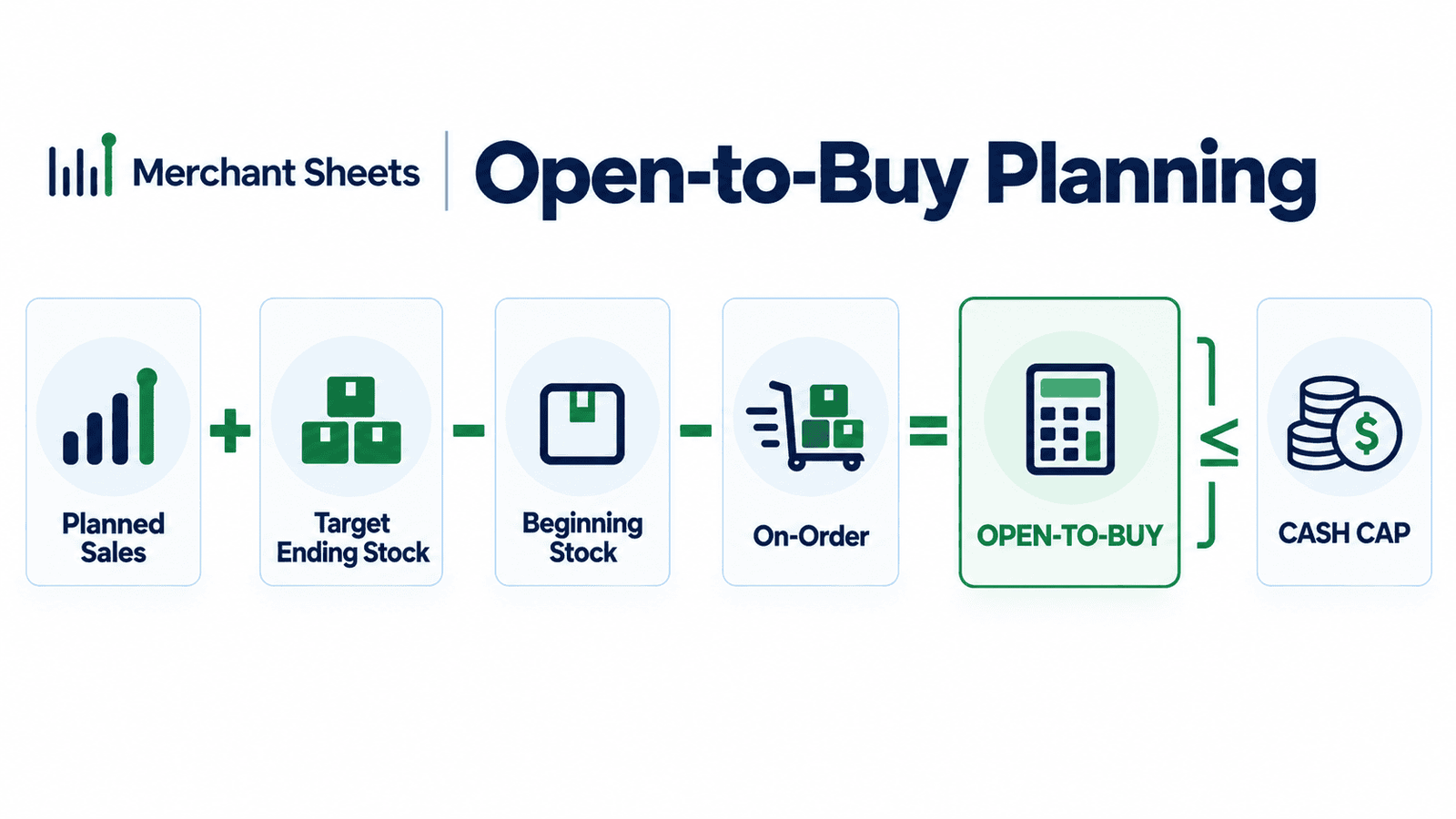
- The formula: planned sales plus planned markdowns plus planned ending inventory, minus beginning inventory, gives planned purchases; subtract stock already on order to get your open-to-buy.
- Classic OTB is calculated at retail value with markdowns, but most DTC brands plan it at cost, and mixing the two makes the number meaningless.
- Ending inventory carries over to become the next period’s beginning inventory, so OTB is a rolling plan that updates every period.
- OTB caps how much you can buy without overstocking; cash on hand caps how much you can afford, and you buy to the lower of the two.
- Run OTB monthly or weekly against a sales forecast, and buying turns from a gut call into a budget you can defend.
Every inventory buy is a bet with your cash. Buy too much, and it sits on a shelf; buy too little, and you sell out. Open-to-buy is the budget that keeps those bets in check: a single number for how much stock you can buy this period.
Here’s the formula, a worked example, and how to plan your buys against cash.
What is open-to-buy?
Open-to-buy (OTB) is the amount of new inventory, in dollars, that you can still buy for a period after you account for what you plan to sell, the stock you want left at the end, and what you already have on hand and on order. It’s a purchase budget that keeps buying in line with your sales and stock targets.
Think of it as a buying budget for a period, usually a month. It exists to stop the two errors every operator knows: overbuying that traps your cash in stock that sits, and underbuying that leaves you stocked out of the products people want.
OTB is the budgeting layer of the inventory planning framework, the number that sizes your buying before you place a single purchase order.
Retailers have run open-to-buy for decades to keep buyers from overspending against a merchandise plan. For an ecommerce brand, the idea is the same in plainer terms: it’s the discipline that ties what you buy to what you expect to sell and the cash you have to fund it.
Most brands run it once a month, alongside the sales forecast, and revisit it weekly in a busy season.
| Open-to-buy answers one question before every purchase order: how much more can I buy this period without blowing past my sales plan, my stock targets, and my cash? |
The open-to-buy formula
The formula runs in two steps. First, your planned purchases for the period equal planned sales, plus planned markdowns, plus the inventory you want at the end of the period, minus the inventory you start with. Second, your open-to-buy equals those planned purchases minus whatever you already have on order.
A few terms carry the formula. Beginning-of-month inventory (BOM) is the stock you start the period with. End-of-month inventory (EOM) is the stock you plan to have left at the end, which becomes next month’s BOM.
Markdowns are the discounts you plan to take to move stock. On-order is inventory you’ve already bought but haven’t received yet. Put those together and the formula tells you the one thing you came for: how much more you can spend on stock this period.
Table 1. The open-to-buy formula, line by line, with a one-month example.
| Line | What it is | Example |
| Planned sales | What you expect to sell in the period | $50,000 |
| + Planned markdowns | Discounts you plan to take to clear stock | $5,000 |
| + Planned end inventory (EOM) | Stock you want left at period end | $40,000 |
| − Beginning inventory (BOM) | Stock you start the period with | $45,000 |
| = Planned purchases | Total you plan to receive this period | $50,000 |
| − On order | Stock already ordered, not yet received | $10,000 |
| = Open-to-buy | New inventory you can still buy | $40,000 |
A worked example, month by month
Open-to-buy is a rolling plan, because the stock you end one month with is the stock you start the next month with. That link is what makes it a plan rather than a single sum.
Here are three months for a brand heading into a busy season. Planned sales climb from $50,000 to $60,000. Each month you set a target ending inventory, and that target becomes the next month’s starting inventory, so the plan carries forward.
Watch the open-to-buy number move with the season: as sales and target stock rise, so does the budget for new buys, held in check by what’s already on order.
Take month two, line by line. You start with $40,000 in stock, the same figure you planned to end month one with. You expect to sell $55,000, plan $4,000 in markdowns, and want $42,000 left at the end. Add those and subtract the starting stock: 55,000 plus 4,000 plus 42,000, minus 40,000, is $61,000 of planned purchases.
You already have $15,000 on order, so your open-to-buy is $46,000. That is how much more you can commit this month, before you check it against cash.
Table 2. A three-month open-to-buy plan (illustrative figures; ending inventory carries to the next month’s beginning).
| Line | Month 1 | Month 2 | Month 3 |
| Beginning inventory (BOM) | $45,000 | $40,000 | $42,000 |
| Planned sales | $50,000 | $55,000 | $60,000 |
| + Planned markdowns | $5,000 | $4,000 | $6,000 |
| + Planned end inventory (EOM) | $40,000 | $42,000 | $45,000 |
| = Planned purchases | $50,000 | $61,000 | $69,000 |
| − On order | $10,000 | $15,000 | $20,000 |
| = Open-to-buy | $40,000 | $46,000 | $49,000 |
Open-to-buy at retail vs at cost
Classic open-to-buy is calculated at retail value, in selling prices, and includes planned markdowns, because that’s how department stores plan. Most DTC ecommerce brands plan at cost instead, budgeting what they’ll spend with suppliers.
Use the version that matches your question. Run OTB at cost when what you care about is how much cash goes out the door to inventory, which is most of the time for a DTC brand. Run it at retail when you plan in selling prices and actively manage markdowns across a catalog.
The one rule that matters either way: pick a basis and keep every line in the formula on it. A plan that mixes retail sales with cost inventory produces a number that means nothing, and it’s the most common way an open-to-buy plan goes wrong.
The gap between the two is real. A product you sell for $50 might cost you $18, so a month of $50,000 in planned sales is roughly $18,000 in cost terms. Budget at retail and your open-to-buy is a retail number you convert back to cost before you cut a purchase order; budget at cost and the figure is already the cheque you write to your supplier.
For a brand that thinks in supplier invoices and cash, planning at cost keeps the number honest and usable.
How to build an open-to-buy plan, step by step
Building an open-to-buy plan is five steps, and two of the inputs have their own methods you can lean on rather than rebuild here.
- Forecast the period’s sales from your sales history and seasonality. This is your demand forecast, and it’s the input the whole plan rests on.
- Set a target ending inventory, usually from your target weeks of cover or your inventory turnover. This is how much stock you want left when the period closes.
- Add any planned markdowns you expect to take to clear aging stock, so the budget reflects the discounting you’ve already committed to.
- Subtract your beginning inventory and whatever you already have on order, since both reduce how much more you need to buy.
- Check the result against the cash you can put toward inventory this period, and buy to the lower of the two numbers.
Budgeting inventory against cash
Open-to-buy tells you how much you can buy without overstocking, but it doesn’t know your bank balance. That’s why the number from the formula is only half the plan.
Inventory is usually the biggest use of cash in an ecommerce business, so a buying budget that ignores cash can still sink you. Pair the two. On one side, the open-to-buy number says how much stock your sales and targets support.
On the other, your cash flow forecast says how much you can commit to inventory this period without missing payroll or a supplier payment. When those two numbers agree, buy to the plan. When they disagree, the lower one wins.
Say the formula gives you $46,000 of open-to-buy for the month, but your cash flow forecast shows $30,000 free for inventory after payroll, ad spend, and a supplier bill. You buy to the $30,000 because the plan says you could hold more stock, while your cash says you can’t fund it.
The budget is a ceiling on overstocking; cash is the ceiling on what you can spend, and it’s the one that stops you first.
| Open-to-buy keeps you from overstocking; your cash balance keeps you from over-committing. When they disagree, cash wins, every time. |
Open-to-buy vs reorder points and safety stock
Open-to-buy and reorder points answer different questions, and a healthy brand runs both. Open-to-buy is the period budget: how much you can buy in total this month. A reorder point is the SKU-level trigger: the stock level that says reorder this specific product now.
They work at two levels. The open-to-buy budget sits on top and sets the size of the pie. Reorder points and safety stock sit underneath and decide which products get a slice, and when. You use the budget to keep total buying in bounds, and the triggers to make sure the right SKUs get restocked inside it. Neither replaces the other.
Common open-to-buy mistakes
A few errors turn an open-to-buy plan into a number you can’t trust. These are the ones worth watching for:
- Mixing retail and cost: Some lines in selling prices and others at supplier cost make the result meaningless. Pick one basis and keep every line on it.
- Forecasting off last year alone: Copying last year’s sales without adjusting for growth, price changes, or a shifted promo calendar bakes last year’s misses straight into this year’s budget.
- Leaving out on-order stock: Forgetting the inventory you’ve already committed to overstates your budget and leads you to double-buy the same demand.
- Treating the budget as a cage: When a product is selling through faster than planned, the budget is a guide you reforecast, so raise it and restock the winner rather than starving it on principle.
Frequently asked questions
What is open-to-buy?
Open-to-buy is the dollar amount of new inventory you can still buy for a period after accounting for planned sales, your target ending inventory, and the stock you already have and have on order, so buying stays in line with your plan.
What is the open-to-buy formula?
Planned purchases equal planned sales plus planned markdowns plus planned ending inventory minus beginning inventory; open-to-buy is planned purchases minus stock already on order.
How do you calculate open-to-buy?
Forecast the period’s sales, set a target ending inventory, add planned markdowns, subtract your beginning inventory and what’s on order, and check the result against available cash before you buy.
What's the difference between open-to-buy and a reorder point?
Open-to-buy is the total dollar budget for buying in a period, while a reorder point is the stock level that triggers a reorder for a single product; the budget sits on top of the per-SKU triggers.
Why does open-to-buy matter for cash flow?
Inventory is usually the biggest use of cash in an ecommerce business, so an open-to-buy plan that’s checked against cash keeps purchasing from quietly draining the bank.
Can you have negative open-to-buy?
Yes, a negative number means you’ve already committed to buy more than your plan supports, so the answer is to buy nothing more this period and work the overbuy back down.
