
Key takeaways
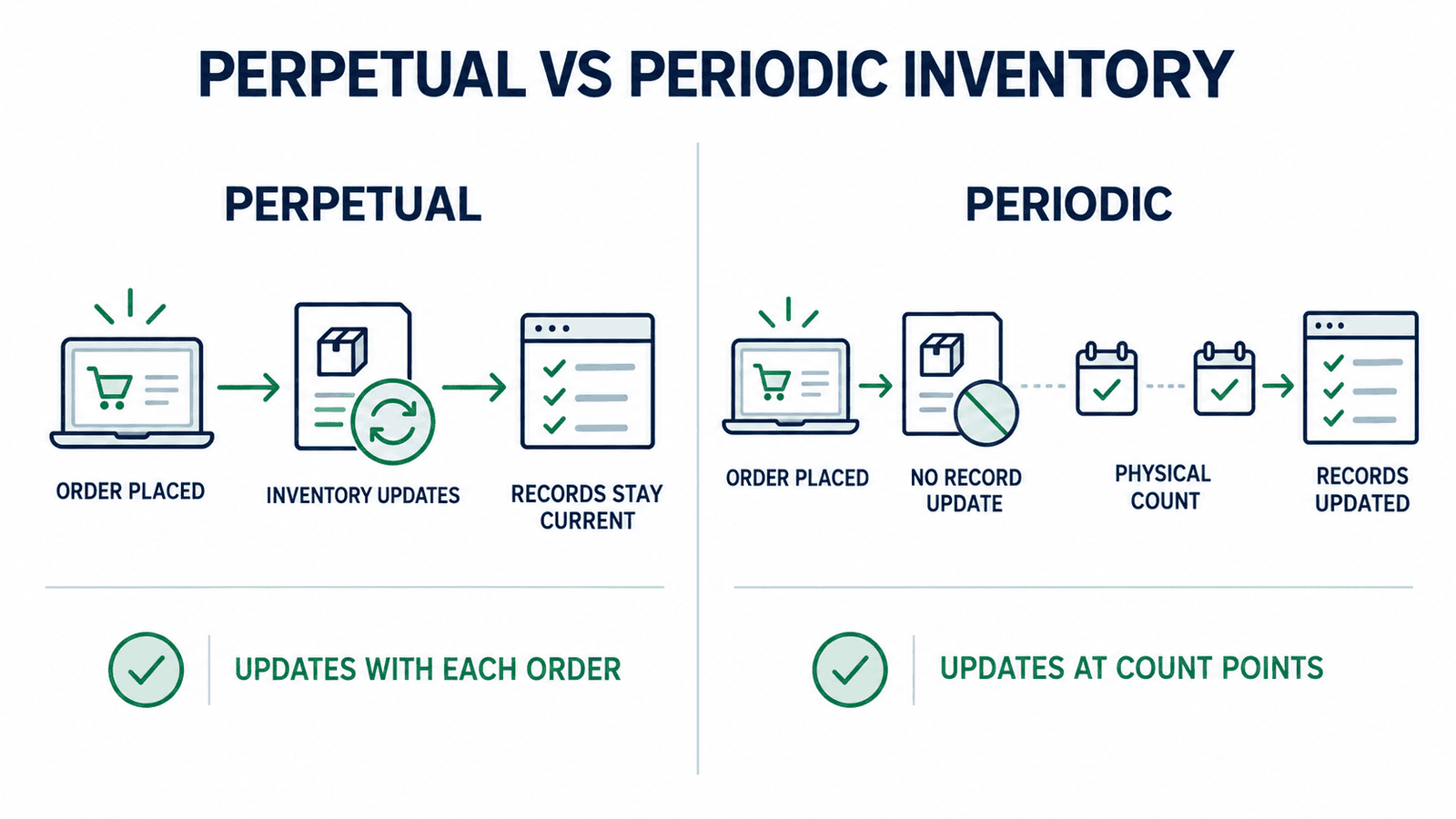
- A perpetual inventory system updates your quantity on hand and cost of goods sold in real time, on every purchase and sale; a periodic system updates them only at a physical count, usually month or quarter-end.
- The practical gap is timing: perpetual knows your inventory and COGS at any moment, while periodic knows them only as of the last count and estimates in between.
- In the books, perpetual posts purchases straight to inventory and records COGS at each sale; periodic parks purchases in a Purchases account and finds COGS at period end as beginning inventory plus purchases minus ending inventory.
- If you sell on Shopify or Amazon, you’re already running a perpetual system operationally, because the platform decrements units on every order, so the real question is how your books get COGS.
- Perpetual tracking doesn’t remove the count: you still cycle count to catch shrinkage and errors, because the system trusts its own records until a count corrects them.
- For most growing ecommerce brands, the fit is perpetual tracking with a clean month-end COGS true-up; pure periodic suits only a small, low-SKU operation.
You’re deciding how to track stock and book cost of goods sold, and the perpetual-versus-periodic question is two questions in one. A perpetual inventory system updates your records on every sale; a periodic inventory system updates them only when you count.
If you sell online, you’re already perpetual where it counts, so the live decision is how your books handle COGS.
What is a perpetual inventory system?
A perpetual inventory system tracks inventory continuously, updating the quantity on hand and the cost of goods sold (COGS) every time you buy or sell. It runs through software, a point-of-sale system, or an e-commerce platform that reads barcodes or SKUs, so your records hold a running balance you can check at any moment.
On a Shopify or Amazon order, the platform drops the on-hand count the moment the order is placed and, once you’ve loaded product costs, books the item’s cost to COGS as it ships. A SKU, the unique code for each product variant, is what lets the system move the right unit and the right cost together.
Because the balance updates on every transaction, you can see what’s in stock, what sold, and what it cost without stopping to count the shelves.
What is a periodic inventory system?
A periodic inventory system updates your inventory only at set intervals, when you physically count, and works out COGS at the end of the period instead of at each sale. Between counts, purchases collect in one account, and the system doesn’t track what’s left; you learn that by counting.
The period-end math is a single formula for the cost of goods sold: beginning inventory plus purchases minus ending inventory. Say you start a quarter with $30,000 of stock, buy $50,000 more, and count $20,000 on the shelf at the end.
Your COGS for the quarter is $30,000 plus $50,000 minus $20,000, or $60,000. It’s cheap to run and needs no software, but it leaves you blind between counts, with no reliable read on margin or stock position until someone counts.
That blind spot is the catch for an online seller. If demand spikes mid-month, a periodic system won’t warn you that a top SKU is running down, and if a product stalls, the cash tied up in it stays invisible until the next count.
The costing method you apply, whether FIFO, LIFO, or weighted average, sits on top of the formula and changes the figures, but it doesn’t change the timing: with periodic, you only know where you stand right after a count.
Perpetual vs periodic: the key differences
The difference between perpetual and periodic inventory is when and how your records update. Perpetual updates inventory and COGS in real time on every transaction, so the numbers are always current. Periodic updates them only at a physical count and calculates COGS at period end, so the numbers are current only right after a count.
Those two timing choices ripple into everything else: how you record a purchase, whether you can see stock between counts, what the system costs to run, and the size of business each one suits.
Table 1. Perpetual vs periodic inventory at a glance.
| Factor | Perpetual | Periodic |
| Records update | Continuously, on every purchase and sale | Only at a physical count |
| COGS calculated | At each sale | At period end (beginning + purchases – ending) |
| Purchase recorded to | Inventory account | Purchases account |
| Real-time stock visibility | Yes | No, estimated between counts |
| Physical count | Still needed to verify, via cycle counts | Required to close the books |
| Cost and setup | Software or a platform; higher setup | Manual; low cost |
| Best fit | Online sellers, higher volume, multiple channels | Small, low-SKU, low-volume |
How the accounting differs
The systems diverge most in the books. Under perpetual, a purchase debits your inventory account, and each sale books two entries: one for the revenue and one that moves the item’s cost out of inventory and into COGS.
Under periodic, a purchase debits a separate Purchases account, a sale books only the revenue, and COGS gets calculated and recorded in one entry at period end.
The journal-entry mechanics behind each are worth a closer look when you set up your chart of accounts and keep your books, and one line of nuance carries over from costing: under perpetual, a weighted average becomes a moving average recalculated on each purchase, while periodic uses one average struck at period end.
A worked example makes the sale line concrete. You sell an item for $50 that cost you $20. Under perpetual, you book $50 to Sales and, in the same moment, move the $20 from Inventory to COGS, so the sale’s profit is visible at once.
Under periodic, you book only the $50 to Sales now; the $20 stays bundled in Purchases until the period-end formula pulls it into COGS. The profit lands the same in the end, on a different clock. The table shows the shape of it.
Table 2. The accounting side by side.
| Event | Perpetual | Periodic |
| Buy inventory | Debit Inventory, credit Accounts Payable | Debit Purchases, credit Accounts Payable |
| Make a sale | Debit Cash or AR, credit Sales; then debit COGS, credit Inventory | Debit Cash or AR, credit Sales (no COGS entry) |
| Period end | No COGS entry needed; verify with a count | Count stock, then record COGS = beginning + purchases – ending |
Which system do ecommerce brands use in practice?
Almost every online seller is already running a perpetual system, whether they chose one or not. Shopify, Amazon, and any inventory app decrement units in real time on each order, so operationally your stock is tracked continuously. That settles the perpetual-versus-periodic question for tracking and moves the real decision onto your books.
It helps to separate two layers that often get blended. The first is operational tracking: how your storefront and apps count units as orders flow, and online that layer is perpetual by default. The second is your accounting method: how and when the cost of those units lands in your financial statements.
The two don’t have to match, and for plenty of brands they don’t.
How your books get COGS when the platform tracks units
So how does the cost get into your books? Many sellers keep the real-time unit tracking their platform gives them and true up COGS at month-end, a hybrid that’s sound and common.
A typical setup posts summarized sales, fees, and COGS from each channel into the accounting file, so your monthly statements carry an accurate margin without a full perpetual accounting build behind them.
In practice, a tool that posts summarized COGS from Shopify and Amazon into QuickBooks or Xero is how most brands bridge the gap. Your platform holds the live unit counts, the tool lands the monthly cost against your product costs, and your books read accrual and accurate at close.
The reason this matters is matching: the point of the true-up is to land each month’s COGS in the same month as the sales it belongs to, so your margin reads true rather than lurching when a big purchase hits.
A cash-basis shortcut that expenses stock when you pay the supplier throws margin off, because a single large inventory buy can swamp a month that had ordinary sales.
This is why the operational system and the accounting method can differ without anything being wrong: the units are perpetual, the COGS posting is periodic, and together they give you a monthly close you can trust.
Does a perpetual system replace physical counts?
No. A perpetual system trusts its own records until a count corrects them, so it can’t see shrinkage (stock lost to theft, damage, or error), a miscount at receiving, or a unit that walked out the door. Perpetual means the records update continuously, not that they’re guaranteed to be right.
That’s why even a fully perpetual operation still counts, usually with cycle counts, a rolling count of a small subset of SKUs on a schedule, rather than one big annual freeze. You count, compare to what the system says, and post an adjustment for the difference.
A common approach counts your fastest movers and highest-value SKUs more often, since those are where an error costs the most, and lets slow, cheap items wait for a wider sweep.
An inventory aging report helps you decide what to count first by flagging what’s been sitting longest.
The trade-offs of each system
Each system earns its place in the right setting.
- Perpetual, the upside: You get real-time stock and margin, fewer oversells, and metrics like inventory turnover that need current data to mean anything.
- Perpetual, the cost: It needs software and clean data, costs more to set up, and still requires cycle counts to stay trustworthy.
- Periodic, the upside: It’s cheap and simple, with no software and little training, which suits a tiny catalog counted by hand.
- Periodic, the limit: You’re blind between counts, so you can’t read true margin or stock in real time and you can’t catch problems as they happen.
How do you move from periodic to perpetual?
You move from periodic to perpetual by putting the tracking in place first, then bringing the accounting in line.
For most ecommerce brands, the tracking already exists in the platform, so the work is loading accurate costs and wiring the books, not buying new software.
- Start with a clean count: Do one full physical count to set an accurate opening balance, since a perpetual system is only as good as the numbers it starts from.
- Load your product costs: Enter a current cost for every SKU so the system can book COGS as items sell, and update those costs as they change.
- Wire the books: Connect the tool that posts your channel sales and COGS into the accounting file, so the monthly close matches the units the platform tracks.
- Keep counting: Set a cycle-count schedule from day one, because the new system still needs counts to stay honest.
Which fits your brand?
For a growing ecommerce brand, the practical answer is perpetual tracking with a clean month-end COGS true-up. Pure periodic fits only a small, low-SKU, low-volume operation with no software. The more channels you run and the more orders you ship, the more real-time tracking pays for itself.
The call comes down to a handful of factors. Weigh your SKU count and order volume, how many channels you sell across, whether you need live stock to avoid overselling, who books your COGS and how, and whether a lender or an investor expects timely, GAAP-style statements.
Any one of these can tip the decision on its own: two sales channels or an outside party that wants monthly numbers points to perpetual well before your order volume does.
Table 3. Which system fits, by factor.
| Factor | Points to periodic | Points to perpetual |
| SKU count | A handful | Dozens or more |
| Order volume | A few a week | Daily and up |
| Sales channels | One | Two or more (Shopify, Amazon, wholesale) |
| Real-time stock need | Low | High, to avoid overselling |
| Who books COGS | You, by hand at period end | Software or a bookkeeper, ongoing |
| Financing or investors | None expected | Lenders or investors want timely statements |
Frequently asked questions
What is a perpetual inventory system?
A perpetual inventory system continuously updates your quantity on hand and cost of goods sold every time you buy or sell, usually through software or an ecommerce platform, so your inventory records are current at any moment.
What is the difference between perpetual and periodic inventory?
Perpetual updates inventory and COGS in real time on every transaction, while periodic updates them only at intervals through a physical count and calculates COGS at period end as beginning inventory plus purchases minus ending inventory.
Which is better, perpetual or periodic inventory?
For almost any business with software or online sales, perpetual is better because it gives real-time stock and COGS; periodic makes sense only for a small, low-SKU operation counting by hand.
Does Shopify or Amazon use a perpetual inventory system?
Yes, both decrement units in real time on every order, so selling on them means you’re running a perpetual system operationally, even if your books still true up COGS at month-end.
Does a perpetual inventory system eliminate the need for a physical count?
No, a perpetual system trusts its own records until a count corrects them, so you still cycle count to catch shrinkage, damage, and errors it can’t see on its own.
What is an example of a perpetual inventory system?
A Shopify business or an inventory app that drops the on-hand count and books the item’s cost the moment an order ships is a perpetual system, and a barcode point-of-sale that updates stock at checkout is another.
What is the periodic inventory COGS formula?
Beginning inventory plus purchases minus ending inventory equals cost of goods sold, and you need a physical count of ending inventory to run it, which is why periodic ties COGS to the count.
What are the disadvantages of a perpetual inventory system?
It needs software and accurate data, costs more to set up, and can drift from reality between counts if scans or receiving are sloppy, so it still requires cycle counts to stay trustworthy.
Do small businesses use periodic or perpetual inventory?
Most small businesses now run perpetual because inexpensive software and ecommerce platforms make it the default, while periodic survives mainly in the smallest, low-volume operations that count by hand.
