
Key takeaways
- A demand planner forecasts what a business will sell and when; a supply planner decides how to meet that forecast through orders, suppliers, quantities, and timing.
- Demand planning is the prediction side and supply planning is the fulfillment side, and the demand forecast is the input the supply plan is built on.
- At a large company these are two roles inside a sales and operations planning (S&OP) process; in an ecommerce brand under a few million in revenue they’re two jobs one person handles.
- A stockout from a forecast that read demand too low is a demand problem; a stockout from a purchase order placed too late or too small is a supply problem, and each has a different fix.
- Supply planning is where cash leaves the business, because the purchase order is the moment money gets committed to stock.
- For a small brand the useful question is whether both functions are getting done, and how to cover them without hiring two people.
A demand planner answers one question: how much will we sell? A supply planner answers a second: how do we get it here, and when?
At a large company, those are two people. In an ecommerce brand under a few million in revenue, they’re two jobs one person is doing.
Here’s how they differ, and what the split means at your size.
What’s the difference between a supply planner and a demand planner?
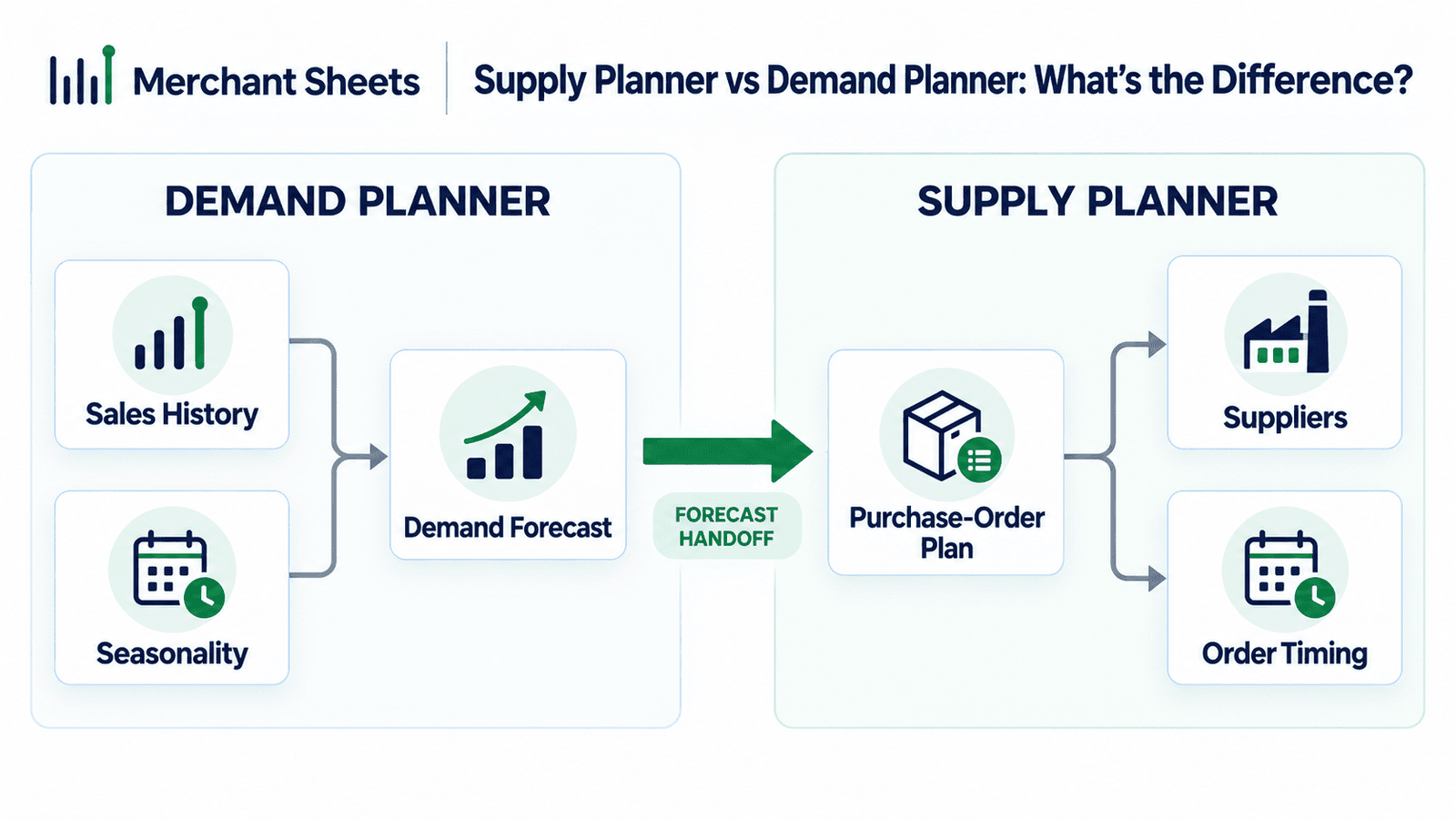
A demand planner forecasts future demand: how much of each product a business will sell and when. A supply planner works out how to meet that demand, deciding what to order, from which supplier, in what quantity, and by when. Demand planning is the prediction side of the business; supply planning is the fulfillment side.
The two run in one direction. You forecast demand first, then build the plan that meets it, so the supply plan inherits the quality of the forecast underneath it.
Table 1. Demand planner and supply planner, side by side.
| Dimension | Demand planner | Supply planner |
| Core question | How much will we sell, and when? | How do we get it, from whom, and by when? |
| Which side | The prediction side (demand) | The fulfillment side (supply) |
| Main inputs | Sales history, seasonality, promotions | The forecast, lead times, MOQs, cash on hand |
| Owns | The demand forecast, by SKU | The purchase-order and replenishment plan |
| Delivers | A forecast the business plans against | Orders sized and timed to meet the forecast |
| Fails when | The forecast misses real demand | Orders land late, too small, or too large |
What a demand planner owns
A demand planner owns the forecast and everything that feeds it. Day to day, that means building a sales forecast for each SKU from order history, seasonality, and the promotions on the calendar, then checking last month’s forecast against what sold and adjusting the next one.
The deliverable is a set of numbers: how many units of each product you expect to move, and when. Building that forecast well is its own discipline, demand forecasting, and so is measuring how far the last one missed. The demand forecast is the number the rest of the business plans against, so its quality sets the ceiling on everything downstream.
Forecast a little high, and you commit cash to stock that sits; forecast a little low and you sell out of the products carrying the brand.
What a supply planner owns
A supply planner takes the forecast as a given and works out how to meet it, deciding what to buy, from whom, in what quantity, and by when, so stock lands before you need it without locking up cash you can’t spare.
The supply side is where the real-world constraints live. Suppliers quote lead times, the weeks between placing an order and receiving it, that run longer and less reliably than the dates on the purchase order, so a supply planner plans around the lead times suppliers hit in practice.
They set minimum order quantities (MOQs) that force buying in fixed chunks whether or not the forecast asked for that many. And once stock sits in more than one place- a warehouse, a third-party logistics provider (3PL), an Amazon fulfillment center- someone decides how much goes where.
Turning the forecast into a purchase-order plan, sizing and sequencing each order against those constraints, and setting the reorder points that trigger the next buy is the supply planner’s work.
How the demand plan and supply plan connect
The two plans run in sequence, demand first, supply second, and the handoff between them is where a lot of small-brand inventory trouble starts.
Here’s the mechanism. The supply plan is only as good as the forecast underneath it, so a demand miss and a supply miss can show up as the same empty shelf. When the forecast and the buying drift apart, you get the swing every operator knows: sold out of the winners, overstocked on the slow movers, cash stuck in the wrong place.
Reconciling the two, lining up what you expect to sell with what you’ve ordered, is what a formal sales and operations planning (S&OP) process does at larger companies. You don’t need the process. You do need the reconciliation.
When something goes wrong on the shelf, you can read the symptom back to the side that broke, because the fix is different for each.
Table 2. Reading an inventory symptom back to the demand side or the supply side.
| Symptom | Likely demand-side cause | Likely supply-side cause |
| Stocked out of a winner | The forecast read that SKU too low | The order went in too late or too small for the lead time |
| Overstocked a slow SKU | The forecast ran too high, or missed a slowdown | Ordered above what the forecast justified, or an MOQ forced it |
| Cash tied up in inventory | Winners and losers forecast alike, with no prioritizing | Ordered too early, or in quantities demand doesn’t need yet |
| Constant last-minute reorders | No forward forecast to plan against | No purchase-order plan; every order is a reaction |
Do you need both a demand planner and a supply planner?
Every brand needs both functions, but a business under a few million in revenue rarely needs two people, or even one dedicated hire, to cover them.
At a large company, demand and supply planning are two seats filled by two people inside a standing S&OP process. In a smaller brand they’re two hats worn by one person, usually the founder, and the supply side is the half that most often goes uncovered: the forecast feels like strategy, while sequencing purchase orders against lead times and cash feels like admin.
For a brand your size, the question that matters is whether both functions are getting done at all, and how to cover the gap.
If they’re not, there are a few ways to close it: handling it yourself, leaning on inventory software, hiring, or bringing in a fractional planner. Which one fits depends on your SKU count, your volume, and how much of your own time you can give it, which comes down to what the role involves and how to staff it.
Whichever route you choose, the work runs on the same inventory planning framework, and when the answer points outside the business, it becomes a decision about when to bring in outside help.
When the two roles split into separate jobs
The two roles start as one job and split only when the supply side grows too complex for the person doing the forecasting to also manage. A few signals tell you you’re there:
- SKU count and volume: Hundreds of active SKUs and enough order volume that forecasting fills a role on its own.
- Multiple or overseas suppliers: Several vendors, long and variable lead times, and container-level ordering that needs constant attention.
- Hard supply constraints: Minimum order quantities, supplier allocations, or production lead times that force a real trade-off on every order.
- Stock in many places: Inventory spread across warehouses, third-party logistics, or Amazon regions, where deciding what goes where becomes a job by itself.
Frequently asked questions
What is the difference between a demand planner and a supply planner?
A demand planner forecasts how much a business will sell and when, while a supply planner decides how to meet that forecast through orders, suppliers, quantities, and timing; demand planning is the prediction side and supply planning is the fulfillment side.
Which comes first, demand planning or supply planning?
Demand planning comes first: you forecast expected demand, then build the supply plan, the purchase orders and their timing, to meet it, so the supply plan is only as reliable as the forecast it’s built on.
What does a supply planner do day to day?
A supply planner turns the demand forecast into a purchase-order plan, works real supplier lead times and minimum order quantities, sizes and sequences orders, and positions inventory across locations so stock arrives before it’s needed without tying up excess cash.
Does a small ecommerce business need both a demand planner and a supply planner?
A small brand needs both functions but rarely needs two people; below a few million in revenue one person, often the founder or a fractional planner, handles both the forecast and the buy plan.
Is a supply planner the same as a supply chain analyst?
No: a supply planner owns the plan for meeting forecasted demand through purchasing and replenishment, while a supply chain analyst is a broader data role that studies and improves the whole chain, so the titles overlap, but the supply planner’s job is the buy plan.
Is demand planning part of supply chain?
Yes: demand planning is the front end of supply chain planning, feeding the supply plan and the wider sales and operations planning process, though its focus is the forecast rather than the sourcing and logistics that supply planning handles.
Can one person do both demand and supply planning?
Yes, and in most brands under a few million in revenue, one person should, because the two functions share the same data and the volume rarely justifies splitting them until SKU count, supplier complexity, or multi-location stock makes the supply side a full job on its own.
