
Key takeaways
- A demand planner owns the forecast and turns it into a buy plan: how much of each SKU to order and when, so you hold enough stock to sell without tying up cash you can’t spare.
- The day-to-day is a forecast by SKU, a reorder point and safety stock per SKU, a purchase-order plan, and a monthly check on how accurate the last forecast was.
- Most sub-$5M ecommerce brands don’t need a full-time demand planner; they need the function handled, which is a different and much cheaper thing.
- A full-time demand planner costs roughly $65,000 to $112,000 a year loaded, and a brand under a few million in revenue rarely has the SKU count or volume to keep one busy.
- Your real options are doing it yourself in a spreadsheet, buying inventory software, hiring, or bringing in a fractional planner, and the right one depends on your SKU count, your volume, and your time.
- A demand planner’s real subject is cash: inventory is the single biggest use of cash in an ecommerce business, so planning it well is cash strategy in an operations hat.
You sell out of your best product for three weeks, then a slow SKU eats your cash for six months. That swing is what a demand planner exists to stop, by forecasting demand and turning it into a buy plan. The real question for a brand your size isn’t whether you need the function; it’s how to staff it.
What is a demand planner?
A demand planner is the person who forecasts how much you’ll sell and turns that forecast into a plan for what to buy and when. In an ecommerce business they own the numbers behind purchasing, so you carry enough inventory to meet demand without sinking cash into stock that sits.
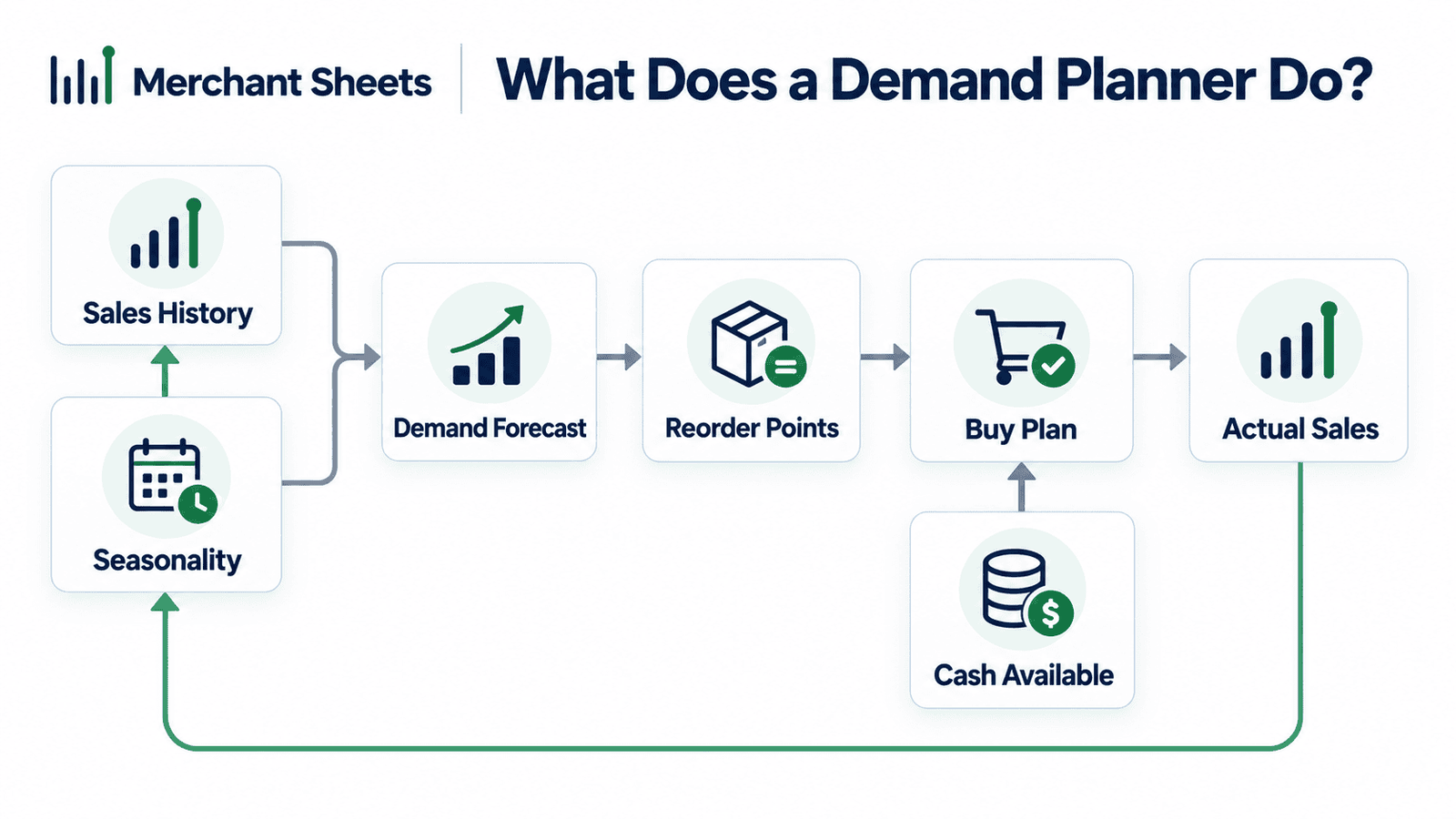
Strip away the corporate supply-chain language and the job is narrow and practical. A demand planner reads your sales history, layers in seasonality and whatever you’re about to promote, and produces a forecast for each product. Then they translate that forecast into orders: how much to buy, from which supplier, and when it has to land.
There’s a related role, the supply planner, who works out how to meet demand once it’s forecast, and in a small brand one person usually wears both hats; the full split is its own topic in supply planner vs demand planner.
In practice it looks like a short weekly routine: pull last week’s sell-through, update the forecast for anything trending or about to go on promo, flag the SKUs closing in on their reorder point, and cut the purchase orders that need to go out.
| Strip away the supply-chain language and a demand planner answers one question every week: how much of each product should we buy, and when, so we don’t run out and don’t drown in stock. |
What does a demand planner do, day to day?
Day to day, a demand planner builds and maintains the demand forecast, sets a reorder point and safety stock for each SKU, turns that into a purchase-order plan, and reviews how accurate last month’s forecast turned out to be. Each of those has a method behind it, so here’s what the planner produces, with the how linked out.
The forecast is the anchor: a monthly view of what each product will sell, built from history and adjusted for seasonality and promotions, which is its own craft in demand forecasting. From there the planner sets a reorder point and a safety stock level per SKU so you reorder before you run dry, the work covered in safety stock and reorder points.
Those feed the buy plan, the actual list of what to order and when, which is the heart of the inventory planning framework. And every month they check the last forecast against what sold so the next one is sharper, which is what forecast error measures.
Table 1. What a demand planner owns, and what it produces.
| What they own | What it produces | The method behind it |
| The demand forecast | A monthly sales forecast by SKU, with seasonality and promo uplift built in | Demand forecasting |
| The reorder policy | A reorder point and safety stock level for each SKU | Safety stock and reorder points |
| The replenishment plan | A purchase-order plan: what to buy, when, and how much | The inventory planning framework |
| The forecast review | A monthly read on how accurate the last forecast was, and why it missed | Forecast error |
| The inventory-to-cash view | A buy plan sized against the cash on hand, so purchasing never outruns the bank | Open-to-buy against cash |
The skills a good demand planner brings
The job looks like spreadsheets, but the value is judgment: reading demand signals, knowing which SKUs carry the business, and sizing a buffer against real-world uncertainty. The core skills are:
- Forecasting and data: Comfortable building a forecast from sales history, seasonality, and promo plans, and checking it against what sold.
- Inventory judgment: Knowing which SKUs carry the business, where to hold a buffer, and where a stockout costs less than the cash to prevent it.
- Supplier and lead-time discipline: Planning to real lead times, the ones your suppliers hit in practice rather than the ones on the purchase order, and sequencing orders against them.
- Cross-functional read: Translating between what marketing is about to promote, what the cash allows, and what the supplier can deliver.
Do you need a demand planner?
You need the demand-planning function the moment guessing at reorders starts costing you real money, but that’s different from needing a full-time hire. The signals are concrete, and most growing brands hit them well before they can justify a salary.
You know the function is missing when you stock out of your winners while cash sits frozen in slow SKUs, when your reorders are last-minute scrambles instead of a plan, when supplier lead times keep catching you off guard, and when the inventory has outgrown the spreadsheet you started with.
Any one of those is costing you margin or cash right now. The thing to be clear about is this: the question is never whether you need the function, because you do the moment inventory gets complicated. The question is how to staff it, which the next section answers.
The reason it matters isn’t tidiness. A stockout on a winner doesn’t only lose the sale, it hands the customer to a competitor and dents your ranking on the channel, so the cost outlives the empty shelf.
An overstock on a dud freezes cash you could have put behind the product that’s selling, and it keeps costing you every month it sits. Both are cash problems wearing an operations costume, and both get more expensive the faster you grow.
| A demand planner’s real job isn’t avoiding stockouts, it’s protecting cash. Inventory is the single biggest use of cash in an ecommerce business, so a good plan is the difference between growth that funds itself and growth that quietly drains the bank. |
DIY, software, hire, or fractional: How to staff the function
There are four ways to get demand planning done, and the right one comes down to your SKU count, your volume, and how much of your own time you can give it. You can do it yourself in a spreadsheet, buy inventory software, hire a full-time demand planner, or bring in a fractional planner who runs the function for you.
Doing it yourself works while you have a handful of SKUs and steady demand, and it breaks the moment the catalog grows or seasonality kicks in. Inventory software does the math, but a tool nobody operates every week is money wasted, and plenty of brands pay for one and still fly blind.
A full-time hire gives you a dedicated owner, but at $65,000 to $112,000 a year loaded you need the SKU count and volume to keep them busy, which most sub-$5M brands don’t have.
A fractional planner sits in the gap: the function handled by a specialist, in your own tools, without the headcount. When outsourcing is the right move is its own decision in inventory planning services.
A rough rule cuts through it: if you can still hold the whole catalog in your head, do it yourself; if you can’t but you’ll commit to running a tool every week, buy software; if you won’t run the tool and can’t fill a full role, bring in a fractional planner; and hire in-house only once the work is genuinely full-time.
Table 2. Four ways to staff demand planning, and who each fits.
| Option | What it costs | What you get | Best for |
| Do it yourself | Your time | Full control and no cash out, but it lives and dies with you and breaks as SKUs grow | Early brands with few SKUs and steady demand |
| Inventory software | ~$199 to $500 a month | Forecasts and reorder suggestions, but only if someone operates it every week | Brands ready to run the tool every week |
| Full-time hire | ~$65K to $112K a year, loaded | A dedicated owner of the forecast and the buy plan | Brands with the SKU count to keep one busy |
| Fractional planner | A monthly fee | The function handled by a specialist, in your own tools, without a hire | Sub-$5M brands that need the function, not a headcount |
How much does a demand planner cost?
A full-time demand planner costs roughly $65,000 to $112,000 a year in salary before benefits and overhead, inventory software runs about $199 to $500 a month, and a fractional planner sits between the two, a monthly fee for the function without the headcount. Those salary and software figures are current as of 2026.
The number that matters for a brand your size isn’t the salary, it’s whether you’d keep a full-time planner busy. Under a few million in revenue, with a catalog a spreadsheet can still hold, you rarely will, so the real choice is usually software you commit to operating or a fractional planner who runs it for you.
Both cost a fraction of a hire, and both get you the thing that matters: a forecast and a buy plan you can trust.
The fractional math is straightforward: a monthly fee that lands well under the cost of a $65,000-plus salary, for someone who has already built these systems for other brands. You skip the ramp-up, you skip the risk of a bad hire, and you can scale the engagement up or down as your volume moves.
Frequently asked questions
What does a demand planner do?
A demand planner forecasts how much a business will sell and turns that into a plan for what to buy and when, owning the demand forecast, the reorder points, and the purchase-order plan so inventory matches demand without tying up cash.
What is the difference between a demand planner and a supply planner?
A demand planner forecasts future demand, while a supply planner works out how to meet that demand through orders, suppliers, and logistics, and in a small ecommerce brand one person usually does both.
Do small ecommerce businesses need a demand planner?
Small brands need the demand-planning function as soon as guessing at reorders costs real money, but they rarely need a full-time hire, so the function is usually better handled with software or a fractional planner until volume justifies a role.
How much does a demand planner make?
A full-time demand planner earns roughly $65,000 to $112,000 a year depending on experience and location, which is why most sub-$5M ecommerce brands get the function through software or a fractional planner instead.
What skills does a demand planner need?
A demand planner needs forecasting and data skills, inventory judgment about which SKUs matter and where to hold a buffer, lead-time discipline, and the cross-functional readiness to line up marketing, cash, and suppliers.
Is demand planning the same as inventory planning?
They overlap but aren’t identical: demand planning forecasts what you’ll sell, and inventory planning turns that forecast into stock levels, reorder points, and purchase orders, and in practice a demand planner does both.
Can software replace a demand planner?
Software can do the calculations, but only if someone operates it, sets the assumptions, and acts on the output, so the tool replaces the spreadsheet, not the judgment, which is why brands buy tools and still drift.
When should you hire a demand planner instead of outsourcing?
You hire in-house once your SKU count and order volume keep a full-time planner genuinely busy, and below that a fractional or outsourced planner gives you the same function without the fixed cost.
Get the planning handled without the hire
Most sub-$10M brands don’t need a full-time demand planner on payroll, they need the function handled: a forecast that holds up, reorder points that match real lead times, and a buy plan that doesn’t outrun the bank.
Building that forecasting-and-reorder system, in a spreadsheet or in the tool you already pay for, is the inventory planning I run for ecommerce brands.
If you’re guessing at reorders and swinging between stockouts and overstock, tell me what you sell and how it moves, and I’ll show you what a real plan would change.
