
Key takeaways
- Break-even ACoS is the advertising cost of sale at which your Amazon ads make zero profit — spend more and each ad sale runs at a loss.
- It equals your contribution margin: sale price minus COGS, Amazon referral and FBA fees, and a returns reserve, divided by sale price — not your gross margin.
- The formula is pre-ad profit per unit ÷ sale price. A $40 product with $15 of pre-ad profit breaks even at 37.5%.
- ACoS is the inverse of ROAS, so break-even ROAS = 1 ÷ break-even ACoS — a 33% break-even ACoS is a 3.0x break-even ROAS.
- Set your target ACoS below break-even to leave the profit you want, and watch TACoS (total ad spend ÷ total revenue) to see whether ads are lifting the whole business.
Break-even ACoS is the advertising cost of sale where your Amazon ads stop making money — spend a dollar more to win the sale and you lose money on it. Sellers trip over it because it’s set by your own margins, so the “good ACoS” from a blog can quietly bankrupt you.
Get it right and every bid decision gets easier: you know the ceiling you can spend to, which products can afford aggressive ads, and when a high ACoS is helping the whole business.
Get it wrong and you’ll either cap spend too low and starve growth, or run past break-even and pay for sales that lose money.
What is break-even ACoS?
Break-even ACoS is the ACoS at which an ad-driven sale earns zero profit. ACoS, or advertising cost of sale, is your ad spend divided by the sales those ads generated.
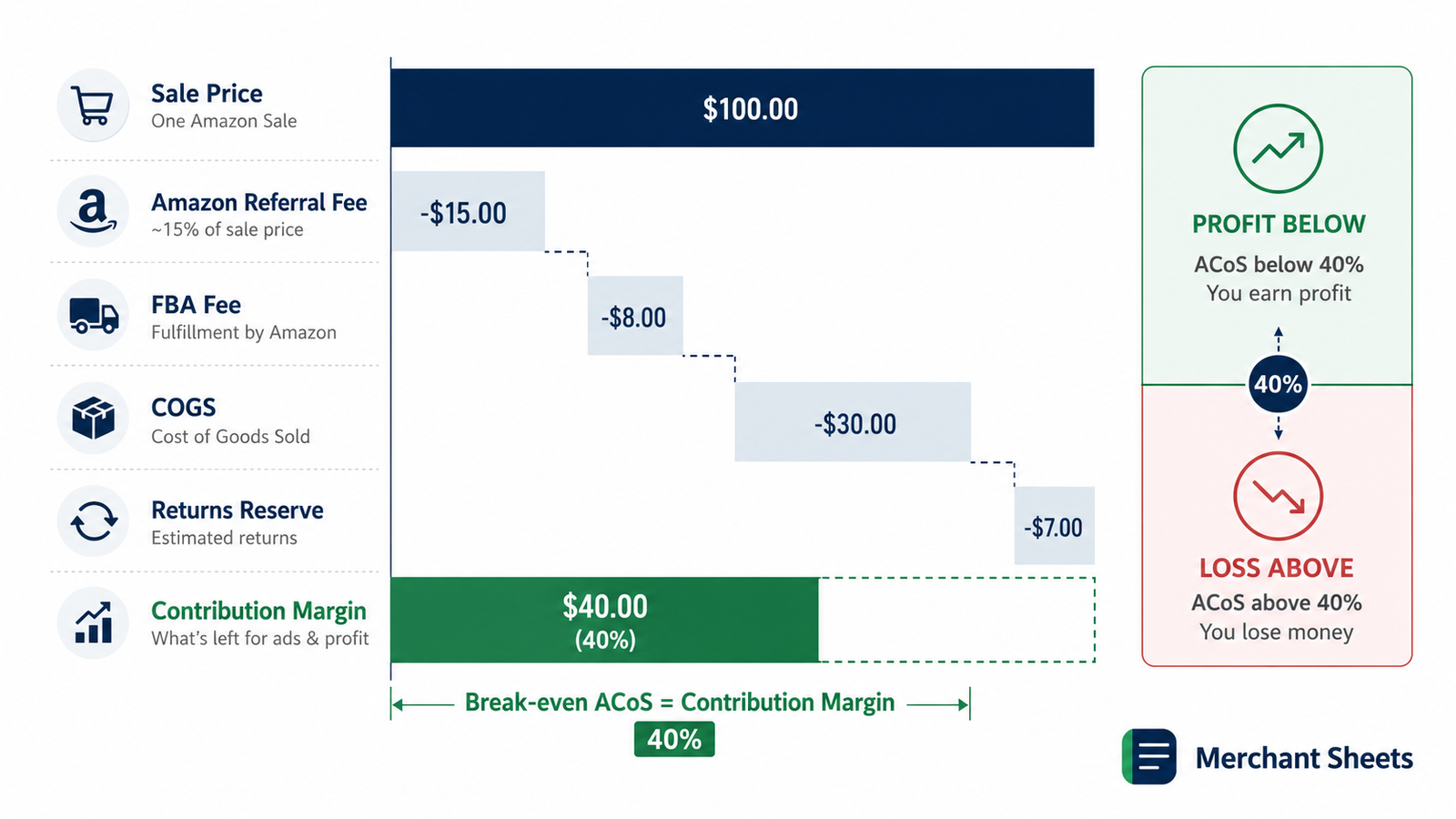
When your ACoS matches your pre-ad profit margin, the ad exactly eats the margin; below that line you profit, and above it you lose money on every ad sale.
Your current ACoS is what you’re running today; your break-even ACoS is the line you can’t cross and stay profitable. A campaign at 25% ACoS sounds efficient, but if you break even at 22%, it’s losing money — and a 40% ACoS that looks expensive is fine if your break-even is 45%.
The number only means something next to your margin, which is why borrowing an “average” ACoS from an agency blog is where sellers go wrong.
How to calculate break-even ACoS
Break-even ACoS is your pre-ad profit stated as a percentage of your sale price. Work out what’s left from a sale after every cost except advertising, then divide by the price.
Break-even ACoS = pre-ad profit per unit ÷ sale price
The math on a $40 product, once Amazon and your supplier take their cuts:
| Line | Per unit |
| Sale price | $40.00 |
| Referral fee (15%) | −$6.00 |
| FBA fee | −$5.50 |
| Landed COGS | −$12.00 |
| Returns reserve | −$1.50 |
| Pre-ad profit | $15.00 |
| Break-even ACoS | 37.5% |
This product breaks even at 37.5% ACoS. Run ads at 30% and you keep $3 of profit on each ad sale; run at 40% and you’re paying about $1 to make each sale. To find your own number, build the pre-ad profit line, since that’s where the mistakes hide:
- Start with your sale price: The price the customer pays, before any fees.
- Subtract the referral fee: Amazon’s cut on each sale, usually 8–15% depending on category.
- Subtract the FBA fee: The per-unit pick, pack, and ship charge if you sell through Fulfillment by Amazon.
- Subtract your landed COGS: Product cost plus inbound freight and duty to get the unit to Amazon.
- Subtract a returns reserve: A few percent of price set aside for refunds and unsellable returns.
- Divide the result by your sale price: That percentage is your break-even ACoS.
Why break-even ACoS equals your contribution margin, not gross margin
Gross margin is your price minus what the product cost you. Contribution margin goes further: it takes out every variable cost of making the sale — your Amazon fees and FBA costs, payment processing, and returns — and leaves what the order truly contributes.
Break-even ACoS is built on the second number, because ads are paid out of what’s left after Amazon takes its cut, not before.
On the $40 product above, gross margin is 70% — price minus $12 of product cost. Set break-even ACoS there and you’d bid toward a 70% ACoS and lose money on most of those sales. The real break-even is 37.5%, because the referral fee, FBA fee, and returns reserve come out first.
That gap is the whole misconception, and it’s why “my ads are profitable” and “my account is profitable” can be two different stories. If you’ve mapped your contribution margin already, you’ve done the hard part — break-even ACoS is that same percentage.
| The trap: Break-even ACoS is your contribution margin, not your gross margin. Set it off gross margin and every referral and FBA fee you left out is a sale you lose money on. |
Break-even ACoS vs target ACoS: what’s the difference?
Break-even ACoS is the line where profit hits zero; target ACoS is the number you actually aim for, set below break-even to leave the margin you want. Break-even tells you the ceiling, and your target is that ceiling minus the profit you need on each order.
Target ACoS = (pre-ad profit − profit you want to keep) ÷ sale price
Setting a target is subtraction. On the $40 product, break-even is 37.5% and pre-ad profit is $15. Want to keep $6 of profit on each ad-driven order? You can spend the other $9 on ads, which is a 22.5% target ACoS. Willing to keep $3 to grow faster? Run up to 30%.
Two things move the target. On a launch you might run close to break-even to buy rank and reviews, treating thin profit as the cost of visibility. On a mature product with steady organic sales, you’d pull the target well below break-even, because you don’t need to pay for every sale.
How do ACoS, ROAS, and break-even connect?
ACoS and ROAS are the same relationship upside down. ROAS, or return on ad spend, is revenue divided by ad spend; ACoS is ad spend divided by revenue. So ACoS = 1 ÷ ROAS, and your break-even ROAS is 1 ÷ your break-even ACoS.
Break-even ROAS = 1 ÷ break-even ACoS
That makes the two break-even numbers interchangeable. A 37.5% break-even ACoS is a 2.7x break-even ROAS; a 33% break-even ACoS is a clean 3.0x. Use whichever your team speaks — sellers deep in Amazon tend to think in ACoS, while anyone coming from Meta or Google thinks in ROAS.
| Break-even ACoS | Break-even ROAS |
| 20% | 5.0x |
| 25% | 4.0x |
| 33% | 3.0x |
| 40% | 2.5x |
| 50% | 2.0x |
ACoS vs TACoS: which should you optimize?
Optimize to break-even ACoS at the campaign level, but watch TACoS to judge the whole account. TACoS, or total advertising cost of sale, is total ad spend divided by total revenue — ad sales and organic together.
ACoS tells you whether a campaign is efficient; TACoS tells you whether advertising is growing the business.
The trap is chasing a lower ACoS until you’ve cut the spend that was feeding organic rank. ACoS looks great, then total sales slide and TACoS creeps up — the sign that fewer ads mean fewer organic sales, not more profit. A 30% ACoS that holds a 10% TACoS while the brand grows beats a 15% ACoS on a shrinking account.
Both belong among the ad metrics worth tracking every month, read together rather than alone.
Know your line before you bid
Your break-even ACoS shifts every time a fee, a cost, or a return rate moves, so a number you calculated once last quarter is already stale. The ROAS & MER Tracker builds your break-even ACoS and break-even ROAS from your real unit economics and lines them up against your live spend, so you can see which campaigns still clear the bar.
Set your target once, then let the sheet flag when a “good” ACoS has quietly crossed your break-even ACoS.
Frequently asked questions
What is a good ACoS on Amazon?
A good ACoS is any number comfortably below your break-even ACoS, which for most products lands between 15% and 40%. There’s no universal target, because a “good” ACoS on a 70%-margin product would sink a 25%-margin one. Compare your ACoS to your own contribution margin and set your target below it.
Is a lower ACoS always better?
A lower ACoS isn’t always better, because cutting spend to force it down can starve the organic sales your ads were feeding. Below break-even, ACoS measures efficiency, and past a point, pushing it lower trades growth for a vanity number. Watch TACoS alongside it to catch that trade-off.
What's the difference between ACoS and TACoS?
ACoS is ad spend divided by the sales those ads generated; TACoS is total ad spend divided by all revenue, organic included. ACoS measures campaign efficiency, while TACoS measures advertising’s impact on the whole business. A rising TACoS with a flat ACoS usually means your organic sales are slipping.
What's the difference between ACoS and ROAS?
ACoS and ROAS are inverses: ACoS is ad spend divided by ad revenue, and ROAS is ad revenue divided by ad spend. A 25% ACoS is a 4.0x ROAS — the same efficiency stated two ways. Amazon reports ACoS, while most other ad platforms report ROAS.
