
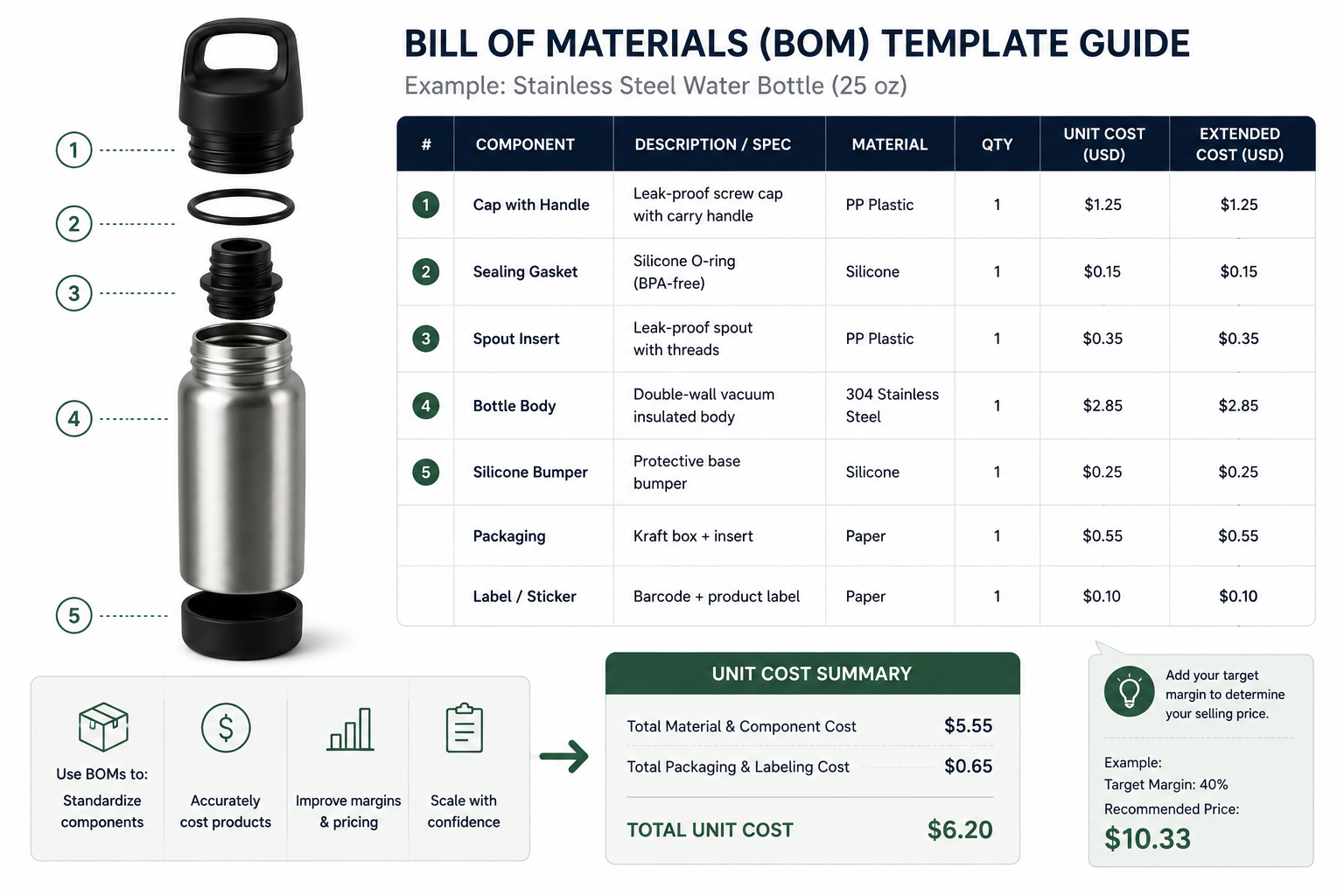
Key takeaways
- A bill of materials (BOM) is the component-level recipe for a product: every part, the quantity per unit, and its cost.
- BOM cost is the sum of each component’s unit cost multiplied by the quantity used in one finished unit.
- A BOM covers materials only. Labor, packaging, inbound freight, and duty turn BOM cost into your landed cost and COGS.
- Kits, bundles, and subscription boxes each get their own BOM, which drives their cost and their reorder plan.
- Component prices move, so a BOM is a living document — re-cost it whenever a supplier quote changes.
Before you can price a product with any confidence, or trust the margin your reports show, you have to know what one unit costs to make. A bill of materials is how you get there. It’s the component-by-component recipe for your product — every part, every quantity, and what each one costs — and it’s the foundation the rest of your unit economics sits on.
This guide covers what goes in a bill of materials (BOM), how to cost a single unit from one, and how that figure rolls up into your landed cost and cost of goods sold (COGS).
What is a bill of materials?
A bill of materials is a structured list of every component, part, and quantity needed to make one finished unit of a product. Think of it as a recipe: it tells you what goes into the product and how much of each ingredient, so anyone can build the same unit and cost it the same way.
BOMs come in two shapes. A single-level BOM lists the components that go straight into the finished product. A multi-level BOM adds sub-assemblies — components that are themselves built from other parts — and drills into each one.
A candle is close to single-level; a gift set that contains a candle, a card, and a box is multi-level, because the candle inside it has its own BOM. Any brand that assembles, kits, or bundles products needs one, because without it the true cost of a unit is a guess.
What goes in a bill of materials
A BOM you can cost from needs a handful of fields for every line. Strip it back to these:
| Field | What it captures |
| Component / SKU | Which part it is, tied to a stock code |
| Description | Plain-language name, material, spec |
| Quantity per unit | How much goes into one finished product |
| Unit of measure | Grams, millilitres, each — so the math is unambiguous |
| Unit cost | What you pay per unit of measure, from the supplier quote |
| Extended cost | Quantity × unit cost — the line’s contribution to the total |
| Scrap / waste % | Expected loss in production, added on top |
| Supplier & lead time | Who supplies it and how long it takes to arrive |
The unit cost and extended cost columns are what make the BOM a costing tool rather than a packing list. They’re also only as accurate as the supplier prices behind them, which is why the quotes, terms, and lead times you keep on each vendor feed straight into the BOM.
How to cost a product from a BOM
Costing a unit from a BOM is one operation repeated down the list: multiply each component’s unit cost by the quantity you use, then add the lines up.
| BOM cost = sum of (component unit cost × quantity per unit) |
Take a scented candle as a worked example. Here’s its bill of materials, with the extended cost worked out on each line:
| Component | Qty / unit | Unit cost | Extended cost |
| Soy wax | 200 g | $0.020 / g | $4.00 |
| Fragrance oil | 20 ml | $0.080 / ml | $1.60 |
| Glass jar | 1 | $2.50 | $2.50 |
| Wick + tab | 1 | $0.30 | $0.30 |
| Lid | 1 | $0.60 | $0.60 |
| Warning label | 1 | $0.20 | $0.20 |
| Gift box | 1 | $0.80 | $0.80 |
| BOM cost (materials) | $10.00 |
The materials come to $10.00. That’s the BOM cost, and it’s where a lot of sellers stop. Two more lines turn it into what the unit really costs to produce: the labor to assemble it, and a scrap allowance for the wax and oil you lose in pouring.
Five minutes of assembly at $18 an hour is $1.50, and a 3% scrap allowance on materials is another $0.30, so the unit product cost lands at $11.80. To run the same build on your own product:
- List every component: One line per part, with its quantity per unit and unit of measure.
- Cost each line: Multiply the unit cost from your supplier quote by the quantity to get the extended cost.
- Add a scrap allowance: Fold in the realistic percentage of material you lose in production.
- Add assembly labor: Include the minutes of work per unit at your loaded labor rate to reach the product cost.
From BOM cost to landed cost to COGS
A BOM stops at materials, so BOM cost is never the whole story. The number you price against and report has more in it, and it’s worth walking the buildup one layer at a time.
| A BOM stops at materials. Your real unit cost adds labor, packaging, freight, and duty — and that’s what becomes COGS. |
Start with the $10.00 of materials. Add assembly labor and the scrap allowance and you have a unit product cost of $11.80. Add the inbound freight and any import duty to move those goods to your warehouse and you reach the landed cost — the fully delivered cost of one sellable unit. For the candle, roughly $1.20 of freight and duty brings the landed cost to about $13.00. That landed figure is the one that flows into your cost of goods sold and, from there, into your margin. Get the BOM right and every number downstream — landed cost, COGS, price, and contribution margin — inherits that accuracy.
BOMs for kits, bundles, and subscription boxes
Kitting is where BOMs earn their keep in ecommerce. A bundle is a product whose components are other products, so it gets its own BOM. A “Summer Essentials” box holding a candle, a hand cream, and a card has a BOM listing each of those SKUs and its quantity.
That single list does three jobs at once. It costs the bundle by summing the landed cost of each component. It drives the reorder plan, because selling one box has to decrement the stock of every SKU inside it. And it protects you from overselling, since the system knows a box can’t ship unless all its components are in stock. Price a bundle without its BOM and you’re guessing at both its cost and how much of it you can fulfil.
Keeping your BOM accurate
A BOM is a living document, not a one-time spreadsheet. Component prices drift, exchange rates move, and suppliers change their terms, so a cost that was right last quarter can quietly slip. A few habits keep it honest:
- Re-cost on every quote change: When a supplier sends new pricing, update the line and let the unit cost flow through.
- Build in a real scrap rate: Use the real loss you see in production rather than an optimistic zero.
- Flag single-source components: If one part comes from a single supplier, mark it — that’s a supply risk as much as a cost line.
- Keep supplier terms alongside the BOM: Lead times and payment terms shape both your cost and your reorder timing, so hold them where you cost the product.
Keep your BOM costed on today’s prices
A bill of materials is only as accurate as the supplier prices behind it, and those move. The Vendor & Supplier Scorecard keeps every supplier’s quotes, lead times, and terms in one place, so when a component price changes you can re-cost the product before it eats your margin.
See how your suppliers really stack up.
Frequently asked questions
What is a bill of materials?
A bill of materials is a structured list of every component and quantity needed to make one finished unit of a product. It works like a recipe, and it’s the basis for costing the product, planning purchases, and managing stock for anything you assemble, kit, or bundle.
What is included in a BOM?
At minimum, each line carries the component or SKU, a description, the quantity per unit, a unit of measure, the unit cost, and the extended cost (quantity × unit cost). A costing-grade BOM also adds a scrap allowance and the supplier and lead time for each component.
How do you calculate BOM cost?
Multiply each component’s unit cost by the quantity used in one unit to get its extended cost, then add every line together. That sum is your BOM cost. Add a scrap allowance and assembly labor to move from BOM cost to the full unit product cost.
Is a bill of materials the same as COGS?
No. A BOM covers materials only, while cost of goods sold includes labor, packaging, inbound freight, duty, and other costs of getting a sellable unit to your shelf. BOM cost is the starting layer; landed cost and COGS are what it rolls up into.
What's the difference between a single-level and multi-level BOM?
A single-level BOM lists the components that go directly into the finished product. A multi-level BOM adds sub-assemblies — components built from other parts — and breaks each one down. Bundles and kits are usually multi-level, because the items inside them have their own bills of materials.
