
Key takeaways
- Sales tax nexus is the connection between your business and a state that obligates you to collect and remit that state’s sales tax; with no nexus, you have no duty to collect there.
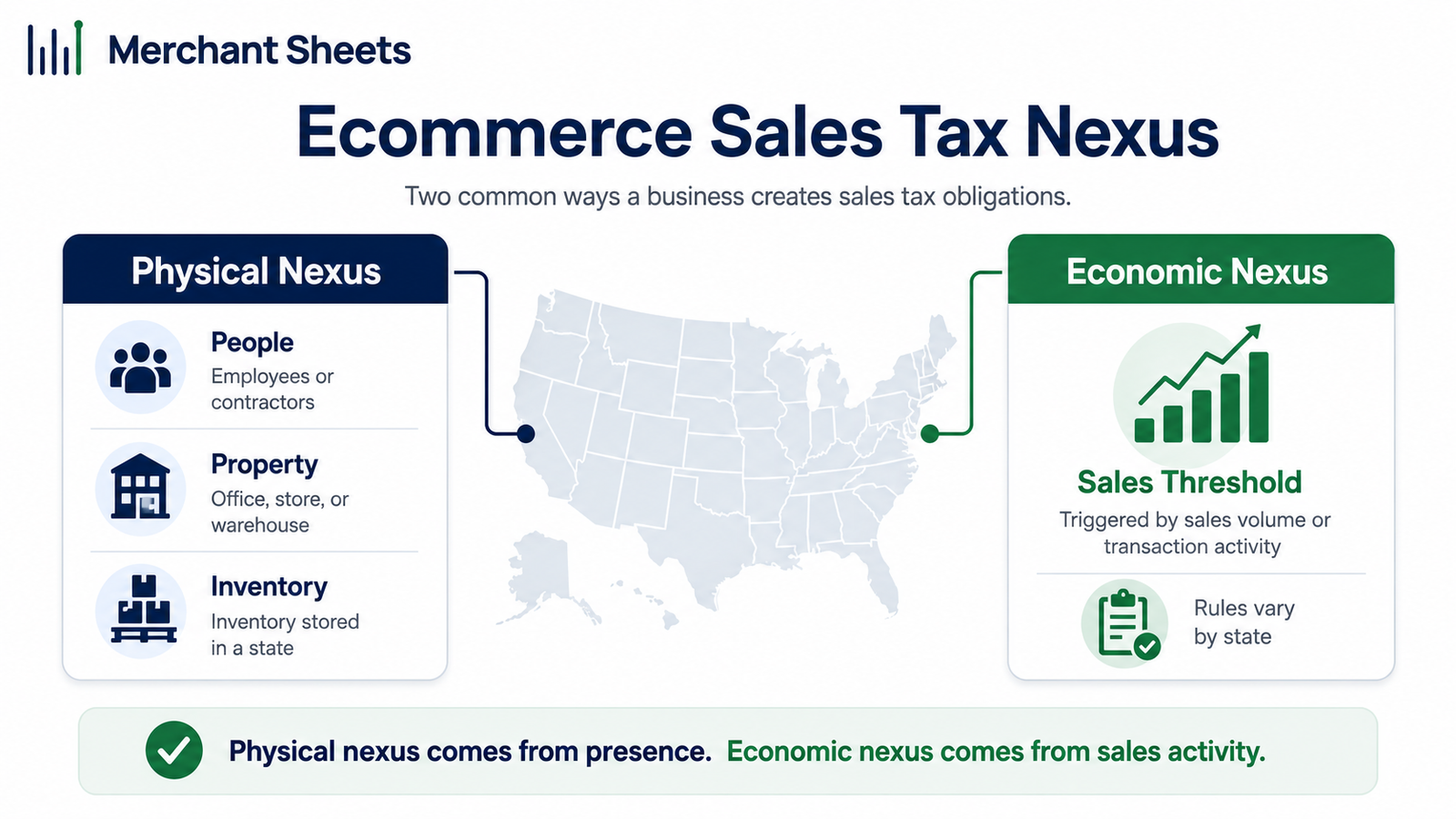
- Two kinds matter for ecommerce: physical nexus (an office, an employee, or inventory in a state, including Amazon FBA stock) and economic nexus (crossing a state’s sales or transaction threshold).
- Economic nexus comes from the 2018 South Dakota v. Wayfair decision; the common threshold is $100,000 in sales or 200 transactions a year, but it varies by state, and California and Texas sit at $500,000.
- Many states are dropping the 200-transaction count and moving to a revenue-only threshold, which lifts the bar for smaller sellers; Illinois removed its transaction count on January 1, 2026.
- On a marketplace like Amazon, the platform collects and remits sales tax for you, but those sales can still count toward your economic-nexus threshold in many states.
- Register for a sales tax permit in a state before you start collecting there, because collecting tax without a permit is itself a violation in most states.
Sales tax nexus is the rule that decides where your business has to collect state sales tax, and for an ecommerce brand selling into 40 states, it’s easy to cross a line without noticing. It happens in two ways, and once you know them, you can map your own exposure. Here’s how it works.
What is sales tax nexus?
Sales tax nexus is a connection between your business and a state strong enough to require you to collect and remit that state’s sales tax. Before you have nexus in a state, you have no duty to collect there. Once you do, you have to register, collect tax at checkout, and file returns.
Nexus comes in two forms, and an ecommerce seller can have either or both. Physical nexus comes from a tangible presence in a state. Economic nexus comes from doing enough business there, measured in sales or order count, even with no physical footprint.
The economic kind is newer: it exists because of a 2018 Supreme Court decision, South Dakota v. Wayfair, which let states tax out-of-state sellers for the first time. To remit means to send the collected tax to the state, and a sales tax permit is the registration that authorizes you to collect it.
If you’re setting up your books alongside this, it connects to the wider work of ecommerce accounting, where the tax you collect has to be tracked correctly.
| No nexus, no duty to collect. Your obligation in a state starts the moment you establish nexus there, either by physical presence or by crossing the state’s economic threshold, and not before. |
Physical nexus: People, property, and inventory
Physical nexus is the older kind, and it comes from a tangible presence in a state. Any of these can create it: an office or a location, an employee or a contractor who works there (including a remote worker who lives in the state), inventory stored in the state, or selling in person at a trade show or market.
The one that catches ecommerce sellers out is inventory. Stock sitting in a state creates physical nexus, and if you use Amazon FBA or a third-party warehouse, your inventory can be moved into fulfillment centers across the country without you choosing each location. That can establish nexus in states you’ve never set foot in.
The catch is that many sellers don’t know which states hold their stock, so the exposure builds quietly. Pull your inventory locations from your fulfillment reports and treat every state that holds your goods as a physical-nexus state to check.
Economic nexus and the Wayfair threshold
Economic nexus is the kind most ecommerce sellers hit first, and it’s the one Wayfair created. Even with no physical presence in a state, once your sales into that state pass its threshold in a year, you have economic nexus and must register and collect. No warehouse, no employee, no office required, only enough sales.
The widely used threshold is $100,000 in sales or 200 separate transactions into a state in a year, whichever you hit first. That figure varies by state, so it has to be checked state by state.
A clear trend is worth knowing: many states are removing the 200-transaction count and moving to a revenue-only threshold, which raises the effective bar for smaller sellers who ship a high volume of low-priced orders. Illinois dropped its transaction count on January 1, 2026, and Utah did the same in July 2025.
There’s a second wrinkle behind the headline number: states differ on which sales count toward the threshold. Some measure your gross sales into the state, while others count only taxable or retail sales and exclude wholesale or exempt orders.
States also differ on the window, some look at the current or prior calendar year, others at a rolling twelve months. That’s why the map has to read each state’s exact definition rather than apply one number everywhere. A few representative thresholds:
| State | Sales threshold | Transaction count |
| Most states (common rule) | $100,000 | 200 (some states only) |
| California | $500,000 | None |
| Texas | $500,000 | None |
| New York | $500,000 | 100 (both required) |
| Illinois | $100,000 | None (count removed Jan 1, 2026) |
Representative economic-nexus thresholds, as of August 2026. Thresholds vary by state and change often; confirm each one against the state’s department of revenue before you act.
Other kinds of nexus you might hear about
Physical and economic nexus cover most ecommerce sellers, but two older types still come up, and both matter less now that economic nexus exists.
- Click-through nexus: This is triggered when in-state affiliates or referrers send you customers through links for a commission, which some states treat as a presence. Since Wayfair, the economic threshold usually catches these sellers anyway.
- Affiliate nexus: This comes from a related business, a parent, subsidiary, or affiliate, having a presence in a state on your behalf. It mainly affects larger multi-entity brands rather than a single ecommerce business.
How do marketplace sales like Amazon affect nexus?
On a marketplace, the platform collects and remits the sales tax for you, but those sales can still count toward your economic-nexus threshold in many states. So Amazon handles the tax on your Amazon orders, while the orders themselves can still pull you into registration elsewhere.
This works through marketplace facilitator laws. In nearly every state, the marketplace (Amazon, Etsy, Walmart) is required to collect and remit sales tax on the sales it facilitates, so you don’t collect on those orders yourself. The catch is that many states still include those marketplace sales when they measure whether you’ve crossed the economic-nexus threshold, which can put you over the line even though the platform is the one remitting.
Your own website sales, on Shopify or your direct-to-consumer site, are always your responsibility to collect on once you have nexus. The practical move is to separate your channels: track marketplace sales the platform handles and direct sales you handle, and measure both against each state’s threshold.
The marketplace side ties back to your books through Amazon seller accounting, where those settlements get reconciled.
Here’s how that plays out. Say you sell $70,000 through Amazon and $40,000 on your own website into a state with a $100,000 threshold that counts marketplace sales. Amazon remits the tax on its $70,000, but your combined $110,000 crosses the line, so you have to register and collect on the $40,000 of direct sales yourself. The marketplace covering its share doesn’t take you off the hook for yours.
How do you figure out where you have nexus?
You find your nexus by mapping two things against every state: your physical presence and your sales. Most of the data you need already sits in your Shopify and Amazon reports; the work is lining it up against each state’s rule. Work through it in order, and the output is a list of states where you already have to collect and the ones you’re about to.
- Map your physical footprint: List every state where you have an office, an employee or contractor, or inventory, including FBA and third-party warehouse locations from your fulfillment reports.
- Pull your sales by state: Get the last twelve months of sales for each state, split into marketplace and direct, so you can see both the totals and where they came from.
- Compare each state to its threshold: Check every state’s total against that state’s current threshold, confirming the exact number and whether it still counts transactions on the state’s department of revenue site.
- Flag where you stand: Mark the states where you already have nexus and the ones you’re approaching, so a threshold you’re near doesn’t sneak up on you.
- Re-run it on a schedule: Thresholds reset on a calendar or rolling basis and your sales grow, so revisit the map at least quarterly rather than once.
What to do once you have nexus
| Register before you collect. Charging sales tax in a state where you hold no permit is itself a violation in most states, so registration comes first, then collection. |
Once you’ve confirmed nexus in a state, the compliance path is the same everywhere, in this order.
- Register for a sales tax permit: Apply with the state before you collect a cent, because collecting without a permit is a violation in most states.
- Set up collection: Configure your platform or a tax tool to charge the right rate by the customer’s address, since rates vary by city and county on top of the state.
- File and remit on schedule: Send the collected tax to the state on its assigned cadence (monthly, quarterly, or annually), and file even a zero return when the state requires one.
- Add a tool as you scale: Once you’re registered in several states, rates and filing calendars get hard to track by hand, so a dedicated sales tax tool earns its place.
What if you’re already behind?
Plenty of sellers discover nexus in a state they should have been collecting in months or years ago. The exposure is real, since you stay liable for tax you failed to collect, but you have better options than ignoring it and hoping. The wrong move is to keep selling untaxed while you know you have nexus, because the liability grows with every order.
For back exposure, many states offer a voluntary disclosure agreement, where you come forward, pay a limited lookback period of tax, and the state often waives penalties. Registering and collecting going forward stops the meter on new exposure right away.
Where the past liability is large or spans several states, this is the point to bring in a sales tax specialist who handles voluntary disclosures, rather than working it out alone.
How sales tax shows up in your books
The point most operators get wrong is that the sales tax you collect is not revenue. It’s money you hold on behalf of the state until you remit it, so it belongs on the balance sheet as a liability, not in your P&L as income. Booking it as revenue overstates your sales and your profit, and leaves you short when the payment is due.
A ledger set up correctly keeps this straight on its own. QuickBooks has a native sales tax feature that tracks what you’ve collected and owe, while Xero leans on a connected tool, one of the differences in how QuickBooks and Xero handle sales tax.
Either way, the collected tax should sit in a liability account that you draw down each time you file, so the balance always reflects what you still owe the states. When you file, the money moves out of that account to the state and zeroes the portion you owed for the period.
If your books show sales tax landing in revenue, that’s the first thing to fix, because it inflates every margin number you read off the P&L.
Frequently asked questions
What is sales tax nexus?
Sales tax nexus is a connection between your business and a state that requires you to collect and remit that state’s sales tax, created by either physical presence or enough economic activity. Without nexus in a state, you have no obligation to collect there.
Do I have to collect sales tax in every state?
No, you only collect in states where you have nexus, and five states (Alaska, Delaware, Montana, New Hampshire, and Oregon) have no general statewide sales tax at all. Everywhere else, the duty depends on whether you’ve established physical or economic nexus.
Does Amazon collect sales tax for me?
Yes, under marketplace facilitator laws Amazon collects and remits sales tax on your Amazon sales in nearly every state, so you don’t remit on those orders yourself. Those sales can still count toward your economic-nexus thresholds, though, which can affect your own registrations.
Does Amazon FBA create sales tax nexus?
It can, because inventory stored in a state creates physical nexus, and FBA moves your stock into fulfillment centers across the country. If Amazon holds your inventory in a state, treat that state as one where you may have physical nexus and check its rules.
What happens if I don't collect sales tax when I should?
You stay liable for the uncollected tax plus penalties and interest, and the exposure compounds the longer it goes unaddressed. States can assess back taxes for years, so an unmanaged nexus obligation only compounds the longer it waits.
When do I need to register for a sales tax permit?
Register once you have nexus in a state and before you begin collecting there, because collecting tax without a permit is itself a violation in most states. Registration first, then collection, then filing is the order everywhere.
This article is general information, not tax advice. Sales tax rules and thresholds change and vary by state; confirm your obligations with each state’s department of revenue or a tax professional.
