
Key takeaways
- A fractional CFO is a senior finance leader who works with your business part-time and ongoing, giving you CFO-level strategy without the cost of a full-time hire.
- For an ecommerce brand, a fractional CFO owns cash flow, unit economics by channel and SKU, inventory and working-capital decisions, forecasting, and board or investor reporting.
- A fractional CFO sits above your bookkeeper and controller: they don’t do the daily bookkeeping or the monthly close, they decide what the numbers mean and what to do next.
- Most fractional CFOs work on a monthly retainer, commonly $3,000 to $15,000 as of 2026, though ecommerce-focused help for smaller brands can start lower or run hourly.
- The usual trigger to hire one is crossing roughly $1M to $5M in revenue, going paid-ads heavy, tightening cash, or preparing to raise, when a bookkeeper is being asked to make strategy calls.
- A full-time ecommerce CFO costs $350,000 or more all-in, so a fractional CFO is how a growing brand gets the same senior judgment at a fraction of the price.
A fractional CFO gives your ecommerce brand a senior finance leader part-time, for a fraction of a full-time salary. They turn your books into a cash-flow plan, channel-level profit, and the next set of moves. Here’s what a fractional CFO does, when a growing brand needs one, and what it costs.
What is a fractional CFO?
A fractional CFO is a senior finance executive who works with your business part-time and on an ongoing basis, usually on a monthly retainer, giving you the financial strategy a full-time chief financial officer (CFO) would provide without the full-time cost.
For an ecommerce brand, that means someone senior owning your cash, your profitability, and the financial decisions behind how you grow.
You’ll see the same role sold under a few names. Virtual CFO, outsourced CFO, and part-time CFO all describe the same thing, with the label chosen mostly for marketing.
What makes the role fractional is that one experienced finance leader splits their time across a small number of businesses, so a brand that’s too small to justify a full-time CFO still gets senior judgment on the decisions that matter.
The role tends to matter earlier for ecommerce than for most businesses. Margins are thin, cash sits locked in inventory for months, and a single channel shift or ad-platform change can swing a quarter.
That mix makes the financial calls, how much stock to buy, what you can spend to acquire a customer, when to raise, come faster and cost more to get wrong than they would in a simpler business.
A fractional CFO is how a brand gets senior judgment on those calls well before it can justify a full-time hire.
What does a fractional CFO do for an ecommerce brand?
A fractional CFO is the strategic layer on top of your books. They take the numbers your bookkeeper produces and decide what to do next: how to price, when to buy inventory, where to spend, and how to protect cash.
Picture a brand deciding whether to reorder a hero SKU while a Meta campaign is scaling, the CFO is the person who models whether the cash and the margin support both. The work centers on a few areas, and we cover what an ecommerce CFO does in more depth separately:
- Cash flow: Building and maintaining a rolling 13-week cash forecast, a week-by-week view of the money coming in and going out, so you can see a shortfall before it happens and time inventory buys around it.
- Unit economics: Measuring contribution margin by channel and SKU, along with customer acquisition cost (CAC) and marketing efficiency ratio (MER), so you know which products and channels make money.
- Inventory and working capital: Turning reorder timing, order minimums, and inventory financing into cash decisions rather than guesses.
- Forecasting and planning: Running budgets, forecasts, and scenario models, so a hire, a big inventory buy, or a price change is quantified before you commit.
- Pricing and financing: Setting price for margin, and modeling a line of credit, an SBA loan, or revenue-based financing against the cash plan.
- Reporting and fundraising: Producing a monthly management report that says what happened and what to do, and getting the numbers investor-ready before a raise.
What a fractional CFO won’t do
The boundaries of the role matter as much as its scope, and a good engagement makes them clear from the start. A fractional CFO owns strategy and decisions, and leans on other roles to feed them clean data, so a few things sit outside the job.
Daily bookkeeping, categorizing transactions, paying bills, and reconciling accounts, stays with your bookkeeper. The monthly close and the balance-sheet detail belong to a controller or an accountant.
Filing your taxes is your CPA’s job, though the CFO will plan around the tax consequences of a decision before you make it. And because the role is part-time by design, a fractional CFO won’t sit in your systems every day or act as an in-house employee.
The point of the arrangement is leverage: you buy senior judgment on the decisions that move the business, while the routine finance work stays where it belongs.
Fractional CFO vs bookkeeper, controller, and full-time CFO
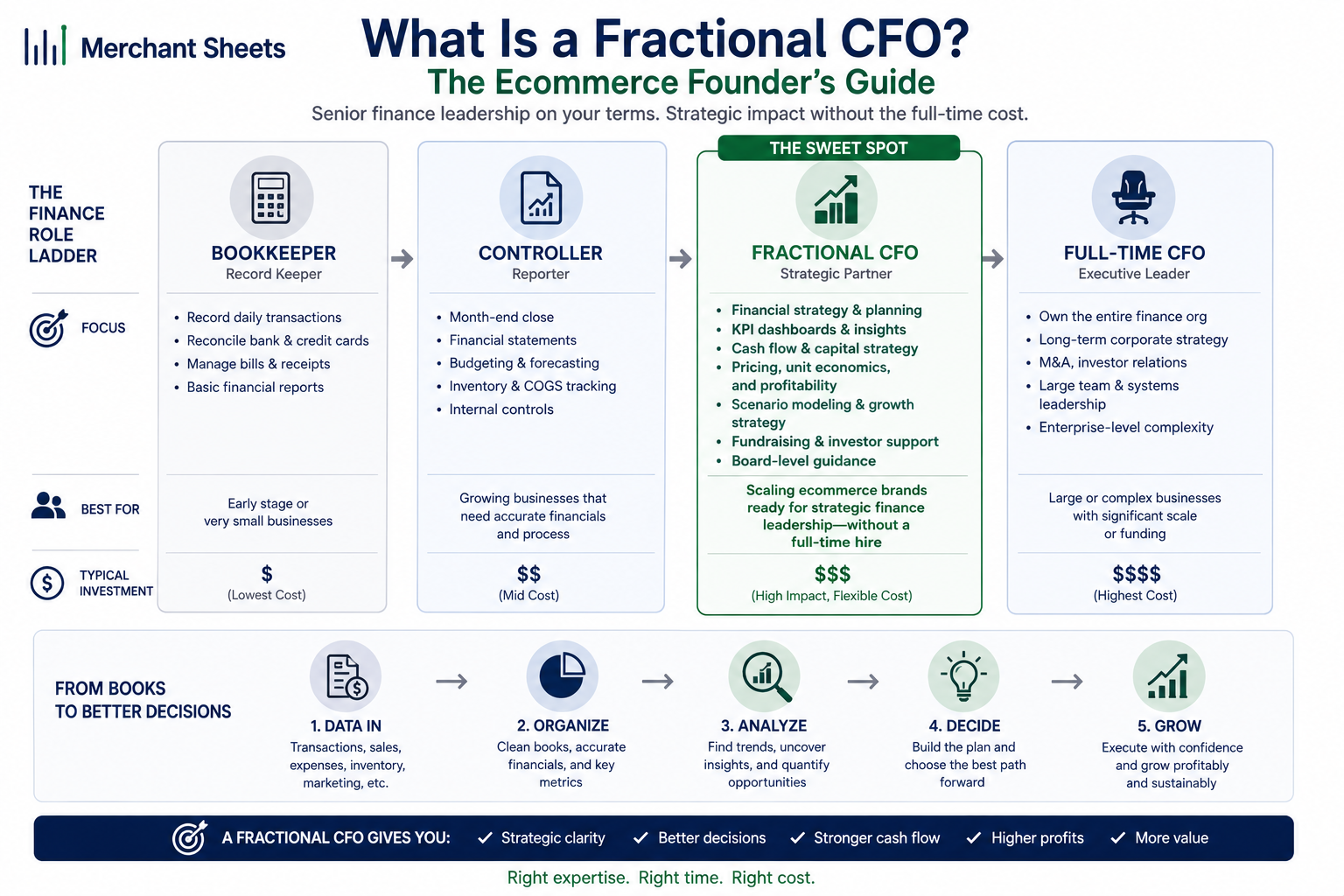
The clearest way to place a fractional CFO is on the finance-role ladder, from recording the numbers to deciding with them. Each role sits on top of the one before it, and most growing brands add them in this order.
A fractional CFO doesn’t replace your bookkeeper or controller, it works above them, using the clean books they produce to drive decisions.
We cover the roles side by side in bookkeeper vs accountant vs CFO if you want the full breakdown.
Table 1. The ecommerce finance-role ladder, from recording numbers to deciding with them.
| Role | What they own | When a brand adds them |
| Bookkeeper | Daily records: categorizing transactions, AP/AR, reconciliations | From day one; the foundation everything else sits on |
| Controller / accountant | The monthly close, accurate statements, and clean books | As transaction volume and channels grow |
| Fractional CFO | Strategy: cash, unit economics, forecasting, pricing, fundraising | When decisions need senior judgment but not a full-time hire |
| Full-time CFO | All of the above, in-house and full-time, at scale | Usually past roughly $10M, when finance is a daily need |
When does an ecommerce brand need a fractional CFO?
A fractional CFO earns its cost once your decisions outgrow the person making them. Any one of the signals below is usually enough on its own, and we go deeper on the timing in when to hire a fractional CFO:
- You’ve crossed roughly $1M to $5M: The numbers are big enough that a wrong call is expensive, and your bookkeeper is being asked questions above their role.
- You’re paid-ads heavy: You’re scaling spend without a firm view of your maximum allowable CAC or your contribution margin by channel.
- Cash feels tight despite growth: You need a 13-week cash forecast to sleep at night, but you can’t justify a six-figure full-time hire.
- Inventory ties up your cash: Reorder timing and inventory financing are guesses, and a stockout or an overstock keeps hitting the bank balance.
- You’re raising or borrowing soon: A fundraise, a line of credit, or a sale is 6 to 12 months out and the numbers aren’t ready.
- You’ve outgrown a basic package: A cheap accounting-firm add-on has stopped answering the strategic questions.
How much does a fractional CFO cost?
As of 2026, a fractional CFO typically costs $3,000 to $15,000 per month on a retainer, with hourly work in the $175 to $500 range and one-time projects priced by scope.
Ecommerce-focused help for smaller brands can start lower or run hourly, so a brand that isn’t ready for a retainer still has an entry point.
What you pay scales with scope and cadence, how complex your business is, and how clean your books are when you start.
Put the number against the alternative: a full-time ecommerce CFO runs $350,000 or more all-in once salary, bonus, and benefits are counted, so a fractional CFO buys the same senior judgment for a fraction of the price.
The table below shows the shape of the market, and we break the numbers down in full in how much a fractional CFO costs.
Table 2. What a fractional CFO costs (market ranges, as of 2026; verify before you buy).
| Engagement | Typical cost (2026) | Best for |
| Hourly / advisory | $175 to $500 per hour | One-off decisions and models |
| One-time project or audit | A few thousand dollars, by scope | A diagnostic or a finance-system build |
| Monthly retainer | $3,000 to $15,000 per month | Ongoing CFO support |
| Full-time CFO (for contrast) | $350,000-plus all-in per year | Brands past roughly $10M |
Does a fractional CFO pay for itself?
The way to judge the cost is against the decisions it improves, not the size of the business. A retainer might run $3,000 to $6,000 a month, and a single better call can cover a year of that on its own: holding back an overstock, catching a channel that loses money after ad spend, or timing an inventory order so you don’t draw on expensive credit.
For a brand spending heavily on ads or tying up six figures in inventory, the math usually works quickly, because those are exactly the decisions a fractional CFO sharpens.
For a very early brand making smaller bets, the payback is thinner, which is why hourly advice or a one-time audit often makes more sense before a retainer.
The value tracks the stakes of the decisions in front of you.
How fractional CFO engagements work
Most fractional CFOs offer a few ways to engage, so you can start small and scale up as the relationship proves out. A common path is to begin with a fixed-scope audit, then move to a build or a retainer once the value is clear:
- Hourly advisory: A single decision or model, billed by the hour, with no ongoing commitment.
- A profit and cash audit: A fixed-scope, one-time diagnostic that finds the profit leaks and cash risks and hands back a roadmap with dollar values.
- A finance foundation build: A short project that stands up the cash model, dashboard, and forecasts a brand doesn’t have yet.
- An ongoing retainer: A standing monthly engagement that keeps the models live, does the scenario work behind your decisions, and delivers a monthly report and call.
How a fractional CFO works with your team
A fractional CFO plugs into the setup you already have. They work alongside your bookkeeper or accounting firm rather than replacing them, and they connect to your existing tools, QuickBooks or Xero, plus the ecommerce data layer like A2X and your sales channels, so the numbers they work from tie back to your books.
The rhythm is monthly and anchored to your close. Once the books are closed for the month, the CFO refreshes the cash model, dashboard, and forecast with the actuals, rolls the 13-week cash view forward, and models whatever decisions you’re facing, a hire, an inventory buy, a price change.
That feeds a monthly report that leads with what to do, followed by a working session where you talk through the decisions and set the next actions. Higher-intensity engagements run the same loop more often, weekly instead of monthly, when a brand is scaling fast or working through a cash crunch.
Fractional vs interim vs full-time CFO
These three get confused, so it’s worth keeping them distinct. A fractional CFO is ongoing and part-time, a steady presence at a few hours a week or month.
An interim CFO is full-time but temporary, brought in to cover a gap or steer a transition, then gone once it’s over.
A full-time CFO is a permanent, in-house executive that a brand adds once finance is a daily, full-time job, usually past roughly $10M in revenue.
For most growing ecommerce brands the answer is fractional, because the need is senior judgment on the big decisions rather than a full-time seat. If you’re weighing the permanent hire, we compare fractional CFO vs an in-house hire in detail, and if you’re covering a sudden vacancy, an interim CFO is the temporary-cover option.
| A fractional CFO is how a growing brand gets senior financial judgment for a few thousand dollars a month, instead of the $350,000-plus a full-time CFO costs all-in. |
How to choose a fractional CFO for ecommerce
Not every fractional CFO fits an ecommerce brand, so weigh a few things before you engage:
- Ecommerce experience: They should know DTC and Amazon economics, channel-level margin, and inventory cash cycles, not general small-business finance alone.
- Works in your tools: They should be comfortable in QuickBooks or Xero and the ecommerce data layer, like A2X and your sales channels, so the numbers tie out.
- A senior person does the work: Confirm the credentialed CFO does the actual thinking, rather than handing you to a junior analyst behind a polished deck.
- Defined deliverables: You should know exactly what you get each month, a cash model, a dashboard, a report, and a call, not vague advice.
- Proof and references: Ask for a sample dashboard or a short diagnostic on your own numbers, so you see the thinking before you commit.
Frequently asked questions
What's the difference between a fractional CFO and a virtual or outsourced CFO?
There’s no real difference: virtual CFO, outsourced CFO, and part-time CFO are all names for a fractional CFO, a senior finance leader who works with your business part-time and ongoing rather than as a full-time employee. The label is a marketing choice, not a different service.
How much does a fractional CFO cost per month?
A fractional CFO retainer typically runs $3,000 to $15,000 per month as of 2026 depending on scope and how often you need them, with ecommerce-focused help for smaller brands sometimes starting lower or billed hourly. Hourly rates generally fall between $175 and $500.
When should an ecommerce business hire a fractional CFO?
Most ecommerce brands bring in a fractional CFO once they cross roughly $1M to $5M in revenue, scale paid ads, feel cash tighten, or prepare to raise, the point where a bookkeeper is being asked to make strategy calls. Any one of those on its own is usually reason enough to start.
What's the difference between a fractional CFO and a bookkeeper?
A bookkeeper records and reconciles your transactions, while a fractional CFO uses those numbers to make strategic decisions on cash, pricing, inventory, and growth, so the CFO sits a level above the bookkeeper rather than replacing them. You typically need both, doing different jobs.
How many hours does a fractional CFO work?
A fractional CFO usually works somewhere between a few hours a month and a few hours a week per client, scaled to the engagement, which is what keeps the cost far below a full-time hire. The retainer tier you choose sets the cadence and depth.
Is a fractional CFO worth it for a small ecommerce brand?
For a brand making real decisions on ad spend, inventory, and pricing, a fractional CFO usually pays for itself by improving those decisions, though a very early or sub-$1M brand may be better served by hourly advice or a one-time audit first. The value tracks the size of the decisions you’re making.
Can a fractional CFO help me raise money or sell my business?
Yes, getting the numbers investor-ready, building the model, and supporting a fundraise, a debt raise, or a sale is core fractional CFO work, and it’s a common reason ecommerce brands bring one in. Starting 6 to 12 months ahead gives you time to clean up the story before buyers or lenders see it.
See whether a fractional CFO fits your brand
If your ecommerce brand has outgrown its bookkeeper, we can help. As your fractional CFO, I turn your books into a cash-flow plan, channel-level profit, and a clear set of moves for the next quarter.
