
Key takeaways
- Ecommerce bookkeeping is the routine of recording, categorizing, and reconciling every transaction across your sales channels, processors, and inventory so your financial statements are accurate.
- It’s harder than generic bookkeeping because channel payouts arrive net of fees and refunds, inventory and COGS have to tie to real landed cost, and sales tax spans states.
- Most ecommerce brands should keep their books on the accrual basis, which matches revenue and inventory cost to the period they belong to.
- A real ecommerce chart of accounts separates sales by channel, puts freight and duty into COGS, and includes the fees and liabilities a generic template leaves out.
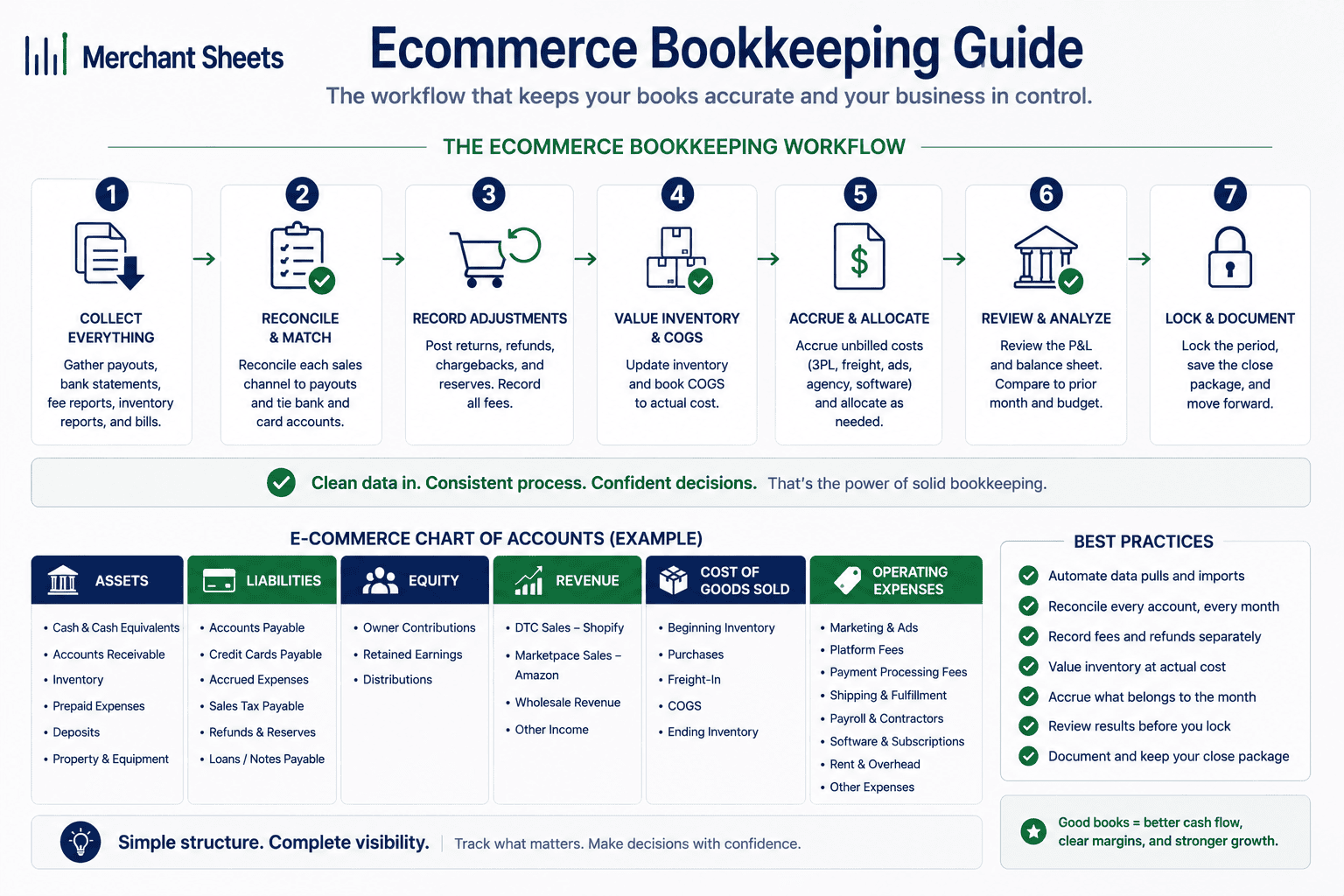
- The monthly workflow is to reconcile each channel to its payouts, book COGS and inventory, tag channel-level profit, close the period, and report.
- Clean books produce a profit and loss statement, a balance sheet, and a cash flow statement, plus a founder-readable summary, and most multi-channel brands eventually hand the work to a specialist.
Ecommerce bookkeeping looks like ordinary bookkeeping until you notice the deposit in your bank isn’t your revenue, your cost of goods depends on freight and duty, and you owe sales tax in states you’ve never set foot in. Multi-channel books carry moving parts a corner store never deals with.
This guide walks the whole thing, from your chart of accounts to the reports that run your brand.
What is ecommerce bookkeeping?
Ecommerce bookkeeping is the practice of recording, categorizing, and reconciling every financial transaction an online business generates, across its sales channels, payment processors, and inventory, so its books and financial statements stay accurate. It’s the day-to-day foundation that accounting and reporting are built on.
To reconcile an account is to tie its balance to an outside record, like a bank statement or a channel payout report, so you know it’s right. Bookkeeping is the recording and reconciling; accounting is the interpretation built on top of it, the wider picture we cover in ecommerce accounting.
What sets ecommerce apart from bookkeeping for a service business is the combination of multiple sales channels, physical inventory, and sales tax, each of which adds work a single-revenue-stream business never sees.
The distinction matters in practice. Good books don’t just satisfy your accountant at tax time; they tell you which products and channels make money while you can still do something about it.
That only works when the numbers underneath are recorded consistently and reconciled every month, which is the job this guide walks through.
Why is ecommerce bookkeeping different from regular bookkeeping?
A handful of things make ecommerce books harder, and they compound as you add channels.
| The money that lands in your bank is a payout, net of platform fees, holds, and refunds, and it often spans two months. Book revenue from the settlement report, so your sales tie to the period they happened in. |
Start with that payout point, because it catches more brands than any other. Your Shopify or Amazon deposit is what’s left after fees and refunds, so revenue has to come from the settlement report rather than the bank feed. Reconciling those settlements across every channel is its own discipline, covered in multichannel reconciliation.
The rest stack on top. Inventory turns a purchase into an asset that becomes cost only as units sell, the sales tax you collect is money you hold for the state, refunds and chargebacks reverse a sale after the fact, and platform and processing fees come out of every payout.
The platform-specific versions of all this live in Shopify accounting and Amazon seller bookkeeping.
Fees and refunds deserve their own attention, because they hide inside the payout. A $10,000 week of Shopify sales might land as an $9,400 deposit after processing fees, and an Amazon payout can be less than half of gross sales once referral fees, fulfillment fees, and storage come out.
Recording only the deposit understates both your revenue and your costs, so the books have to break the payout back into gross sales, fees, refunds, and the net that hit the bank.
Table 1. What makes ecommerce bookkeeping different.
| Challenge | Why it’s different | Where it’s covered |
| Channel payouts are not revenue | Deposits arrive net of fees, holds, and refunds, and can span two months, so revenue is booked from the payout report | Multichannel reconciliation |
| Inventory and landed-cost COGS | Product cost includes freight, duty, and 3PL, capitalized into inventory and released as it sells | COGS and inventory costing |
| Sales tax across states | Selling into many states creates tax obligations you have to track and, where required, file | Sales tax nexus |
| Refunds and chargebacks | Returns reverse revenue and COGS after the sale and need a reserve for what comes back later | Month-end close |
| Platform and payment fees | Marketplace and processor fees come out of every payout and belong in the books as expenses | Multichannel reconciliation |
| Transaction volume | Thousands of small orders make manual entry impractical, so books rely on a connector and clean automation | Accounting automation |
Cash or accrual, and your chart of accounts
Two setup choices shape everything after them. The first is your accounting method. Most ecommerce brands should keep their books on the accrual basis, which records revenue when a sale happens and costs when they’re incurred, rather than the cash basis, which records them when money moves.
Accrual is what makes channel-level profit and margins meaningful, and businesses carrying inventory are often required to use it for tax once revenue passes a threshold. The full comparison is in cash vs accrual accounting.
The second is your chart of accounts, the organized list of every account your books post to. An ecommerce chart of accounts separates sales by channel, puts landed-cost components like freight and duty into cost of goods sold (COGS), and includes accounts a generic template omits: sales tax payable, a gift card liability, and a clearing account for each channel.
The channel separation is the part worth building in from day one, because retrofitting it onto a year of blended transactions is slow and error-prone. Building one right is its own job, walked through in the chart of accounts guide.
Table 2. An ecommerce chart of accounts, in brief.
| Account group | Example accounts |
| Income | Sales by channel (DTC, Amazon, wholesale), shipping income, discounts and returns (contra-revenue) |
| Cost of goods sold | Product cost, inbound freight and duty, 3PL and pick-pack, landed-cost adjustments |
| Operating expenses | Advertising by channel, software and apps, merchant and marketplace fees, payroll, professional fees |
| Assets | Operating cash, inventory, and a clearing or undeposited-funds account per channel |
| Liabilities | Sales tax payable, gift card and store credit liability, loans and lines of credit |
| Equity | Owner contributions and distributions, retained earnings |
The monthly bookkeeping workflow, step by step
Once the books are set up, bookkeeping becomes a monthly rhythm. The core loop is to reconcile each sales channel to its payout reports, book COGS and update inventory to actual landed cost, tag revenue and costs to the right channel so you get a channel-level profit and loss, then close the period and produce the reports. The full close, with the order and every reconciliation, is laid out in the monthly close checklist.
A connector feeding transactions from each channel into your accounting software is what keeps this workable at ecommerce volume, where thousands of small orders make manual entry hopeless.
It maps each payout into gross sales, fees, and refunds automatically, so the monthly close becomes a review instead of hours of manual journal entries.
The work also spreads across the month rather than piling onto close week. Categorizing transactions and reconciling payouts weekly keeps the backlog small and the cash picture current, so month-end is a matter of finishing inventory and COGS, tagging the channel P&L, and reviewing the statements.
Table 3. The ecommerce bookkeeping cadence.
| Frequency | What you do | Why |
| Ongoing (automated) | Transactions and payouts sync from each channel and processor into the accounting system | Keeps entry manageable at ecommerce volume |
| Weekly | Categorize new transactions, reconcile payouts received, and check cash | Catches problems while they’re small and keeps cash visible |
| Monthly | Reconcile every channel’s settlements, book COGS and inventory, tag channel P&L, close, and report | Produces accurate statements to steer by |
| Quarterly | Review estimated taxes, revisit nexus, and sanity-check the numbers | Avoids year-end surprises |
| Annually | Close the year, prepare for tax filing, and issue 1099s | Meets filing obligations cleanly |
Inventory, landed cost, and COGS
For a product business, inventory and COGS are where the books most often drift from reality, because a unit costs more than its purchase price.
Landed cost capitalizes freight, duty, tariffs, and 3PL fees into the value of your inventory, and that cost releases to COGS only as the unit sells. That timing is what makes gross margin real, and it’s covered step by step in how to calculate COGS.
A quick example shows why it matters. Say a unit costs $10 from your supplier, plus $2 of freight and duty and $0.50 of inbound 3PL handling. Its landed cost is $12.50, and that full amount sits on your balance sheet as inventory until the unit sells, then moves to COGS.
Sell it at $30 and your real gross margin is about 58 percent; count only the $10 purchase price and the books show a flattering 67 percent that isn’t there.
| Landed cost is the difference between a margin you can trust and one you can’t. On a $30 unit, $12.50 of true landed cost is a 58 percent gross margin; counting only the $10 supplier price inflates it to 67 percent, and that nine-point gap is often the whole profit. |
The method you use to value what sells, first-in first-out (FIFO), last-in first-out (LIFO), or weighted average, changes the COGS number when your unit costs move, and the trade-offs are in inventory costing methods.
Booking units sold against a stale average cost, or expensing inventory the day you buy it, throws off both margin and profit, which is why this is the part worth getting right first.
Sales tax: tracking nexus and filing
Selling into many states creates economic nexus, an obligation to collect and remit sales tax once you cross a state’s sales or transaction threshold.
The bookkeeping job is to track where you have nexus and keep the tax you collect sitting as a liability you owe, held separately from revenue. The thresholds, registration, and how nexus gets triggered are covered in sales tax nexus.
Marketplaces add a wrinkle worth knowing. Under marketplace facilitator rules, platforms like Amazon (and Walmart, Etsy, and others) collect and remit sales tax on your behalf in most states, so that tax never sits in your accounts, while sales through your own website are yours to collect, hold, and remit. Your books have to keep the two straight, which is one more reason channel separation pays off.
Filing is a separate treadmill. Many brands hand the returns themselves to a specialist or an automated filing tool, while the books track the liability and the exposure.
This is general information rather than tax advice, so confirm your own situation with a tax professional.
The reports your books produce
Everything above exists to produce a few reports you can steer by. Clean books generate the three core financial statements: the profit and loss statement (what you earned and spent), the balance sheet (what you own and owe), and the cash flow statement (where the cash moved).
For an ecommerce brand, the most useful cut is a channel-level P&L that shows which channel makes money once its real costs are loaded in. Each statement is walked through in financial statements explained.
The channel-level P&L is where the reporting earns its keep. Blended numbers hide which channel pays its way: Amazon can look healthy on revenue and thin on profit once referral and fulfillment fees land, while your own website often carries a higher margin at lower volume.
Seeing each channel’s gross margin and contribution side by side is what turns the books into a decision tool.
On top of the statements, the report that earns its keep is a short, founder-readable summary that pulls everything down to the handful of numbers you act on: revenue, margin, and cash. Tracked month over month, those feed the weekly cash KPIs and just about every decision downstream.
Should you do your own ecommerce bookkeeping?
You can do your own books early on with good software and some discipline, though multi-channel complexity, inventory, and sales tax are the point where most brands bring in a bookkeeper. There are three realistic ways to run it.
The simplest is a spreadsheet, which works for a single channel at low volume and struggles once inventory and multiple channels enter the picture. The middle path is accounting software like QuickBooks or Xero paired with a connector, which handles the volume and still needs someone who understands settlement reconciliation and COGS.
The third is a professional bookkeeper or service, where most multi-channel brands land as they grow. What it costs is broken down in ecommerce bookkeeping cost, and the in-house-versus-outsourced trade-off is weighed in outsourced vs in-house bookkeeping.
The signal to switch is usually the same: the close keeps slipping, the numbers stop tying out, or you add a channel and the reconciliation load doubles. When keeping the books current starts costing you the time you should spend running the brand, that’s the point most operators hand it off.
Table 4. Doing your ecommerce books: three ways.
| Option | Best for | What to watch |
| DIY in a spreadsheet | Pre-revenue or a single channel with low volume | Struggles with inventory, multiple channels, or sales tax |
| Accounting software plus a connector | A brand ready to run its own books on QuickBooks or Xero | Still needs someone who understands settlement reconciliation and COGS |
| A professional bookkeeper or service | Multi-channel brands past roughly $1M, or anyone whose books are behind | Cost scales with channel count; pick an ecommerce specialist |
Frequently asked questions
What does an ecommerce bookkeeper do?
An ecommerce bookkeeper records and categorizes every transaction, reconciles each sales channel and processor to its payouts, books COGS and inventory, tracks sales tax, and closes the books each month so the financial statements are accurate.
How do you do bookkeeping for an ecommerce business?
You set up an ecommerce chart of accounts on the accrual method, connect your channels and processors to accounting software through a connector, then reconcile payouts, book COGS and inventory, tag channel-level profit, and close each month.
What accounting method should an ecommerce business use?
Most ecommerce businesses should use the accrual method, because it matches revenue and inventory cost to the period they belong to, and businesses carrying inventory are often required to use accrual for tax once revenue passes a threshold.
Is QuickBooks or Xero better for ecommerce?
Both work well for ecommerce when paired with a connector like A2X; QuickBooks Online is the more common default in the US, while Xero is strong on multi-currency and a cleaner multi-entity structure, so the right choice depends on your stack and your accountant.
Why isn't my Shopify or Amazon deposit the same as my revenue?
Your deposit is a payout, net of platform and processing fees, holds, and refunds, and it often covers orders from more than one period, so revenue has to be booked from the settlement report rather than the bank deposit.
How much does ecommerce bookkeeping cost?
Ecommerce bookkeeping is usually priced by channel count and complexity rather than a flat rate, so a single-channel brand pays far less than a multi-channel one with inventory and sales tax, and the full ranges are in the ecommerce bookkeeping cost guide.
Do I need a bookkeeper or can I use software?
You can run your own books on software early on, though multi-channel volume, inventory, and sales tax are the point where most brands bring in a bookkeeper, because the reconciliation and COGS work is where errors hide.
Get your books built and kept clean
Clean books are the foundation every other financial decision sits on, and for a multi-channel brand they take real work to keep that way.
If you’d rather have your books built and closed right than wrestle settlement reports every month, I can set up and run your ecommerce bookkeeping end to end, reconciled to every channel’s payouts, with landed-cost COGS and a channel-level P&L, closed on a set cadence and handed to you as a one-page summary you can read at a glance.
Tell me how your books look today, and we’ll map out getting them clean and keeping them there.
This is general information, not accounting or tax advice, and every brand’s books are different. For how the rules apply to yours, work with a qualified accountant or tax professional.
