
Key takeaways
- In-house bookkeeping is a fixed salary you pay through slow months, while outsourced bookkeeping is a monthly fee that scales with your channels and volume.
- A full-time in-house bookkeeper costs about $60,000 to $90,000 or more a year all-in once salary, payroll taxes, and benefits are counted; the median bookkeeping wage was about $49,000 in 2024.
- Outsourced ecommerce bookkeeping runs about $750 to $5,000 or more a month in 2026, and for most brands under $5M it costs less than a full-time hire.
- Ecommerce-experienced bookkeepers are hard to hire at generalist pay, so an outsourced specialist often brings platform skills a single in-house hire can’t.
- For most $500K to $5M multi-channel brands an outsourced specialist is the right call; in-house earns its keep at high daily volume or past roughly $25M.
- A hybrid works too: run the software and basic entry in-house, and outsource the settlement reconciliation, COGS, and monthly close to a specialist.
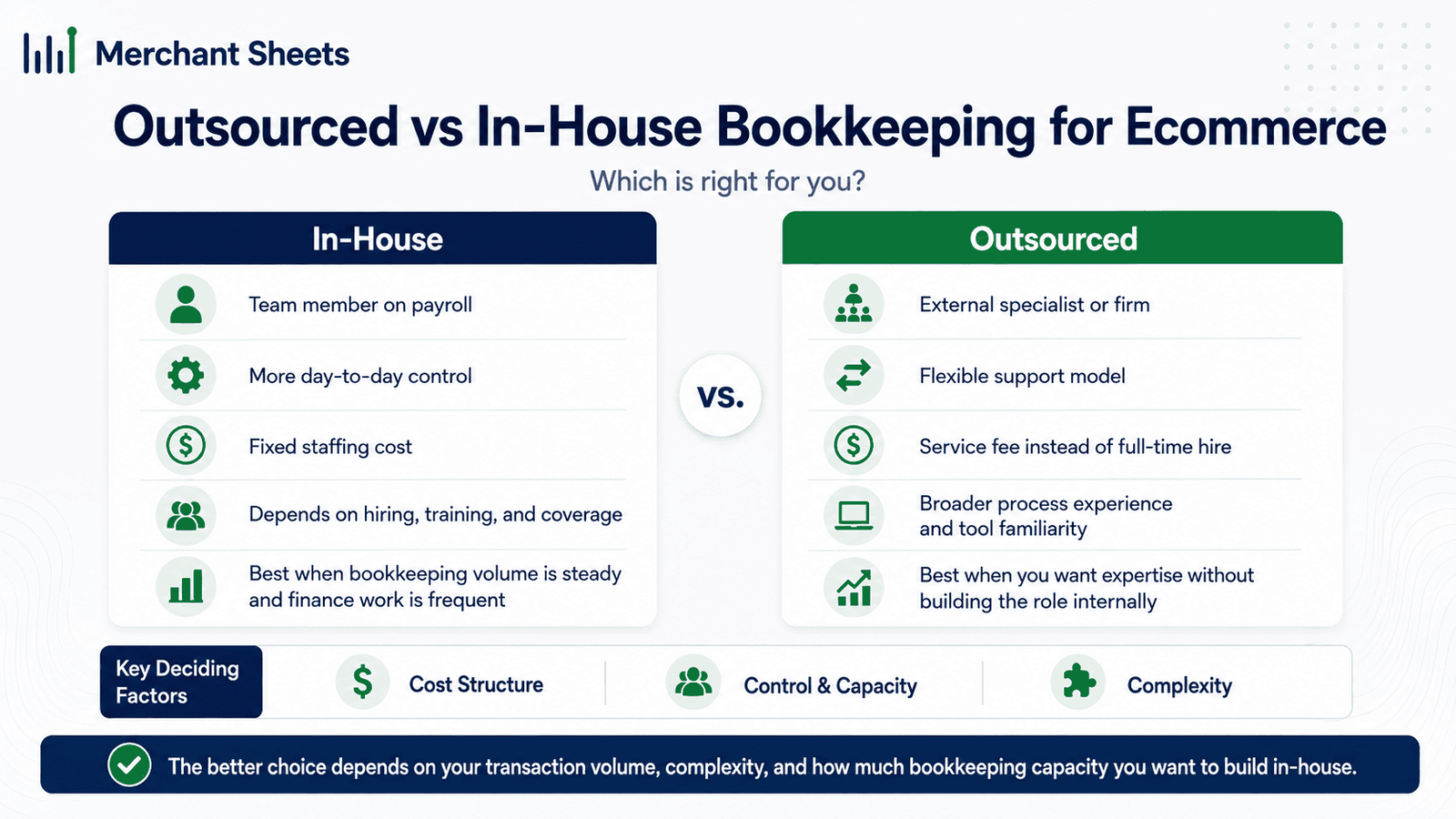
In-house bookkeeping puts a dedicated person on your team and your hours. Outsourced bookkeeping hands your books to a specialist for a monthly fee that scales with your volume. For most ecommerce brands the real questions are which one costs less at your size and which one knows your channels.
Outsourced vs in-house bookkeeping: what’s the difference?
In-house bookkeeping means hiring an employee to keep your books on your team and your hours. Outsourced bookkeeping means paying an outside specialist or service a monthly fee to keep them for you. In-house gives you a fixed salaried seat with full daily access, and outsourced gives you a scalable fee plus specialist skill built across many brands.
Both do the same core job, bookkeeping, which is the routine work of recording, categorizing, and reconciling every transaction so your financial statements hold up, covered in full in the complete ecommerce bookkeeping guide.
They differ on four things that decide the cost and the fit: the cost model, the expertise you get, how each one scales, and how much daily control you keep. The right answer comes down to your size and how you sell.
Table 1. In-house vs outsourced ecommerce bookkeeping, at a glance.
| In-house bookkeeper | Outsourced ecommerce service | |
| Cost model | Fixed salary plus benefits, paid through slow months | Monthly fee that scales with channels and volume |
| Expertise | One person’s skill set; ecommerce specialists are hard to hire at bookkeeper pay | A specialist team that already knows the platforms |
| Scalability | You re-hire or add staff as you grow | The service flexes up and down with your volume |
| Control and access | On your team, on your hours, full daily visibility | A scheduled cadence, less real-time |
| Coverage risk | One person, so a vacation or an exit leaves a gap | A team, so no single point of failure |
| Best for | High daily volume, or finance kept in-house | Most $500K to $5M multi-channel brands |
How much does an in-house bookkeeper cost?
A full-time in-house bookkeeper costs about $60,000 to $90,000 or more a year all-in in 2026, which is the true cost of an employee once everything beyond salary is counted. The median wage for bookkeeping, accounting, and auditing clerks was about $49,000 a year as of 2024, according to the U.S. Bureau of Labor Statistics, and an ecommerce-experienced bookkeeper sits above that.
Add payroll taxes, benefits, software, and a workstation, and you reach the all-in figure. A part-time bookkeeper at ten to twenty hours a week runs roughly $20,000 to $45,000, and the deeper detail on what the work itself costs is in what ecommerce bookkeeping costs.
For that spend you get a dedicated person on your hours, full visibility into the books day to day, and someone who learns the business from the inside. The trade-offs are worth naming plainly. It’s a fixed cost you carry through the slow months, when order volume drops but the salary doesn’t. One person is also a single point of failure, so a vacation or a resignation leaves the books unattended.
And a specialist is hard to find at a generalist’s pay, so a first hire often hasn’t done settlement reconciliation, the routine of tying each channel’s payouts back to gross sales, fees, and refunds, or landed-cost COGS, the cost of goods sold with freight and duty folded in.
What outsourced ecommerce bookkeeping costs and covers
Outsourced ecommerce bookkeeping runs about $750 to $5,000 or more a month in 2026, and the number tracks your channel count and volume more than your revenue. For that fee you get a specialist team that already knows Shopify and Amazon payouts, reconciling every channel, landed-cost COGS, and the monthly close across channels.
You also get coverage that doesn’t hinge on one person being at their desk, and a cost that flexes up in peak season and back down when volume drops, instead of a salary that runs at the same rate year-round.
The trade-offs run the other way. You work on a scheduled cadence rather than with someone down the hall, so a mid-week question waits for the next check-in.
And the quality depends on picking a genuine ecommerce specialist, since a general bookkeeping service can miss the channel-level work. Set side by side, the real cost of each path looks like this.
Table 2. The real all-in cost of each path.
| Path | Typical all-in cost (2026) | What you get |
| Part-time in-house bookkeeper | About $20,000 to $45,000 a year | 10 to 20 hours a week, fine at low volume on one or two channels |
| Full-time in-house bookkeeper | About $60,000 to $90,000+ a year all-in | Salary near the ~$49,000 median plus payroll taxes and benefits, a dedicated seat |
| Outsourced ecommerce service | About $750 to $5,000+ a month ($9,000 to $60,000+ a year) | A specialist team, with the fee scaling by channels and volume |
| Hybrid (software plus help) | Software $30 to $200+ a month, plus a freelancer or oversight | You or a clerk handle entry, a specialist reviews and closes |
The hybrid option: Software plus a specialist
There’s a middle path many brands settle into. Run accounting software like QuickBooks or Xero with a connector, a tool such as A2X that posts each channel’s sales, fees, and payouts into the books automatically, and keep the basic entry in-house or with a part-time clerk.
Then hand the settlement reconciliation, landed-cost COGS, and monthly close to an outside specialist. You keep daily visibility and control, and you buy senior skill only where the books need it.
This is usually the step between doing the books yourself and a full outsourced engagement. The software carries the volume, though it doesn’t do the judgment, so someone still has to understand reconciliation and COGS to trust the output.
When the spreadsheet has stopped keeping up but a full-time hire is hard to justify, the signs you’ve outgrown doing it yourself point to this hybrid as the next move.
Which should you choose?
For almost every ecommerce brand between $500K and $5M, an outsourced specialist is the right call. At that size you need platform-specific skill a few days a month, and a full-time seat would sit underused while costing more, so outsourcing both costs less and covers the channel-level work a generalist would struggle with.
| For most brands under $5M, an outsourced specialist costs less than a full-time hire and already knows your channels. An in-house bookkeeper earns their keep once daily volume is high enough to keep them busy. |
In-house earns its keep further up the curve. Once daily transaction volume is high enough to keep a full-time person busy, usually well past $5M, or once a brand wants finance on its own team for control, a salaried bookkeeper makes sense, and a hybrid fits many brands in between.
Treat this as a volume-and-complexity call rather than a revenue rule, because channels, entities, and wholesale can move the line either way.
Table 3. Outsourced, in-house, or hybrid, by ecommerce revenue stage (2026; a starting signal, not a rule).
| Brand revenue | The usual right call | Why |
| Under $1M, 1 to 2 channels | Outsourced specialist, or DIY plus software | Volume rarely justifies a salaried hire, and a specialist or a solid software stack covers it |
| $1M to $5M, multi-channel | Outsourced specialist | Settlement reconciliation and landed-cost COGS need skill a generalist hire seldom has at that pay |
| $5M to $25M | An outsourced team, or a first in-house hire under outsourced oversight | Volume can justify staff, and a fractional controller keeps the specialist skill in place |
| $25M and up | An in-house finance team, often with outsourced channel support | Finance is a daily job at scale, though many brands still outsource the channel reconciliation |
The ecommerce difference: why these books aren’t generic
This decision tilts toward a specialist because ecommerce bookkeeping is a specialist job. Each sales channel settles its own way: a payout lands in your bank as one net figure, and someone has to split it back into gross sales, platform fees, and refunds before the books are right.
Inventory adds landed-cost COGS, and selling into more states adds sales tax tracking. A bookkeeper who has kept books for service businesses often hasn’t done any of it, while a service that works ecommerce all day has done it hundreds of times.
Seasonality is the other piece, and it feeds straight back into the cost comparison. A salaried bookkeeper is a fixed cost that runs at the same rate through your quietest months, while an outsourced fee rises and falls with the volume it’s handling.
As the books grow past recording and reconciling into questions about pricing, cash, and margin, a controller or CFO on top becomes the next layer, and the difference between a bookkeeper and an accountant starts to matter.
Frequently asked questions
Is it cheaper to outsource bookkeeping or hire in-house?
For most ecommerce brands under about $5M, outsourcing is cheaper, because a full-time in-house bookkeeper costs about $60,000 to $90,000 or more a year all-in while an outsourced specialist runs about $750 to $5,000 a month and scales with volume.
How much does an in-house bookkeeper cost?
A full-time in-house bookkeeper costs about $60,000 to $90,000 or more a year in 2026 once salary near the ~$49,000 median, payroll taxes, benefits, and software are counted, while a part-time bookkeeper runs roughly $20,000 to $45,000 a year.
Should I outsource my ecommerce bookkeeping?
Outsourcing makes sense for most multi-channel brands under about $5M, because an outside specialist knows Shopify and Amazon reconciliation and landed-cost COGS and costs less than hiring, while in-house fits high daily volume or a brand that wants finance on its own team.
What does outsourced ecommerce bookkeeping include?
It usually includes settlement reconciliation across channels, landed-cost COGS, inventory, the monthly close, and channel-level financial statements, done by a specialist who knows the platforms, with the fee scaling by channel count and volume.
When should I hire an in-house bookkeeper instead of outsourcing?
Hiring in-house makes sense once daily transaction volume is high enough to keep a full-time person busy, usually well past $5M in revenue, or when a brand wants finance in-house for control and day-to-day access.
Can I do a mix of in-house and outsourced bookkeeping?
Yes, many brands run the software and basic entry in-house and outsource the settlement reconciliation, COGS, and monthly close to a specialist, which keeps daily control while buying platform skill only where it’s needed.
Do outsourced bookkeepers understand Shopify and Amazon?
A genuine ecommerce specialist does, reconciling channel payouts, booking landed-cost COGS, and using connectors like A2X every day, which is why picking an ecommerce-focused service over a generalist matters.
