
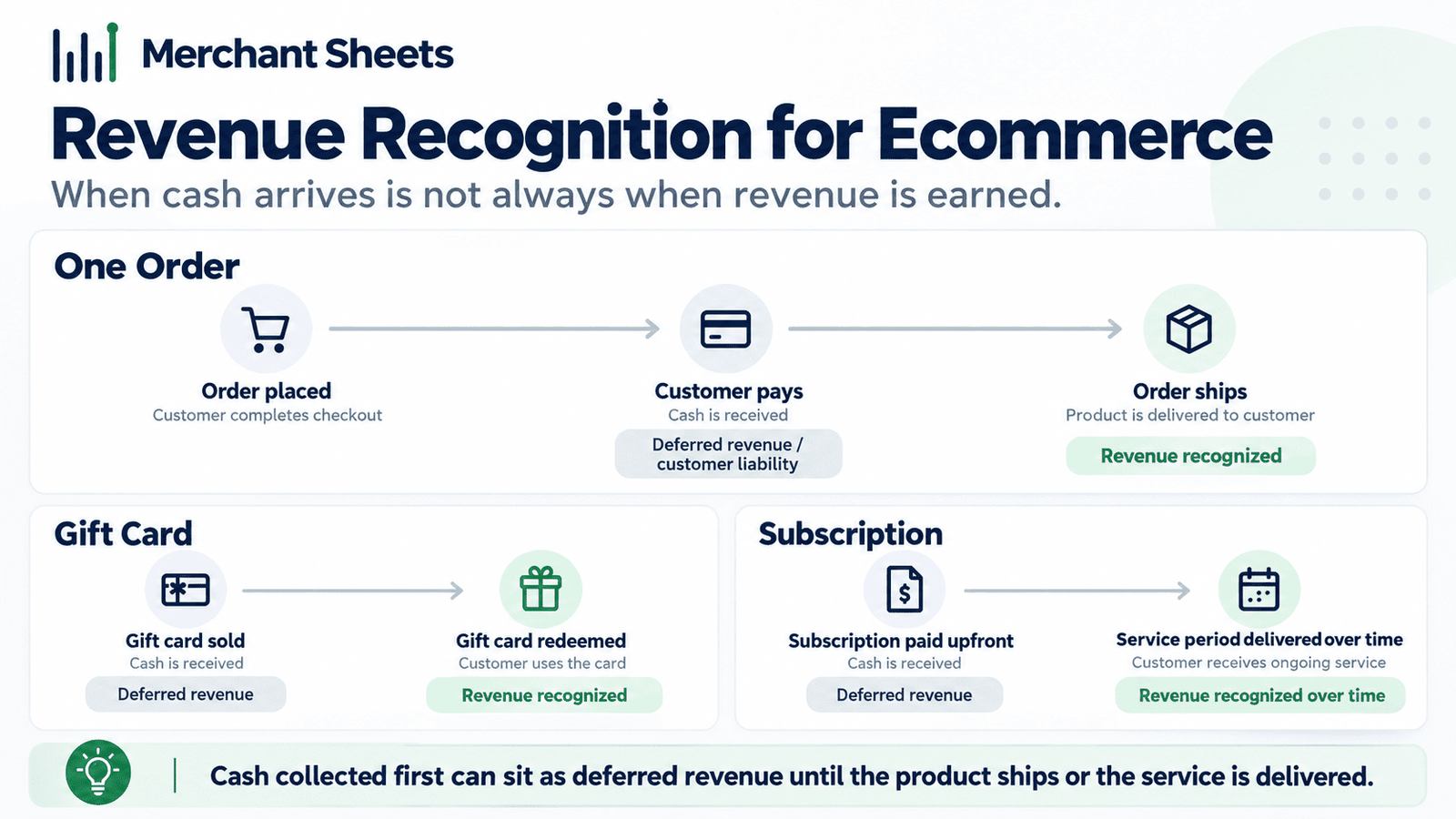
Key takeaways
- Revenue recognition is the rule for when a sale counts as revenue in your books, and for most ecommerce orders that moment is when the product ships or is delivered, not when the order is placed or paid for.
- Under ASC 606, the revenue standard US businesses follow, you earn revenue when control of the product passes to the customer, so getting paid early creates a liability called deferred revenue that becomes revenue only once you deliver.
- Gift cards, pre-orders, deposits, and pre-paid subscriptions are all deferred revenue: real cash you hold, with product you still owe against it until you deliver.
- If you sell your own goods on a marketplace like Amazon, you’re the principal and record the gross sale as revenue with the platform’s fees as an expense, so your revenue is larger than the payout that lands in your bank.
- Because some orders come back, the accrual-correct treatment reserves for expected returns and reduces revenue at the time of sale rather than waiting for each refund.
- Recognizing revenue on the wrong date quietly distorts your margins, your sales-tax figures, and your valuation, so the timing is worth getting right in your books.
The money is in your bank account, so it’s revenue, right? Not always. An ecommerce business can take a gift card order, a pre-paid subscription, and a marketplace payout in the same week and not have earned revenue on any of them yet.
Revenue recognition is the rule that decides when each of those sales counts, and for ecommerce the answer is rarely the day the cash arrives.
What is revenue recognition, and why isn’t getting paid enough?
Revenue recognition is the accounting rule for when a sale counts as revenue. Under ASC 606, the standard every US business follows, you recognize revenue when you deliver what the customer paid for, when control of the product passes to them. Getting paid earlier creates a liability that turns into revenue only once you deliver.
Three moments get mixed up here: the order, the payment, and the delivery, and only delivery earns revenue. Shopify and your payment processor record the sale the instant the cart is checked out, which is why your platform dashboard and your accounting revenue can disagree; the dashboard is counting orders and cash, while your books count what you’ve earned.
This matters because everything downstream, your margins, the base you owe sales tax on, and the revenue a buyer would pay for, is built on revenue landing in the right period.
It’s an accrual idea at heart, part of the same system as the ecommerce bookkeeping guide, and the choice between cash-basis and accrual books is its own topic in cash vs accrual accounting.
| An order is a promise, a payment is a prepayment, and delivery is the sale. Revenue is earned when the customer gets what they paid for, which is why the cash can sit in your bank for weeks before it’s allowed to count as revenue. |
The five-step model in plain ecommerce terms
The standard turns “when do I earn revenue” into five steps, and for a typical ecommerce order most of them happen on their own. You have a contract, a promise to deliver, a price, a way to split that price when there’s more than one promise, and revenue you recognize as each promise is delivered.
In ecommerce language the five steps read like this. There’s a contract the moment a customer places and pays for an order. There’s a performance obligation, the thing you owe them, usually the product plus any extras like expedited shipping or a future box.
There’s a transaction price, what they paid after any discount. If a sale carries more than one promise, you allocate the price across them. And you recognize the revenue as you satisfy each promise, which for a physical product means when it’s delivered.
For a single in-stock item shipped once, all five collapse into ship it, then count it. The steps only start to bite when money arrives before delivery, or a sale bundles more than one promise.
Table 1. The five steps of revenue recognition, in ecommerce terms.
| Step | What it means for an ecommerce order | When it matters most |
| 1. Identify the contract | The customer places and pays for an order | Automatic on every order |
| 2. Identify the performance obligations | The promises you owe: the product, plus extras like expedited shipping, a warranty, or future boxes | Bundles, shipping, subscriptions |
| 3. Determine the transaction price | What the customer paid, after any discount or coupon | Discounts, coupons, variable pricing |
| 4. Allocate the price to the obligations | Split that price across the promises when there’s more than one | Bundles and subscriptions |
| 5. Recognize revenue as each obligation is satisfied | Count the revenue when you deliver each promise | The step that sets the date, usually at shipment or delivery |
When does an ecommerce sale become revenue?
For a standard ecommerce order you recognize revenue when the product ships or is delivered, when control passes to the customer, not the moment the order is placed and not when the payment is captured. The order and the payment can happen on Monday while the revenue belongs to Wednesday, the day it leaves your warehouse.
Whether revenue lands exactly at shipment or at delivery follows your shipping terms, but for most ecommerce brands it’s close enough to treat fulfillment as the trigger.
Walk one order through its life: the order is placed and it’s a promise with no revenue yet; the payment is captured and the cash is real but held as a liability until something ships; the order ships or is delivered and the revenue is earned; and if it comes back, the revenue is reversed.
Table 2. When common ecommerce sales become revenue.
| Sale type | What triggers revenue | When it is recognized | Where the money sits until then |
| Standard in-stock order | The product ships or is delivered | At fulfillment, not at checkout | Deferred revenue between payment and shipment (often a day or two) |
| Marketplace order (your own goods) | The product ships or is delivered | At fulfillment; the gross sale is revenue, fees are an expense | Same as a standard order; the payout arrives later, net of fees |
| Pre-order or deposit | The item ships | When the product is delivered | Deferred revenue from payment until it ships |
| Gift card | The card is redeemed for product | On redemption; breakage over time | Deferred revenue until redeemed |
| Subscription box | Each box ships | As each shipment is delivered | Deferred revenue for prepaid terms, drawn down box by box |
| Membership or access plan | The period is delivered | Evenly across the period it covers | Deferred revenue, recognized across the term |
| Refund or return | A return is expected, then happens | Revenue is reduced at the sale via a reserve, trued up on the actual return | A returns reserve (refund liability) offsets revenue |
Selling on a marketplace: Do you book gross sales or net payout?
If you sell your own products on Amazon or another marketplace, you’re the principal in the sale, so you recognize the full gross sale as revenue and record the marketplace’s fees as expenses. That makes your revenue larger than the payout that reaches your bank.
You’d record only the net amount if you were an agent, arranging someone else’s sale without ever holding the goods, which isn’t the typical brand.
Booking only the net payout as revenue is one of the most common ways ecommerce revenue goes wrong; it understates the top line, hides the fee stack, and throws off every margin and benchmark built on revenue.
The plain test for being the principal: you’re responsible for fulfilling the order, you carry the inventory and its risk, and you set the price, all of which describe a brand selling its own goods.
The payout that lands is the gross sale minus fees minus any reserve, and splitting a marketplace settlement back into revenue, fees, and tax is its own job, covered in multi-channel ecommerce accounting.
| On a marketplace, your revenue is the sticker price the customer paid, while the deposit the platform sends is that amount after its fees. Booking only the deposit as revenue makes a healthy brand look thin and buries fees you could be managing. |
Gift cards, pre-orders, and deposits: Cash you can’t count yet
Money you collect before you deliver, a gift card, a pre-order, or a deposit, is deferred revenue, a liability on your balance sheet, and it becomes revenue only as you deliver the product it’s owed against. It’s real cash you can spend, with product you still owe for it, so it hasn’t been earned.
Take the cases quickly. A gift card is deferred revenue when it’s sold and turns into revenue when it’s redeemed for product; the slice that’s never redeemed, called breakage, is recognized over time in line with your real redemption pattern, so it isn’t booked all at once or left on the books forever.
A pre-order or a deposit is deferred revenue until the item ships, which is why a big pre-order launch can fill your bank account without adding revenue that month. These live on the balance sheet as a liability, set up in your chart of accounts, and they show up on your financial statements as deferred revenue.
The month-to-month entries that move money out of the liability and into revenue as you deliver are their own walkthrough in the deferred revenue guide.
| A full bank account after a gift-card holiday or a pre-order launch is a liability you now owe product against, and the revenue shows up later, as the cards get redeemed and the orders ship. The cash comes first and the revenue follows it. |
How subscriptions earn revenue over time
A subscription is a promise to deliver over time, so you recognize its revenue over time as you deliver, rather than all at once when the customer pays. If a customer pre-pays for six monthly boxes, that cash is deferred revenue up front and turns into revenue one box at a time as each ships. A month-to-month plan earns each month’s revenue as that month is delivered.
Ecommerce subscriptions come in two shapes, and they earn revenue a little differently. A physical subscription box is earned as each shipment goes out, tied to delivery like any other product.
A membership or access plan, a discount club or a content perk, is earned evenly across the period it covers, because the customer gets the benefit across the whole stretch.
The case brands most often get wrong is the annual pre-pay: twelve months of cash arrives in one month, while eleven months of it are still deferred revenue, and the recurring entries, proration, and mid-term changes are covered in the deferred revenue guide.
Here’s a simple worked example, and the figures are illustrative teaching numbers.
A customer pre-pays $180 for a six-month box subscription, so on day one the business records $180 of cash and a $180 deferred revenue liability, then recognizes $30 of revenue each month as a box ships, and the liability winds down to zero over the six months.
Table 3. One six-month subscription: how prepaid cash becomes revenue over time (illustrative numbers).
| Point in time | Box shipped? | Revenue recognized | Deferred revenue remaining |
| At sign-up (Day 1) | No, cash collected only | $0 | $180 |
| Month 1 | Yes | $30 | $150 |
| Month 2 | Yes | $30 | $120 |
| Month 3 | Yes | $30 | $90 |
| Month 4 | Yes | $30 | $60 |
| Month 5 | Yes | $30 | $30 |
| Month 6 | Yes | $30 | $0 |
Refunds and returns: Revenue you have to un-count
Because some orders come back, revenue isn’t final at the moment of sale. The accrual-correct treatment estimates the revenue that will be returned and reduces recognized revenue for it in the same period as the sale, holding a returns reserve, then trues it up as actual returns arrive. It keeps a launch month from looking better than it really was.
There are two ways this gets handled. A brand new or very small business often records each refund as it happens, netting it against revenue in whatever month the return lands, which is easy to run but pushes the cost of a return into the wrong period.
The accrual-correct approach reserves for expected returns in the period of the sale, using the brand’s own return rate, so revenue isn’t overstated the month of a big launch and then dented later.
Your own ecommerce return rate is what sizes the reserve, and refunds and the reserve appear as contra-revenue at the top of the P&L, which is walked through in how to read your ecommerce P&L.
A sale isn’t fully earned until its return window has closed. Reserving for returns up front keeps a launch month honest and stops the following month from taking a hit that belonged to the first.
How to get revenue recognition right in your books
You keep revenue recognition right by recording each sale on the date you deliver it, holding prepaid money as a liability until then, and reserving for returns, and your accounting software can handle most of it once it’s set up correctly. The routine looks like this:
- Put your books on the accrual basis: Revenue then lands when it’s earned rather than when the cash moves, which is the setup the rest of this depends on.
- Recognize a standard order at fulfillment: Book the revenue when it ships or delivers, so the sale lands in the period you delivered it rather than at checkout.
- Hold every prepayment as deferred revenue: Gift cards, pre-orders, deposits, and subscriptions go to a liability account first and move to revenue as you deliver.
- Book marketplace sales gross: Record the full sale as revenue and the platform’s fees as expenses, then reconcile the payout back to those two.
- Reserve for returns in the period of the sale: Size it with your own return rate, and true the reserve up as actual returns come in.
- Reconcile revenue every month: Tie your booked revenue to your platform and processor, and treat any figure that only matches by accident as a bookkeeping problem to fix.
Frequently asked questions
When do you recognize revenue in ecommerce?
You recognize revenue when you deliver the product and control passes to the customer, which for a standard order means at shipment or delivery, not when the order is placed or when the payment is captured. The order is a promise, and the payment can be a prepayment, and only delivery earns the revenue.
Is revenue recognized at the time of sale or when payment is received?
Neither by default, because revenue is recognized when you deliver what the customer paid for. If you’re paid before you ship, the cash is held as deferred revenue and becomes revenue only when the product goes out.
Do I record Shopify revenue when the order is placed?
No, because Shopify shows the order and the payment at checkout, but you recognize the revenue when the order ships. Your accounting revenue can sit a few days behind your Shopify dashboard, which is counting orders and cash rather than earned revenue.
Should I record Amazon sales as gross or net?
Gross, if you sell your own products, because you’re the principal in the sale, so you record the full sale as revenue and Amazon’s fees as expenses. Only an agent arranging someone else’s sale records the net amount.
How is gift card revenue recognized?
A gift card is deferred revenue, a liability, when it’s sold, and it becomes revenue when the card is redeemed for product. The portion that’s never redeemed, called breakage, is recognized over time in line with your actual redemption pattern.
How do you recognize subscription revenue?
You recognize it over time as you deliver, so a pre-paid subscription is deferred revenue up front and turns into revenue as each box ships or as each month of a membership is delivered. It isn’t booked all at once when the customer pays.
What is deferred revenue for an ecommerce business?
Deferred revenue is money you’ve collected but not yet earned because you still owe the product, so it sits as a liability on your balance sheet. Gift cards, pre-orders, deposits, and prepaid subscriptions are common examples.
Why doesn't my revenue match my bank deposits?
Because revenue is earned on delivery while cash moves on its own schedule, so prepaid money sits as a liability before it’s revenue, marketplace payouts arrive net of fees and on a lag, and returns pull revenue back. None of those line up with the deposit dates.
