
Key takeaways
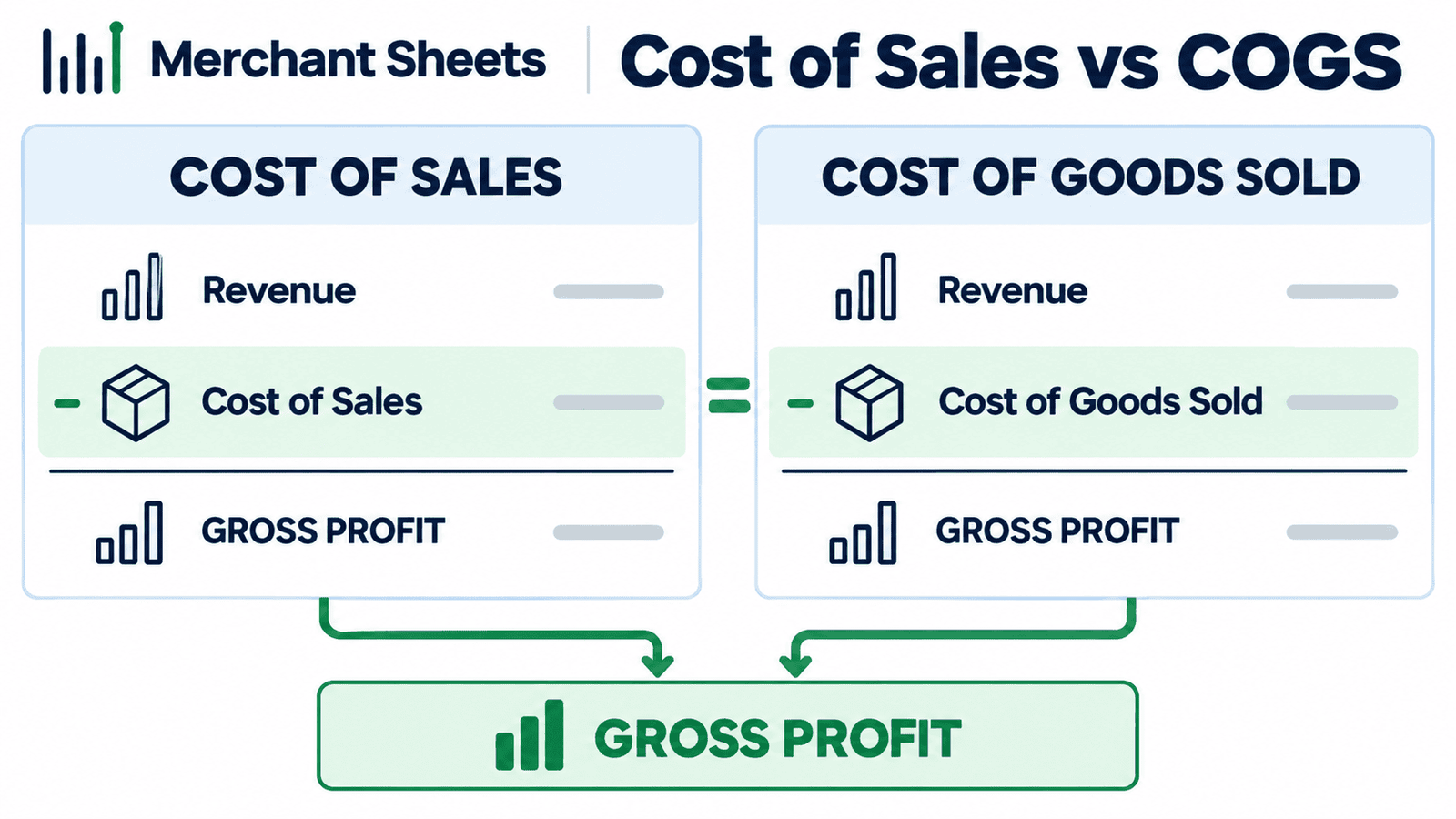
- For a business that sells physical products, cost of sales and cost of goods sold (COGS) are the same thing: two names for one line on your income statement.
- The difference is a labeling convention. US guidance and tax forms lean on “cost of goods sold,” while many income statements and accounting software use “cost of sales.”
- Both names sit in the same place, directly below revenue, and both get subtracted from it to give gross profit.
- The label doesn’t change the number, your gross margin, or your tax treatment. What matters is what you put inside the line, not what you call it.
- The one genuine difference is cost of revenue, a broader term that can add costs like fulfillment, delivery, and payment processing on top of product cost.
- Service businesses, which have no goods to cost, usually report “cost of sales” or “cost of revenue” instead of COGS.
For a business that sells physical products, cost of sales and cost of goods sold are the same thing. They’re two names for one line on your income statement: the direct cost of the products you sold. Which label you see is a matter of convention, and it changes nothing about the math.
Are cost of sales and COGS the same thing?
For a business that sells physical products, cost of sales and cost of goods sold are the same thing: the direct cost of the goods you sold, reported directly below revenue on your income statement. Standard accounting treats the two terms as interchangeable.
The only variation is which label an income statement, a piece of software, or a region prefers.
Cost of goods sold (COGS) is the direct cost of the products you’ve sold, the unit cost plus what it took to get them ready to sell. Cost of sales is the same figure under a different name.
Your income statement, the report that shows what you earned and spent over a period, lists that cost right under revenue. Whichever label sits on the line, it’s doing one job: capturing what the goods you sold cost you.
Why there are two names for the same line
Both names exist out of convention, not accounting substance. In the United States, “cost of goods sold” is the common label, and it’s the term the IRS uses on the tax forms. “Cost of sales” is equally correct, and it turns up widely: as the section header inside accounting software like Xero and QuickBooks, on plenty of published income statements, and across non-US and IFRS-style reporting.
That’s why the same operator sees “Cost of Sales” in their books and “COGS” in every guide they read. Neither one is wrong. The line does the same work under either name, and nothing about your numbers changes when the label does.
When cost of sales is broader than COGS
There’s one place the terms genuinely part ways, and it involves a third term: cost of revenue. Cost of revenue is a broader measure. It can fold in costs like outbound shipping, delivery, and payment processing on top of the product cost that makes up COGS.
It’s common to see a hard line drawn between COGS and cost of sales, with one treated as broader than the other. For a product business that line doesn’t hold: the two are synonyms, and cost of revenue is the term that carries the wider meaning. Two things drive the real distinction.
Service businesses, which sell time or expertise rather than goods, have no cost of goods, so they report cost of sales or cost of revenue for the direct cost of delivering the service.
And for a business that sells products, cost of revenue is the wider bucket: product cost is COGS, while whether you also fold in fulfillment and merchant fees is a choice about how your income statement is laid out. The table below lines up all three.
Table 1. COGS, cost of sales, and cost of revenue at a glance.
| Cost of goods sold (COGS) | Cost of sales | Cost of revenue | |
| What it is | Direct cost of the products you sold | The same cost under a different name | The direct cost of delivering a sale, more broadly |
| Who tends to use it | US product sellers; the label on tax forms | Retailers, accounting software, non-US reporting | Service and platform businesses; wider income statements |
| Typically includes | Landed cost of the goods sold | Landed cost of the goods sold | Product cost plus items like fulfillment, delivery, and payment processing |
| Where it sits | Below revenue, above gross profit | Below revenue, above gross profit | Below revenue, above gross profit |
Does the label change your margins or your taxes?
No. Your gross profit is revenue minus this cost line whether your statement calls it COGS or cost of sales, so your gross margin comes out identical either way. Your taxes don’t move either: the return uses “cost of goods sold” regardless of the label in your books.
Gross profit, revenue minus the cost of the goods you sold, is the same figure under either name, so your gross margin lands in the same spot.
On taxes, the label in your bookkeeping is cosmetic; what the IRS asks for is cost of goods sold, and the question that carries real weight there is a separate one, whether that cost is an asset or an expense and when it moves between them.
Table 2. Same income statement, either label (illustrative figures). The name on the line doesn’t change gross profit.
| Line | If your P&L says “COGS” | If your P&L says “Cost of Sales” |
| Revenue | $100,000 | $100,000 |
| The cost line | $58,000 | $58,000 |
| Gross profit | $42,000 | $42,000 |
| Gross margin | 42% | 42% |
What matters is what’s inside the line
Since the label is cosmetic, the thing to get right is the contents. Two income statements can both say “cost of sales” and still not line up, because one includes inbound freight and duties in the product cost and the other leaves them out.
The cost line should carry the landed cost of the goods you sold, the unit cost plus freight, duties, and the other costs of getting the product to you.
Across a period, the figure works out to beginning inventory plus purchases minus ending inventory, which is how the number is calculated, and which unit cost moves depends on your costing method.
Set the account up once in your chart of accounts, pick the label your software uses, and keep the same costs inside it every month.
Do that and your gross margin compares cleanly from one period to the next. Keeping it consistent is a bookkeeping-setup question more than a labeling one.
Frequently asked questions
Is cost of sales the same as cost of goods sold?
For a business that sells physical products, yes; they’re two names for one income-statement line, the direct cost of the goods you sold, and standard accounting uses the terms interchangeably.
What's the difference between cost of sales and COGS?
For a product business, there’s no substantive difference; it’s a labeling convention, with “cost of goods sold” common in the US and on tax forms and “cost of sales” common in accounting software and non-US reporting.
Is cost of sales an operating expense?
No, cost of sales is a direct cost reported above gross profit, while operating expenses like marketing, apps, and salaries are reported below it.
Why does QuickBooks or Xero say "Cost of Sales" instead of COGS?
It’s a labeling choice; the “Cost of Sales” section in your accounting software plays the same role as cost of goods sold and sits in the same place on the income statement.
Is cost of revenue the same as COGS?
Not quite; cost of revenue is a broader term that can include fulfillment, delivery, and payment processing on top of the product cost that makes up COGS.
Does cost of sales include shipping?
Inbound freight to get your products to you is usually part of the cost line as landed cost, while outbound shipping to the customer is more often recorded separately as a fulfillment cost.
Do service businesses have COGS?
Service businesses usually report “cost of sales” or “cost of revenue” rather than COGS, because they have no physical goods to cost.
