
Key takeaways
- All-in fulfillment costs about $8 to $15 per order in 2026: From roughly $10 for light apparel to $18-plus for heavy or fragile home goods.
- “Fulfillment cost” means two different numbers: The pick-and-pack fee (around $3) and the all-in landed cost that adds packaging and outbound shipping. Confirm which one any quote refers to before you compare.
- Outbound shipping is 50 to 70 percent of the all-in cost: It’s the line with the most room to move, not the pick fee most operators try to negotiate.
- Read the dollar figure against your average order value: Aim to keep all-in fulfillment near 8 to 15 percent of AOV, and always inside your contribution margin.
- Method changes the math: In-house looks cheapest on paper, a 3PL trades a per-order fee for carrier rates and scale, and Amazon FBA bundles reach with fees that climb with size and returns.
All-in fulfillment runs about $8 to $15 per order for most ecommerce brands in 2026, but the raw number tells you almost nothing on its own.
Twelve dollars is cheap on a $180 home order and brutal on a $40 apparel order. What counts is the cost measured against what you charge.
Below are the 2026 benchmarks by vertical and by fulfillment method, what sits inside the number, and the one ratio that tells you whether yours is healthy.
Track it alongside your other ecommerce KPIs and it stops being a mystery line on the invoice.
What’s the average fulfillment cost per order?
All-in fulfillment costs about $8 to $15 per order in 2026 for a typical small-parcel ecommerce brand, covering pick and pack, packaging, and outbound shipping. Light apparel sits near the bottom of that range and heavy or fragile home goods near the top. The figure to compare is your total fulfillment spend divided by the orders you shipped.
The formula is straightforward: fulfillment cost per order equals total fulfillment cost divided by the number of orders shipped in the same period. The trap is in the word “total.”
Some quotes count only the pick-and-pack fee, the labor to pull your items off the shelf and box them, which runs around $3. Others mean the all-in landed cost that adds packaging materials and the outbound carrier charge, which is where most of the money goes.
Compare a fee to a full cost and you’ll reach the wrong conclusion. This page benchmarks the all-in number, as of mid-2026.
What’s inside the number
The all-in cost breaks into four parts. Three of them are small and predictable. One of them dominates.
Table 1: What makes up an all-in fulfillment cost per order (industry ranges, as of mid-2026).
| Cost component | Typical range | Note |
| Pick and pack labor | $2.75–$4.25 / order | The fee operators usually negotiate; rarely the biggest line |
| Packaging materials | $0.35–$1.00 / order | Mailer or box, plus dunnage and protection |
| Outbound carrier / parcel | $5.50–$11.00 / order | 50–70% of the total; driven by weight and dimensions |
| Storage (allocated) | $0.45–$0.75 / cu ft / mo | Spread across orders; rises with slow-moving stock |
Outbound shipping is 50 to 70 percent of the total, so that is the line worth your attention. Weight and dimensions set the carrier charge, which makes package size and product weight the real levers, well ahead of the pick fee.
Fulfillment is the cost to get an order out to the customer. It’s the mirror image of landed cost, what you pay to get inventory into your warehouse in the first place. Watch both, because a product can look cheap to buy and expensive to ship.
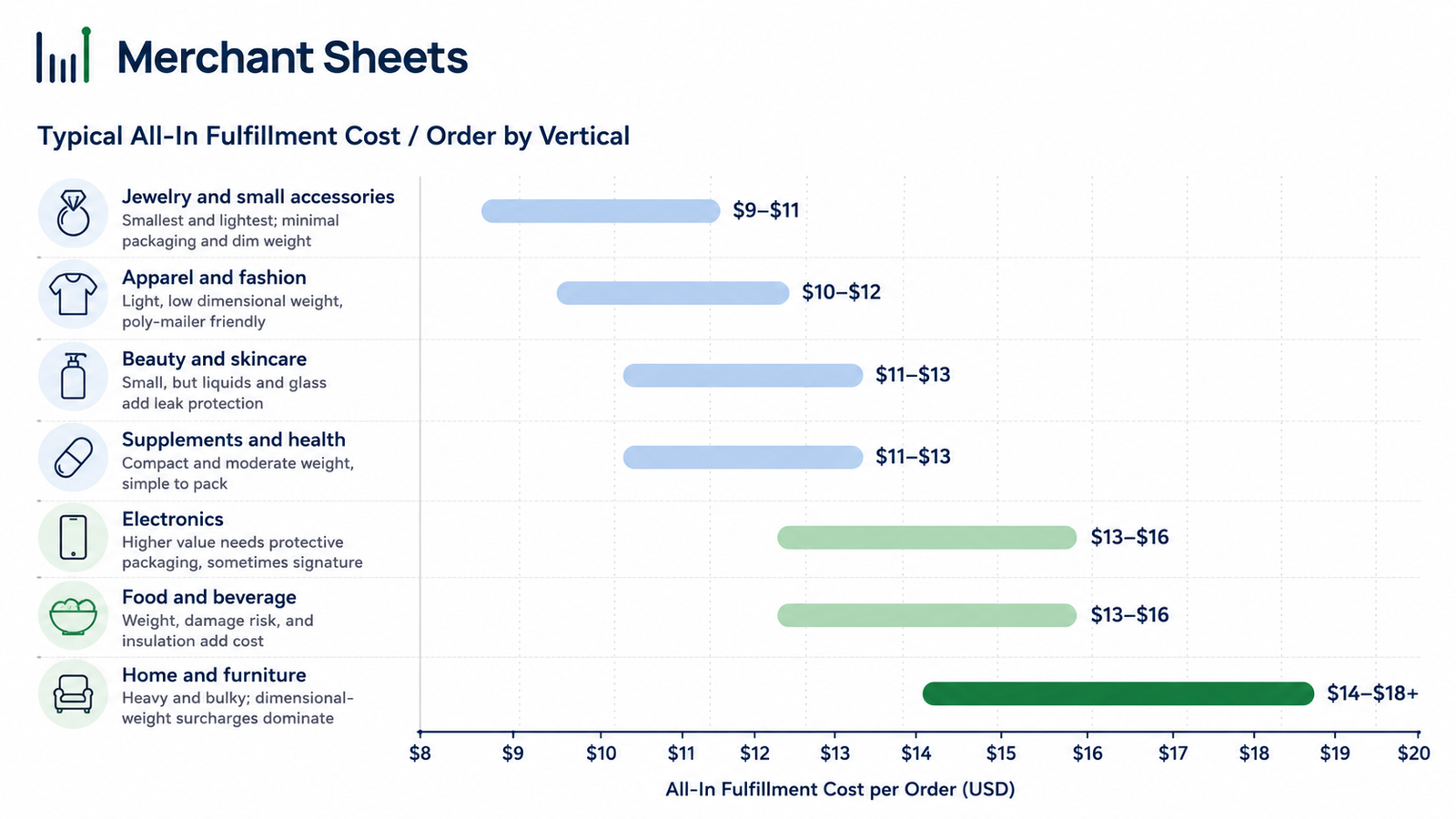
Fulfillment cost per order by vertical
What you sell sets the range more than how you sell it. A light poly-mailer order and a heavy boxed order can differ by $8 before you optimize anything.
Table 2: Typical all-in fulfillment cost per order by ecommerce vertical (directional ranges, aggregated from industry data, as of mid-2026).
| Ecommerce vertical | Typical all-in cost / order | Why |
| Jewelry and small accessories | $9–$11 | Smallest and lightest; minimal packaging and dim weight |
| Apparel and fashion | $10–$12 | Light, low dimensional weight, poly-mailer friendly |
| Beauty and skincare | $11–$13 | Small, but liquids and glass add leak protection |
| Supplements and health | $11–$13 | Compact and moderate weight, simple to pack |
| Electronics | $13–$16 | Higher value needs protective packaging, sometimes signature |
| Food and beverage | $13–$16 | Weight, damage risk, and insulation add cost |
| Home and furniture | $14–$18+ | Heavy and bulky; dimensional-weight surcharges dominate |
Read the table against what ships. Weight, box size, fragility, and dimensional weight, the way carriers price bulky-but-light packages, explain most of the spread.
A supplements brand shipping small, dense bottles lands near the bottom; a homewares brand shipping fragile, boxy items sits at the top.
Fulfillment cost by method
Method is the second axis. The same product can cost different amounts to fulfill depending on who handles it.
Table 3: Typical fulfillment cost per order by method (ranges overlap because volume, size, and vertical move each one).
| Fulfillment method | Typical cost / order | What’s happening |
| In-house | $5–$10 | Looks cheapest on paper, but hides labor, space, and overhead |
| 3PL (third-party) | $6–$14 | A per-order fee buys scale, carrier rates, and predictable pricing |
| Amazon FBA | $7–$15 | Bundles fulfillment with reach; fees climb with size and returns |
In-house often looks cheapest because the labor and space are already on your books, so they hide inside overhead instead of showing up per order. A 3PL, a third-party provider that stores and ships your inventory for a fee, trades that hidden cost for a clear per-order price and better carrier rates once you have volume.
Amazon FBA bundles fulfillment with Prime reach, but its Amazon fulfillment fees climb with product size and with returns, so a bulky or return-heavy SKU can erode the margin fast.
Your real target is fulfillment as a percentage of AOV
One ratio settles whether your fulfillment cost is healthy: fulfillment as a percentage of your average order value (AOV), the average dollar amount a customer spends per order. The same $12 cost reads completely differently depending on the order it rides on.
Table 4: The same per-order cost against different order values.
| AOV | Fulfillment cost / order | Fulfillment as % of AOV | Read |
| $40 | $12 | 30% | Danger: fulfillment is eating the order |
| $65 | $12 | 18% | High; needs a leaner pack, higher AOV, or a bundle |
| $120 | $13 | 11% | Healthy for the category |
| $180 | $14 | 8% | Comfortable; a high AOV absorbs the shipping weight |
Aim to keep all-in fulfillment around 8 to 15 percent of AOV, or roughly 10 to 20 percent of revenue once you fold in shipping you don’t pass through. A low dollar figure on a low-AOV order can still be too expensive, and a higher figure on a high-AOV order can be perfectly fine.
Fulfillment is a variable cost, so it comes straight out of your contribution margin, what’s left from a sale after the costs that rise with each order. If fulfillment plus your other variable costs leave nothing for overhead and profit, the order loses money no matter how the dollar figure compares to a benchmark.
A high return rate makes it worse, because a returned order pays to ship out, ship back, and process, which lifts your true fulfillment cost. Keep fulfillment inside the room your gross margin gives you, and watch it next to the other metrics that decide your net profit margin.
| A $12 fulfillment cost is 30% of a $40 order and only 7% of a $180 order. Benchmark the percentage of AOV, and keep it inside your contribution margin. A low dollar figure on a low-AOV order can still be too expensive. |
Track your fulfillment cost per order
A per-order fulfillment cost you don’t watch quietly widens until it’s eating a category’s margin. The KPI Dashboard puts fulfillment cost per order next to AOV, contribution margin, and return rate in one view, so you read it as a percentage of every order and catch it drifting before it costs you a quarter.
Frequently asked questions
What is a good fulfillment cost per order?
A good all-in fulfillment cost sits around 8 to 15 percent of your average order value, not a fixed dollar amount. For a typical small-parcel brand that’s roughly $8 to $15 per order, but $12 is healthy on a $150 order and expensive on a $40 one. Benchmark against your AOV and your margin.
How do you calculate fulfillment cost per order?
Divide your total fulfillment cost for a period by the number of orders you shipped in that period. Include pick and pack, packaging, outbound shipping, and a share of storage for a true all-in figure. Keep the same components in the number each month so the trend stays comparable.
What percentage of revenue should fulfillment cost be?
Most brands run all-in fulfillment, including outbound shipping, at about 10 to 20 percent of revenue, and closer to 8 to 15 percent of AOV at the order level. Heavier and bulkier categories sit at the high end. If you’re above the range, the fix is usually packaging size, carrier rates, or order value, not the pick fee.
Is 3PL or Amazon FBA cheaper per order?
It depends on your product and volume. Amazon FBA often costs $7 to $15 per order and gets expensive for bulky or return-heavy items, while a 3PL runs about $6 to $14 and tends to win once you ship enough volume to negotiate rates. Many brands use FBA for Amazon demand and a 3PL for everything else.
Why is my fulfillment cost per order so high?
Usually weight and box size. Outbound shipping is 50 to 70 percent of the cost, and carriers price on dimensional weight, so an oversized box on a light product inflates the charge. Oversized packaging, a distant warehouse, low order volume, and returns are the common culprits.
