
Key takeaways
- Most tools sold as cash flow forecasting software sync to QuickBooks or Xero, not Shopify, so they forecast cash only after it posts to your accounting ledger.
- “Cash flow forecasting” is really three jobs: accounting-synced forecasting (Float, Fathom, Cash Flow Frog, Pulse, Dryrun, Jirav), inventory-to-cash planning (Cogsy, Prediko, Inventory Planner), and financing the gap (Settle, Wayflyer).
- Entry pricing for the accounting-synced forecasters clusters tight at roughly $29 to $55 a month as of mid-2026, so price rarely decides the choice; fit does.
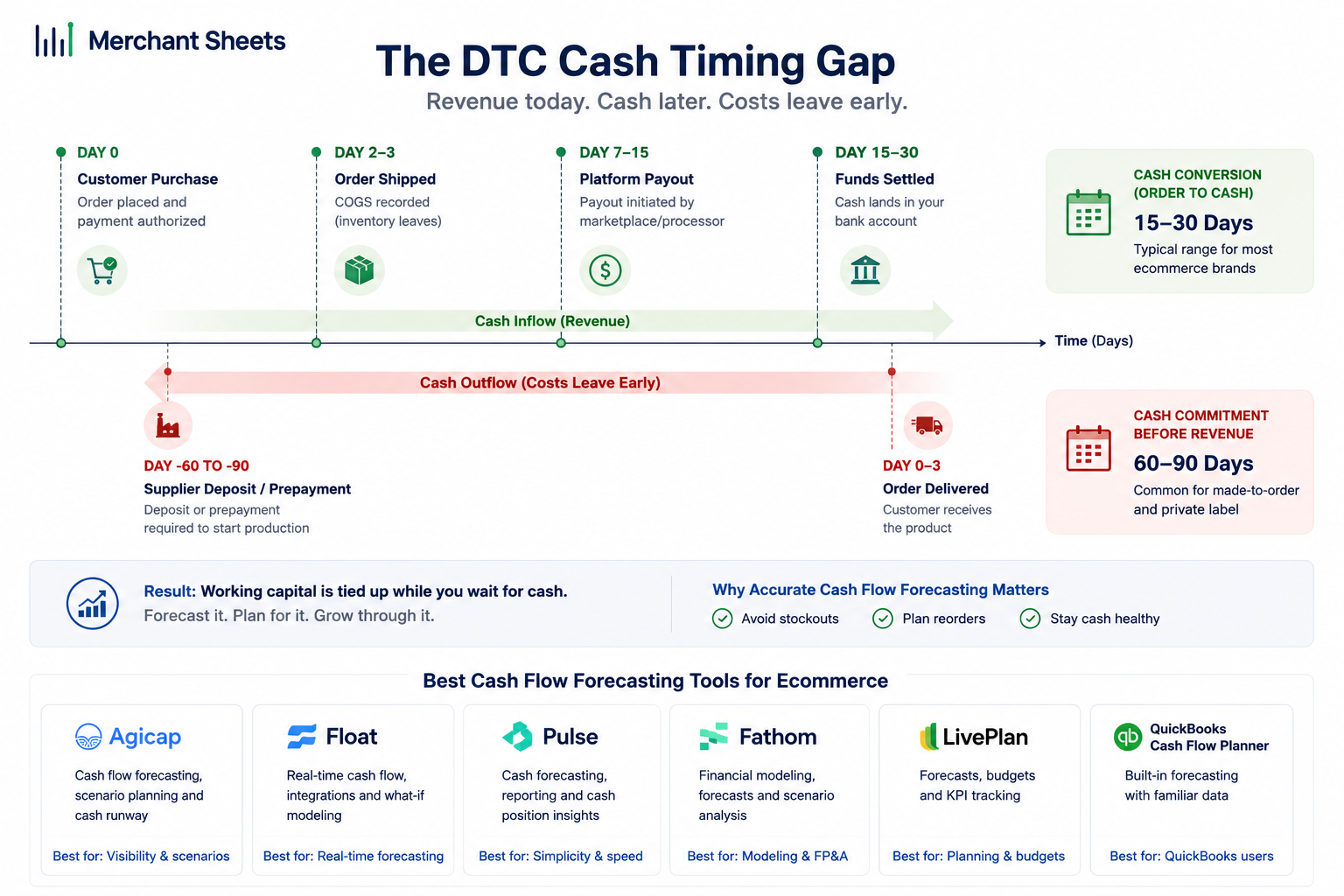
- The gaps that break DTC cash sit upstream of accounting: Shopify payout holds of 2 to 5 business days, Amazon’s biweekly settlement, return rates of 20% to 30%, and supplier deposits wired 60 to 90 days before the goods sell.
- For most brands between $500K and $5M, a 13-week spreadsheet you control models payout and purchase-order timing directly and beats a subscription until keeping it current costs more than the software would.
Search for the best cash flow forecasting tools for ecommerce and every list hands you the same names, usually with the author’s own product sitting at the top.
This guide sorts the market into the three jobs people bundle under “cash flow forecasting,” ranks the real options in each, and shows why a purpose-built 13-week sheet still wins for most brands between $500K and $5M.
What is a cash flow forecasting tool?
A cash flow forecasting tool projects the cash moving in and out of a business over a set horizon, usually by pulling actuals from your accounting system and rolling them forward against expected sales and bills. Most connect to QuickBooks or Xero, which means they see your cash only once it posts to the books.
That lag is the catch for ecommerce. The ledger where your ecommerce accounting lives records a sale after the order clears and a supplier bill after you enter it. For a brand that lives and dies on inventory timing, the cash decisions happen weeks before any of that lands in the books, so a tool reading from the ledger is answering the right question with data that’s already behind.
The three jobs bundled into “cash flow forecasting”
The biggest reason buyers pick the wrong tool is treating one label as one job. Compare a financing platform against a spreadsheet against an FP&A suite and you’re comparing three different purchases. Sort your shortlist into these buckets first.
- Accounting-synced forecasting: Float, Fathom, Cash Flow Frog, Pulse, Dryrun, and Jirav pull actuals from Xero or QuickBooks and project them forward. They’re strong at the three-way forecast a lender or board wants and blind to anything that happens before a transaction hits the books.
- Inventory-to-cash planning: Cogsy, Prediko, and Inventory Planner start from your Shopify orders and stock, forecast demand, and turn reorder timing into a cash-out schedule. This is the upstream half the accounting tools can’t see.
- Working-capital financing: Settle and Wayflyer don’t forecast the gap, they fund it, pairing purchase-order and payables automation with cash advances that cover the inventory buy.
How we compared these tools
We weighted the criteria toward the question an ecommerce operator actually asks: will I have the cash for my next inventory buy, and when?
That puts native Shopify or inventory sync first, then purchase-order and supplier-deposit timing, then seasonality and scenario modeling for the Black Friday curve, then clean accounting integration for reconciling actuals, and price last.
We didn’t rank on feature counts or star ratings, or on how many of the ecommerce KPIs that matter each tool can chart. Most generic “best cash flow tool” lists rank accounting tools for what is really an inventory problem, which is how a brand ends up blindsided by an October cash crunch its forecast never flagged.
The tools at a glance
Table 1: Entry pricing and ecommerce fit for the main cash flow forecasting tools (vendor pages plus G2 and Capterra, as of mid-2026; several prices are revenue-banded).
| Tool | Best for | Entry price/mo | Shopify sync | Accounting sync | PO/inventory timing | Scenarios |
|---|---|---|---|---|---|---|
| Float | Visual scenario forecasting | ~$50 | No | Xero, QBO | Manual | Yes |
| Fathom | Three-way & board reporting | ~$43 | No | Xero, QBO | Manual | Yes |
| Cash Flow Frog | Simple & affordable | $33–$55 | No | QBO, Xero, +more | No | What-if |
| Pulse | Cheapest cash calendar | $29 | No | QBO | No | Toggle |
| Dryrun | Scenario-heavy forecasting | ~$50 | No | QBO, Xero | Manual | Yes |
| Jirav | Driver-based FP&A | $50–$150+ | No | QBO, Xero | Via drivers | Yes |
Accounting-synced forecasters, tool by tool
These six are what most “cash flow software” lists actually rank. One note before the picks: Causal, long the SMB favorite for flexible modeling, was acquired by Lucanet in October 2024 and folded into an enterprise platform, so it’s effectively off the table for a DTC brand now.
- Float: The best visual scenario forecaster if you’re on Xero or QuickBooks, around $50 a month on revenue-banded tiers. It models a supplier deposit only as a bill you enter by hand.
- Fathom: The strongest three-way forecasting and board reporting, near $43 a month per company, with a deep feature set. It carries the same manual-entry limit on inventory timing.
- Cash Flow Frog: Simple and affordable at $33 to $55 a month, and the most generous on integrations, connecting to QuickBooks, Xero, Zoho, and more. It has no native purchase-order timing.
- Pulse: The cheapest cash calendar at $29 a month, clean and visual, though it syncs to QuickBooks only and sees no inventory.
- Dryrun: Built for brands that live in what-if scenarios, around $50 a month, still accounting-sourced so deposit timing stays manual.
- Jirav: Driver-based FP&A from roughly $50 to $150 and up, powerful for a brand that has outgrown a simple forecast and more tool than most sub-$5M businesses need.
Inventory-to-cash planners (the upstream half)
Cogsy, Prediko, and Inventory Planner see what the forecasters can’t. They pull your Shopify demand and stock, tell you what to reorder and when, and turn that into a cash-out schedule for the deposits and balances you’ll owe suppliers.
They aren’t a full three-way forecast on their own, which is why brands from $1M to $10M often run one alongside an accounting-synced forecaster: one tool sees the ledger, the other sees the buys.
Working-capital financing (funding the gap)
Settle and Wayflyer sit in their own lane. A forecasting tool models the gap so you can see it coming; a financing platform advances the cash so you can cover the inventory buy before the revenue lands. Settle in particular pairs purchase-order and payables automation with financing, which puts it closest to the supplier-deposit timing that trips up every accounting-synced forecast.
Growing brands often end up using both a forecaster and a line of credit.
What actually breaks a DTC cash forecast
Four structural timing gaps decide whether any forecast survives contact with reality. All four sit upstream of the accounting ledger these tools read from, and each one stretches your cash conversion cycle, the stretch between paying for stock and collecting on the sale.
- Shopify payout holds: Shopify Payments holds your money 2 to 5 business days, so sale-day revenue isn’t sale-day cash.
- Amazon’s biweekly settlement: if you sell on Amazon, cash lands roughly every 14 days, so you’ve made the sale but can’t spend it yet.
- Returns: in apparel, returns run 20% to 30% of gross revenue, and the refund rarely times to the original sale.
- Supplier deposits: you wire a 30% deposit 60 to 90 days before the goods sell, then the balance on shipment, a large outflow a full quarter ahead of the matching revenue.
The workaround, and why it points back to a sheet
You can force an accounting-synced tool to handle these gaps. Enter each purchase order as a planned bill, and discount gross revenue for returns before it hits the model. It works. It’s also a weekly manual reconciliation you have to keep current, at which point you’re doing a spreadsheet’s work inside a tool that charges you every month for the privilege.
When a spreadsheet beats the software
Here’s the case a CFO would make. Every gap above is something you can enter directly in a spreadsheet the week it happens, instead of waiting for the ledger to catch up. When you build a rolling 13-week forecast on the direct method, cash in minus cash out week by week, you shift Shopify revenue three to five days for the payout hold, haircut gross sales for returns, and drop the supplier deposit in the week you’ll wire it.
You control every assumption, there’s no sync lag, and once it’s running you update it weekly against actuals and a handful of weekly cash flow KPIs.
The same sheet is where you watch net working capital, and it feeds straight into a fuller ecommerce financial model when you’re ready. Be fair about the trade-off: a spreadsheet won’t auto-refresh your actuals or spin up ten scenarios at a click, and it takes discipline to update each week.
That maintenance cost is the real signal for when to buy software, which is the next question.
| A 13-week forecast that shifts Shopify revenue for the payout hold, haircuts gross sales for returns, and books the supplier deposit in the week it clears will catch a cash crunch that an accounting-synced tool won’t see until the bill posts. |
Our pick by revenue band
The right setup depends on scale more than on any single feature. The forecast exists to protect your free cash flow, so the goal is the cheapest setup that reliably catches a gap before it hits. The upgrade trigger that matters isn’t a revenue number; it’s the moment keeping the sheet current costs more than the subscription would.
Table 2: Recommended cash flow setup by revenue band.
| Revenue band | Recommended setup | Move up when |
|---|---|---|
| Under $1M | A 13-week spreadsheet you control | Rarely for software’s sake — put the cash into inventory |
| $1M–$5M | The sheet, or pair it with an accounting-synced forecaster (Float, Fathom) | Weekly updates and scenarios start eating an hour or more |
| $5M and up | An accounting-synced forecaster plus an inventory-to-cash tool, and a working-capital line | Inventory buys are large enough that financing beats funding from cash |
Start where your cash moves
The tools on this list forecast your cash after it hits your books. If your real problem is the three weeks between a sale and the spendable cash, minus the returns and minus the deposit you already wired to the factory, you need a view that starts where the money moves.
The 13-Week Cash Flow Forecast does that: enter your Shopify payouts, your returns haircut, and your supplier deposit schedule, and it rolls a week-by-week picture of the cash you can really spend.
Frequently asked questions
What's the best cash flow forecasting tool for a Shopify store?
There isn’t a single one, because no tool sees both your Shopify orders and your accounting ledger at once. Most brands pair an accounting-synced forecaster like Float or Fathom with a Shopify-native inventory tool like Cogsy or Prediko, or run a 13-week spreadsheet they update by hand.
Is there a free cash flow forecasting tool for a small business?
Yes, a 13-week spreadsheet costs nothing and gives you full control over payout and purchase-order timing, and both Cash Flow Frog and Pulse offer free trials if you want to test paid software before committing.
Is a spreadsheet good enough for cash flow forecasting?
For most brands under about $5M, yes — a well-built 13-week sheet models payout holds, returns, and supplier deposits more directly than an accounting-synced tool, and the right time to switch is when weekly maintenance costs more than a subscription would.
Do QuickBooks and Xero forecast cash flow?
Both offer basic short-term cash flow projections, but they read only from your accounting ledger, so they miss the Shopify payout timing, returns, and inventory deposits that drive ecommerce cash; a dedicated forecaster or a purpose-built sheet handles those.
Do Float or Fathom sync with Shopify?
Not for cash — both connect to Xero and QuickBooks rather than to your store, so they see revenue only after it posts to the accounting ledger, and forecasting Shopify payouts or inventory timing means adding an inventory tool or modeling it in a spreadsheet.
