
Key takeaways
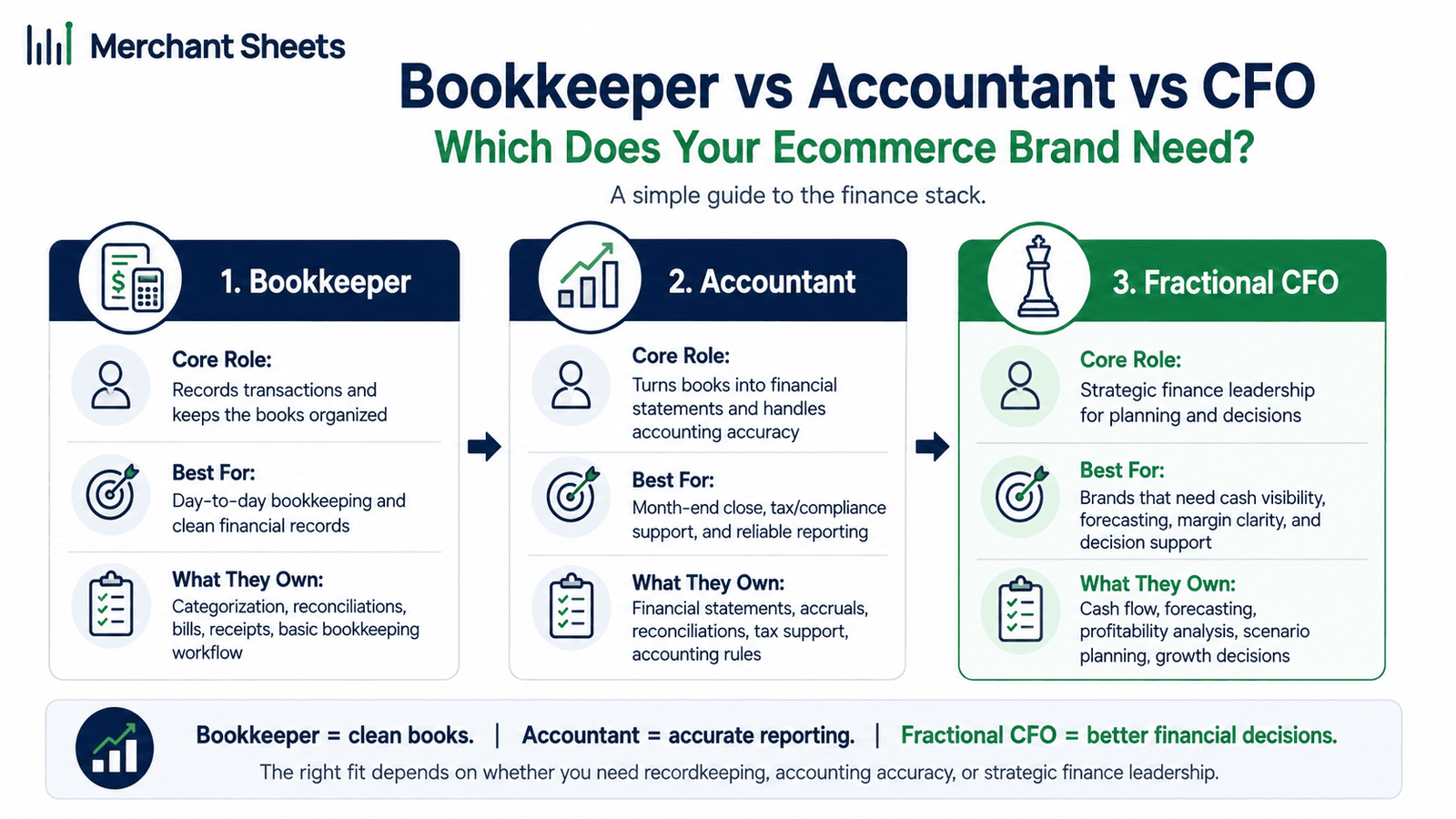
- A bookkeeper records and reconciles your transactions, an accountant handles tax and accurate statements, and a fractional CFO decides what the numbers mean for cash, pricing, and growth.
- The quick rule: a bookkeeper keeps the books, an accountant keeps you compliant, and a CFO drives the strategy.
- An accountant and a CPA overlap, but a CPA is a licensed accountant who can sign certain filings and represent you to the IRS; many ecommerce brands use a CPA for tax and a bookkeeper for the day-to-day.
- Most ecommerce brands need a bookkeeper and a tax accountant first, and add a fractional CFO later, once decisions on cash, pricing, and inventory need senior judgment.
- The roles stack rather than compete: the bookkeeper and accountant produce clean, compliant numbers, and a CFO decides with them.
- A fractional CFO usually works on top of your existing bookkeeper and accountant rather than replacing them, which is part of why the model is affordable.
A bookkeeper records your transactions and keeps the books current. An accountant handles your taxes and makes sure the statements are right. A fractional CFO uses those numbers to steer cash, margin, and growth. Most ecommerce brands need them in that order. Here’s what each one does, and which yours needs now.
Bookkeeper vs accountant vs CFO: what’s the difference?
A bookkeeper records and reconciles your daily transactions, an accountant prepares your taxes and accurate financial statements, and a fractional CFO, a senior finance leader who works with your business part-time and ongoing, decides what those numbers mean for cash, pricing, and growth. Each role sits a level above the last in what it decides.
The three run from recording the numbers to deciding with them, they cost very differently, and most brands add them in a predictable order. Here’s the whole picture at a glance before the detail.
Table 1. Bookkeeper vs accountant vs fractional CFO, at a glance (as of 2026).
| Bookkeeper | Accountant / CPA | Fractional CFO | |
| Focus | Recording and reconciling transactions | Tax, compliance, and accurate statements | Strategy: cash, margin, forecasting |
| Time horizon | Day to day, backward-looking | Periodic, backward-looking (tax and close) | Forward-looking (what to do next) |
| Typical work | Categorize, reconcile payouts, run payroll | File taxes and sales tax, year-end close, statements | Cash forecast, unit economics, pricing, fundraise |
| Typical cost (2026) | ~$500 to $2,500 a month | ~$150 to $400 an hour, or a fixed tax fee | $3,000 to $12,000+ a month |
| Best for | Keeping the books current and clean | Staying compliant and filing right | Senior decisions without a full-time hire |
What a bookkeeper does for an ecommerce brand
A bookkeeper is the foundation that keeps your books current and accurate. The work is categorizing transactions, reconciling accounts, managing accounts payable and receivable, and running payroll.
On an ecommerce brand the day-to-day is heavier than it sounds: reconciling Shopify and Amazon payouts to your bank deposits, tying the sales-channel or A2X feed back to the books, and keeping inventory and cost of goods sold (COGS) entries current as products move.
The mess usually hides in timing and fees. A single Amazon payout bundles two weeks of sales, refunds, and a dozen fee types into one deposit, and a bookkeeper untangles that so your revenue and margin read correctly instead of landing in the books as one lump. Get this layer wrong and every number above it inherits the error.
Where the bookkeeper stops is tax and strategy. They keep the record straight, but they generally don’t file your taxes, produce audited statements, or decide what to do next. You need one from early on, because everything above it depends on clean books.
For what founders should track and how the pieces fit, how ecommerce accounting works covers the ground.
What an accountant does for an ecommerce brand, and accountant vs CPA
An accountant keeps you compliant and turns clean books into filings and statements. The work is preparing income tax, handling sales tax across the states you sell into, running the year-end close, and producing financial statements.
On the accountant-versus-CPA question: the two overlap, but a CPA is a licensed accountant who can represent you to the IRS and sign certain filings, so many ecommerce brands use a CPA for tax and a bookkeeper for the daily work.
Sales tax is where an ecommerce accountant earns their fee. Selling into many states creates filing obligations a general accountant may miss, and the rules turn on where you have sales tax nexus. Good accounting also produces the financial statements a lender or a buyer will later ask for, so the work pays off beyond staying compliant.
An accountant is usually a periodic relationship rather than a daily one, brought in around tax deadlines and the year-end close rather than every week.
What a fractional CFO does, and how it’s different
A fractional CFO is the strategic layer that sits on top of clean, compliant books. The work is cash forecasting, unit economics and margin by channel and stock keeping unit (SKU), inventory-to-cash decisions, pricing, and support for a fundraise or a lender, delivered a few days a month by a senior person.
The bookkeeper and accountant produce and certify the numbers; the CFO decides what to do with them.
Because the role is about decisions, the numbers it turns on are specific. A clear read on contribution margin by channel usually matters more to a fractional CFO than any single line on the tax return. Where an accountant tells you what you earned last year for the IRS, a CFO tells you whether next quarter’s inventory buy will leave you short on cash.
This article keeps to the comparison, so for the full picture of the role, the fractional CFO guide walks through what one is and does.
Bookkeeper vs accountant: do you need both?
Yes, most ecommerce brands need both, because they do different jobs. A bookkeeper keeps the books current all year; an accountant or CPA uses those books to file taxes and produce statements a few times a year. The two make each other better: a good bookkeeper hands the accountant clean books, which cuts the bill for their time and lowers the risk of errors at filing.
The setups vary by size. A very early brand might use one accountant for both the books and the taxes, but as volume grows the daily bookkeeping and the periodic tax work usually split into two roles or two providers.
A $1.5M brand, for instance, might pay a bookkeeper a few hundred dollars a month to keep the books current and a CPA a fixed fee at tax time, two modest costs that together beat untangling a year of messy books every April.
The question then becomes less whether you need both and more which one to add next, and in what order.
Which do you need, and in what order?
Most ecommerce brands add these roles in a predictable order. A bookkeeper (or careful DIY) and a tax accountant come first, then a fractional CFO once the decisions on cash, pricing, and inventory need senior judgment, with a controller slotting in between when the monthly close gets heavy. The table below maps the usual sequence by revenue stage.
The neighboring decisions have their own guides. There’s a separate comparison for where a controller fits and how a fractional CFO compares to a full-time hire, and the timing of the CFO layer specifically is covered in when to hire a fractional CFO.
Read the stages as a starting point and adjust for your own complexity.
Table 2. The usual order ecommerce brands add finance roles, by stage (as of 2026; a starting point, adjust for your own complexity).
| Stage | The finance help most brands add | Why |
| Pre-$500K | A bookkeeper (or DIY) plus a tax accountant at year-end | Keep the books clean and file taxes right |
| $500K to $1M | A dedicated bookkeeper and a CPA for tax and sales tax | Volume and multi-state tax outgrow DIY |
| $1M to $3M | Add a fractional CFO for the decisions; a controller if the close is heavy | The decisions on cash, pricing, and inventory now need senior judgment |
| $3M and up | Bookkeeper plus accountant or CPA plus controller plus fractional CFO | A full finance stack, still without a full-time CFO |
How the roles work together
The clearest way to hold all three is as a stack rather than a set of rivals. A bookkeeper records the transactions, an accountant makes them compliant and turns them into statements and filings, and a CFO decides what those numbers mean and what to do next.
Each role sits on top of the one before it, and most ecommerce brands add them in that order as they grow. For the day-to-day of that top layer, what an ecommerce CFO does breaks down a fractional CFO’s week.
In practice, a fractional CFO usually works on top of your existing bookkeeper and accountant rather than replacing them, which is part of what keeps the model affordable. If your books and taxes are already handled and the gap is decision-making, the missing layer is the CFO.
If the books or filings themselves are the problem, the missing layer is lower down. Getting the order right keeps you from paying CFO rates to fix a bookkeeping issue.
Frequently asked questions
What's the difference between a bookkeeper and an accountant?
A bookkeeper records and reconciles your day-to-day transactions and keeps the books current, while an accountant uses those books to prepare taxes, handle compliance, and produce financial statements, so the accountant works on top of the bookkeeper’s records.
Do I need a bookkeeper or an accountant?
Most ecommerce brands need both, because a bookkeeper keeps the books current all year and an accountant or CPA files your taxes and produces statements a few times a year, and a good bookkeeper makes the accountant’s work faster and cheaper.
What's the difference between an accountant and a CPA?
A CPA is a licensed accountant who has passed the CPA exam and can represent you to the IRS and sign certain filings, while accountant is a broader term, so for tax and compliance many brands specifically want a CPA.
Do I need a CFO if I already have an accountant?
An accountant keeps you compliant and reports what happened, while a fractional CFO decides what to do next with cash, pricing, and inventory, so once those decisions need senior judgment a CFO adds something your accountant doesn’t.
Does an ecommerce business need a bookkeeper and an accountant?
Yes, an ecommerce brand needs a bookkeeper to reconcile Shopify and Amazon payouts and keep inventory and COGS accurate, and an accountant or CPA to handle income and multi-state sales tax, and the two roles rarely fit in one person as the business grows.
When should I hire an accountant for my ecommerce business?
Bring in an accountant or CPA once you owe income tax, cross sales-tax thresholds in multiple states, or need real financial statements, which for most ecommerce brands is well before the first six figures of revenue.
Is a CFO the same as an accountant?
No, an accountant records and reports on what already happened and keeps you compliant, while a CFO uses those numbers to make forward-looking decisions on cash, pricing, financing, and growth, so they sit at different ends of the finance function.
Start in the right place
Where you start depends on what’s missing. If it’s clean, compliant books, that’s the accounting work I handle, reconciled across Shopify and Amazon with your sales tax covered.
If your books are already solid and the gap is deciding what the numbers mean, that’s the fractional CFO work, and I start there with a fixed-scope profit and cash audit. Tell me where your brand is, and we’ll start in the right place.
