
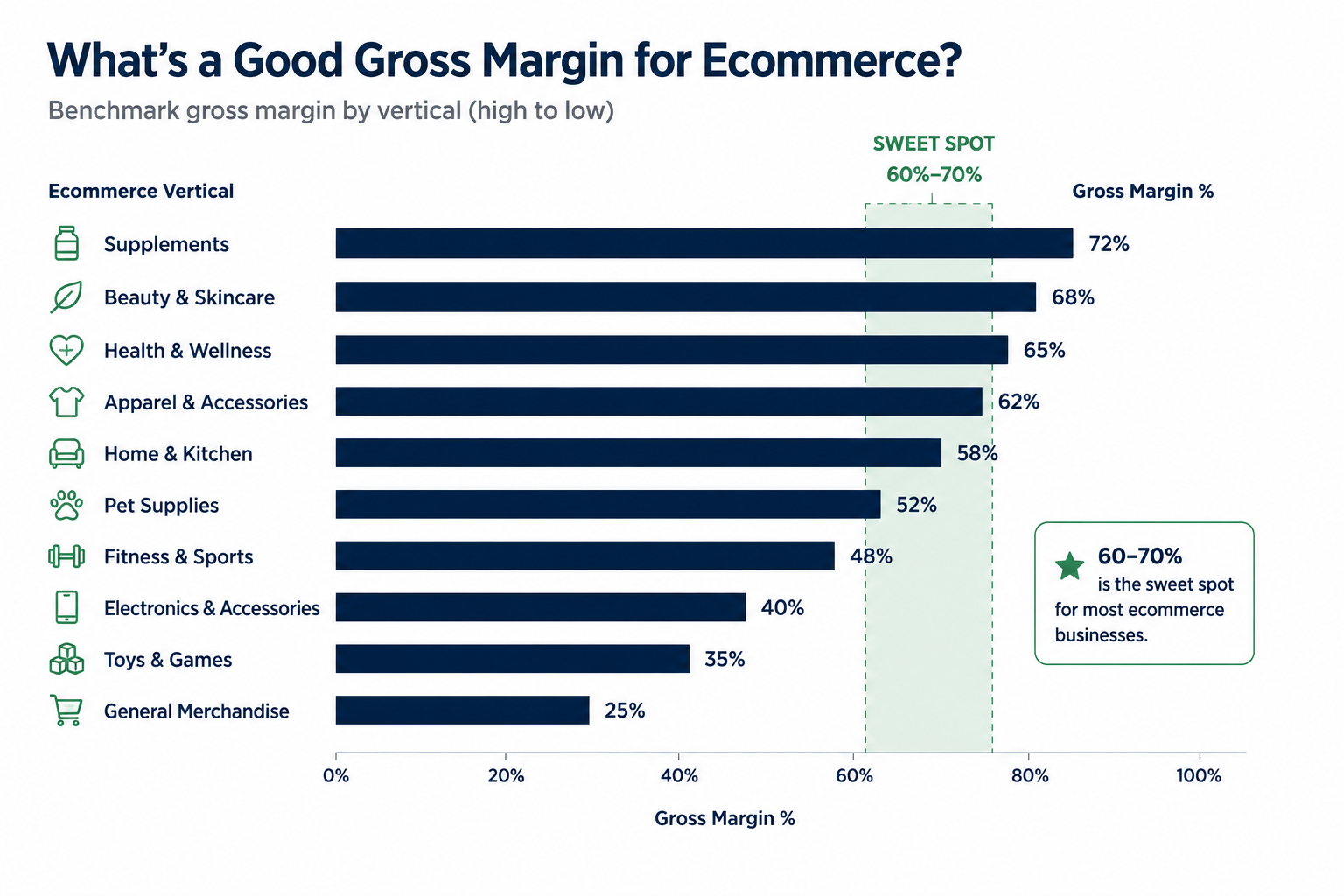
A good gross margin for ecommerce lands in the 60–70% range for most stores, but that number hides a lot. Beauty runs far higher, electronics far lower, and gross margin alone won’t tell you whether you’re profitable.
Here’s the honest benchmark by vertical, and what your number buys you.
What’s a good gross margin for ecommerce?
A good gross margin for ecommerce sits in the 60–70% range for most stores. That’s the band where there’s enough left after product cost to cover marketing, fulfillment, and overhead and still turn a profit.
The field runs wider — roughly 40% to 80% by category — with 50% a common floor below which scaling starts to feel tight.
Gross margin is what’s left of a sale after the direct cost of the product, expressed as a share of revenue: (revenue − COGS) ÷ revenue. If you need to run the numbers on your own store, here’s how to calculate gross margin step by step.
This guide is about the benchmark — what’s healthy once you have your number. The ranges below are current as of early 2026.
Gross margin benchmarks by vertical
There’s no single good number, because gross margin is driven more by what you sell than by how well you run the store.
Digital products carry almost no unit cost, so they sit highest; branded beauty and supplements command a price well above their ingredients; commodity electronics and grocery compete on price against thin product margins.
Both ends of that range include healthy, profitable businesses.
Table 1. Typical gross margin by ecommerce vertical, as of early 2026. Ranges vary widely by catalog and sourcing.
| Ecommerce vertical | Typical gross margin |
| Digital products | 70–90% |
| Beauty & skincare | 65–85% |
| Supplements & health | 60–78% |
| Apparel & fashion | 50–65% |
| Pet | 45–60% |
| Home & furniture | 40–50% |
| Food & beverage | 40–55% |
| Jewelry | 42–47% (DTC leaders 60–70%) |
| Electronics | 15–25% |
Read your number against your own vertical and your own trend, not the blended average. A 55% gross margin is thin for beauty and strong for food.
What matters as much as the level is the direction: a margin sliding quarter over quarter usually means rising product or freight costs you haven’t passed through yet.
For a deeper cut by brand, see the public-company gross margin data.
Gross margin isn’t your profit — the gross-to-net bridge
Gross margin is the ceiling on your profit, and that ceiling can sit a long way above the floor. It’s what’s left after the product cost alone.
Everything else — marketing, fulfillment, payment fees, software, salaries — comes out below the gross line to leave your net margin, the profit you keep.
The gap between the two is bigger than most operators expect: 35 to 40 points is common. A beauty brand at 70% gross margin that spends 60 cents of every dollar on ads, shipping, and overhead nets 10%.
A healthy net profit margin for ecommerce lands around 15–25%, so gross margin has to clear all of that with room to spare.
Table 2. Gross-to-net bridge for a beauty brand at 70% gross margin (illustrative, % of revenue).
| Line | % of revenue |
| Revenue | 100% |
| − COGS | −30% |
| = Gross margin | 70% |
| − Marketing | −30% |
| − Fulfillment & shipping | −18% |
| − Overhead & other | −12% |
| = Net margin | 10% |
Contribution margin sits between the two: it subtracts the variable costs of a sale, like fulfillment and per-order ad spend, and leaves fixed overhead for the net line.
It’s the sharper number for per-order decisions, and it’s worth understanding how contribution margin differs from the gross figure.
Gross margin is the ceiling on your profit. A 70% gross margin only matters if what’s left after marketing and fulfillment clears your overhead.
What separates high-margin stores from low-margin ones
Within a category, the stores at the top of the band tend to share a few traits. These are the levers that move gross margin:
- Pricing power: Brands that can charge a premium — through differentiation, a strong brand, or a product buyers can’t easily comparison-shop — hold higher margins than those competing on price.
- COGS and sourcing: A lower landed cost per unit lifts every sale’s margin, so tighter supplier terms, better freight, and duty planning show up directly in the number. It starts with knowing your true COGS.
- Product mix: A catalog weighted toward high-margin SKUs pulls the blended margin up, which is why adding accessories or consumables often beats discounting the hero product.
- Pricing method: Setting price off cost with a deliberate markup — keystone pricing and its variants — keeps margin consistent as costs move, instead of leaving it to guesswork.
When a low gross margin still works — and a high one isn’t enough
A low gross margin isn’t a verdict on the business. Low-margin, high-velocity models — food, electronics, marketplaces — can turn a healthy profit when stock sells fast and operating costs stay lean. Volume and speed do the work that margin does elsewhere.
Picture two stores at the same revenue. A supplement brand running 75% gross margin but paying 45 cents of every dollar to acquire customers can easily net less than a housewares store at 45% gross margin that acquires cheaply and turns its stock six times a year.
The margin headline favors the first; the bank balance can favor the second.
The reverse holds too: a high gross margin doesn’t guarantee profit. A brand at 75% gross can still lose money when customer acquisition cost eats most of what’s left.
That’s why gross margin is one of several ecommerce KPIs worth reading together — margin next to turnover, CAC, and net margin tells you what the single number can’t.
See where your gross margin lands
A benchmark only helps if you can see your own number beside it. The KPI Dashboard tracks gross margin along with 11 other core metrics across 24 months of actuals, compares each to the target you set, and flags where you stand with status pills — in Excel or Google Sheets.
Paste in your numbers and watch the trend, instead of guessing where you sit.
Frequently asked questions
Is a 50% gross margin good for ecommerce?
A 50% gross margin is workable for many ecommerce stores and thin for others, depending on the category. It’s a common floor — enough to cover costs and turn a profit when marketing and fulfillment are efficient — but it leaves less room than the 60–70% most profitable stores run. For beauty or supplements it’s low; for food or electronics it’s normal to strong.
What’s the difference between gross margin and net margin?
Gross margin is what’s left after the direct cost of the product (COGS), while net margin is what’s left after every cost — marketing, fulfillment, payroll, overhead, and tax. Gross margin usually runs 35 to 40 points higher than net. A store can post a 65% gross margin and a 12% net margin in the same period; the gap is where the business gets run.
What gross margin do I need to be profitable?
Enough to cover your marketing, fulfillment, and overhead with a net profit left over — for most ecommerce stores that means a gross margin of at least 50%, and comfortably 60% or more when customer acquisition cost is high. The more it costs to acquire a customer, the more gross margin you need to clear that cost and still profit.
Is a higher gross margin always better?
A higher gross margin is better all else equal, but all else rarely is. A high-margin brand can still lose money when acquisition costs are steep or the product turns slowly, while a lower-margin store that sells fast and runs lean can out-earn it. Read gross margin alongside turnover and CAC rather than chasing the number on its own.
