
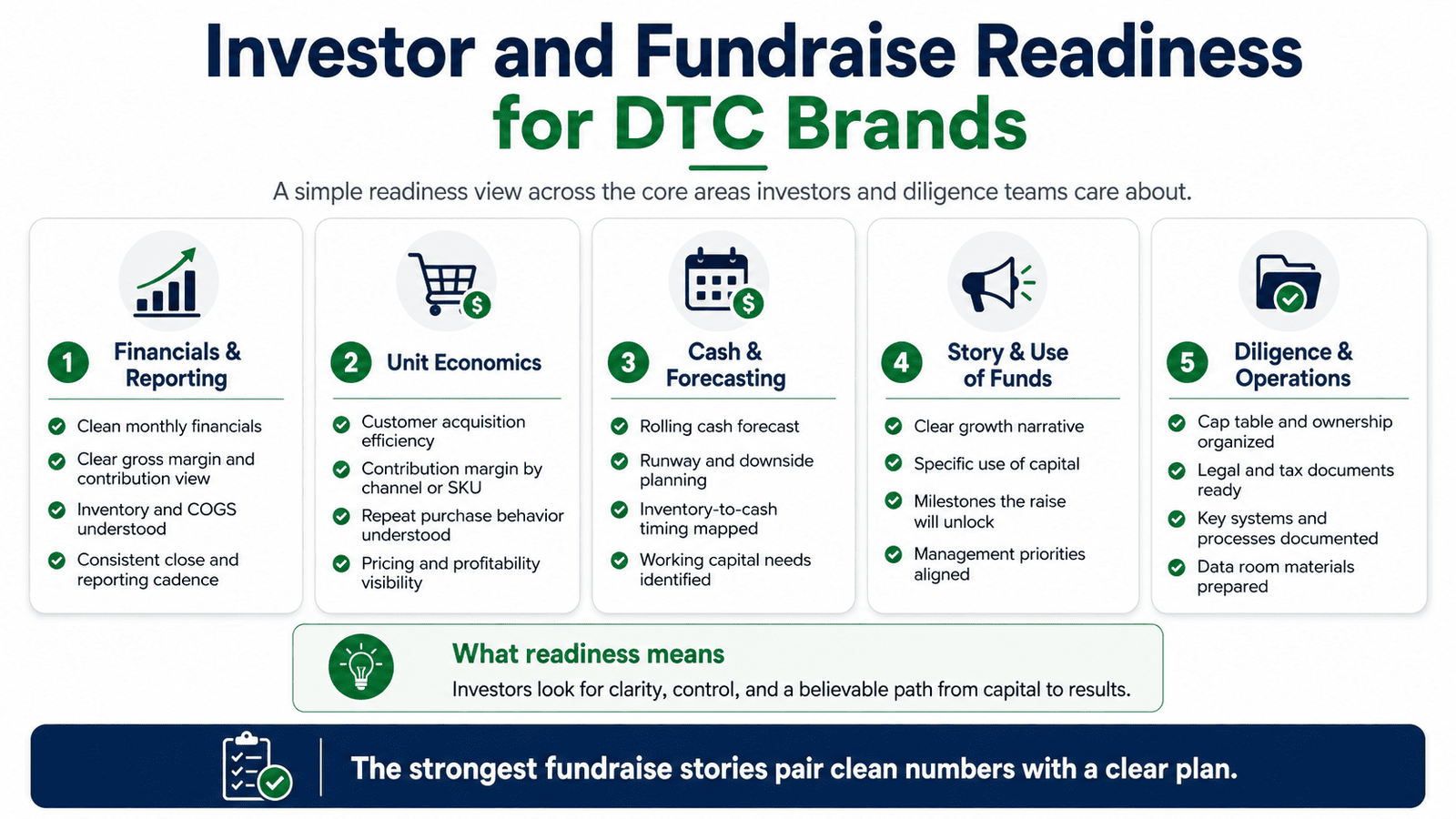
Key takeaways
- Being investor-ready means your numbers, story, and documents hold up under diligence, which is a higher bar than running a good business.
- Readiness is a separate question from valuation and from the decision to raise; you can be ready and still choose to wait.
- Investors and lenders stress-test the same core: contribution margin, CAC payback, LTV to CAC, cohort retention, gross margin, inventory-to-cash, and honest burn and runway.
- Build the data room (deck, monthly financials, unit economics, cohorts, cap table, cash forecast, inventory, and an integrated model) before you go out, not during the raise.
- Equity and debt want different things: durable growth and clean cohorts for equity, cash flow and collateral for a lender.
- A raise usually stalls on numbers that don’t tie or cohorts that were cherry-picked, which is the part a fractional CFO is there to fix.
Raising money is a test of your numbers as much as your story. Before an investor or a lender wires anything, they’ll pull apart your unit economics, your cohorts, and your cash, and they’ll notice what doesn’t tie.
Here’s what they check in a direct-to-consumer (DTC) brand, what belongs in your data room, and how to get ready before you go out.
What does investor-ready mean?
Being investor-ready means your financials, unit economics, and data room hold up when an investor or a lender examines them in detail, so the raise turns on price and fit rather than on cleaning up your numbers.
Diligence, the close review a funder runs before committing, is unforgiving, and the brands that clear it fastest are the ones whose numbers were ready before the first meeting.
It’s a higher bar than having a healthy business. Plenty of good businesses aren’t ready, because readiness is about how legible your numbers are to an outsider, and most brands run on numbers that make sense to the founder and no one else yet.
It helps to hold three distinctions in mind. Readiness is three things at once: numbers that tie, a story those numbers support, and the documents to prove both.
Readiness is a separate question from valuation, which is what the business is worth and is its own exercise, covered in how to value an ecommerce business.
And being ready is separate from deciding to raise at all, which is a strategic call about dilution, timing, and whether you need the capital. This article is about the first one, clearing the bar, and the rest of it walks the numbers, the data room, and the preparation in turn.
One thing worth saying plainly: readiness is mostly about trust. A funder who finds one number that holds up starts believing the next one, and a funder who finds one that doesn’t starts checking everything twice. The whole exercise is earning that first bit of trust and keeping it.
The numbers investors and lenders stress-test
Whatever the funding type, the same handful of numbers decide the conversation. Investors and lenders both reward founders who present them honestly, full cohorts and true customer acquisition cost, over a prettier story built on cherry-picked months.
Getting caught with an optimistic number early costs you trust on every number after it. Assume every figure will be rebuilt.
A serious investor recomputes your CAC from your ad spend and new-customer count, splits blended acquisition cost from new-customer cost, and pulls your cohorts apart month by month, so a number that only works when it’s averaged tends to come apart in the room.
A few carry most of the weight. Contribution margin, your revenue after all the variable costs of a sale, shows whether the unit makes money before overhead and ad spend.
Customer acquisition cost (CAC) and its payback period show how fast that spend comes back as cash. LTV to CAC, the ratio of lifetime value to acquisition cost, shows whether the economics compound.
Cohort retention shows whether growth is durable or a one-time spike. Gross margin sets how much room there is to fund acquisition and overhead.
And for a physical-product brand, inventory-to-cash is where DTC founders surprise investors, because growth that ties up cash in stock is a different risk than a software company’s burn.
Cash and inventory are the pair that catch product brands off guard, since a profitable-looking month can still drain the bank when a large purchase order lands, which is why funders read the cash forecast alongside the profit and loss.
Table 1. The numbers a DTC raise turns on (rough 2026 ranges, verify for your category).
| What they test | Why it matters to an investor or lender | Rough benchmark (2026, verify) |
| Contribution margin (after all variable costs) | Shows the unit makes money before overhead and ad spend | Often 30%+ after shipping and fulfillment; varies by category |
| CAC payback | How fast acquisition spend comes back as cash | Many DTC brands aim well under 12 months |
| LTV to CAC | Whether customer economics compound over time | 3:1 is the common rule of thumb, but context decides |
| Repeat rate and cohort retention | Whether growth is durable or one-time | Category-dependent; investors want full, honest cohorts |
| Gross margin | Room to fund CAC, overhead, and a profit | Often 60% to 70%+ for DTC; lower in some categories |
| Inventory-to-cash | Whether growth ties up cash faster than it returns it | Faster turns preferred; watch the cash conversion cycle |
| Burn and runway | How long the money lasts and how efficiently | 12 to 18+ months of runway commonly expected post-raise |
What belongs in your data room
Your data room is the organized set of documents a funder reviews during diligence, and the practical rule is to build it before you go out, keep every file consistent, and separate historical numbers from projections so no one has to guess which is which.
Investors prefer a lean, honest room to an overstuffed one, and the fastest way to lose a room’s trust is a deck and a model that quietly disagree on the same number.
Small inconsistencies do outsized damage, because a funder can’t tell an honest typo from a number you’re hoping they won’t check, so they treat both the same way. Version every file, date it, and make sure the revenue in the deck, the model, and the financials is the same revenue.
Most of what belongs there is straightforward, and the neighboring pieces have their own guides: the cap table, your table of who owns what, is its own topic, and the integrated financial model that ties the whole story together is its own build.
Keep the room focused on what a funder reads, and let the model carry the projections.
Two files do most of the work, the model and the deck, and the rest of the room exists to support them. The checklist below is the working version.
Table 2. A DTC fundraise data room, at a glance.
| Category | What to include |
| The story (deck) | Thesis, product, traction, team, and a clear use of funds |
| Historical financials | Monthly profit and loss (revenue to net), balance sheet, and cash flow |
| Unit economics | Contribution margin, CAC, payback, and LTV to CAC, by channel |
| Cohorts and retention | Full retention cohorts, repeat rate, and average order value |
| Cash | A 13-week cash forecast, plus burn and runway |
| Cap table | Current ownership, prior rounds, and the option pool |
| Inventory and operations | Inventory position, supplier terms, and lead times |
| The model | An integrated financial model with history and projections clearly split |
| Legal and corporate | Incorporation, key contracts, and intellectual property (kept light) |
Equity or debt: what each side needs to see
Readiness isn’t a single bar, because the funder shapes what matters. An equity investor is buying a share of future growth, so they weight durable cohorts, a market big enough to support a large exit, and a credible path from where you are now to something much bigger.
Their downside is a business that grows slowly, so a steady, profitable brand can leave an equity investor cold even when it’s a good company.
That mismatch surprises founders who assume any healthy brand is fundable, when equity is a specific bet on scale, and a brand that will happily compound at a steady rate is often a better fit for a lender than for a venture fund.
A lender or an inventory financier is protecting a loan, so the weighting flips. They care about cash flow, margins, predictable repayment, and collateral, which for an ecommerce brand is often the inventory itself.
A brand with strong cash flow and steady growth can be far more debt-ready than equity-ready, and knowing which door you’re built for saves months of pitching the wrong room.
The full menu of debt, equity, revenue-based, and inventory financing is its own decision, covered in funding options for ecommerce; the point here is that readiness looks different depending on who you’re asking.
A useful test before you pick a lane: if your growth would slow without more cash but the unit economics already work, a lender may fund you on those economics, while an equity investor will want to see that the same cash buys a much bigger business a few years out.
How to get investor-ready before you raise
Start earlier than feels necessary, because readiness takes longer than founders expect, usually a few months to get the model, the cohorts, and the cash forecast into shape.
The order matters. Get the numbers to tie first: the books reconciled, cost of goods sold (COGS) and inventory current, the monthly statements clean.
Then build the unit economics and the cohorts honestly, using full data rather than your best stretch. Then assemble the data room so every file agrees with every other file.
A rough sequence helps: spend the first weeks getting the books clean and the historicals reconciled, the middle stretch building the model and the cohorts, and the final weeks pressure-testing the story so nothing in the deck outruns what the model can support.
The goal through all of it is a set of numbers you can defend line by line under questioning, because that is what diligence is. This is where senior finance help earns its keep, and not because founders can’t do math.
Most founders can run the business but haven’t packaged it for a funder, and that packaging, a defensible model, honest cohorts, and a clean data room, is core work for a fractional CFO.
If the role is new to you, the fractional CFO guide explains how it works, and what an ecommerce CFO does covers the wider job. Getting this right before you go out is what turns a raise from a scramble into a process.
It also changes how the raise feels from the other side of the table, because a founder who can answer the follow-up question without opening three tabs reads as someone who runs a tight business, and that impression is worth as much as any single metric.
Frequently asked questions
What do investors look for in a DTC brand?
Investors look for strong unit economics, durable cohort retention, healthy contribution and gross margins, efficient customer acquisition with a reasonable payback, and a credible path to a much larger business, all backed by numbers that tie.
What should be in a data room for a fundraise?
A fundraise data room should include the pitch deck, monthly historical financials, unit economics, retention cohorts, a cash forecast, the cap table, inventory and operations detail, and an integrated financial model, with historical numbers clearly separated from projections.
What metrics do investors care about for an ecommerce brand?
Investors focus on contribution margin, CAC and payback, LTV to CAC, repeat rate and cohort retention, gross margin, inventory-to-cash, and burn and runway, because together these show whether the unit economics work and the growth is durable.
What LTV to CAC ratio do investors want?
A 3:1 LTV to CAC is the common rule of thumb, but investors care more about honest inputs and a reasonable CAC payback period than a single ratio, since LTV to CAC is easy to inflate with optimistic assumptions.
Should a DTC brand raise equity or debt?
A DTC brand with strong cash flow, healthy margins, and steady growth is often better suited to debt or inventory financing, while a brand chasing fast growth with durable cohorts and a large market is better suited to equity, so the right answer depends on the numbers and the goal.
How long does it take to get investor-ready?
Getting investor-ready usually takes a few months, because the model has to be built, the books reconciled, the cohorts assembled honestly, and the data room made consistent, which is why the work should start well before you plan to raise.
Do you need a CFO to raise money?
You don’t strictly need a CFO to raise, but a CFO makes a brand far more fundable by getting the numbers to tie, building a defensible model, and preparing the data room, which is the part most founders haven’t done before.
This is general information, not investment or financial advice, and every brand is different. Confirm your own numbers and any fundraising decision with a qualified professional before you act.
