
Key takeaways
- A minimum order quantity (MOQ) is the smallest quantity a supplier will sell in a single order, and the supplier sets it, not you.
- Suppliers set MOQs to cover the setup and batch costs of a production run, which is why a larger order carries a lower cost per unit.
- A high MOQ buys a lower unit price but ties up cash and raises the risk of overstock and dead stock; a low MOQ keeps you flexible but costs more per unit.
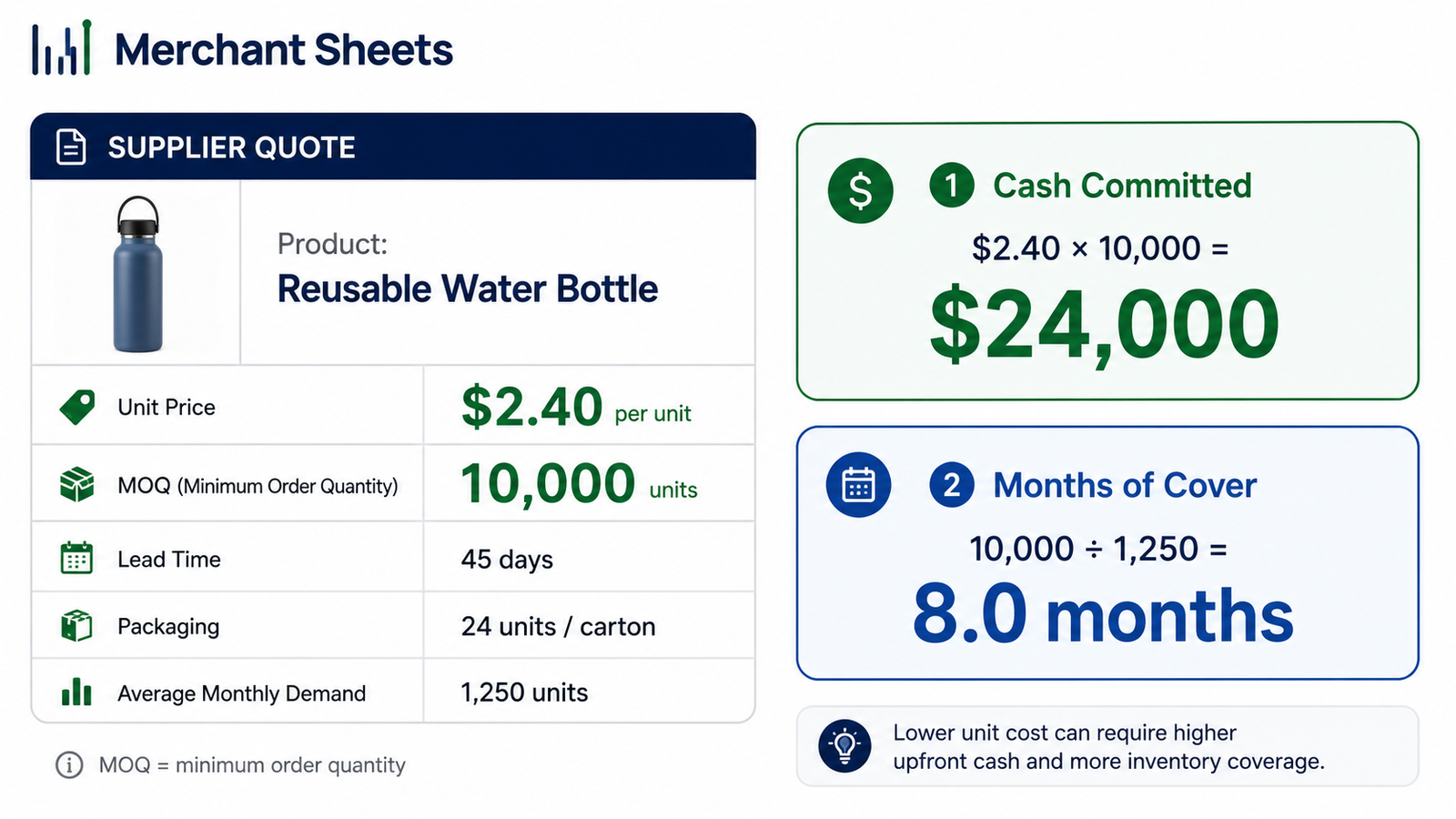
- Judge an MOQ against your own numbers: months of cover = MOQ ÷ monthly unit sales, and cash committed = MOQ × landed unit cost.
- MOQ is negotiable. Staggered deliveries, combined SKUs, trial orders, and a longer commitment are the levers that move it.
A supplier quotes you a great price per unit, then adds the catch: you have to buy 5,000 of them. That number is the minimum order quantity, and it quietly decides two things that matter more than the unit price, how much cash you tie up and how long you sit on the stock.
This guide covers what a minimum order quantity (MOQ) is, why suppliers set one, how to tell whether an MOQ fits your demand and your cash, and the levers that get it lower.
What is a minimum order quantity (MOQ)?
A minimum order quantity (MOQ) is the smallest quantity, or smallest order value, a supplier will accept in a single order. Suppliers set it so a production or fulfillment run is worth their while, and you either work within it or negotiate it down. It’s the floor on the deal, set on the supplier’s side.
MOQs come in two shapes. A unit-based MOQ sets a floor on quantity, say 1,000 pieces per order. A value-based MOQ, sometimes called a minimum order value (MOV), sets a floor on dollars, say $5,000 per order regardless of the mix. Manufacturers usually quote a unit MOQ per SKU; wholesalers and distributors more often quote a minimum order value across the cart.
Either way, the number lives on a bill of materials conversation with your supplier, alongside unit cost and lead time.
Why do suppliers set MOQs?
Suppliers set MOQs because every production run carries fixed costs, machine setup, materials sourcing, and labor to start the line, that don’t change whether they make 100 units or 10,000. Spreading those costs over a bigger order is what makes the run profitable, so they require a minimum to protect their margin.
You can see the logic in a break-even. If a run costs $1,000 to set up, each unit costs $6 in materials and labor, and the supplier sells to you at $10, they cover their setup at 250 units. Below that, the run loses money; above it, the fixed cost thins out across more pieces and their margin grows.
| Supplier break-even quantity = fixed run cost ÷ (unit price − variable cost per unit). Example: $1,000 ÷ ($10 − $6) = 250 units. |
A real MOQ usually sits above that break-even, not right on it, because the supplier wants profit and buffer on top of coverage. The same math explains why volume earns a discount: once the setup is paid off, each extra unit is cheaper to make, so suppliers share some of that saving as a price break on larger orders.
What does an MOQ cost you?
An MOQ costs you cash and flexibility, on top of the price on the invoice. A high minimum buys a lower unit cost, but it commits cash up front, fills your warehouse, and raises the odds of overstock and dead stock if the product doesn’t sell. A low minimum keeps you nimble and protects cash, but you pay more per unit and reorder more often.
Two quick checks tell you what a given MOQ commits you to. The first is how long the order will last; the second is how much cash it locks up. Run both before you agree to a number.
| Months of cover = MOQ ÷ monthly unit sales. Cash committed = MOQ × landed unit cost. |
Say a supplier’s MOQ is 5,000 units, you sell about 500 a month, and your landed cost is $4 a unit. That order is 10 months of cover and $20,000 of cash committed to a single SKU. If you’d sell through 5,000 in three months, that’s a fine buy.
If it takes 10, you’ve parked $20,000 you could have spent on faster movers, and every month it sits, it drags on your net working capital and your inventory turnover. Stock that outlives its demand is how dead stock starts.
The trade-off between a high and low MOQ, at a glance:
| Factor | High MOQ | Low MOQ |
| Unit cost | Lower | Higher |
| Cash committed up front | Higher | Lower |
| Overstock / dead-stock risk | Higher | Lower |
| Reorder frequency | Lower | Higher |
| Flexibility to change product | Lower | Higher |
How do you decide if an MOQ works for you?
An MOQ works for you when you can both sell through it in a reasonable window and afford the cash it ties up.
The test is to hold the supplier’s number against your own demand and your available cash, then decide whether to accept it, negotiate it, or walk. Here’s the sequence:
- Check the cover: Divide the MOQ by your monthly unit sales from your demand forecast. More months of cover than you can confidently forecast is a warning sign.
- Check the cash: Multiply the MOQ by your landed cost. If that number strains your cash position, the discount on the unit price won’t save you.
- Check the shelf life: For perishable or fast-changing products, make sure the order sells through before it expires or goes stale.
- Set the number against your reorder point: Confirm the order covers you comfortably past your supplier’s lead time without burying you in months of extra stock.
How to negotiate a lower MOQ
MOQ is one of the most negotiable terms a supplier offers, because what a supplier wants is volume certainty, and a single large shipment is only one way to get it. Give them that certainty in another form and the minimum usually moves. The levers that work:
- Stagger the deliveries: Commit to the full volume on a blanket purchase order, then have it shipped in smaller batches over months. You get low quantities per shipment; they get the total.
- Combine SKUs into one order: Bundle several products or variations from the same supplier so the combined run hits their minimum without overcommitting on any one item.
- Start with a trial order: Ask for a smaller first run to prove the product, with a clear plan to scale. Suppliers often flex on a first order that opens a lasting account.
- Offer a longer commitment: A signed forecast or a term agreement gives the supplier the certainty they price MOQs to protect, and earns you a lower one.
- Split the minimum across variations: Order 100 each of three colors instead of 300 of one, so you hit the run size without drowning in a single variant.
MOQ, MOV, case packs, and price breaks
A supplier’s terms sheet carries a few cousins of the MOQ, and reading them together tells you the true floor on an order:
- Minimum order value (MOV): A dollar floor on the order rather than a unit count. Common with wholesalers, where the mix varies but the cart has to clear a set amount.
- Case and inner packs: The quantity a product ships in, say 12 or 24 to a case. You order in whole cases, so the pack size sets a floor even below the stated MOQ.
- Price breaks: Tiered discounts that reward larger orders, such as $4.00 a unit at 1,000 and $3.60 at 5,000. They’re the upside of a higher MOQ, and the number you weigh against the cost of the extra stock.
Weigh every supplier’s MOQ in one place
An MOQ is only worth taking if the supplier behind it is, and that’s a judgment you can’t make one quote at a time. The Vendor & Supplier Scorecard lines up each supplier’s MOQ, price breaks, lead time, and terms side by side, so you can see which minimum buys the best landed cost and which supplier is worth pushing for a lower one.
See how your suppliers compare.
Frequently asked questions
What does MOQ mean?
MOQ means minimum order quantity, the smallest quantity a supplier will sell in a single order. Suppliers set it to keep each production or fulfillment run profitable, and it applies per SKU or, as a minimum order value, across the whole order.
What is an example of MOQ?
A candle supplier that won’t produce fewer than 1,000 jars per order has a 1,000-unit MOQ. If you sell 200 candles a month, that order is five months of cover, and you’d weigh the lower unit price against the cash and storage it commits.
How is MOQ calculated?
The supplier calculates MOQ from a break-even, fixed run cost ÷ (unit price − variable cost per unit), then sets the minimum above it to protect margin. There’s no single formula that gives a buyer’s MOQ; you instead test the supplier’s number against your demand and cash.
Why do suppliers set MOQs?
Suppliers set MOQs because each run carries fixed setup, sourcing, and labor costs that don’t change with order size, so small orders lose money. A minimum spreads those fixed costs over enough units to make the run worth producing.
Can you negotiate MOQ?
Yes, MOQ is often negotiable, especially if you can give the supplier the volume certainty they price it to protect. Committing to the full quantity on a blanket order with staggered deliveries, combining SKUs, or starting with a trial run are the usual ways to bring it down.
What is the difference between MOQ and MOV?
MOQ is a floor on the number of units in an order, while MOV, minimum order value, is a floor on the dollar amount. Manufacturers tend to set a unit MOQ per SKU; wholesalers more often set an MOV across a mixed cart.
