
Key takeaways
- The monthly close is the routine of finalizing last month’s books, reconciling every account, recording what belongs to the month, and locking the period so the numbers can’t change.
- An ecommerce close is harder than a generic one because revenue arrives through channel payouts on a delay, and inventory and COGS have to be reconciled to actual cost.
- Reconcile every sales channel to its payout reports so revenue lands in the right month; bank deposit dates combine and delay orders across periods.
- The ecommerce-specific steps are payout timing, COGS to actual cost, chargeback and returns reserves, platform fees, gift cards as deferred revenue, and collected sales tax as a liability.
- A well-run ecommerce close finishes in about five business days; many brands take ten to fourteen, which means steering by stale numbers.
- Speed comes from preparation, a named owner per step, and automating channel reconciliation, rather than from working faster on close day.
An ecommerce brand’s books close differently from a corner store’s. Your revenue arrives through Shopify and Amazon payouts on a delay, your inventory and cost of goods have to tie to real cost, and the sales tax you collect is a liability you hold for the state. Here’s the full monthly close checklist, in order, built for ecommerce.
What is the monthly close?
The monthly close, or month-end close, is the routine of finalizing the previous month’s accounting so your financial statements are complete and correct. You reconcile every account, record everything that belongs to the month, review the numbers, and lock the period so the books can’t change after the fact.
To reconcile an account means to tie its balance to an outside record, like a bank statement or a payout report, so you know it’s right. To lock the period means to close it to further edits once it’s final.
The close matters because the numbers you steer by, gross margin, contribution margin, and cash, are only trustworthy once it’s done, and a late close pushes back the weekly cash KPIs and the monthly review that depend on closed books.
An ecommerce close carries more moving parts than a service business’s, because sales come in through channel payouts that clear on a delay and inventory has to be reconciled to real cost.
The ecommerce monthly close checklist, step by step
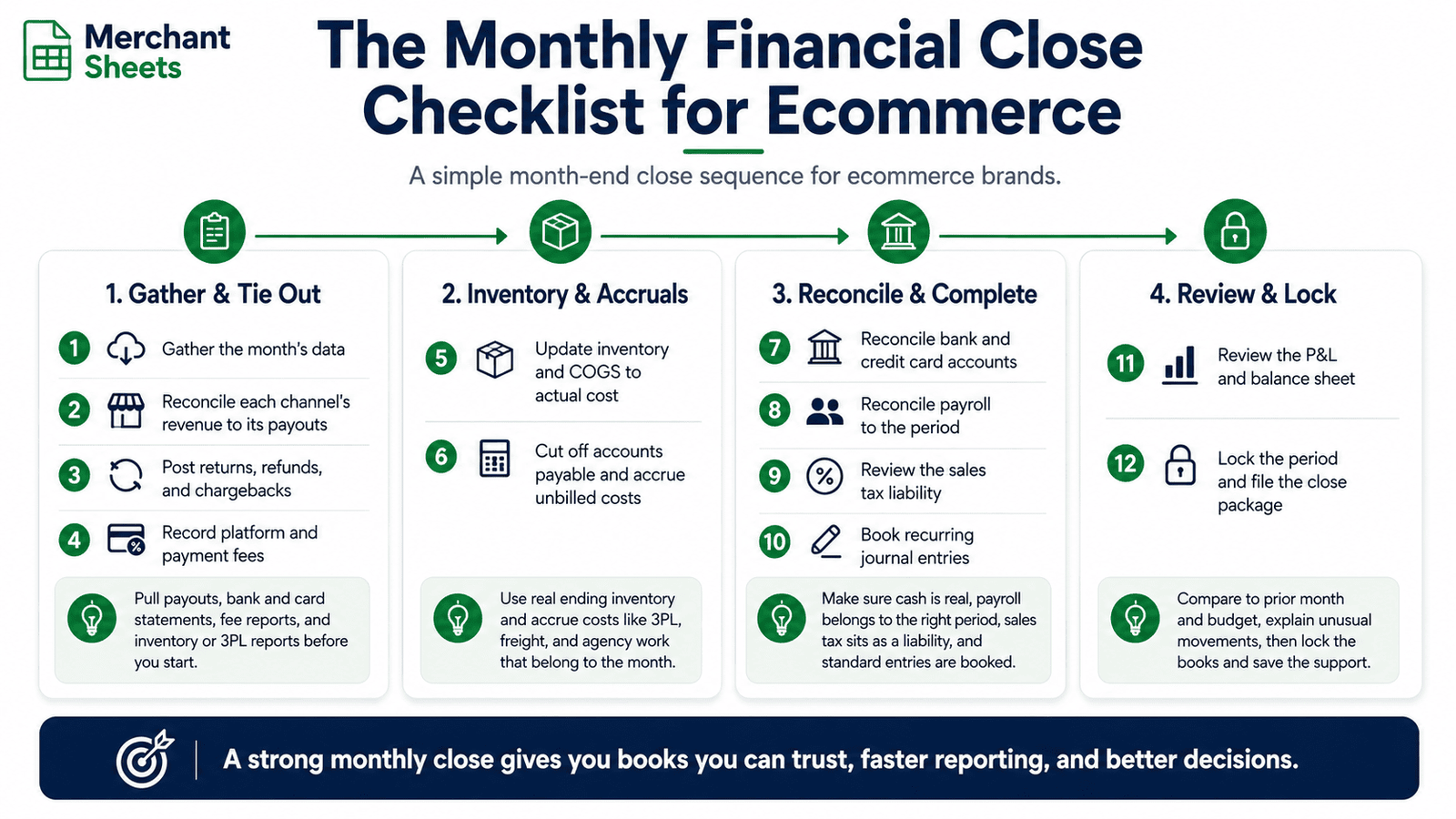
The close runs in a sensible order: reconcile revenue and cash first, get inventory, costs, and accruals right next, then review and lock. Working the steps in that sequence keeps you from reviewing a profit and loss statement that’s about to change under you.
Start by gathering the month’s data, then reconcile each sales channel’s revenue to its payout reports. Post the month’s returns, refunds, and chargebacks, and record the platform and payment fees that come out of every sale. The bookkeeping picture behind these entries is covered in ecommerce accounting.
Next, update inventory and book cost of goods sold (COGS), the direct cost of the units you sold, to actual cost rather than units sold times a stale average.
Set the accounts payable cutoff and accrue costs that belong to the month but haven’t been invoiced yet, then reconcile payroll to the period it was earned. Getting the cost side right is its own topic, walked through in how to calculate COGS.
Finish by reviewing the sales tax you owe, booking recurring journal entries like depreciation and prepaid amortization, reviewing the profit and loss statement and balance sheet against the prior month and budget, and locking the period. The full checklist is below.
Table 1. The ecommerce monthly close checklist, in order.
| # | Step | Ecommerce note |
| 1 | Gather the month’s data | Pull payout reports for every channel, bank and card statements, platform and processor fee reports, and the inventory or 3PL report before you start. |
| 2 | Reconcile each channel’s revenue to its payouts | Match Shopify, Amazon, and wholesale revenue to each channel’s payout report so revenue lands in the right month. |
| 3 | Post returns, refunds, and chargebacks | Record the month’s returns and chargebacks, and set a reserve for what will come back later. |
| 4 | Record platform and payment fees | Capture Shopify, Amazon, marketplace, and payment-processor fees; they are real costs and are easy to leave netted out of revenue. |
| 5 | Update inventory and COGS to actual cost | Reconcile ending inventory and book COGS to the real cost of units sold, rather than units sold times a stale average cost. |
| 6 | Cut off accounts payable and accrue unbilled costs | Set the AP cutoff and accrue costs that belong to the month but haven’t been invoiced yet, such as 3PL, freight, and agency work. |
| 7 | Reconcile bank and credit card accounts | Tie every bank and credit card account to its statement so the cash balance is real. |
| 8 | Reconcile payroll to the period | Book payroll to the period it was earned, rather than the date it was paid. |
| 9 | Review the sales tax liability | Confirm collected sales tax is sitting as a liability by state and matches what was collected. |
| 10 | Book recurring journal entries | Record depreciation, prepaid expense amortization, and standing accruals so the month is complete. |
| 11 | Review the P&L and balance sheet | Compare the month to the prior month and to budget, and explain anything that moved before signing off. |
| 12 | Lock the period and file the close package | Lock the period so the books can’t change, and save the reconciliations and reports as the month’s record. |
The reconciliations that set an ecommerce close apart
A standard close checklist stops at bank reconciliation and accruals, which serves a service business well. An ecommerce brand has a handful of reconciliations on top of that, and they are where the numbers usually go wrong.
| Reconcile each channel to its payout report. Payouts clear on a delay and often combine two months of orders, so matching to the bank deposit date puts revenue in the wrong period. |
Channel payouts clear on a delay, so late-month sales sit as receivables that land next period, and revenue is easy to book in the wrong month. Whether that timing changes your numbers depends on how you keep the books, which is the difference between cash vs accrual accounting.
Inventory and COGS have to tie to the real cost of what sold, and the method you use to value it is covered in inventory costing methods.
Platform and processor fees belong in the books gross, as revenue and a separate expense, and returns and chargebacks need a reserve for what comes back after the month closes.
Two items trip up brands more than any others. Gift cards and store credit are deferred revenue, a liability you hold until the customer redeems them, so a sold gift card becomes revenue only at redemption.
Collected sales tax is money you owe the state, tracked as a liability by jurisdiction, and where you owe it is a question of sales tax nexus.
Marketplace settlements run on their own cycle with a reserve, which is spelled out in Amazon seller accounting.
Table 2. Ecommerce channel reconciliation, at a glance (2026, verify current terms).
| Channel or item | Reconcile to | Ecommerce timing or treatment note |
| Shopify Payments | The Shopify payout report | Payouts clear a few business days after the sale and can mix orders from two months, so match to the payout report. |
| Amazon (FBA and FBM) | The Amazon settlement report | Settlements run on a fixed cycle with a reserve, so late-month sales sit as receivables that clear next period. |
| Wholesale and marketplaces | The platform payout or the invoice terms | Net terms (often 30 to 60 days) mean month-end orders are receivables; the platform fee comes out of the payout. |
| Payment processors (Stripe, PayPal) | The processor payout and fee report | Fees are netted out of deposits, so record revenue gross and the processing fee as an expense. |
| Gift cards and store credit | The liability balance | A sold gift card is deferred revenue; it becomes revenue when the customer redeems it. |
| Sales tax collected | The sales tax liability by state | Collected tax is money you owe, held as a liability until you remit it. |
How fast should your close be?
A well-run ecommerce close commonly finishes in about five business days, while many brands take ten to fourteen. The gap matters because a close that lands two or three weeks into the month means you’re deciding on numbers that are already stale. The goal is usable numbers early enough to act on, and a tight close is what makes that possible.
A simple shape helps: reconcile the channels and cash in the first day or two, get inventory, COGS, and accruals done next, then review and lock by day five. Treat the timeline as a target rather than a rule, since the biggest lever on it is preparation during the last week of the month rather than effort on close day.
How to make the close faster and repeatable
A slow close is usually a process problem rather than an effort one. The fix starts before the month ends: pull payout and fee reports and chase supplier invoices in the final week, so close day is reconciliation instead of data-gathering.
Give every step a named owner so parts of the close run in parallel, and automate the repetitive reconciliations, especially channel payouts and marketplace settlements, so the close becomes a review rather than manual journal-building.
Keep a written checklist and a close binder, the saved reconciliations and reports, so the process survives a handoff and every month looks the same. Most operators can run a close, and at some point most decide they shouldn’t be the one running it every month.
Who owns the close is part of the wider finance function that what an ecommerce CFO does lays out, and the practical signals for handing it off are in when you’ve outgrown spreadsheets.
For how that senior layer fits an ecommerce brand, the fractional CFO guide covers the role in full.
Frequently asked questions
What is the monthly close in accounting?
The monthly close is the routine of finalizing the prior month’s books, reconciling every account, recording everything that belongs to the month, reviewing the statements, and locking the period so the numbers can’t change.
How do you close the books for an ecommerce business?
You gather the month’s data, reconcile each sales channel to its payout reports, post returns and fees, update inventory and COGS to actual cost, cut off and accrue payables, reconcile bank, card, and payroll, review sales tax, book recurring entries, review the statements, and lock the period.
How long should a month-end close take?
A well-run ecommerce close commonly finishes in about five business days, though many brands take ten to fourteen, and the timeline depends far more on preparation and automation than on how fast the work is done on close day.
What is the difference between an ecommerce close and a regular close?
An ecommerce close adds the reconciliations a general close doesn’t need: matching channel payouts that clear on a delay, tying inventory and COGS to actual cost, capturing platform fees, reserving for returns and chargebacks, and handling gift cards and sales tax correctly.
Why do you reconcile to payout reports instead of bank deposits?
Channel payouts clear on a delay and often combine orders from more than one month, so matching revenue to the payout report keeps sales in the right period, while matching to bank deposits pushes revenue into the wrong month.
What is a soft close versus a hard close?
A soft close is a quick, estimate-based month-end used for a fast internal read, while a hard close is the full, reconciled, locked close used for statements you can rely on and share, and most brands aim for a hard close each month.
Do I need an accountant or CFO to run the monthly close?
You can run the close yourself with a checklist, though many growing brands hand it off, because a clean, on-time, ecommerce-correct close every month is process work that a finance partner is built to own.
Get the close off your plate
A clean close every month is the difference between financials you can steer by and a scramble that lands two weeks late.
If you’d rather hand the close off than build the checklist habit yourself, that’s the core of what I do: I run the monthly close and reporting for ecommerce brands, so your channel revenue, inventory, and sales tax are reconciled correctly and your numbers are on your desk within days of month-end.
Tell me where your close stands today, and we’ll talk about taking it off your plate.
This is general information, not accounting or tax advice, and every brand’s books are different. For how the rules apply to yours, work with a qualified accountant or tax professional.
